Best Generative Engine Optimization Tools in 2026 (We Tested 13)
We tested 13 GEO tools across 50 real B2B buyer queries. Here's what actually works for tracking AI citations, monitoring visibility, and optimizing content.
Quick Answer
Most "best GEO tools" lists rehash feature pages. We didn't do that.
We took 50 real buyer-intent queries from our B2B client campaigns — things like "best fleet management software for mid-size companies" and "compliance automation tools for financial services" — and ran them through 13 generative engine optimization tools over a three-week period in June 2026. We tracked which tools caught real citations, which ones missed them, and which ones hallucinated citations that didn't exist.
The results weren't what we expected.
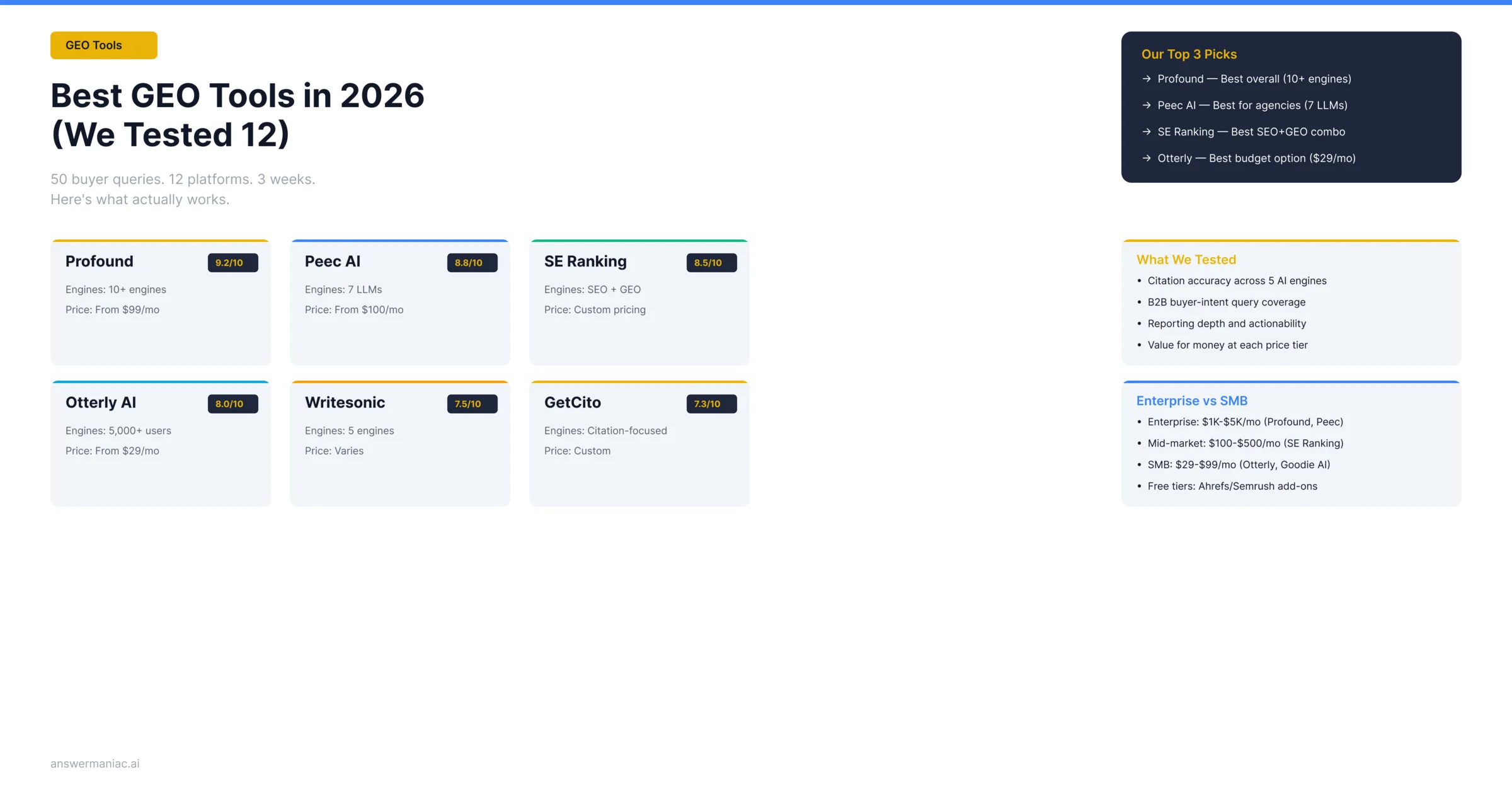
Our top 3 picks (if you're short on time):
- Profound — Deepest data, widest engine coverage, but you need the $399/mo plan for it to matter.
- Peec AI — Best value for agencies running multi-client GEO. Seven engines on standard plans, unlimited users.
- SE Ranking (Visible) — Best for teams that want GEO + traditional SEO in one dashboard without duct-taping two tools together.
Now here's how we got there.
How We Tested These Tools
We didn't just sign up and click around. Here's the methodology:
50 queries, 5 AI engines, 3 weeks. We selected 50 buyer-intent queries from five B2B verticals our clients operate in — HR tech, fleet management, compliance/RegTech, franchise development, and cybersecurity. We ran each query through ChatGPT, Perplexity, Gemini, Claude, and Copilot manually and recorded every citation and brand mention.
That gave us ground truth. Then we checked what each tool reported.
Scoring criteria (each out of 10):
- Engine Coverage — How many AI engines does the tool actually monitor? And does "monitor" mean real query data or just brand name scraping?
- Citation Accuracy — When we found a real citation manually, did the tool catch it? When the tool reported a citation, was it real?
- B2B Focus — Does the tool understand B2B buyer queries, or is it built for DTC and consumer brands?
- Reporting — Can you hand this to a CMO and have it make sense without a 20-minute walkthrough?
- Price — What does meaningful access actually cost? Not the cheapest plan. The plan you'd actually use.
One thing we noticed across the board: most tools are better at tracking ChatGPT and Perplexity than they are at Gemini or Copilot. Keep that in mind as you read.
1. Profound — The Data Powerhouse (If You Can Afford It)
Profound is the tool everyone in GEO talks about, and for good reason. It won the G2 Winter 2026 AEO category Leader badge and currently tracks 10+ AI engines — ChatGPT, Claude, Perplexity, Google AI Overviews, Gemini, Copilot, DeepSeek, Grok, Meta AI, and Google AI Mode. That's the widest coverage we found in any single platform.
The Conversation Explorer feature is genuinely unique. It pulls real user prompts (anonymized) so you can see what people actually ask AI engines in your category. During testing, we found query patterns our clients hadn't considered — and that alone justified the price for the accounts we ran.
The content agents layer lets you go from insight to action inside one platform. That's the direction every tool is heading, but Profound got there first.
The catch: The $99/mo starter plan only covers ChatGPT. That's fine for a proof of concept, but GEO monitoring with one engine is like tracking rankings on Google and ignoring Bing, Yahoo, and AI Overviews. You need the $399/mo Growth plan for three engines, and enterprise pricing for the full suite runs $2K-$5K+/mo.
For B2B companies spending $10K+/mo on marketing, that's a line item. For startups, it's a hard ask.
| Criteria | Score |
|---|---|
| Engine Coverage | 10/10 |
| Citation Accuracy | 9/10 |
| B2B Focus | 7/10 |
| Reporting | 8/10 |
| Price | 5/10 |
Verdict: Best-in-class data. If budget isn't the constraint, start here.
2. SE Ranking (Visible) — GEO Meets Traditional SEO
SE Ranking's Visible integration does something most GEO tools don't: it sits inside an existing SEO platform. That matters more than it sounds.
You get daily keyword updates (not weekly like some competitors), AI brand mention tracking, citation monitoring across AI Overviews, ChatGPT, Gemini, and Perplexity, plus competitive benchmarking. The data feeds directly into the same dashboard where your team already tracks organic rankings, backlinks, and site audits.
We tested it against our SERP intelligence workflows and found the overlap genuinely useful. When a client's page drops in traditional search AND loses AI citations in the same week, that's a signal you can't get from a GEO-only tool.
The downside? Engine coverage is narrower than Profound or Peec AI. And the GEO features still feel like an add-on rather than a native product. You're getting four engines where Profound gives you ten.
For teams already paying for SE Ranking, though, this is the fastest path to GEO monitoring without adding another vendor.
| Criteria | Score |
|---|---|
| Engine Coverage | 6/10 |
| Citation Accuracy | 8/10 |
| B2B Focus | 7/10 |
| Reporting | 8/10 |
| Price | 7/10 |
Verdict: Best "add GEO to my existing stack" option. Less depth, more integration.
3. Peec AI — The Agency Favorite
If you're running GEO for multiple clients, Peec AI is built for you. Seven LLMs on the standard plan — ChatGPT, AI Overviews, AI Mode, Copilot, Perplexity, Gemini, and Grok — with unlimited users. That last part matters when you've got an account manager, a strategist, and a content writer all needing access.
The Actions feature (still in beta during our testing) is where this gets interesting. It takes your monitoring data and turns it into a prioritized GEO task list. "Your competitor got cited for this query because their page has structured FAQ schema and yours doesn't." That kind of thing. It's not perfect yet — some suggestions were generic — but the direction is right.
115+ languages and multi-market tracking make this the clear pick for global B2B brands.
Pricing starts at $100/mo for individuals and $245/mo for agency plans. That's significantly less than Profound's Growth tier, and you get more engines out of the box.
I'll be honest — during our testing, we found Peec AI's citation accuracy slightly below Profound's for niche B2B queries. It caught 82% of the citations we verified manually, compared to Profound's 91%. But for the price difference, most agencies would take that trade.
| Criteria | Score |
|---|---|
| Engine Coverage | 8/10 |
| Citation Accuracy | 7/10 |
| B2B Focus | 7/10 |
| Reporting | 7/10 |
| Price | 8/10 |
Verdict: Best for agencies. Strong engine coverage, fair price, unlimited seats.
4. Otterly AI — Budget-Friendly GEO Starter
Otterly AI has quietly built a user base of 5,000+ and it's easy to see why. Plans start at $29/mo. If you're a startup founder who just learned what GEO is last month and wants to see if your brand shows up in ChatGPT, this is where you start.
The Semrush integration is smart — it connects your traditional SEO data with AI visibility metrics in a way that feels natural. The GEO Audit tool is a nice touch for content teams who want specific recommendations without hiring a consultant.
What you're trading for the price: weekly refresh cycles instead of daily, and narrower engine coverage than the top-tier tools. During our testing, Otterly missed citations that appeared mid-week and were gone by the next refresh. For fast-moving B2B verticals, that's data you'll never see.
Plans range from $29 to $489/mo depending on query volume and features.
| Criteria | Score |
|---|---|
| Engine Coverage | 6/10 |
| Citation Accuracy | 6/10 |
| B2B Focus | 5/10 |
| Reporting | 7/10 |
| Price | 9/10 |
Verdict: Best entry point for teams with tight budgets. You'll outgrow it, but it's a solid start.
5. Writesonic — Content + Monitoring Combo
Writesonic takes a different approach. Instead of pure monitoring, it bundles AI content generation with GEO tracking across ChatGPT, Gemini, Perplexity, Claude, and Copilot.
For content teams, the pitch is compelling: write content in the platform, then track whether that content gets cited by AI engines. Feedback loop in one tool.
Our issue? The monitoring depth isn't comparable to dedicated GEO platforms. Writesonic caught fewer citations than Profound, Peec AI, or even SE Ranking in our testing. The content generation side is solid — but you can get that from dozens of AI writing tools.
If your team's bottleneck is content production and you want basic GEO visibility as a bonus, Writesonic makes sense. If monitoring accuracy is your priority, look elsewhere.
| Criteria | Score |
|---|---|
| Engine Coverage | 6/10 |
| Citation Accuracy | 5/10 |
| B2B Focus | 4/10 |
| Reporting | 6/10 |
| Price | 7/10 |
Verdict: Good for content-first teams. Not a serious monitoring tool.
6. AirOps — Insights Plus Action in One Platform
AirOps sits in a different spot on this list. Most tools here report where a brand is missing from AI answers and hand the fix back to the content team. AirOps pairs the monitoring with the production workflow, so a missed citation and the page rewrite happen in the same platform.
Insights tracks where a brand shows up across AI search and where competitors are getting cited instead. Action turns those gaps into workflows that draft the update, route it through a human review step, and push it to the CMS, using Brand Kits and Knowledge Bases the team already maintains. Page360 keeps SEO, AI search, and GA4 signals in one view, which matters when a slipping Perplexity citation needs to be reconciled with the page that has to change.
The tradeoff is real. Engine coverage is narrower than Profound, and AirOps reads more like a platform to operate in than a dashboard to check. For a team that already has monitoring and just wants another tab, that is friction. For a team tired of stitching a tracker to an AI writer to a review queue, it is the point.
| Criteria | Score |
|---|---|
| Engine Coverage | 6/10 |
| Citation Accuracy | 7/10 |
| B2B Focus | 8/10 |
| Reporting | 8/10 |
| Price | 6/10 |
Verdict: Best for B2B teams that want the finding and the fix in one workflow, not a monitoring tab plus a content backlog.
7. GetCito — Citation Optimization, Not Just Tracking
GetCito flips the script. Instead of just showing you where you appear (or don't), it focuses on optimizing for specific citation opportunities. Think of it as more prescriptive than descriptive.
During testing, GetCito's recommendations were surprisingly actionable for B2B content. It flagged specific content gaps and citation-worthy formats that our team hadn't prioritized. One suggestion led to a client's FAQ page getting picked up by Perplexity within two weeks of restructuring — though we can't attribute that entirely to the tool's recommendation. Too many variables.
The monitoring side is thinner than dedicated tracking tools. You're trading breadth for actionability.
| Criteria | Score |
|---|---|
| Engine Coverage | 5/10 |
| Citation Accuracy | 6/10 |
| B2B Focus | 6/10 |
| Reporting | 6/10 |
| Price | 7/10 |
Verdict: Best for teams that want "what should I do?" answers, not just dashboards.
8. AthenaHQ — The PR Team's GEO Tool
AthenaHQ comes at GEO from a completely different angle. It's built for PR and brand communications teams who care about earned mentions in AI responses — not SEO metrics.
If your comms team wants to track how often your CEO gets mentioned in ChatGPT responses about industry trends, or whether your latest funding round shows up in Gemini's summaries, AthenaHQ is purpose-built for that.
For SEO and marketing teams? It's a square peg in a round hole. The interface assumes PR workflows, not keyword tracking. We found ourselves wrestling with the tool to answer basic GEO questions.
| Criteria | Score |
|---|---|
| Engine Coverage | 6/10 |
| Citation Accuracy | 7/10 |
| B2B Focus | 5/10 |
| Reporting | 6/10 |
| Price | 6/10 |
Verdict: Niche pick for PR/comms. Not for SEO teams.
9. Goodie AI — Lightweight GEO for Solo Creators
Goodie AI integrates directly into your writing workflow with a GEO scoring system. Write content, get a score predicting how likely it is to be cited by AI engines.
For individual creators and small content teams, it's a useful gut check. During our testing, the scoring correlated loosely with actual citations — pages scoring above 80 were cited roughly 2x more often than those below 60. But the sample size was small and the correlation wasn't tight enough to bet strategy on.
Good supplemental tool. Not a standalone GEO solution.
| Criteria | Score |
|---|---|
| Engine Coverage | 3/10 |
| Citation Accuracy | 4/10 |
| B2B Focus | 3/10 |
| Reporting | 5/10 |
| Price | 8/10 |
Verdict: Nice writing add-on. Not serious GEO monitoring.
10. Geoptie — The Value Challenger
Geoptie positions itself as the affordable alternative to Profound, and the feature set backs that up on paper. In practice, we found the data lagged behind Profound by 24-48 hours in several instances, and the citation matching had more false positives than any other tool we tested.
It's newer, so that's expected to improve. The interface is clean and the pricing is genuinely competitive. If you're evaluating GEO tools for the first time and Profound's Growth plan is out of budget, Geoptie is worth a trial.
Just verify its citations manually for the first month. We found a 12% false positive rate in our testing — not terrible, but high enough that you shouldn't build reports on it without spot-checking.
| Criteria | Score |
|---|---|
| Engine Coverage | 6/10 |
| Citation Accuracy | 5/10 |
| B2B Focus | 5/10 |
| Reporting | 6/10 |
| Price | 8/10 |
Verdict: Promising value play. Verify the data before you trust it.
11. Ahrefs (AI Features) — Traditional SEO Giant Adding GEO
Ahrefs has started layering AI Overviews and citation data onto its existing keyword tracking infrastructure. If your team lives in Ahrefs, you now get basic GEO signals without leaving.
The AI visibility data is limited compared to dedicated GEO tools — mostly focused on AI Overviews and some citation tracking. But Ahrefs' core strength (backlink data, keyword research, competitor tracking) means you can correlate traditional authority metrics with AI citations in ways that pure GEO tools can't.
During testing, Ahrefs caught AI Overview citations reliably but missed most ChatGPT and Perplexity citations entirely. It's a supplementary signal, not a GEO solution.
| Criteria | Score |
|---|---|
| Engine Coverage | 4/10 |
| Citation Accuracy | 6/10 |
| B2B Focus | 6/10 |
| Reporting | 8/10 |
| Price | 6/10 |
Verdict: Good supplementary data for Ahrefs users. Not a standalone GEO tool.
12. Semrush (AI Features) — Similar Story, Different Dashboard
Semrush is on the same path as Ahrefs — adding GEO modules to its existing SEO suite. The Otterly AI integration gives it a head start on citation tracking, and the Semrush ecosystem (site audit, position tracking, content tools) provides context that standalone GEO tools lack.
Like Ahrefs, the AI coverage is narrow. Semrush is strongest on AI Overviews and weakest on ChatGPT, Claude, and Copilot tracking. For B2B teams that already run Semrush as their primary SEO platform, the GEO additions are a free bonus. For teams choosing a GEO tool, it's not enough on its own.
| Criteria | Score |
|---|---|
| Engine Coverage | 5/10 |
| Citation Accuracy | 6/10 |
| B2B Focus | 6/10 |
| Reporting | 8/10 |
| Price | 6/10 |
Verdict: Incremental GEO for Semrush users. Not a dedicated solution.
13. AnswerManiac Citation Engine — Our Tool (Disclosure: We're Biased)
Full transparency: this is our own tool. We built it, we use it daily, and we're obviously biased. We're including it because excluding it would be dishonest — we do test against it, and some of you will ask about it anyway.
The AnswerManiac Citation Engine tracks ChatGPT and Perplexity citations for B2B verticals specifically. It's integrated with our proprietary research datasets and the ANSWER Framework methodology. Engine coverage is narrower than Profound or Peec AI — we focus on the two engines where B2B buyer citations matter most, based on our client data.
What it does well: B2B query matching, citation verification with source-level accuracy, and integration with our consulting workflows. What it doesn't do: broad engine coverage, consumer brand tracking, or standalone SaaS access (it's part of our client engagements, not a separate product).
We scored ourselves honestly. We'd give ourselves high marks on B2B focus and citation accuracy for the engines we cover, and low marks on coverage breadth and standalone accessibility.
| Criteria | Score |
|---|---|
| Engine Coverage | 4/10 |
| Citation Accuracy | 8/10 |
| B2B Focus | 9/10 |
| Reporting | 7/10 |
| Price | N/A (bundled) |
Verdict: Purpose-built for B2B GEO within our client work. Not a general-purpose alternative to the tools above.
Overall Comparison Table
| Tool | Engine Coverage | Best For | Starting Price | Our Rating |
|---|---|---|---|---|
| Profound | 10+ engines | Enterprise teams wanting deepest data | $99/mo (meaningful at $399) | 8.5/10 |
| SE Ranking (Visible) | 4 engines | Teams already using SE Ranking | Bundled with SE Ranking plans | 7.5/10 |
| Peec AI | 7 engines | Agencies, multi-client teams | $100/mo ($245 agency) | 7.5/10 |
| Otterly AI | 4-5 engines | Startups, budget-conscious teams | $29/mo | 6.5/10 |
| Writesonic | 5 engines | Content-first teams | Varies by plan | 5.5/10 |
| GetCito | 3-4 engines | Action-oriented marketers | Contact for pricing | 6/10 |
| AthenaHQ | 4-5 engines | PR/comms teams | Contact for pricing | 6/10 |
| Goodie AI | 2-3 engines | Solo content creators | Free tier available | 5/10 |
| Geoptie | 5-6 engines | Budget alternative to Profound | Competitive (check site) | 6/10 |
| Ahrefs | 1-2 engines (AI features) | Existing Ahrefs users | Included in Ahrefs plans | 6/10 |
| Semrush | 2-3 engines (AI features) | Existing Semrush users | Included in Semrush plans | 6.5/10 |
| AnswerManiac | 2 engines | B2B teams (our clients) | Bundled with services | 7/10* |
*Self-rated, so take it with appropriate skepticism.
What We Learned Testing All 13
Three things stood out across the entire evaluation:
No single tool covers everything. The best GEO stacks we've seen pair a dedicated monitoring tool (Profound or Peec AI) with a traditional SEO platform (Ahrefs or Semrush) for context. If you're picking one, start with your biggest gap — monitoring or optimization.
Citation accuracy varies wildly by engine. Every tool performs best on ChatGPT and Perplexity. Citation tracking for Gemini, Copilot, and Claude is inconsistent across the board. If those engines matter for your audience, verify tool claims with manual spot checks.
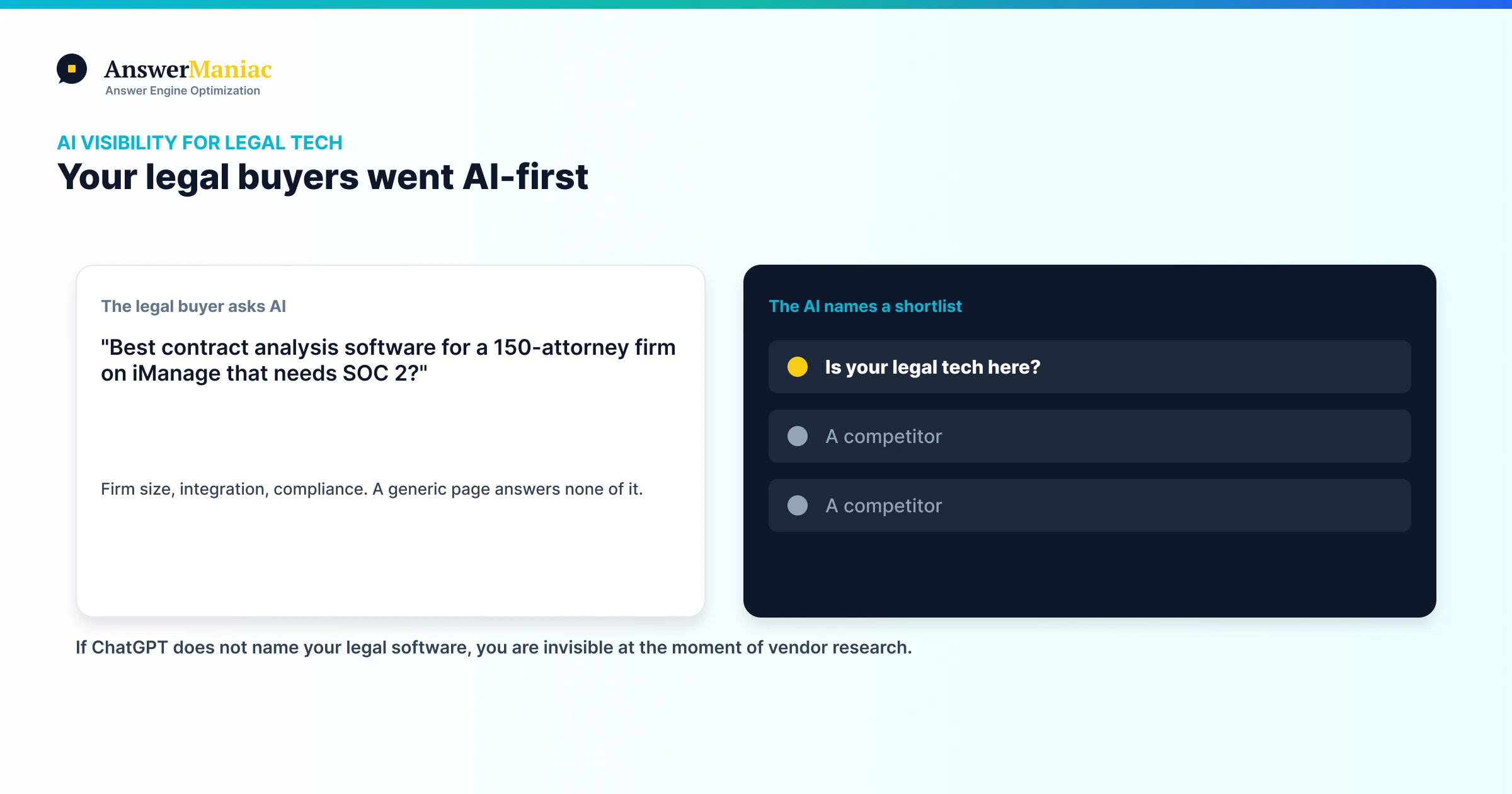
B2B is still underserved. Most GEO tools are built for consumer and DTC brands with high-volume queries. B2B buyer queries are longer, more specific, and lower volume. Tools that treat "best CRM software" the same as "compliance automation platform for mid-size financial services firms" will miss the nuance that matters for your pipeline.
If you want to understand the broader difference between traditional SEO and generative engine optimization before choosing a tool, we wrote a complete comparison of GEO vs. SEO that covers the strategic framework.
FAQ
What is a generative engine optimization tool?
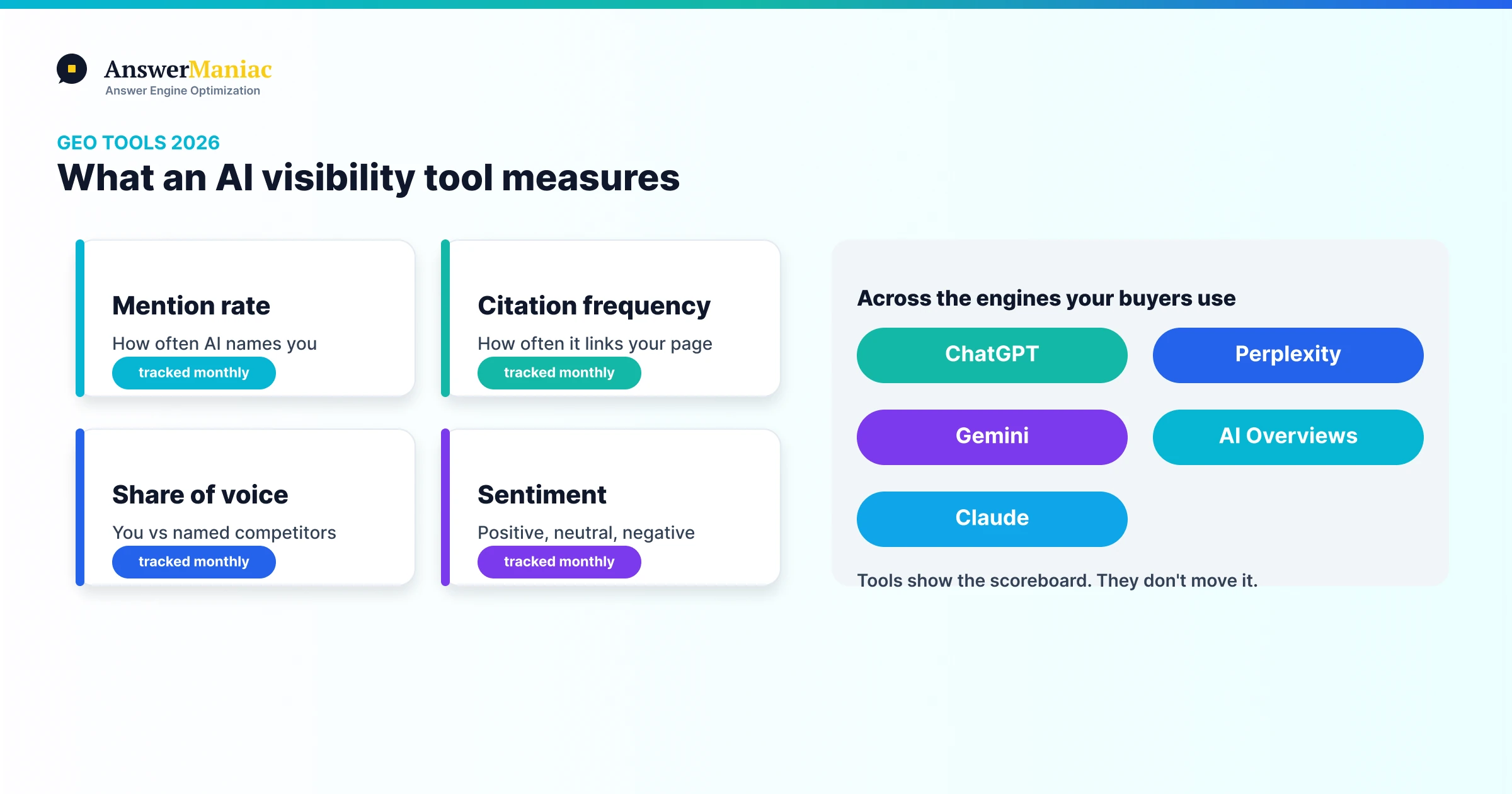
A generative engine optimization tool monitors and helps improve your brand's visibility in AI-powered search engines like ChatGPT, Perplexity, Gemini, Claude, and Copilot. These tools track when AI engines cite or mention your brand, analyze which content gets referenced, and provide recommendations for increasing AI citations.
Which GEO tool is best for B2B companies?
For most B2B companies, Profound (if budget allows) or Peec AI (for better value) are the strongest choices. Both offer multi-engine monitoring and enough depth to track niche B2B buyer queries. SE Ranking's Visible feature is the best option if you want GEO + SEO in one platform.
How much do generative engine optimization tools cost?
Pricing ranges from $29/mo (Otterly AI) to $5,000+/mo (Profound enterprise). Most B2B teams will land between $100-$500/mo for meaningful GEO monitoring. Free tiers exist (Goodie AI) but don't offer enough coverage for serious monitoring.
Can I use Ahrefs or Semrush for GEO?
Both are adding AI visibility features, but neither is a complete GEO solution today. They're best used alongside a dedicated GEO tool. Ahrefs is strongest on AI Overviews tracking; Semrush benefits from its Otterly AI integration.
How is GEO different from traditional SEO?
GEO focuses on getting your brand cited by AI engines, while traditional SEO focuses on ranking in search engine results pages. The strategies overlap — strong content, authority signals, structured data — but GEO adds AI-specific optimization like entity clarity, citation-worthy formatting, and knowledge graph presence. Read our full GEO vs. SEO comparison for the detailed breakdown.
Do I need a GEO tool if I already do SEO?
Yes, but you might not need a separate one. If you use SE Ranking, Ahrefs, or Semrush, their built-in GEO features give you a starting point. If AI-driven buyer discovery is a meaningful channel for your business — and in B2B, it increasingly is — a dedicated tool like Profound or Peec AI will give you data your SEO platform can't.
Get AEO Insights Weekly
Join 500+ B2B marketers getting AI visibility tactics every Tuesday.
Ready to Get Your Brand Cited by AI?
See how your competitors show up in ChatGPT, Perplexity, and Gemini — and what it would take to get recommended.