AI Visibility for Legal Tech Companies: Getting Cited When Buyers Ask AI for Legal Software
79% of legal professionals now use AI, and they research legal tech the same way. Here's how legal software companies get cited by ChatGPT, Perplexity, and Gemini.
Quick Answer
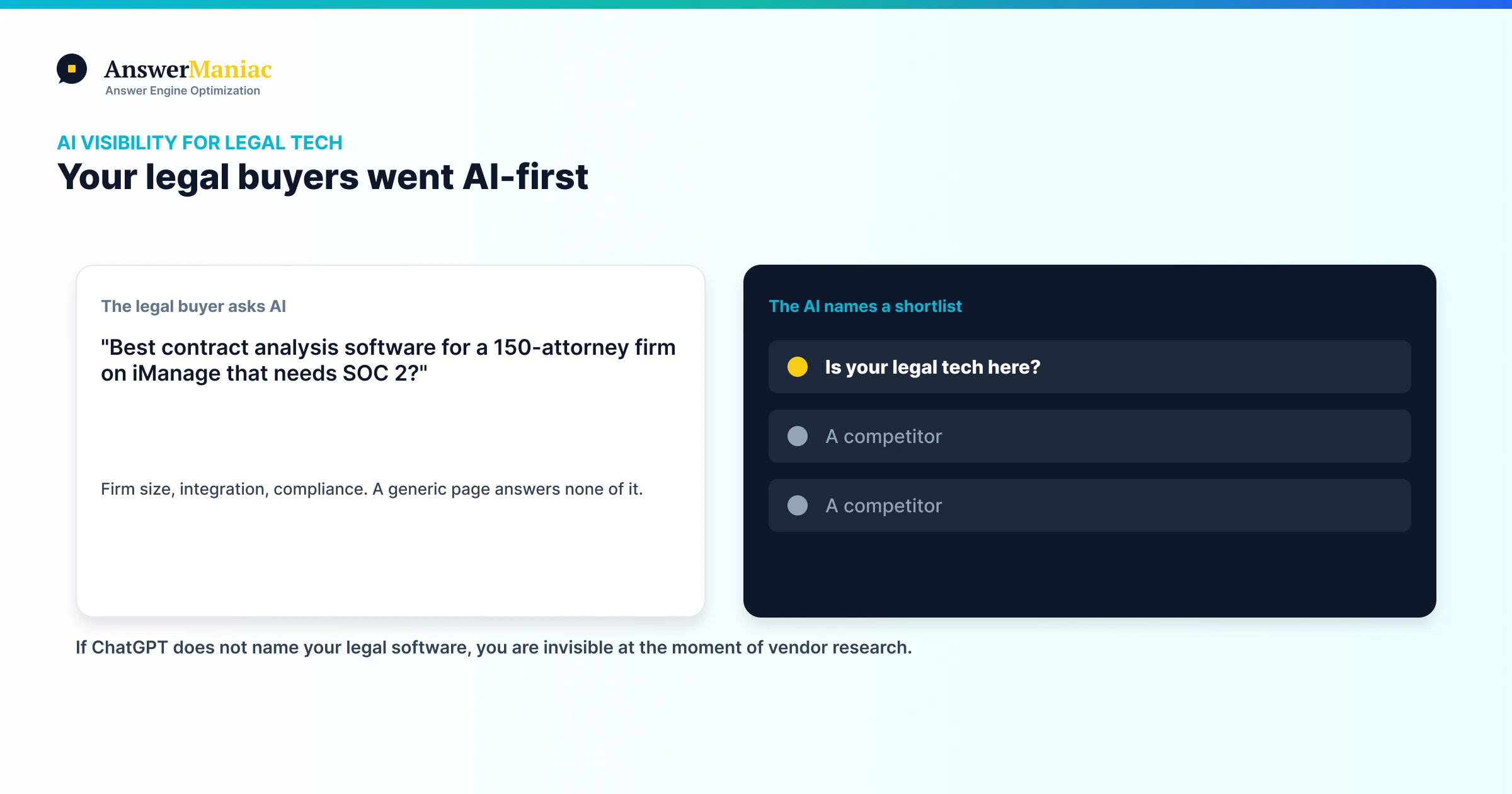
AI visibility for legal tech: The buyers of legal software are now among the heaviest AI users in any vertical. Roughly 79% of legal professionals use AI tools in 2026, and law-firm AI adoption jumped from 37% in 2024 to 80% in 2025 (industry reporting). The legal technology market sits around $29B, with the legal AI segment growing fast. When a legal ops lead or managing partner asks ChatGPT "best contract analysis software for a mid-size firm," the AI names two to five vendors. If your legal tech company is not one of them, you are invisible at the exact moment of vendor research. Getting cited takes entity authority, content that answers real legal-buyer questions, and structured data, not more generic SEO.
There is an irony worth sitting with. Legal tech companies build AI products. Yet many of them are invisible in AI search, which means the AI-savvy buyers they are chasing cannot find them through the channel those buyers now trust most.
The people who buy legal software, managing partners, legal ops leads, general counsel, are not casual AI users. They adopted it fast, they use it daily for research, and they research vendors the same way they research a statute: they ask the AI. If the AI does not name your product, you are not in the consideration set, no matter how good your product is.
This is a vertical problem with a vertical answer. Legal buyers ask specific questions, weigh specific constraints, and trust specific signals. This piece lays out how legal tech companies get cited by ChatGPT, Perplexity, and Gemini for the queries their buyers actually type.
The Legal Buyer Went AI-First, Fast
The adoption curve in legal is steeper than most verticals, which cuts both ways.
| Signal | Figure | Source |
|---|---|---|
| Legal professionals using AI tools (2026) | ~79% | Industry reporting 2026 |
| Law-firm AI adoption, 2024 to 2025 | 37% to 80% | Industry reporting |
| Legal technology market size (2026) | ~$29B | Market research 2026 |
| B2B buyers who used AI in their last purchase | 94% | Forrester 2026 |
Two things follow. The upside: your buyers are already in the channel, so being cited pays off immediately. The risk: adoption this fast means the vendors who established AI visibility early are already the default answers, and catching up gets harder each quarter.
The legal buyer also brings a specific temperament. They are trained to check sources, distrust unsupported claims, and value precision. That is good news for anyone doing AI visibility honestly, because the signals that earn citations, clear entities, sourced content, transparent comparisons, are exactly what a skeptical legal buyer respects.
The Questions Legal Buyers Actually Ask AI
Generic "legal software" content does not match how these buyers prompt. They ask constrained, situation-specific questions.
- "Best contract lifecycle management software for a 150-attorney firm on iManage."
- "Alternatives to [incumbent] for e-discovery in a mid-market corporate legal department."
- "Which legal research tool integrates with Clio and handles [practice area]?"
- "Is [category] worth it for a small firm, or is it built for BigLaw?"
- "[Vendor A] vs [Vendor B] for contract review accuracy and data security."
Every one carries a firm size, a practice area, a tech stack, or a compliance concern. The winning content answers the specific version. A page titled "Contract Software" answers none of it. This is why the Navigate stage of any real program starts by mapping these constrained buyer questions before writing a word.
The Legal Tech AI Visibility Playbook

Four moves, in order of foundation.
1. Fix your entity, because legal buyers and models both want certainty. Clean Organization schema, consistent company facts across your site, LinkedIn, Crunchbase, and legal directories like Capterra and G2, and a clear entity presence the models can trust. Legal buyers verify; models confirm. An inconsistent entity fails both.
2. Answer the constrained buyer questions. Publish content that names the firm sizes, practice areas, integrations (iManage, Clio, NetDocuments), and compliance frameworks your buyers carry. A page that says "for mid-size litigation firms on iManage that need SOC 2 and matter-level security" gets matched to prompts a generic page never will.
3. Lead with security, compliance, and accuracy. Legal is a trust-first, risk-averse category. Content that clearly addresses data security, confidentiality, jurisdiction, and accuracy earns both the buyer's confidence and the model's willingness to recommend you for a regulated use case. Vague reassurance does not; specifics do.
4. Build comparison and alternatives content. Legal buyers shortlist and switch. Comparison pages, "best X for [firm type]" and honest "X vs Y" pages, are where AI assembles the shortlist your buyers ask for. Name the real field, including the incumbents.
The pattern across all four: specificity and honesty. A skeptical legal buyer and a citation-cautious model reward the same things.
Why Overlooked Legal Niches Win First
There is a strategic wrinkle worth naming. The broad terms, "legal software," "legal AI," are crowded and defended by the biggest players. But legal is full of specific niches, practice areas, firm sizes, jurisdictions, and integrations, where almost no one has built proper AI visibility content yet.
That is where a focused legal tech company wins. Own "contract analysis for construction law firms" or "e-discovery for in-house teams under 20 people" and you become the default answer for a real, high-intent buyer segment while competitors fight over the head term. In our work across overlooked B2B verticals, this niche-first approach consistently earns citations faster than chasing the crowded category term. It is the same reason our research keeps finding that 44% of B2B companies get zero AI citations: most are aiming at the wrong, too-broad target.
Frequently Asked Questions
Do legal software buyers really use AI to find vendors? Yes, heavily. Around 79% of legal professionals use AI tools in 2026, and law-firm adoption jumped from 37% to 80% between 2024 and 2025. They research vendors through AI the same way they research case law.
What makes legal tech AI visibility different from other verticals? Legal buyers are trust-first and risk-averse, so security, compliance, jurisdiction, and accuracy signals matter more than in most categories. The good news is those are exactly the signals that also earn AI citations for regulated use cases.
Should we target "legal AI" or narrower terms? Narrower first. The broad terms are crowded and defended by the largest players. Specific niches, practice areas, firm sizes, and integrations, have far less competition and higher buyer intent, and they earn citations faster.
How do we get cited for security-sensitive legal queries? Address data security, confidentiality, jurisdiction, and accuracy explicitly and specifically in your content. Models are cautious about recommending vendors for regulated use cases, and clear, sourced security content gives them the confidence to name you.
How long does it take a legal tech company to get cited? It depends on your starting entity and content, but a focused 90-day program on a specific niche, entity plus buyer-question content plus comparison pages, is a realistic path to first citations. Broad category terms take much longer.
The Takeaway
Your legal buyers went AI-first faster than almost any other vertical, and they research software the way they research the law: they ask the AI. If ChatGPT does not name your legal tech for their constrained, security-conscious questions, you are invisible at the decision point. Fix your entity, answer the specific buyer questions, lead with security and compliance, build honest comparison content, and win the overlooked niches before the giants notice them. In legal, precision and trust are the whole game, for the buyer and the model alike.
Want to see whether AI names your legal software for your buyers' queries? Run a free AI visibility audit and start with your real practice-area prompts.
Sources
- Industry reporting 2026 on legal AI adoption (~79% of legal professionals using AI; law-firm adoption 37% in 2024 to 80% in 2025) and the ~$29B legal technology market
- Forrester 2026 Buyers' Journey Survey (18,000 buyers; 94% used AI during most recent purchase)
- AnswerManiac benchmark research: 376 B2B companies across five verticals (44% received zero AI citations)
Related Reading
Get AEO Insights Weekly
Join 500+ B2B marketers getting AI visibility tactics every Tuesday.
Ready to Get Your Brand Cited by AI?
See how your competitors show up in ChatGPT, Perplexity, and Gemini — and what it would take to get recommended.
Related Articles
AI Visibility for Compliance Software: How RegTech Companies Get Cited by ChatGPT and Perplexity
AI Visibility for Cybersecurity Software: How to Get Recommended by ChatGPT When Companies Search for Security Solutions