The ANSWER Framework: Build AI Visibility in 90 Days
The ANSWER Framework is a 6-stage methodology for getting B2B companies cited by ChatGPT, Perplexity, and Google AI Mode. Here's every stage, deliverable, and measurement criterion.
Quick Answer
The Problem This Framework Solves
The GEO services market crossed $1 billion in 2026. Dimension Market Research estimates it at $1.09 billion, with a 40.6% CAGR projecting $17.1 billion by 2034. Gartner Research found 67% of Fortune 500 CMOs named generative engine optimization a top-three digital priority for fiscal year 2026, up from 18% in 2024.
The money is moving. The methodology hasn't kept up.
We talked to 40+ B2B marketing leaders before building the framework. The same pattern showed up in every conversation. They knew AI visibility mattered — 93% of B2B SaaS marketers told Conductor they consider it critical. But only 14% had anything resembling a mature strategy. The rest were doing one of three things: repurposing their SEO playbook and hoping it transferred, adding FAQ schema to a few pages and calling it "AEO," or waiting to see how things shook out.
None of those work. We know because we tested all three on client sites before figuring out why.
The signals that make Google rank you and the signals that make ChatGPT cite you are different enough that you need a separate system. That's what the ANSWER Framework is. Not a philosophy. A system — with stages, deliverables, timelines, and measurement criteria at each step.
Why Traditional SEO Playbooks Don't Transfer
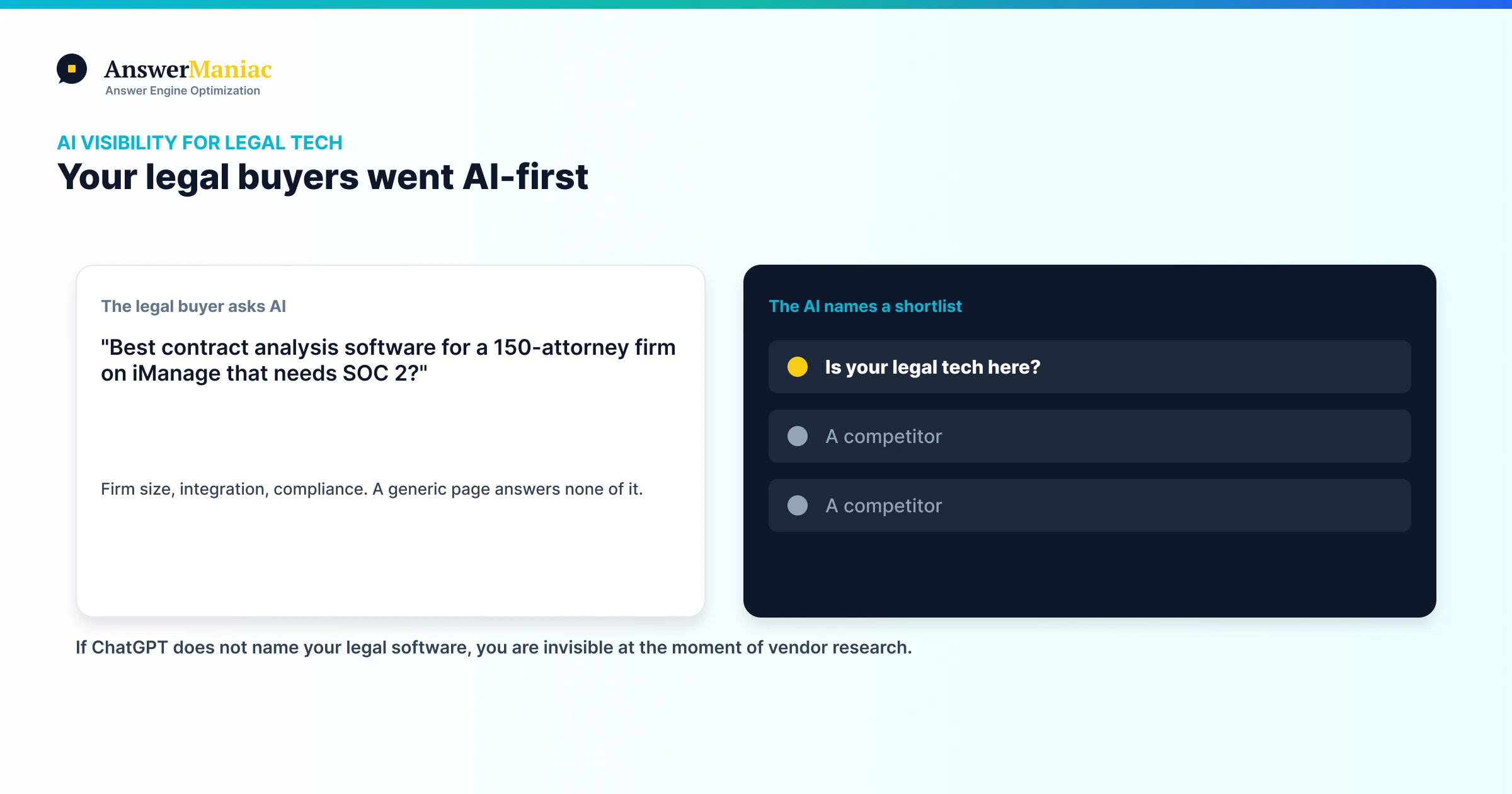
I was looking at ChatGPT results for "best compliance management software for mid-size banks" last month. The top-cited brand had a domain rating of 34. Three competitors with DR 60+ weren't mentioned once.
This isn't an edge case. When we benchmarked 376 B2B companies across five verticals — cybersecurity, MSP, Microsoft integrators, NetSuite integrators, and B2B SaaS — we found the correlation between traditional SEO metrics and AI citation frequency was weaker than most marketers assume.
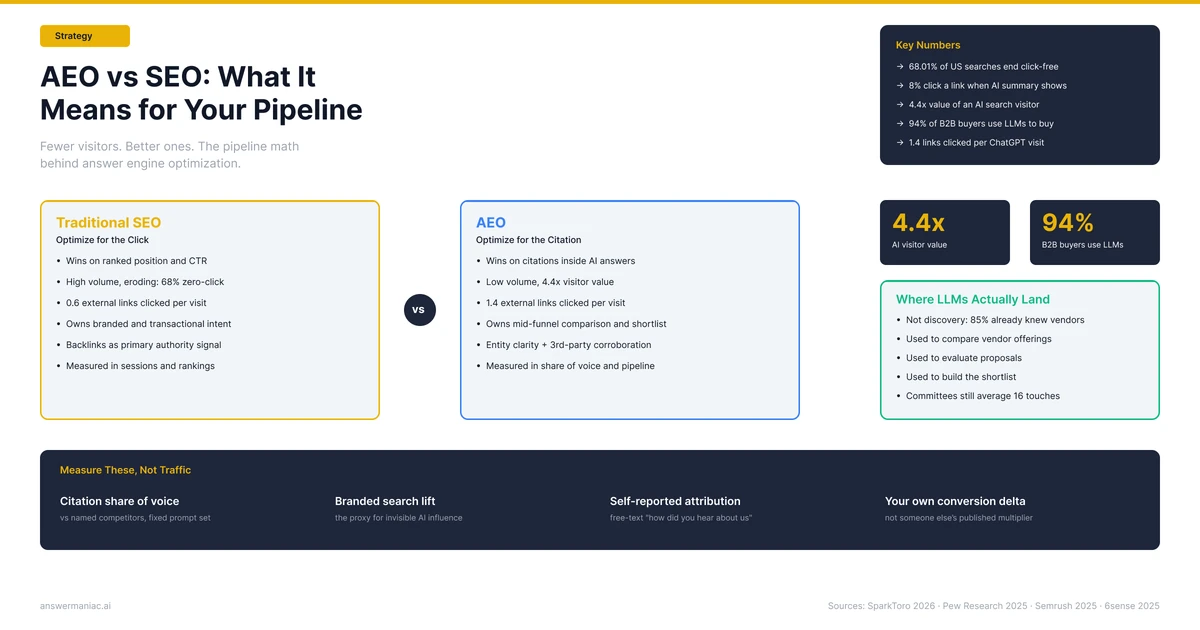
Ahrefs confirmed this at scale in March 2026. They studied 75,000 brands and found brand-mention correlation with AI Overview visibility at 0.664 versus 0.218 for backlinks. YouTube mentions were even stronger at 0.737. The three signals that correlate most with AI citation visibility are all off-site brand signals, not link metrics.
Google ranks pages. AI models cite entities. That distinction is the reason the ANSWER Framework exists as a separate discipline from SEO, and the reason each stage addresses a different set of signals than a traditional SEO audit would.
For the full comparison of where GEO and SEO overlap and where they diverge, see GEO vs SEO: The Complete Comparison for B2B Marketers.
The ANSWER Framework: Stage by Stage
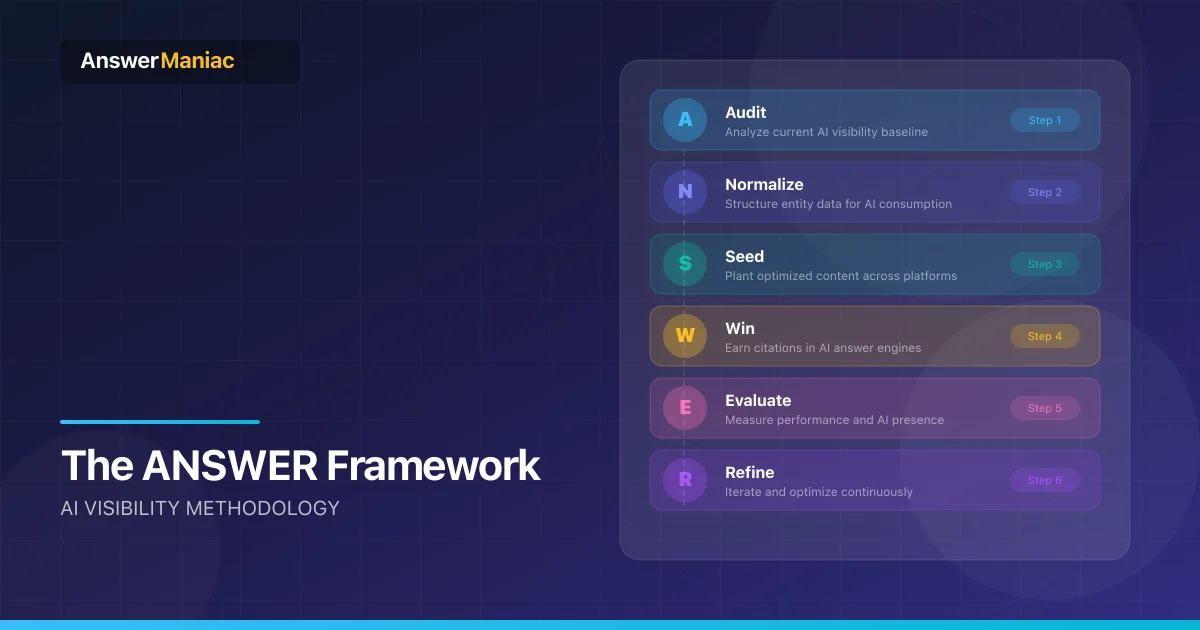
Audit. Navigate. Structure. Write. Earn. Refine.
Each stage has a defined entry condition, deliverables, and exit criteria. You don't move to the next stage until the current one is complete. That sequencing matters — we've seen teams waste months writing AI-optimized content before fixing entity confusion that made the content uncitable.
Here's every stage, with the deliverables and timelines from our 90-day sprint.
A — Audit: Know Where You Stand Before You Move
Timeline: Days 1-10 Entry condition: Signed engagement + access to client's GSC, GA4, and existing content inventory Deliverables: AI Visibility Score, per-engine citation baseline, entity audit, competitive citation map
Every client we've onboarded overestimated their AI visibility. Every single one. A company ranking #3 on Google for their primary keyword assumed ChatGPT would mention them. It didn't. A SaaS firm with 2,000+ blog posts and DR 71 turned up zero citations across ChatGPT and Perplexity for their top buyer queries.
The audit exists because assumptions are worthless. You need a number.
How we run it: We define 30-50 canonical buyer questions — the actual prompts your buyers type into ChatGPT and Perplexity when they're researching your category. Not keyword variations. Actual questions, weighted toward opening queries because Profound's data shows turn 1 produces citations 12.6% of the time versus 3.0% by turn 20.
We run each query through ChatGPT, Perplexity, and Google AI Mode. For every response, we log:
- Whether your brand appears at all (mention)
- Whether your domain is cited as a source (citation)
- Your competitors' mentions and citations on the same query
- The sources the AI actually pulled from
- The freshness and format of cited content
That gives you two baseline metrics:
Positioning accuracy = earned points / maximum possible points x 100. Each observation scores 0-2 against your company truth (what you actually do, what you actually offer).
Recommendation coverage = queries where you're recommended / total queries x 100.
Most B2B companies score below 20% on both metrics when they start. In our 376-company benchmark, 44% scored zero — not low, zero.
The audit also maps your entity health. We ask each AI engine "What is [your company]?" in a clean session and check whether it gets your category, product, and positioning right. If ChatGPT thinks you're a consulting firm when you're a software company, no volume of new content will fix your citation rate.
Exit criteria: Documented baseline scores, entity audit complete, competitive map delivered, client alignment on findings.
Run a free AI Visibility Audit — it takes 60 seconds and gives you the top-line numbers.
N — Navigate: Find the Questions That Actually Matter
Timeline: Days 8-20 (overlaps with late-stage audit) Entry condition: Audit complete, baseline established Deliverables: Prioritized buyer question map, content gap analysis, opportunity scoring matrix
"Write more content" isn't a strategy. Neither is "optimize for AI." Navigate is where you figure out which buyer questions to target and in what order.
We pull from five sources:
- Your prompt baseline. The 30-50 queries from the audit, now scored by competitive gap (where you're absent but competitors are cited).
- Search console data. What people already find you for — and which of those queries are likely to appear in AI answers.
- Competitor citation sources. The specific pages your competitors are being cited from. Not their blog index. The exact URLs that AI engines pull from.
- Community signals. What your buyers ask on Reddit, G2, Quora, and industry forums. These are the natural-language phrasings that AI engines mirror.
- Sales team input. The questions that come up in demos and discovery calls. These are almost always more specific than what keyword tools surface.
Each question gets scored on three dimensions:
- Citation opportunity — how likely is this query to trigger a web search in ChatGPT? (82% of conversations don't trigger one at all, per Profound's analysis of 700,000 US conversations.)
- Commercial value — does this question appear in buying conversations, or is it purely informational?
- Competitive gap — are competitors being cited here while you're absent?
The output is a prioritized list: which questions to target first, what format to publish in, and which existing content to restructure versus what needs to be created from scratch.
Exit criteria: Buyer question map approved by client, content calendar drafted, resource allocation agreed.
S — Structure: Make Your Content Machine-Readable
Timeline: Days 15-35 Entry condition: Navigate complete, priorities set Deliverables: Entity optimization, schema markup implementation, on-page restructuring, technical fixes
This is the stage most "AI SEO" agencies skip entirely, and it's the one that determines whether your content can be cited at all.
Structure has three layers:
Entity optimization. Consistent naming, category placement, and description across every surface: your website, Crunchbase, LinkedIn, G2, Wikipedia (if you qualify), and industry directories. AI models build entity representations from the consensus across these sources. If your LinkedIn says "enterprise software," your website says "SaaS platform," and G2 categorizes you under "IT management," the model gets confused. Confused models don't cite.
Schema markup. Organization, Product, Article, FAQPage, HowTo, and SoftwareApplication markup with sameAs links to your verified profiles. Schema is foundation, not differentiator. Anyone selling it as the whole strategy is selling you a checkbox. But missing it means you've left structured signals on the table that every competitor will have. Implementation details in schema markup for AI and ChatGPT citations.
On-page architecture. The Wix Studio AI Search Lab analyzed 75,000 AI answers and more than a million citations across ChatGPT, Google AI Mode, and Perplexity. They found query intent predicted citation format better than industry or model. That finding drives how we restructure pages:
- Direct answer in the first 100 words
- H2s phrased the way buyers phrase questions
- Tables wherever a comparison exists (AI engines extract tabular data more reliably than prose)
- Stats with named sources — Ahrefs found statistics lift AI visibility 41%
- FAQ sections with genuine buyer questions, not keyword-stuffed filler
We also run a technical check: page speed, server-side rendering of key content (ChatGPT's browsing tools fetch pages directly), crawlability of your content graph, and internal linking architecture. If your best content is buried three clicks deep with no internal links pointing at it, AI models that crawl your site will underweight it.
Exit criteria: Schema deployed and validated, entity consistency verified across platforms, restructured pages live.
W — Write: Create Content AI Engines Actually Pull From
Timeline: Days 25-55 Entry condition: Structure complete, on-page architecture in place Deliverables: New citation-targeted content, updated existing pages, comparison and listicle assets
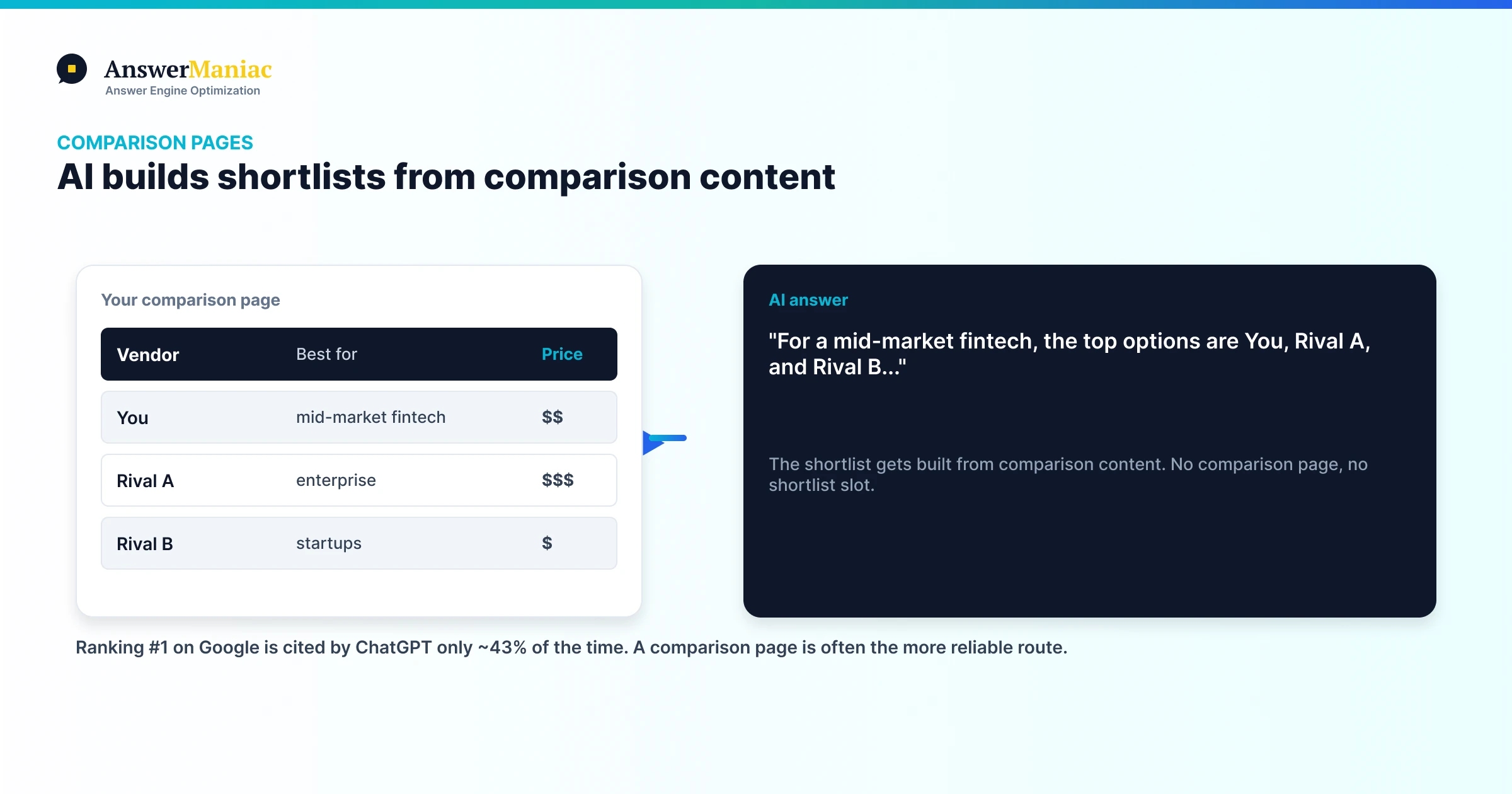
Wix Studio's research found listicles took 21.9% of all AI citations, articles 16.7%, and product pages 13.7%. Together, those three formats account for 52% of everything AI engines cite.
More importantly, listicles captured about 40% of commercial-intent citations — nearly double any other format. That's the format most B2B companies refuse to build because it means naming competitors.
We publish it anyway.
The content map from Navigate tells us what to write. Structure tells us how to format it. Write is execution, but with three rules that separate citation-worthy content from the other 97% of B2B blog posts that AI engines ignore:
Rule 1: Information gain. Every piece must add something new — original data, proprietary benchmarks, contrarian analysis with evidence. Summaries of existing knowledge don't earn citations. We found this pattern in our research: the B2B companies with the highest citation rates across verticals were the ones publishing original data sets, named methodology, and downloadable resources.
Rule 2: Format for extraction. AI engines don't read your content the way a human does. They extract structured answers from it. That means:
- A clear answer to the query in the first paragraph
- Comparison tables that can be lifted directly into an AI response
- Named entities throughout (specific company names, product names, pricing figures)
- Year signals in titles and content — Perplexity cites content published within the last 30 days at an 82% rate, and visible "2026" signals improve citation rates by roughly 30%
Rule 3: Multi-engine awareness. ChatGPT, Perplexity, and Google AI Mode select sources differently. ChatGPT pulls 47% from brand-owned sites and 30% from earned media. Perplexity favors recency and source diversity. Google AI Mode correlates strongly with brand mentions (0.664) rather than backlinks (0.218). Writing for one engine is like optimizing for one browser in 2010 — you need content that works across all three.
For the specific content types and formats that earn citations, see the AI citation playbook covering 23 content types.
Exit criteria: All priority-1 content published, existing pages restructured, citation-targeted assets live.
E — Earn: Build the Off-Site Presence AI Models Trust
Timeline: Days 40-75 Entry condition: Write stage producing content, initial assets live Deliverables: Review acquisition, earned media placements, community presence, co-citation development
Profound's analysis of 11.84 billion citations across 29 industries found that earned media captures 39.5% of all LLM citations globally. For ChatGPT specifically, 30% of citations come from earned media — the highest share of any major model.
But here's the wrinkle most teams miss: SaaS and software companies see only 11.4% of their citations come from earned media. That's the lowest of any major industry. The gap between what's possible (39.5%) and what most B2B software companies achieve (11.4%) is where the Earn stage lives.
Four earn channels, in order of impact for B2B:
1. Review platforms. G2, TrustRadius, Capterra. AI engines treat reviews as third-party validation of entity claims. Semrush and Kevin Indig found comparative queries ("best X for Y," "A vs B") produce 2.4x more brand mentions than informational queries. Reviews are where those comparative answers get sourced.
2. Earned media in your citation cluster. ChatGPT cites sources in packs. When we analyze citation co-occurrence for a client's category, the same three to five domains appear repeatedly: usually a review site, a trade publication, and a community thread. Getting placed in those specific co-citation sources matters more than general PR.
3. Community presence. Reddit is the #1 cited source across every major AI engine, appearing at roughly 40% frequency. Wikipedia dominates ChatGPT at 26-48% of top-10 citation share. Genuine participation in category-relevant communities creates the kind of third-party signals that AI engines weight heavily.
4. Co-citation development. When your company and a well-known competitor appear together on authoritative third-party pages, AI engines learn to associate you with that category. This is the entity-level equivalent of link building — you're building association, not links.
Exit criteria: Review velocity established, earned placements secured in top co-citation sources, community presence active.
R — Refine: Measure, Classify, Iterate
Timeline: Days 60-90 (and ongoing) Entry condition: Audit → Earn stages complete, measurement protocol established Deliverables: Follow-up measurement run, outcome classification, next-cycle recommendations
The worst thing you can do after running a 90-day AI visibility campaign is eyeball the results and say "I think it's working."
Refine runs the exact same measurement protocol from the Audit stage — same queries, same engines, same scoring rubric — and compares the numbers.
Positioning accuracy change: Did your score against company truth improve? By how much?
Recommendation coverage change: Are you showing up on more buyer queries than at baseline?
Guardrail checks: Did anything else break? Refine includes three guardrails we built after learning the hard way on early client engagements:
- Indexability guardrail. Did the schema and restructuring work cause any pages to drop from Google's index? (It happens more often than you'd think when teams refactor URLs or consolidate content.)
- Traffic guardrail. Did organic traffic hold steady or improve? AI visibility work should complement SEO, not cannibalize it.
- Conversion guardrail. Did conversion rates on key pages maintain? Sometimes restructuring for AI extraction makes content less persuasive for human readers. We check.
If any guardrail fails, we fix it before claiming the campaign produced results.
Outcome classification. At the 90-day mark, we classify the result:
- Positive — positioning accuracy and/or recommendation coverage improved, all guardrails passed
- Negative — metrics declined or no movement, guardrails passed
- Inconclusive — too few observations to determine
- Invalid — material change to the AI engines or our measurement protocol during the period (engine version update, protocol bug, rubric change) that makes before-after comparison unreliable
We never silently rebaseline. If the measurement protocol changed, the comparison is invalid and we say so. That's a policy, not a preference.
Exit criteria: Outcome classified, guardrails verified, next-cycle recommendations delivered, client briefed.
For the details on tracking your AI visibility over time, see how to track AI citations and AI visibility tracking.
What 90 Days Actually Looks Like
Here's the typical timeline for a 90-Day AI Visibility Sprint:
| Days | Stage | Key activities |
|---|---|---|
| 1-10 | Audit | Baseline AI Visibility Score, entity audit, competitive citation map |
| 8-20 | Navigate | Buyer question mapping, content gap analysis, opportunity scoring |
| 15-35 | Structure | Entity optimization, schema markup, on-page restructuring |
| 25-55 | Write | Citation-targeted content creation, page restructuring |
| 40-75 | Earn | Review acquisition, earned media, community presence |
| 60-90 | Refine | Follow-up measurement, outcome classification, next-cycle planning |
Stages overlap intentionally. You don't wait for every page to be restructured before starting content creation. You don't wait for all content to be published before starting earn activities. The stages are sequential in logic but parallel in execution.
What This Costs
Transparency on pricing is part of how we operate. Three engagement options:
The 90-Day AI Visibility Sprint is $2,997, one-time, no contract. That gets you through all six stages with a focus on quick wins and establishing your baseline. It's designed for companies that want to prove the category before committing to ongoing investment.
The Growth Engine is $6,500/month with a six-month minimum. That's the full framework running continuously: monthly measurement cycles, ongoing content creation, earn activities, and refinement. This is where most of our B2B software clients land.
The Monopoly tier runs $9,997/month with a six-month minimum and a 90-day proof gate. If we haven't demonstrated measurable improvement by day 90, you can exit. We don't guarantee citations, rankings, or pipeline — nobody can guarantee algorithmic outcomes. We guarantee execution, deliverables, and AI Visibility Score improvement.
Full pricing details at answermaniac.ai/pricing.
Why Most "AI SEO" Agencies Produce Mediocre Results
I'll be direct about this because it matters for anyone evaluating agencies in this space.
Most agencies offering AI visibility services are doing one of two things. They're running a traditional SEO playbook with "AI" bolted on — same keyword research, same content briefs, same link building, just with FAQ schema added. Or they're monitoring AI citations without a system for influencing them, which is like tracking your stock price without running the company.
The ANSWER Framework exists because we tested both approaches and measured the results. Adding FAQ schema to existing pages without fixing entity confusion produced zero citation improvement across three client sites. Running a traditional content strategy optimized for Google rankings produced marginal AI citation gains on only 12% of target queries.
What worked was treating AI visibility as its own discipline with its own signals, its own measurement criteria, and its own playbook. That's what the framework codifies.
Frequently Asked Questions
What is the ANSWER Framework?
The ANSWER Framework is AnswerManiac's 6-stage methodology for building AI visibility: Audit (baseline measurement), Navigate (question mapping), Structure (entity and schema optimization), Write (citation-targeted content), Earn (off-site presence building), and Refine (outcome measurement and iteration). It was built from benchmarking 376 B2B companies across five verticals.
How long does it take to see results from AI visibility work?
A typical 90-day sprint produces measurable changes in positioning accuracy and recommendation coverage. Based on our client data, most companies see their first AI citations within 30-45 days of the Structure stage completing, with meaningful coverage improvement by day 75-90. The timeline varies by competitive intensity in your category and the severity of entity issues at baseline.
Is AI visibility the same as SEO?
No. There's overlap — both involve content quality, structured data, and authority signals. But the ranking factors differ. Ahrefs studied 75,000 brands in March 2026 and found brand-mention correlation with AI visibility at 0.664 versus 0.218 for backlinks. YouTube mentions correlated at 0.737. AI visibility is driven more by entity clarity and off-site brand signals than by traditional link metrics. For the full comparison, see GEO vs SEO: The Complete Comparison.
How do you measure AI visibility?
Two primary metrics: positioning accuracy (how accurately AI engines describe your company when they mention you) and recommendation coverage (what percentage of relevant buyer queries result in your company being recommended). Both are measured against a fixed set of canonical buyer questions, run through ChatGPT, Perplexity, and Google AI Mode monthly. We also track guardrails: indexability, organic traffic, and conversion rates to ensure AI optimization doesn't come at the cost of existing performance.
Do you guarantee AI citations?
No. Nobody can guarantee algorithmic outcomes — and any agency that does is either lying or doesn't understand how AI engines work. We guarantee execution, deliverables, and AI Visibility Score improvement. Our pricing structure reflects this: the 90-Day Sprint is no-contract, and retainer engagements include a 90-day proof gate.
What industries does the ANSWER Framework work for?
We built it for B2B software companies in overlooked verticals — franchise development, RegTech, fleet management, cybersecurity, managed services. The methodology applies across B2B categories, but the specific tactics in each stage adjust based on your industry's citation dynamics. For example, cybersecurity companies have a 74% brand-citation share (the highest of any industry), while pharma sits at 59% earned media citations. Those different starting points change how you allocate effort across the Earn stage.
How is this different from what other agencies offer?
Three differences. First, the framework is publicly documented with named stages, defined deliverables, and measurable exit criteria at each step. Most agencies describe "our process" without specifics. Second, it's built on original research — 376 companies, 5 verticals, the largest published B2B AI visibility benchmark. Third, we separate measurement from claims. Every engagement starts with a frozen measurement protocol and ends with a classified outcome (positive, negative, inconclusive, or invalid). We don't cherry-pick metrics after the fact.
Get AEO Insights Weekly
Join 500+ B2B marketers getting AI visibility tactics every Tuesday.
Ready to Get Your Brand Cited by AI?
See how your competitors show up in ChatGPT, Perplexity, and Gemini — and what it would take to get recommended.