AEO vs SEO: What Answer Engine Optimization Means for Your Pipeline
AEO vs SEO, measured against pipeline instead of traffic. Semrush, Pew, SparkToro and 6sense data on what answer engine optimization actually changes for B2B.
Quick Answer
Key facts
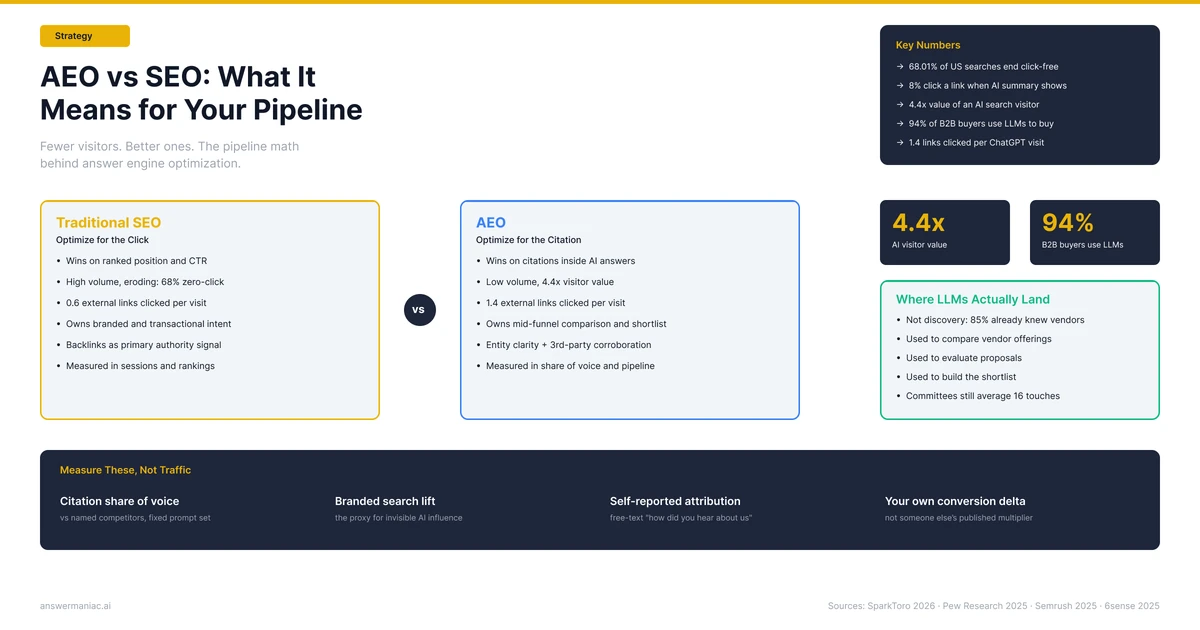
- 68.01% of US Google searches ended without a click in Jan–Apr 2026, up from 60.45% in 2024 (SparkToro, Similarweb clickstream data)
- When a Google AI summary appears, only 8% of users click a traditional result, versus 15% when no summary appears (Pew Research Center, July 2025)
- The average AI search visitor is worth 4.4x a traditional organic search visitor (Semrush, 2025)
- 94% of B2B buyers use LLMs during their purchase process, and 85% had prior direct experience with the vendors they evaluated, the highest 6sense has ever recorded (6sense 2025 Buyer Experience Report)
- ChatGPT users click 1.4 external links per visit compared with 0.6 from Google (Momentic, 2025)
The AEO Pitch Everyone Runs Is Slightly Wrong
Most AEO pitches go like this: buyers now start their research in ChatGPT, so if you're not in the answer, you're not in the deal.
The data doesn't support the first half of that sentence.
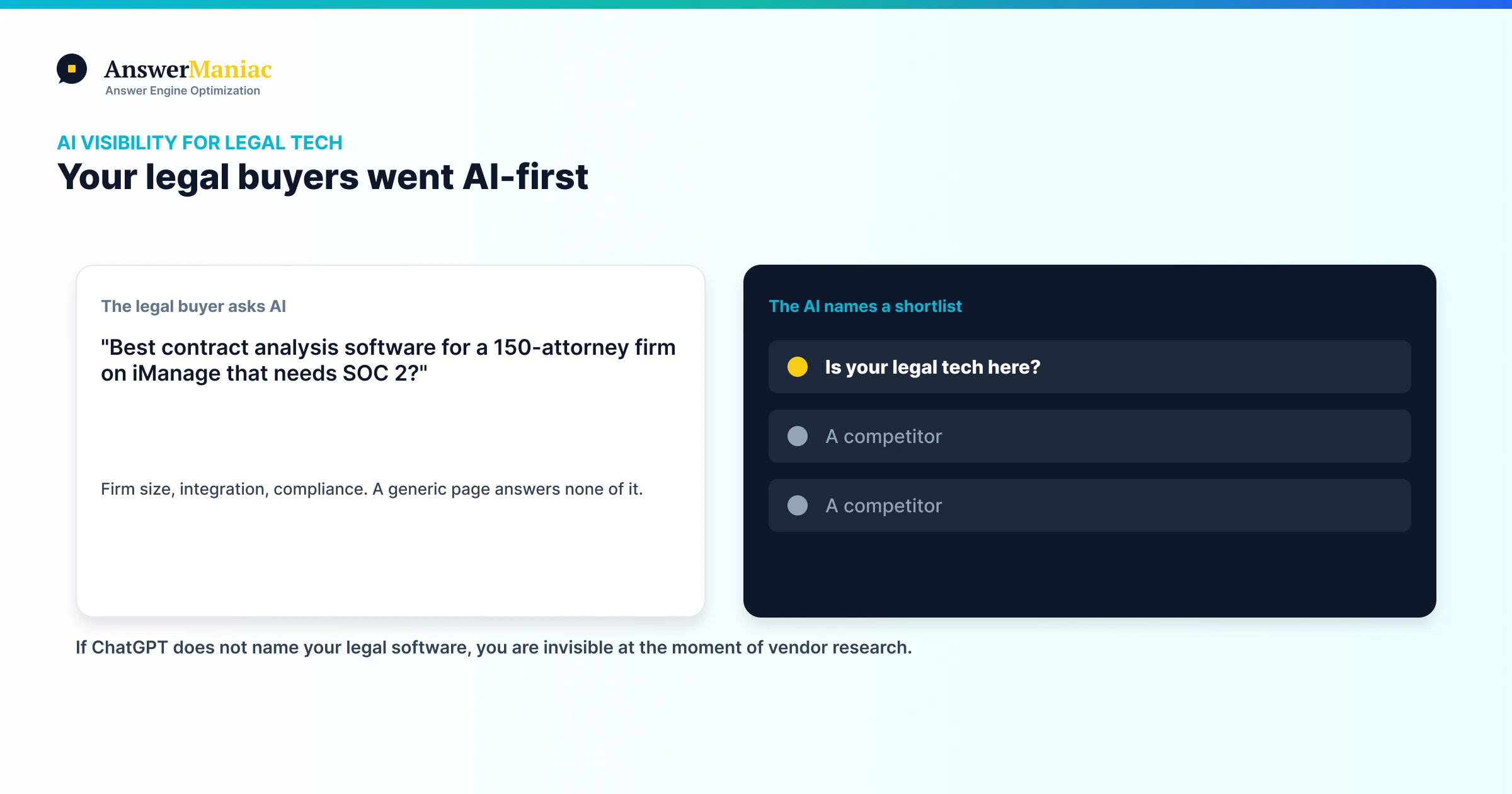
6sense's 2025 Buyer Experience Report surveyed B2B buyers on where LLMs actually show up in their journey. The answer: the middle. Not discovery. Buyers use LLMs to compare vendor offerings, evaluate proposals, analyze stakeholder input, build shortlists, and summarize documentation. Those are synthesis tasks, not discovery tasks.
The same report found 85% of buyers had direct prior experience with the vendors they evaluated. That's the highest number 6sense has recorded. Buyers largely already know the players. They're asking AI to help them decide, not to help them discover.
I'll be honest, this reframing cost us a slide in our own pitch deck. We'd been leading with "get found first." The 6sense data says the real win is "get chosen during evaluation." Those require different content.
So AEO still matters enormously. It just matters at a different point in the funnel than the industry keeps claiming, and that changes what you build.
AEO vs SEO: The Side-by-Side That Actually Maps to Revenue
Traffic comparisons between AEO and SEO are misleading because the two channels operate at wildly different volumes. Compare them on pipeline mechanics instead.
| Dimension | Traditional SEO | AEO |
|---|---|---|
| Unit of success | Ranked position, click | Citation, recommendation, brand mention inside the answer |
| Traffic volume | High, but eroding. 68.01% of US Google searches now end without a click (SparkToro, 2026) | Low. Most measured properties report AI referrals in the low single digits of total sessions |
| Visitor value | Baseline | 4.4x the average organic visitor (Semrush, 2025) |
| Click behavior | 0.6 external links clicked per Google visit (Momentic, 2025) | 1.4 external links clicked per ChatGPT visit (Momentic, 2025) |
| Funnel position | Discovery through decision | Concentrated mid-funnel: comparison, shortlist, proposal evaluation (6sense, 2025) |
| Primary technical work | Crawlability, Core Web Vitals, internal linking, backlinks | Entity definition, knowledge graph presence, extractable structure, third-party corroboration |
| What breaks it | Algorithm updates, competitor link velocity | Being absent from the sources the model reaches for, or described inaccurately in them |
| Measurement | Rankings, sessions, CTR from Search Console | Citation frequency, share of voice across prompts, branded search lift, self-reported attribution |
| Attribution difficulty | Moderate, well-tooled | High. Much of the influence happens with no referrer at all |
The row that matters most for a CFO conversation is the last one. AEO's effect is real and partly invisible, which is exactly why teams underinvest in it.
Why Fewer Visitors Can Mean More Pipeline
Three separate findings stack into one mechanism.
One: the AI answer filters out the browsers. Pew Research Center's July 2025 analysis found that when Google shows an AI summary, only 8% of users click a traditional result, compared with 15% when no summary appears. Pew also found 26% of AI-summary searches end with no further action at all, versus 16% for standard results. The people who still click after reading a complete answer are the ones with a reason to click.
Two: the ones who click, click more. Momentic's 2025 data shows ChatGPT users click 1.4 external links per visit against 0.6 from Google. That's over twice the outbound behavior per session. In a B2B evaluation, that looks like a buyer opening your pricing page, your docs, and a competitor's comparison page in the same sitting.
Three: the value gap is measured, not theoretical. Semrush's 2025 AI search traffic study put the average AI search visitor at 4.4x the value of a traditional organic search visitor. Their own projection has AI search visitors surpassing traditional organic visitors within a few years, sooner if Google makes AI Mode the default.
Put together: AEO doesn't grow the top of the funnel. It improves the composition of what arrives. That's a pipeline argument, not a traffic argument, and it's the honest way to sell it internally. We break down how to instrument this in how to measure AI search ROI.
A caveat we insist on. Conversion-rate comparisons floating around the AEO space right now range from roughly parity to 5x depending on the study, the industry, and the sample. Anyone quoting you a single confident multiplier across all B2B is selling something. Semrush's 4.4x is a cross-industry average with a named methodology, which is why we cite it and why we still tell clients to measure their own.
The Zero-Click Squeeze Is Not a Prediction Anymore
Gartner's Predicts 2024 report forecast that traditional search engine volume would drop 25% by 2026 as AI chatbots absorbed queries. That specific prediction didn't land. Google still holds the overwhelming majority of search, and raw query volume didn't fall off a cliff.
Something more consequential happened instead. Query volume held. Clicks didn't.
SparkToro's June 2026 study, built on Similarweb desktop and mobile panel data covering US Google searches from January through April 2026, found 68.01% of searches ended without a click. In 2024 that figure was 60.45%. The share of searches generating at least one click fell 9.51 percentage points across those two years, a 22.9% decline. Meanwhile the share of searches leading to another Google search rose 7.2 points.
AI Overviews appear on more than 20% of searches, and when they do, CTR drops by nearly 60% according to the same research. AI Mode barely registered in the study period at 0.34% of searches, but Google said at I/O 2026 that AI Mode had passed 1 billion monthly users with query volume more than doubling each quarter.
Rand Fishkin's own read on it: SEO alone is likely insufficient for publishers trying to recover historical Google-referred traffic, and branded, local, and high-intent transactional queries remain the categories where SEO still pays reliably.
That's the squeeze. Your rankings can be stable while your sessions decline, because the SERP is answering the question. For a fuller treatment of how the two disciplines overlap and diverge, see GEO vs SEO: the complete comparison.
What Actually Moves the Needle Mid-Funnel
If buyers reach for LLMs during comparison and shortlisting, your AEO work should target comparison and shortlisting. Concretely:
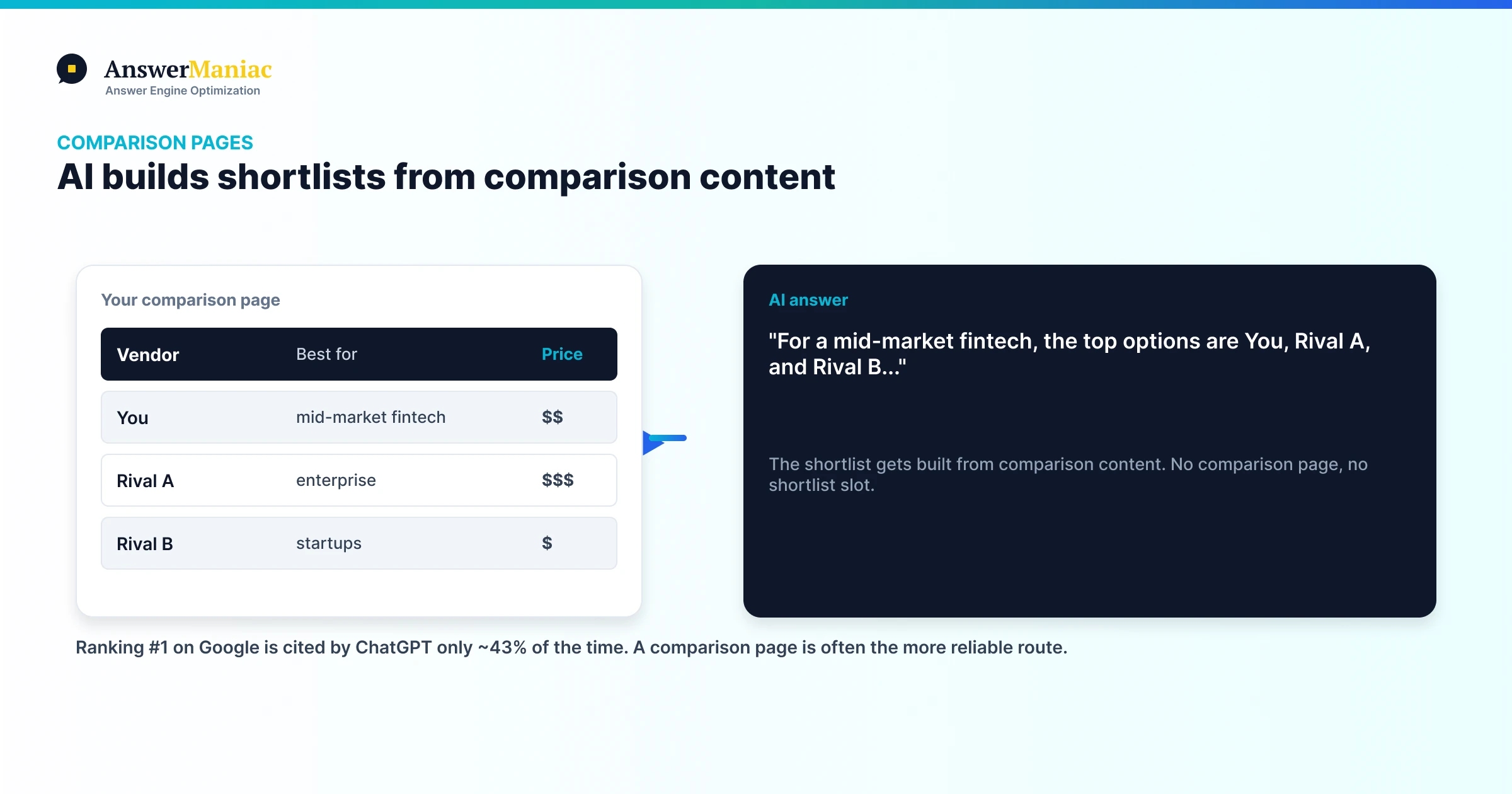
Comparison content with real specificity. Buyers paste product descriptions into ChatGPT and ask for a comparison table. If your capabilities are described in vague marketing language, the model produces a vague row. Name the integration. State the limit. Give the number.
Entity clarity over schema volume. Schema markup is table stakes, not a differentiator. The harder work is making sure your company, product, and category are consistently defined across the sources models actually reach for. Semrush found business and service websites account for 50% of ChatGPT's cited sources, which means your own properly structured pages are eligible, not just G2 and Reddit. We cover the mechanics in answer engine optimization and the tactical sequencing in AEO optimization strategy.
Third-party corroboration. A model asked "which fleet management platforms handle DOT compliance" is synthesizing across review sites, community threads, and comparison posts. If your product only appears on your own domain, you're a single-source claim. Community consensus on G2, Reddit, and vertical forums is what turns a claim into a citation.
Structure for extraction. Direct answers near the top, clear H2s that mirror the way buyers phrase questions, tables where a comparison exists, FAQs at the end. Not because it's clever, but because it's what gets lifted cleanly into an answer. More on this in content strategy for AI visibility.
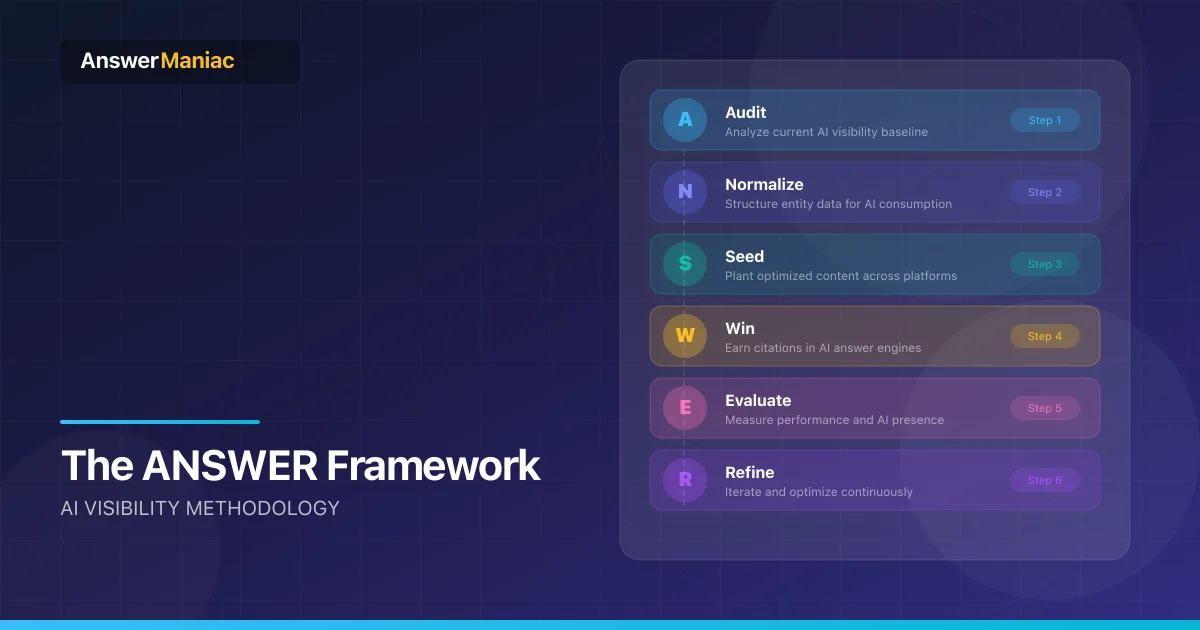
This is the Structure and Write half of The ANSWER Framework — Audit, Navigate, Structure, Write, Earn, Refine. The Earn stage is where the third-party work lives, and in our experience it's the stage most teams skip and then wonder why their citations plateau.
How to Measure AEO Against Pipeline Without Fooling Yourself
Traffic dashboards will undersell AEO. Referrer data is incomplete, AI Overviews send no referrer at all, and a buyer who read about you in ChatGPT often arrives via a branded Google search two days later.
Track these instead:
- Citation frequency and share of voice. How often you appear across a fixed set of buying-intent prompts, versus named competitors. Fixed prompt set, consistent cadence, or the numbers mean nothing.
- Branded search volume. The most reliable proxy for AI-driven awareness you can't see directly. If AEO is working, branded queries rise without a corresponding paid or PR spike.
- Self-reported attribution on forms. Add "How did you hear about us?" as a free-text field. It's crude, and it's currently the most honest signal available for LLM influence.
- Sales call mentions. Ask AEs to flag when a prospect says they asked ChatGPT or Perplexity about the category. Cheap qualitative data that leads the quantitative by months.
- AI referral conversion rate, measured against your own baseline. Not against a published multiplier. Your number.
For tooling that covers the first item at scale, see our breakdown of the best generative engine optimization tools for 2026.
So Which One Do You Fund?
Both, but not equally, and not for the same reasons.
SEO still owns branded search, local intent, and high-intent transactional queries. Those categories keep converting and keep sending clicks. Defunding SEO because 68% of searches are zero-click is a misread. The 32% that still click skews toward the queries you most want to win.
AEO owns the evaluation window. It's where a 94%-LLM-adoption buying committee builds its shortlist, and where a 4.4x-value visitor comes from. It costs less than SEO in raw content volume and more in entity work, structure, and third-party earning.
The practical split we recommend for a B2B company in an overlooked vertical: keep SEO funded for the bottom-funnel and branded terms, and shift net-new content investment toward comparison, category, and evaluation content structured for extraction. Then measure your own conversion delta for six months before you let anyone quote you a multiplier.
Frequently Asked Questions
What is the difference between AEO and SEO?
SEO optimizes content to rank in search results and earn clicks. AEO optimizes content to be cited, quoted, and recommended inside AI-generated answers from ChatGPT, Perplexity, Gemini, Claude, and Copilot. They share most of their technical foundation (crawlability, content quality, authority), but AEO adds entity optimization, extractable content structure, and third-party corroboration as first-class requirements.
Does AEO actually generate B2B pipeline or just brand awareness?
Both, and the awareness portion is harder to see. Semrush's 2025 research put the average AI search visitor at 4.4x the value of a traditional organic visitor, and Momentic found ChatGPT users click 1.4 external links per visit versus 0.6 from Google. But a significant share of AEO's pipeline effect arrives with no referrer, showing up later as branded search or a direct visit. Measure branded search volume and self-reported attribution alongside referral data.
How much AI referral traffic should a B2B company expect?
Less than the hype suggests. Most measured properties report AI referrals in the low single digits as a share of total sessions, though growth rates are steep. Volume is not the reason to invest in AEO. Visitor quality and mid-funnel influence are.
Is SEO dead because of zero-click search?
No. SparkToro's 2026 study found 68.01% of US Google searches end without a click, which means roughly a third still send one. Rand Fishkin's own commentary on that study notes branded searches, local business queries, and high-intent transactional searches continue to benefit significantly from SEO. Those are precisely the queries B2B companies convert on.
Where in the B2B buying journey do LLMs matter most?
The middle. 6sense's 2025 Buyer Experience Report found buyers use LLMs primarily to compare vendor offerings, evaluate proposals, analyze stakeholder input, and build shortlists. Those are synthesis tasks, not discovery. 85% of buyers had prior direct experience with the vendors they evaluated, the highest figure 6sense has recorded. Optimize for the comparison stage, not just for being discovered.
What should I fix first if I'm starting AEO from zero?
Run a citation baseline across 30–50 buying-intent prompts to see where you currently appear, then fix entity consistency before you write anything new. If ChatGPT can't reliably state what your company does and which category it belongs to, no amount of new content will fix your citation rate. That's the Audit and Navigate stages of The ANSWER Framework, and they come before Write for a reason.
Sources
- SparkToro, "In 2026, Less than One Third of Google Searches Still Send a Click" (June 2026), via Search Engine Land
- Pew Research Center, "Google users are less likely to click on links when an AI summary appears in the results" (July 2025)
- Semrush, AI Search SEO Traffic Study (2025)
- 6sense, 2025 B2B Buyer Experience Report
- Momentic, Google reach vs ChatGPT click-throughs (2025)
- Gartner, "Gartner Predicts Search Engine Volume Will Drop 25% by 2026" (February 2024)
Get AEO Insights Weekly
Join 500+ B2B marketers getting AI visibility tactics every Tuesday.
Ready to Get Your Brand Cited by AI?
See how your competitors show up in ChatGPT, Perplexity, and Gemini — and what it would take to get recommended.