How to Measure AI Search ROI: The Metrics That Actually Matter
How to Measure AI Search ROI: See which metrics actually matter by tracking AI citations, visibility, and the results they create for your business.
Quick Answer
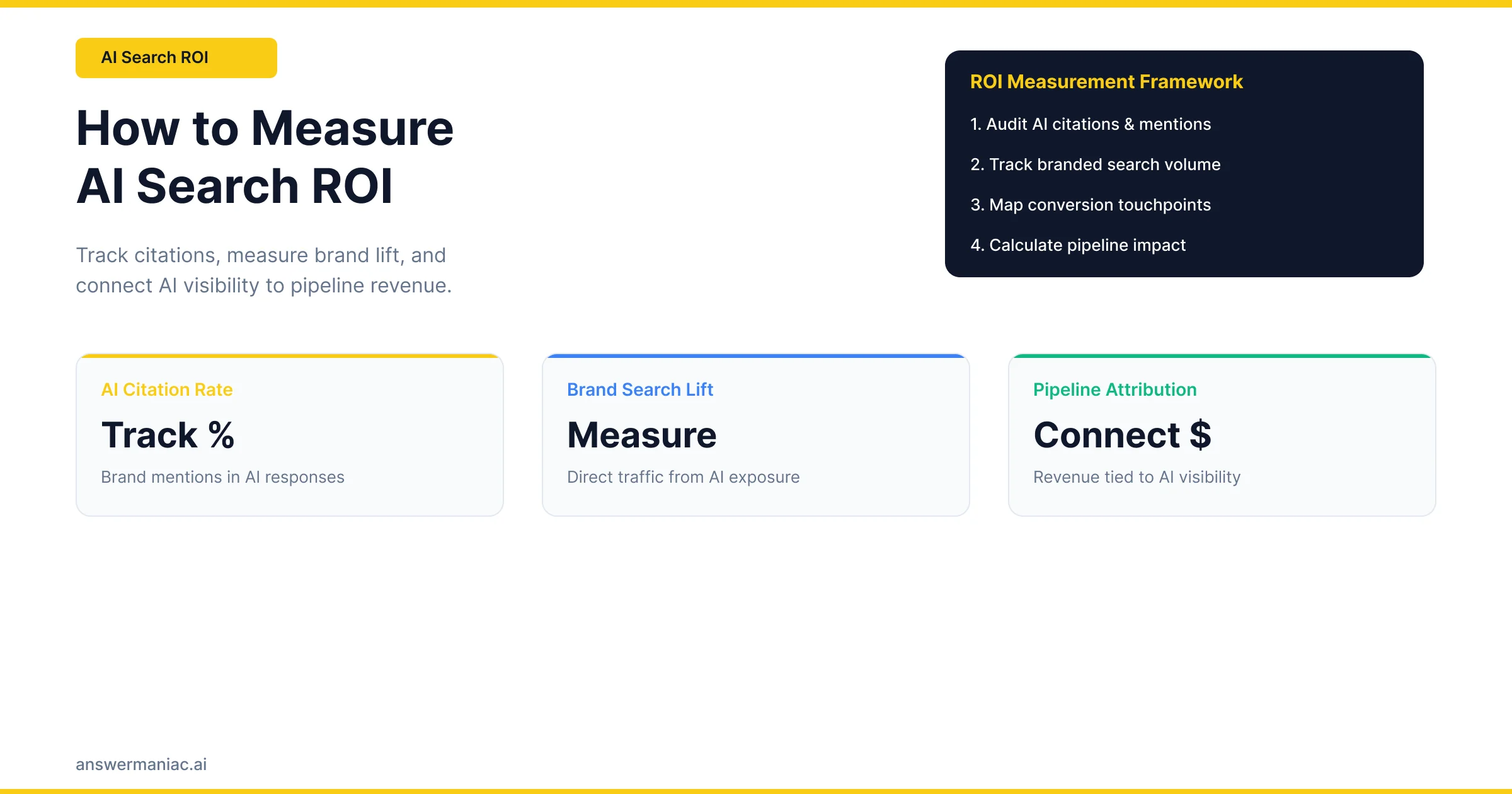
Measuring AI search ROI requires tracking visibility metrics like citation frequency, share of voice, and mention rate across AI platforms, then connecting those signals to business outcomes like revenue, lead quality, and customer lifetime value. The old model of counting clicks doesn't capture AI's influence on brand perception and purchase decisions. Companies that build a structured measurement framework using multi-touch attribution, proper citation tracking, and revenue-connected KPIs typically see 300-500% first-year returns. The key is treating AI search as a long-term channel, not a quick fix, and investing in the right AI search strategy to compound value over time.
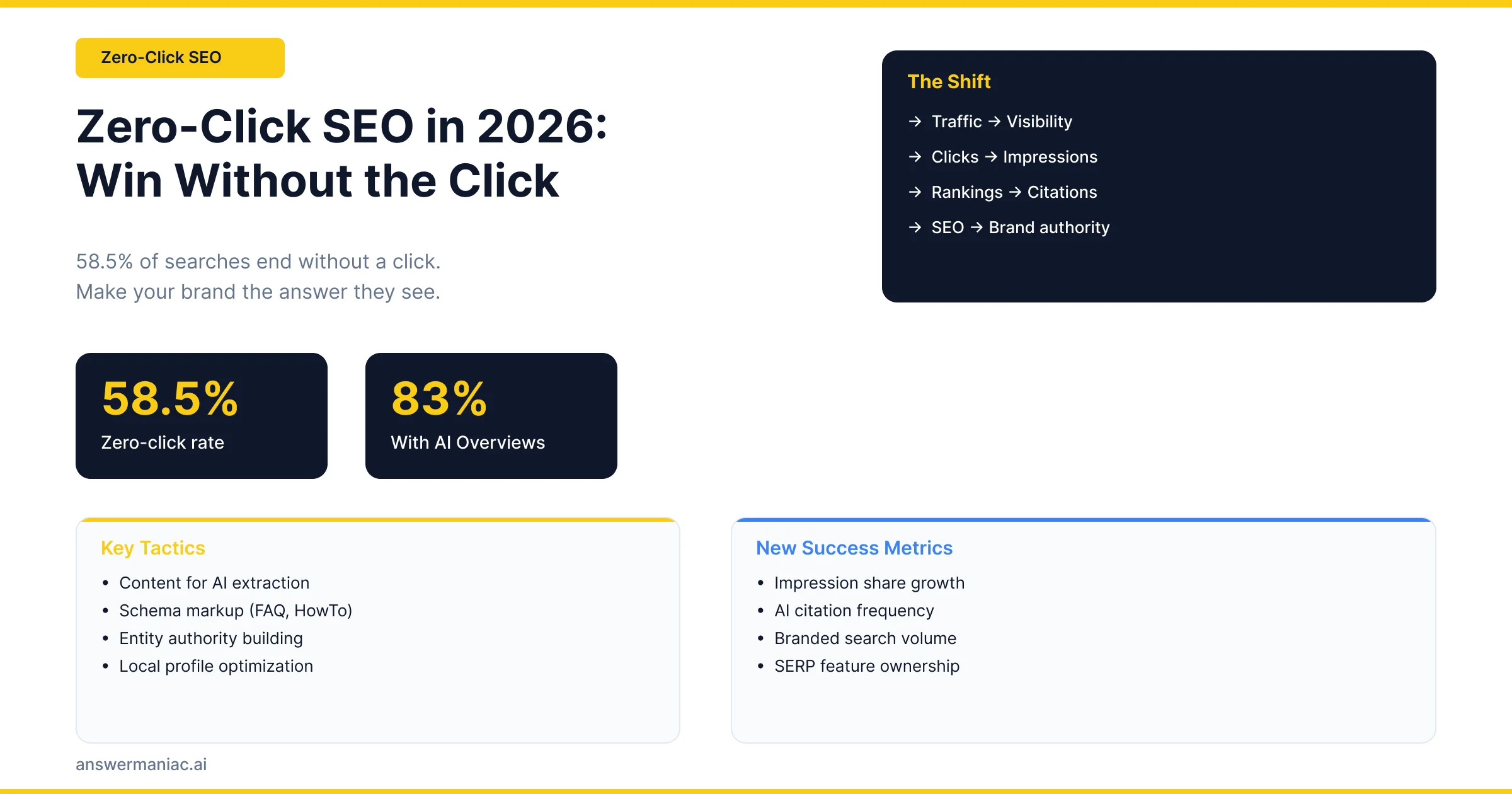
Measuring AI search ROI is about whether citations by ChatGPT or Google AI actually drive your brand value. The old model based on counting clicks is starting to become irrelevant. Today, the market value of content is determined by brand exposure and influence, which occurs long before the audience even visits your website.
ROI measures how often your content is cited, your share of voice in AI responses, and whether that presence drives growth or sales. ROI is what shows whether your plan is working. Want to know which metrics to pay attention to? Read on for more complete information.
AI Search ROI at a Glance
These quick points summarize how to evaluate and prove the real value of AI search performance.
- AI search ROI depends on visibility signals, not just traffic or rankings.
- Metrics such as AI visibility, citations, and downstream revenue impact reveal the true business value.
- Brand mentions, share of voice, and citation frequency are key indicators. These metrics show how often AI systems reference your content across relevant queries.
- Strong programs connect AI visibility to real outcomes. Successful teams link visibility metrics with engagement, conversions, and lifetime customer value.
What Is AI Search ROI and Why It Matters
Getting mentioned in an AI search answer is a kind of advertising. It puts your name in front of people, and that can make them think differently about your company, even if they don't click through to your site. That's the brand recognition part of the value.
The other part is more direct. You need to see if those AI-driven views turn into paying customers. The real return on investment is measured by the sales and revenue that follow. It measures the actual business value you get from being mentioned by an AI compared to the cost of getting there.
People are using AI tools more for research and to decide what to buy. The old yardstick of success, counting page views, doesn't apply here. These systems measure what truly counts today: conversions and brand awareness.
When an AI mentions your brand, it's a subtle endorsement. That idea gets planted in a customer's mind long before they ever reach your website.
If companies just watch their traffic numbers, they're missing the point. The real influence of AI visibility comes into play further down the line, as a customer moves through their journey. Success today is about grasping how AI guides decisions, not just keeping score of clicks.
What Is the Core ROI Formula for AI Search Performance
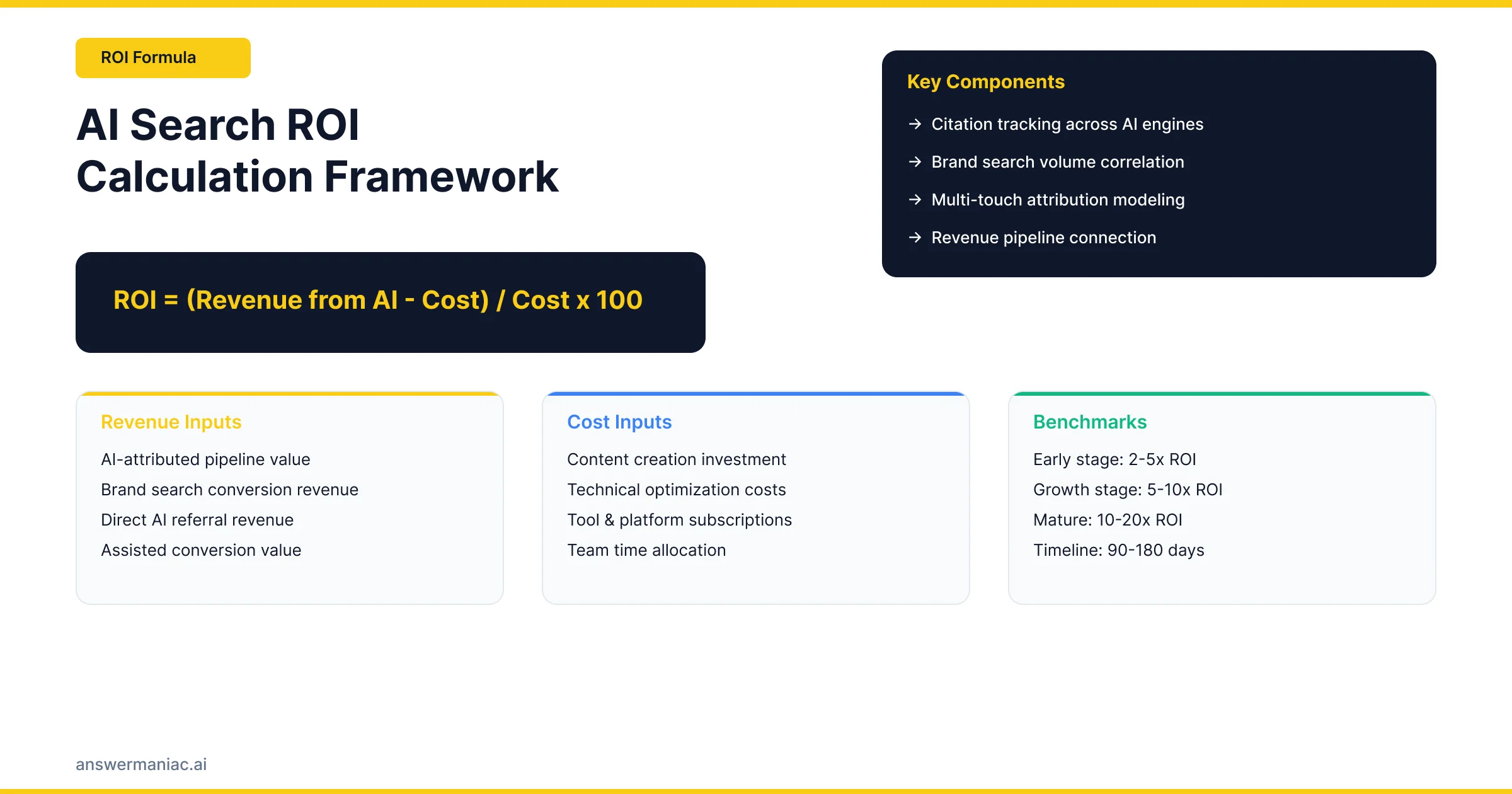
The formula to figure out AI search ROI is straightforward. It's the same math you'd use for any business investment: (Value Gained minus Cost Invested), divided by Cost Invested, then multiplied by 100. The real shift is in how you define that "value." It's no longer just about traffic numbers.
Most businesses measure over six to twelve months. Enterprise AI search initiatives typically require 6--12 months to build data coverage and training signals before ROI stabilizes. The value can come from several areas: direct sales driven by an AI's mention, increased branded search volume, and a measurable lift in brand recognition.
Costs include software subscriptions, prices a lot, plus the labor for creating content, analyzing performance data, and managing the strategy. Teams often evaluate whether to work with an AI SEO agency or build an in-house team, especially when comparing long-term ROI and operational costs.
The value side also includes new visitors generated by AI, moving prospects through a sales funnel, or increasing the lifetime value of a customer the AI helped find.
Thinking of AI search as a long-term play, not a quick fix, is how you build stable returns. It's about investing in a system that compounds value over time, instead of just chasing those one-off traffic spikes.
Which Visibility Metrics Reveal AI Search Presence
Visibility metrics show how often an AI mentions your brand in its answers. This tells you if the AI views your brand as a relevant source. The same principles apply in specialized sectors such as AI search optimization for Healthcare & MedTech, which depends heavily on credible sources and consistent citations to establish authority.
For valuable search terms, tools like Profound suggest aiming for 15-30% mention rate and 20-35% SOV as strong performance.
"Answer share blends two core ratios: Visibility score (Responses mentioning your brand / Total responses) x 100 [and] Citation rate (Answers citing your domain / Total answers with at least one citation) x 100... Because it blends recall and trust, it acts as a leading indicator of AI market strength." - Rankshift Blog
The key metrics are outlined in the table below:
| Metric | Formula | Purpose |
|---|---|---|
| Mention Rate | (Mentions / Queries) x 100 | How often your brand appears. |
| Share of Voice | Brand mentions / Total mentions | Your presence vs. competitors. |
| Citation Rate | Citations / Mentions | How often AI cites your source. |
| Sentiment Score | Positive minus negative + 50 | Tracks the quality of perception. |
To track this, you need to test hundreds of prompts across different AI tools each week. Watch for your brand's name in answers, direct links to your site, inclusion on product lists, and its position in the response. You can see whether the AI is beginning to depend on your content, if it's choosing your information to share more and more often.
How to Track AI Driven Traffic and Engagement
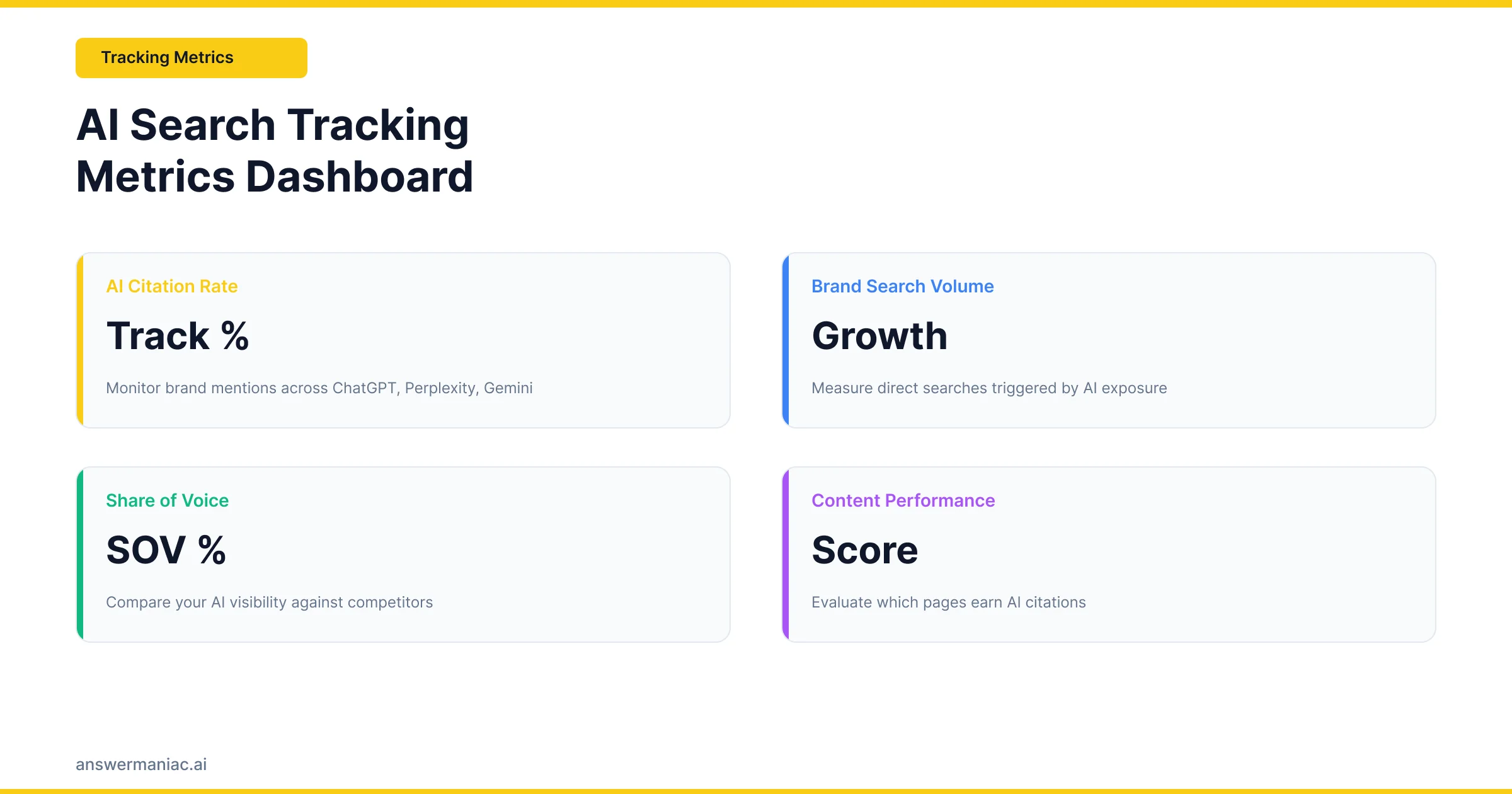
To see if AI is sending people your way, check your analytics. Enterprise teams track referral signals from AI assistants, support chatbots, internal knowledge bases, and AI-powered search interfaces to measure discovery pathways. Once you spot it, pay close attention to what those visitors actually do.
AI referrals show 20-50% higher engagement time per Similarweb data. They've already been pre-qualified by the AI, so they land with a clearer intent.
You'll want to watch for a few specific signals: longer session times, fewer people bouncing away, more repeat visitors, more pages viewed per visit, and an uptick in people searching for your brand name directly.
For clean tracking, create a custom channel in your analytics to group all this AI-driven traffic together.
You'll want to use regex filters to catch the various referral domains. After that, you can put the engagement metrics from your new AI channel side-by-side with your regular organic traffic for a direct comparison. This comparison will tell you if the AI is just sending casual browsers or people who are actually interested.
Which Conversion and Revenue Metrics Prove AI Search Impact
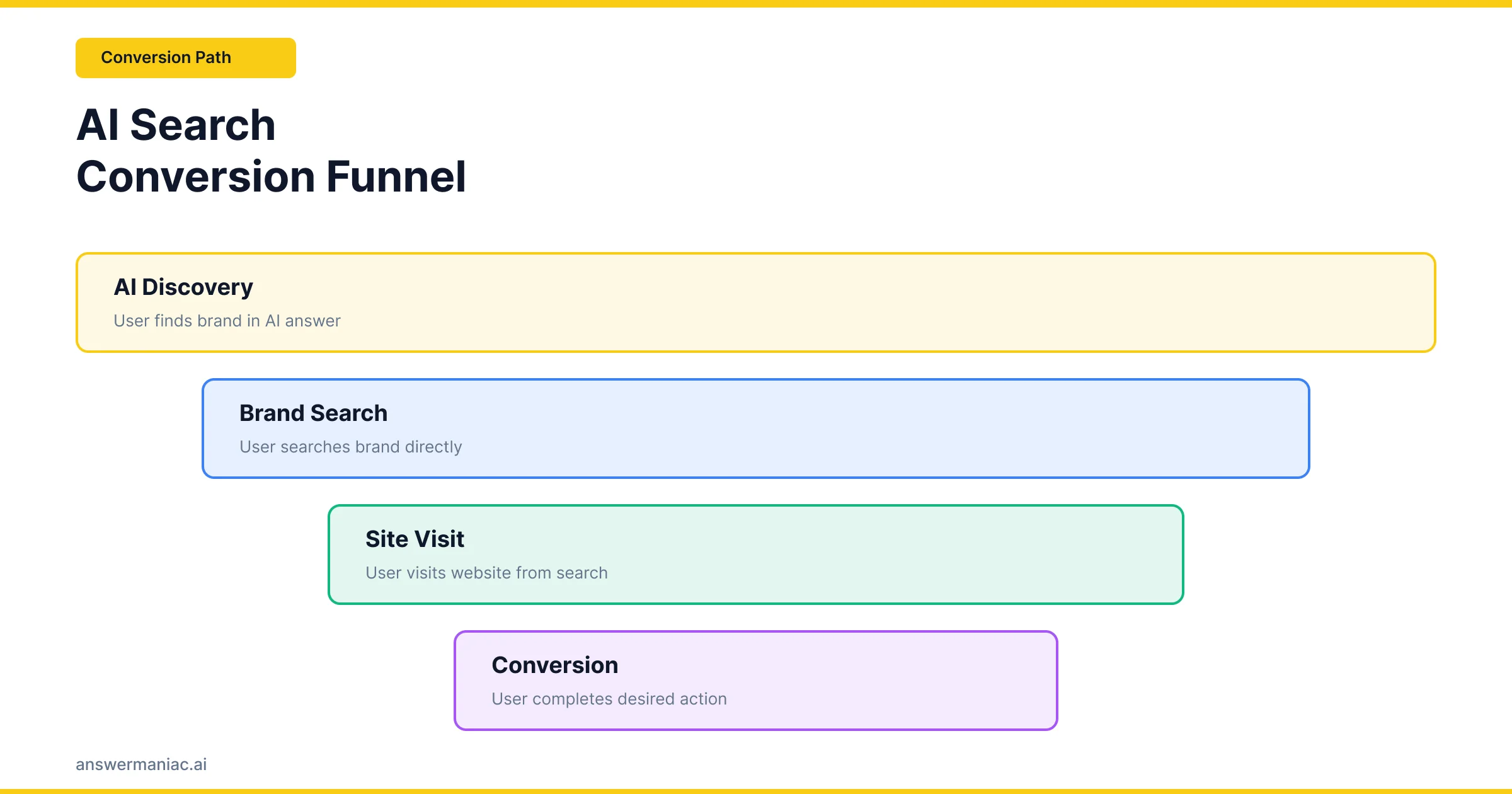
Seeing your brand mentioned in AI-generated responses is a positive step, but the true value lies in how that visibility translates into tangible business outcomes, such as increased revenue and customer acquisition. That's where conversion and revenue metrics matter. They tell you if the people who come from your AI content actually buy something.
The math is straightforward: Revenue = Sessions x Conversion Rate x Average Order Value. It links your AI traffic directly to money.
HubSpot used AI to collect business URLs, identify company size, and map out content interests. And the results shows 82% higher conversion rates.
Businesses measure a few key things to see if AI is paying off: the quality of leads it generates, the average size of the deals, and the lifetime value of those customers.
If the key performance metrics, such as conversion rates and average order values, from AI-referred traffic consistently outperform your other marketing channels, then it's a clear indication that your AI search optimization efforts are generating a positive return on investment.
Why Multi Touch Attribution Works Better Than Last Click Models
Measuring AI search with a last-click model is incomplete. The final click ignores AI's role in the earlier discovery phase, when a customer is first learning about their options.
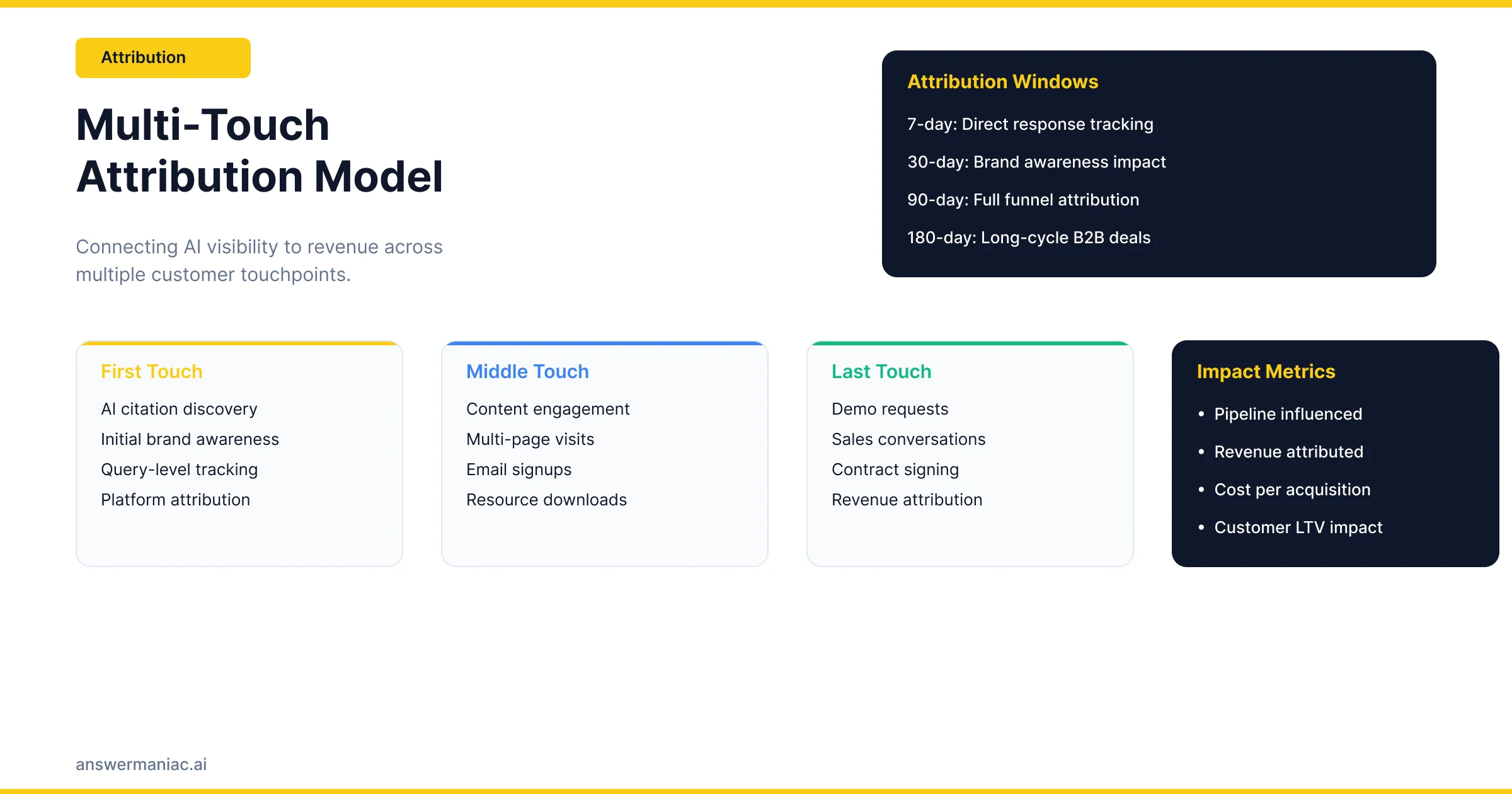
Enterprise attribution models distribute value across discovery stages such as AI research queries, knowledge base exploration, product comparison searches, and final sales engagement that led to a sale. The Harvard Business Review supports this, noting it better reflects the actual, multi-step digital buying journey.
Here's one way you could split the credit between different touchpoints:
- Finding the answer in an AI tool: 30%
- A follow-up search on Google or another engine: 30%
- Coming directly to your website: 20%
- Completing the purchase after an email: 20%
This approach tracks the whole journey. It starts with someone discovering your brand through AI, then shows how that leads to searches, site visits, and finally, a conversion. This gives you a clearer picture of AI's actual role in the process.
What Real World AI Search ROI Looks Like
Real-world AI search ROI requires upfront work: good tracking and consistent optimization. For established programs across different sectors, first-year returns often land between 300% and 500%. In deals involving large contracts, the percentage can climb much higher.
"Research from Princeton found that pages with quotes and statistics have 30-40% higher visibility in AI answers... AI systems parse content differently than traditional search crawlers. Optimize your structure: Clear headings hierarchy, one idea per paragraph, and front-load key information." - Grew AI
Consider this e-commerce snapshot:
- AI sessions per month: 8,000
- Conversion rate: 4%
- Average order value: $75
- Monthly revenue: $24,000
- Monthly optimization cost: $3,000
The most effective programs typically share three practices.
They record a clear performance baseline before launching. They track visibility for key search queries every week. They directly connect revenue to customer journeys started by AI.
Many successful teams also focus on building structured statistics, expert commentary, and research-backed explanations that function as AI citation assets, increasing the likelihood that AI systems repeatedly reference their content.
When you manage AI search as a dedicated marketing channel, the returns usually accumulate and strengthen over the long term.
Why Traditional SEO Metrics Fail in AI Search Environments
Traditional SEO metrics are becoming outdated. Success used to be about ranking high on a page of blue links to get clicks. AI search changes the game by delivering direct answers, so simply being in the answer matters more than being the top link.
The key measurements have shifted, as shown below:
| Traditional SEO Metric | AI Search Equivalent |
|---|---|
| Keyword ranking | Answer inclusion rate |
| Organic traffic | AI referral traffic |
| Backlink count | Citation frequency |
| Click-through rate | Brand mention rate |
AI responses can answer a query without needing a click, giving brands a "silent" endorsement. Your visibility also now spans multiple AI platforms, shaping opinions long before a formal search begins. Companies that adapt their measurement framework will better understand how AI search actually fuels growth. Understanding how AI shapes brand reputation and adopting a search everywhere optimization approach are essential steps in this transition.
FAQ
What are common challenges in achieving a positive ROI with AI search systems?
Many teams rely on incomplete AI SEO metrics. Traffic alone rarely reflects real AI SEO ROI because AI answers influence decisions without clicks. Weak connections between AI search performance, revenue attribution, and GEO metrics also create problems. Without clear KPIs for AI-driven ROI, organizations struggle to justify AI search investment.
How does AI search integration impact customer satisfaction and retention rates?
Enterprise AI search systems cut information retrieval time by 30--50%. Organizations report 15--25% higher customer satisfaction and stronger repeat engagement as faster answers reduce support and discovery friction. Performance is measured through answer accuracy, response latency, and repeat engagement, key indicators of AI search ROI.
How do I calculate the break-even point for investing in AI search tools?
Calculate break-even by comparing implementation costs with measurable gains, including AI search revenue, operational savings, and marketing efficiency. Enterprise AI search investments typically reach break-even within 12--24 months when total gains equal the initial investment.
What are the best practices for maximizing ROI from AI search technology?
Maximize ROI by creating structured content and tracking reliable metrics. Monitor visibility scores, citation frequency, and source attribution to measure AI references. Use dashboards to track GEO performance and evaluate AI SEO ROI. Consistent reporting helps prove AI search ROI to stakeholders.
Focus on Results, Not Just Mentions
You see AI tools mention brands more often, yet the traffic in your dashboard doesn't always explain what's really happening. It's frustrating when numbers go up but you still can't tell if those mentions turn into real business. That's the reality.
Instead of watching traffic alone, start tracking visibility and what visitors actually do after they arrive. If you want a simple way to stay on top of it, Answer Maniac AI can help you follow brand mentions and see how AI search connects to real results. Share your thoughts! Learn more and get monthly updates.
References:
Related Articles:
Get AEO Insights Weekly
Join 500+ B2B marketers getting AI visibility tactics every Tuesday.
Ready to Get Your Brand Cited by AI?
See how your competitors show up in ChatGPT, Perplexity, and Gemini — and what it would take to get recommended.