The Difference Between AEO and GEO: Which Strategy Does Your Business Need?
AEO vs GEO explained, key differences, strategies, and how to optimize content for AI search visibility and citations.
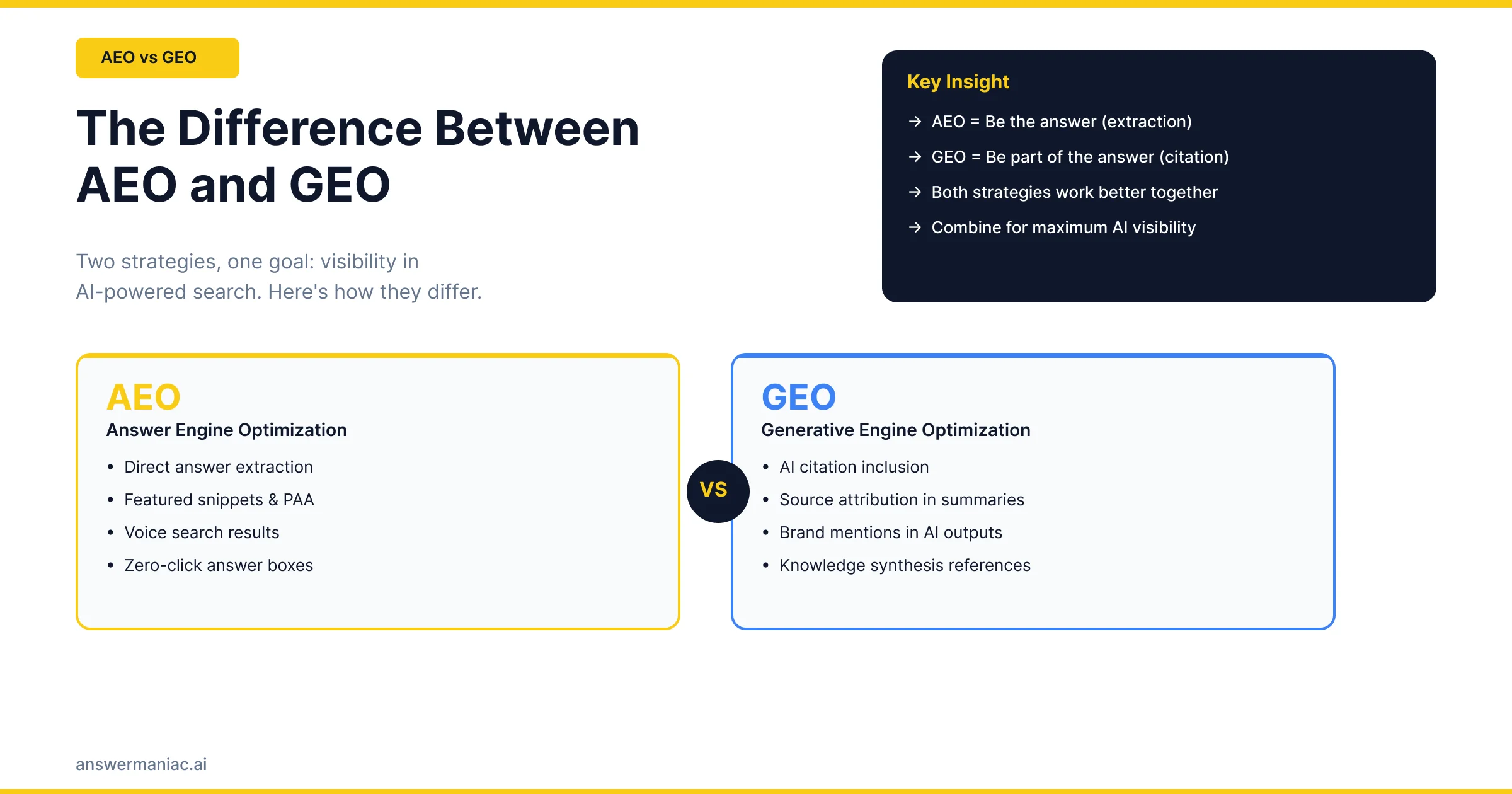
The difference between AEO and GEO lies in how content appears in AI-driven search.
AEO makes content easy to extract as direct answers, while GEO ensures content is credible enough to be cited in AI-generated summaries.
Websites still need traffic, but the process has evolved.
AEO targets quick, clear responses for simple queries, while GEO supports deeper, context-rich explanations.
Different approaches, same goal: improving visibility in AI-powered search.
Keep reading to see how each strategy works and how you can apply them.
AEO vs GEO: Key Differences to Know
Understanding the difference between AEO and GEO helps us design content that works across both answer engines and generative AI systems. Not just one environment, but both.
AEO focuses on direct answers. The type search engines can extract quickly and place in featured snippets, voice search results, or zero-click answers. Simple. Immediate.
GEO focuses on citations inside AI responses. Generative systems look for credible sources when they create summaries or research explanations. When our content appears there, it becomes part of the answer.
Both strategies work better together. Combining AEO and GEO expands visibility across answer engines, AI summaries, and conversational search systems.
Understanding the Difference Between AEO and GEO
What Is Answer Engine Optimization (AEO)?
Generative Engine Optimization focuses on making content visible to AI systems that create synthesized responses, where the goal is not direct extraction but building reliable source material that AI can use when forming explanations.
This requires clear structure, depth, and strong authority signals so systems can evaluate trustworthiness, according to Google Search Central, which explains how content quality and helpfulness are assessed. As noted,
"Content should be created to help people and demonstrate expertise, not to manipulate search rankings."
AEO often appears in familiar search features. You have probably seen them many times.
- Featured snippets
- People Also Ask boxes
- Voice assistant answers
- Direct response search results
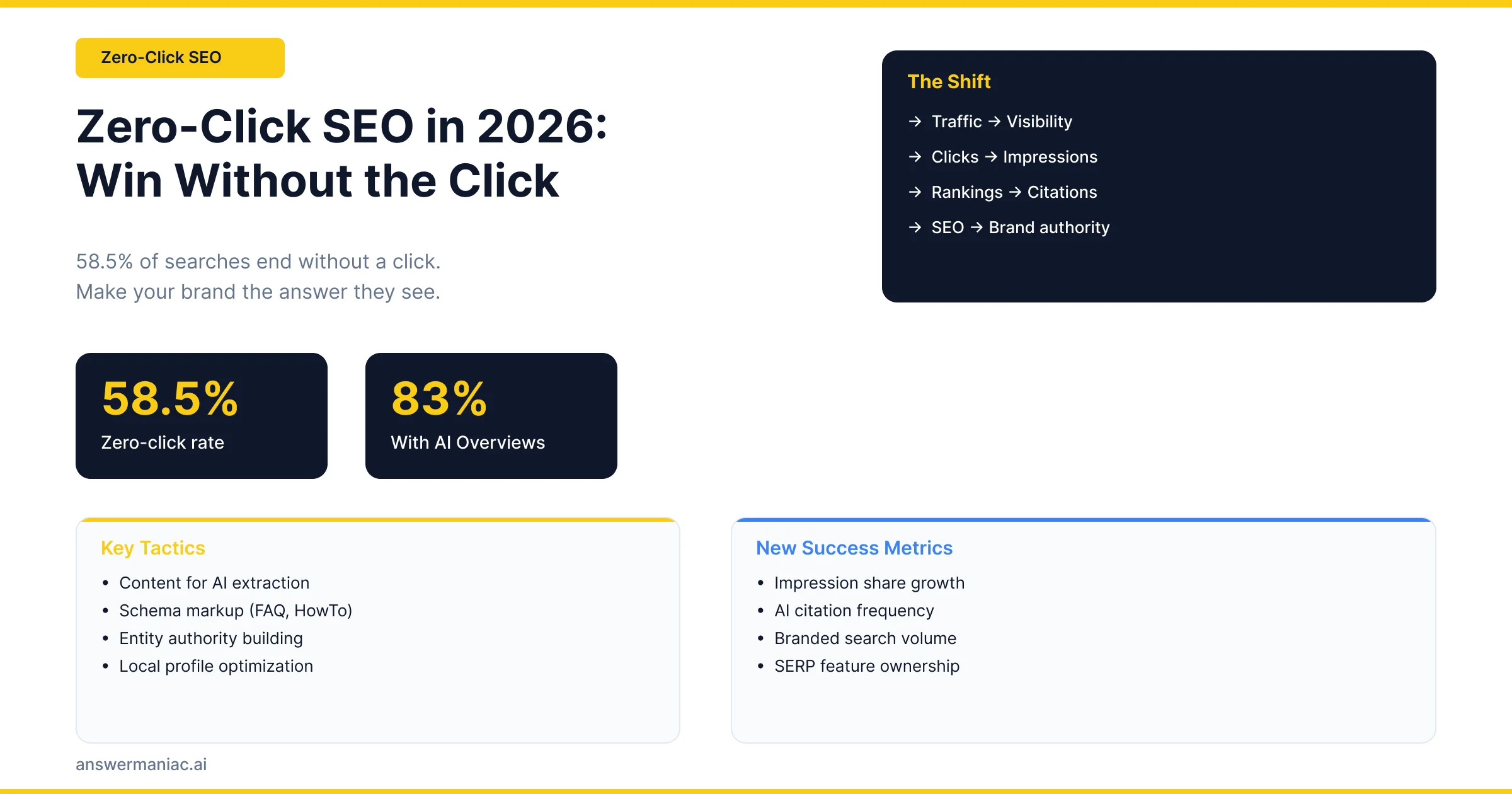
- Zero click search outcomes
These features appear when a search engine finds a clear answer on a page. No extra navigation needed. The system simply pulls the information and shows it.
For AEO to work, structure matters. The answer usually appears early in the page. Clear wording helps. Direct language helps even more.
Question headings are common. Concise explanations follow. Then supporting details expand the answer a bit further. Not too long though. Just enough.
What Is Generative Engine Optimization (GEO)?
Generative Engine Optimization focuses on making content visible to AI systems that create synthesized responses. Different environment. Different logic.
Unlike AEO, GEO does not aim for direct extraction of one single answer. Instead, it aims to make content useful as a source. Something an AI system can rely on while generating its own explanation.
Generative systems often combine information from several sources before presenting a response. GEO helps ensure our content becomes one of those sources.
That process usually includes several elements.
- Source attribution inside AI responses
- Citations within generated summaries
- Brand mentions in AI outputs
- Knowledge synthesis across multiple sources
Authority matters here. Credibility too.
To succeed with GEO, content needs depth and structure. Generative systems tend to prioritize sources that demonstrate expertise signals and reliable information. Strong explanations help. Clear evidence helps even more.
So GEO places heavy emphasis on research depth, structured explanations, and consistent topic authority. It asks for more context. More substance.
Core Goal Differences Between AEO and GEO
Both strategies support visibility in modern search. But they pursue different goals.
The differences appear in how information is delivered and how systems retrieve it. Sometimes the contrast feels subtle. Other times it is obvious.
AEO prioritizes immediate answers. The system extracts a single response directly from a page and shows it to the user.
GEO prioritizes source credibility. Instead of copying one sentence, the system references a page while generating a new explanation.
AEO focuses on snippet ownership. Being the answer.
GEO focuses on citation inclusion inside synthesized responses. Being part of the answer.
Understanding these differences changes how we structure content. Slight adjustments in format, depth, and clarity can influence whether content appears in an answer box or inside an AI generated summary.
AEO vs GEO Strategies in Modern Search
Content Structure Differences
Content structure plays a big role in whether a page supports AEO or GEO. Sometimes more than we expect. AEO usually needs a clear format -- predictable and something search engines can scan quickly. GEO is a bit different; it needs more depth, context, and a fuller explanation so AI systems can grasp the topic completely.
To better understand how structure aligns with user intent, refer to the strategic mapping below:
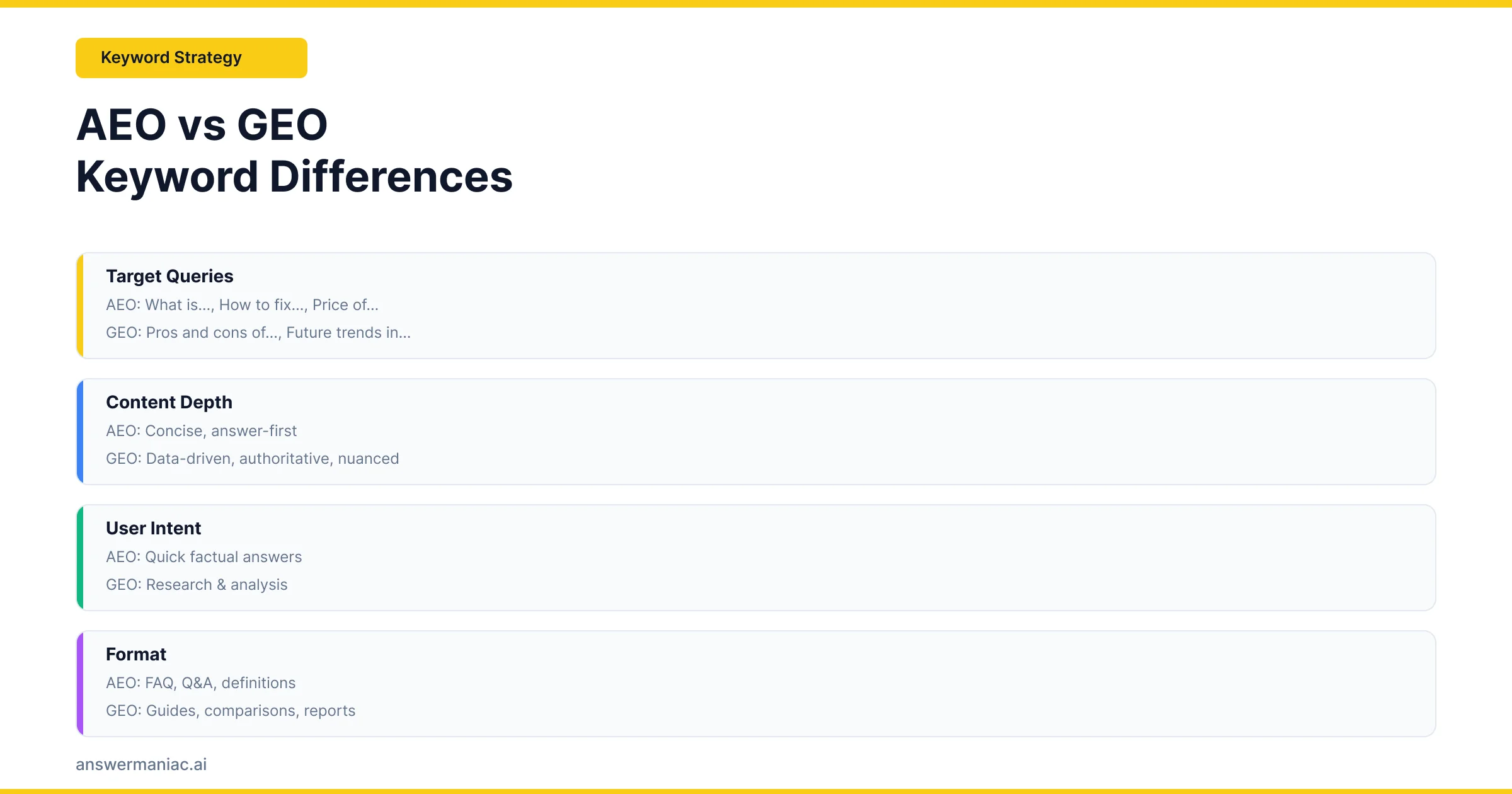
Keyword and Content Strategy Mapping
| Strategy | Target Query Types | Example Keywords/Phrases | Content Needs |
|---|---|---|---|
| AEO Focus | High-intent, factual questions | "What is...", "How to fix...", "Price of..." | Concise, "Answer-first" |
| GEO Focus | Analytical, comparative, or broad | "Pros and cons of...", "Future trends in...", "Comparison between..." | Data-driven, authoritative, nuanced |
Structure matters. A lot. Common patterns often appear in content designed for these environments:
- Answer-first structure where the main response appears right after the heading.
- Modular explanations that divide complex ideas into smaller readable sections.
- Citation-friendly content with clear claims and supporting context.
- Inverted pyramid writing that places the most important information first.
- Structured question and answer formatting that mirrors real search queries.
Together, these elements improve machine readability. They also increase the chance that content is either extracted as a direct answer or referenced in an AI response.
Search optimization for AI driven environments requires clear structure for AEO and strong authority signals for GEO, where FAQ schema, question based headings, and concise answers support extraction, while entity authority and research backed claims support citation in AI systems.
This shift is becoming more critical as user behavior changes, according to McKinsey & Company, which reports widespread adoption of generative AI across industries. As reported,
"Generative AI adoption has surged, with many organizations already using it in at least one business function."
Optimization Techniques for AEO
Answer Engine Optimization depends on several practical techniques that help systems locate answers quickly. Search engines prefer clarity. A question appears, the answer follows. Simple. Direct. When that connection is clear, extraction becomes easier.
Common AEO techniques often include the following:
- Optimizing pages for featured snippets using direct answers.
- Adding FAQ schema markup.
- Writing headings as clear questions.
- Aligning content with voice search queries.
- Targeting high-intent user questions.
- Formatting responses in short and readable paragraphs.
These approaches help search engines locate the exact section of a page that contains the best answer. Sometimes a single paragraph is enough. But clarity always wins.
Optimization Techniques for GEO
Generative Engine Optimization works differently because AI systems evaluate information differently from traditional search engines. They look for signals of authority, evidence, and reliable explanations. Depth matters here.
Effective GEO strategies often include these practices:
- Building strong entity authority across related topics.
- Supporting claims with research or data.
- Demonstrating expertise through clear explanations.
- Aligning content with knowledge graph concepts.
- Updating content regularly to maintain freshness.
- Structuring information so AI systems can read it easily.
These steps increase the chance that generative systems treat the content as a trusted source. Not just useful, but reliable enough to reference.
Technical Foundations of AEO and GEO
https://youtu.be/_gjfuJY4f8E?si=DhYQZBKfsPlv189i
Credit: Matt Diamante
Structured Data and Schema Differences
Structured data helps machines understand the meaning behind content. Not just the words, but the relationships between them.
For AEO, schema markup often helps search engines identify questions and answers on a page. That small detail can improve visibility in answer focused search features.
FAQ schema is common. Question and answer formatting too.
For GEO, schema still matters. But the focus shifts slightly. It moves toward entity clarity and contextual relationships.
Structured data can define connections between topics, organizations, and ideas. Quiet signals, but powerful ones. They help AI systems interpret the content more accurately.
Content Extraction vs Content Attribution
Search systems use content in different ways depending on the environment.
Answer engines extract information directly from a page. The extracted text becomes the answer shown in the search result. Straightforward.
Generative systems take another path. They analyze multiple sources first, then produce a new response that blends those sources together.
The difference shows up in a few key processes.
- Direct extraction where systems copy the answer from a page
- Summarization where AI condenses information from several sources
- Source attribution where AI references the original content
- Citation inclusion where a page appears as a supporting source
Understanding this distinction helps when designing content. One system pulls answers. The other builds them.
Semantic Clarity and AI Readable Content
AI systems perform better when content clearly defines ideas and relationships.
Semantic clarity helps machines interpret information correctly. When definitions are vague, confusion happens. And machines notice that.
Several formatting practices improve readability for AI systems.
- Clear headings and subheadings
- Direct definitions of key terms
- Logical progression of ideas
- Language that avoids ambiguity
These details help machines parse content more accurately. And when interpretation improves, visibility often follows.
Visibility in Answer Engines and Generative AI
Answer Engines Visibility
Answer engines prioritize speed. Users ask a question and expect an answer immediately.
No extra clicks. Just the information.
To appear in these environments, content must support direct response features.
Common opportunities include:
- Featured snippets in search results
- People Also Ask responses
- Zero click answer boxes
- Voice assistant responses
These placements create instant visibility. Sometimes users never visit the page, but they still see the source. Recognition still matters.
Generative AI Summaries
Generative AI platforms operate differently. Instead of showing a single excerpt, they produce synthesized responses.
These responses combine information from several trusted sources.
Typical outputs may include:
- AI summaries of complex topics
- Multi source research explanations
- Contextual responses to longer questions
- Conversational answers inside chat interfaces
For content to appear within these summaries, it needs structure and credibility. Information must be reliable, clear, and complete. Understanding how to get cited in Perplexity AI provides a practical example of these principles in action.
LLM Source Attribution
Large language models often reference sources that demonstrate strong authority signals.
Not every page qualifies.
Source attribution depends on several credibility factors.
Important signals often include:
- Demonstrated expertise in the topic
- Clear explanations supported by evidence
- Consistent authority across related content
- Reliable and transparent information presentation
When these signals are present, generative systems are more likely to reference the content. Managing your AI brand reputation across platforms strengthens these signals over time.
AEO and GEO Keyword Strategy Differences
AEO Keyword Focus
Answer Engine Optimization typically targets question based search queries.
These queries reflect users looking for quick explanations or definitions. Something immediate.
Examples of AEO friendly queries often include:
- What is a specific concept
- How a process works
- Definitions of key terms
- Simple comparison questions
Content designed for these queries should deliver answers right away. No delay. No wandering introduction.
Just the answer.
GEO Keyword Focus
Generative Engine Optimization often focuses on research oriented queries.
These searches usually require deeper explanations or multiple steps of reasoning.
Common GEO queries may include:
- Comparative research questions
- Strategic or analytical topics
- Multi part informational searches
- Broad educational questions
Content built for GEO needs context. Data helps. Structured explanations help even more.
Intent Matching Across Both Strategies
Both AEO and GEO rely on understanding user intent. Without that, optimization becomes guesswork.
Matching content to intent improves visibility across different search environments.
Effective intent alignment often includes:
- Identifying the primary question behind a query
- Understanding how much depth the user expects
- Structuring content that satisfies the entire information need
When intent is matched correctly, content performs better in both answer engines and generative systems.
Hybrid AEO and GEO Approach
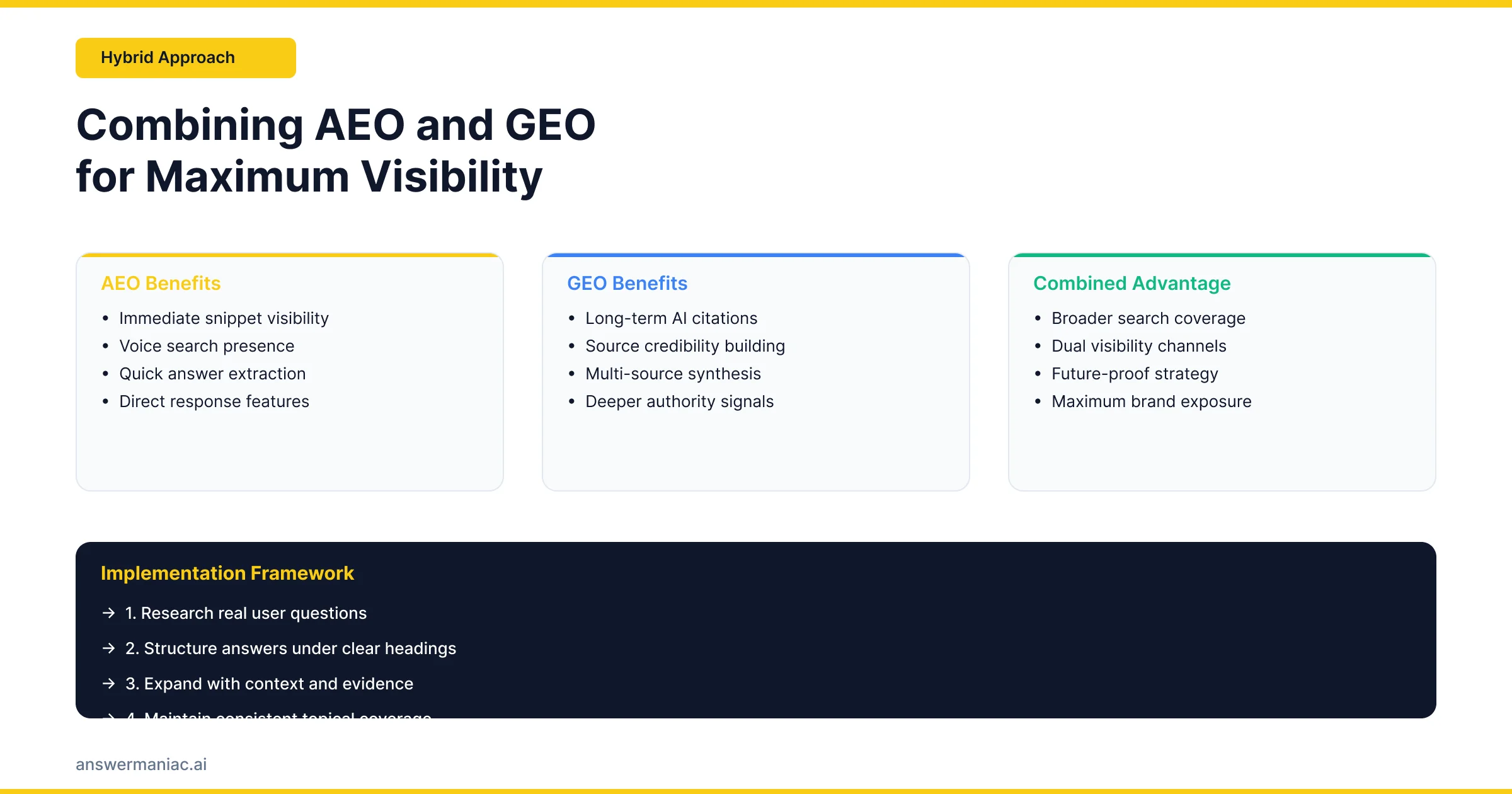
Why Combine AEO and GEO
Modern search environments now rely on both direct answers and AI generated summaries.
Using only one strategy limits reach. Sometimes severely.
Combining AEO and GEO creates several advantages.
- Immediate visibility through answer snippets
- Long term presence in AI citations
- Broader coverage across search platforms
The hybrid approach helps content stay relevant as search technology evolves.
Shared Optimization Foundations
Despite their differences, AEO and GEO share several core principles.
Content that performs well across both environments usually follows similar foundations.
These include:
- Clear structure throughout the page
- Accurate and reliable information
- Logical organization of topics
- Consistent terminology across content
Simple practices. But powerful ones.
They improve both search extraction and AI interpretation.
Practical Implementation Framework
Combining AEO and GEO requires a structured content process. Without one, things get messy quickly.
A practical workflow often includes several steps.
- Research real questions users ask
- Structure answers clearly under relevant headings
- Expand explanations with context when needed
- Maintain consistent topical coverage across pages
Tools like AnswerManiac help streamline this process. They help us discover real questions and create structured answers that match search intent.
Sometimes the hardest part is simply knowing what questions to answer. That part matters more than most people think. For a deeper look at how to measure AI search ROI, we cover the metrics and frameworks that track this visibility over time.
Evolution from SEO to AEO and GEO
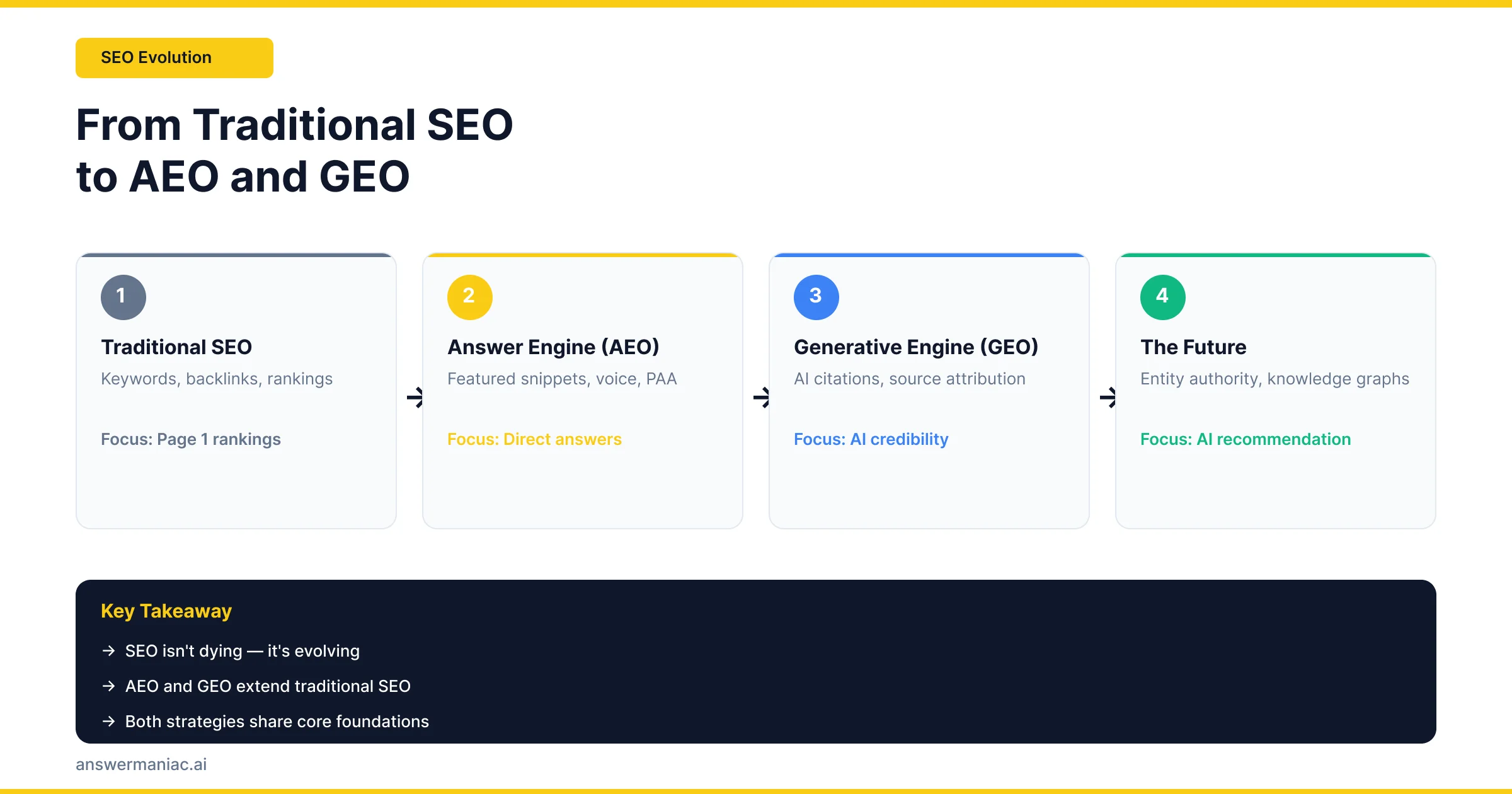
Traditional SEO Foundations
Traditional SEO focused mostly on ranking web pages in search results.
The strategy centered around keywords, backlinks, and technical optimization. Familiar territory for most marketers.
Those elements still matter today. They have not disappeared.
But search systems are shifting. Direct answers and AI generated responses now play a larger role.
Shift Toward Answer Centric Search
User behavior has changed.
People expect faster responses. Faster than ever.
Instead of browsing multiple pages, many users now rely on direct answers or AI summaries to get information quickly.
This shift has increased the importance of AEO and GEO strategies.
And it happened faster than many expected.
Future Trends in GEO
Generative AI continues expanding across search and information platforms.
Looking ahead, several developments are likely.
- Increased AI citation systems
- Expanded generative summaries within search results
- Greater emphasis on entity recognition
These trends highlight the importance of building structured and authoritative content. Not just optimized pages, but reliable sources.
FAQ
What is the main difference between AEO and GEO?
AEO focuses on providing direct answers that search engines can extract instantly, while GEO focuses on making content credible enough for AI systems to cite in generated responses.
Which is more important, AEO or GEO?
Both are important. AEO helps with immediate visibility in answer boxes, while GEO supports long-term visibility through AI citations and summaries.
How do I optimize content for AEO?
We can optimize for AEO by using clear question-based headings, placing answers at the top, and formatting content in short, direct paragraphs.
How do I optimize content for GEO?
We can optimize for GEO by creating in-depth content, supporting claims with data, and building strong topical authority across related subjects.
Can AEO and GEO be used together?
Yes, combining AEO and GEO helps improve visibility across both answer engines and generative AI platforms, making content more effective overall.
Difference Between AEO and GEO: Why Both Matter for Modern Search
The difference between AEO and GEO shows how search systems deliver information today. Some platforms extract direct answers, while others generate responses using multiple sources.
AEO helps our content appear in answer boxes, featured snippets, and voice responses. GEO helps our content become a trusted source in AI generated summaries.
Both approaches make information easier for machines to understand and present to users.
Tools like AnswerManiac help identify real questions and organize answers, supporting stronger visibility in modern AI driven search.
References:
- Google Search Central - Creating Helpful Content
- McKinsey & Company - The State of AI: Generative AI's Breakout Year
Related Articles:
Get AEO Insights Weekly
Join 500+ B2B marketers getting AI visibility tactics every Tuesday.
Ready to Get Your Brand Cited by AI?
See how your competitors show up in ChatGPT, Perplexity, and Gemini — and what it would take to get recommended.