Zero-Click Search in 2026: Why B2B Companies Need a Citation Strategy
68% of Google searches end without a click. Learn why B2B companies need a citation strategy to win visibility in AI Overviews, ChatGPT, and zero-click search.
Quick Answer
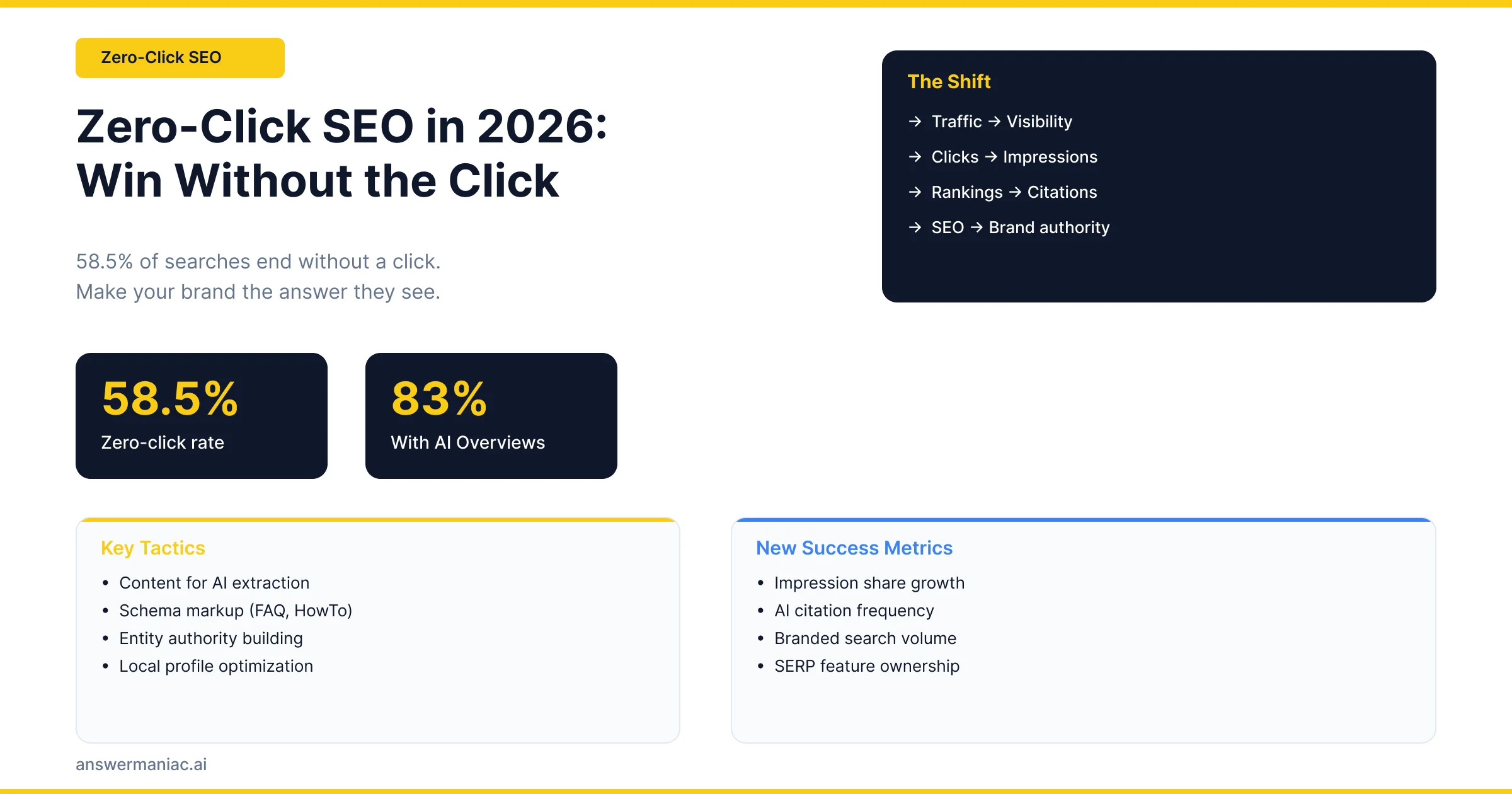
Zero-Click Search (2026 Definition): A search where the user gets their answer directly on the results page — through AI Overviews, featured snippets, or knowledge panels — without clicking any link. As of June 2026, 68% of US Google searches end this way (SparkToro). When AI Overviews appear, that number jumps to 83% (Datos/SparkToro). For B2B companies, the strategic response isn't chasing lost clicks — it's becoming the brand AI systems cite in the answer.
Zero-click search isn't new. But the scale of it in 2026 is.
SparkToro's June 2026 data puts the number at 68% of US Google searches ending without a click — up from roughly 65% in 2024. The share of searches that actually generate a click fell 9.51 percentage points between 2024 and 2026, a 22.9% decline. That's not a trend. That's a structural shift.
For B2B companies, this creates a strange new reality. Your content powers AI answers that millions of people read, but fewer of those people ever visit your site. The goal isn't to fight that current. It's to make sure your brand is the one getting cited.
This article breaks down the 2026 zero-click data, explains what's driving the shift, and lays out the citation strategy B2B companies need to win visibility when clicks disappear.
Zero-Click SEO: The New Visibility Playbook
These essentials capture how search success now depends on appearing in AI answers and search features, not just driving website clicks.
- Success is measured by visibility in search features, not just website traffic, requiring new strategies and metrics.
- The core task is optimizing content for AI extraction using clear Q&A formats, structured data, and entity authority.
- The main benefit is stronger brand authority, but the challenge is adapting to potential drops in clicks for informational pages.
Defining Zero-Click SEO for the Modern Era
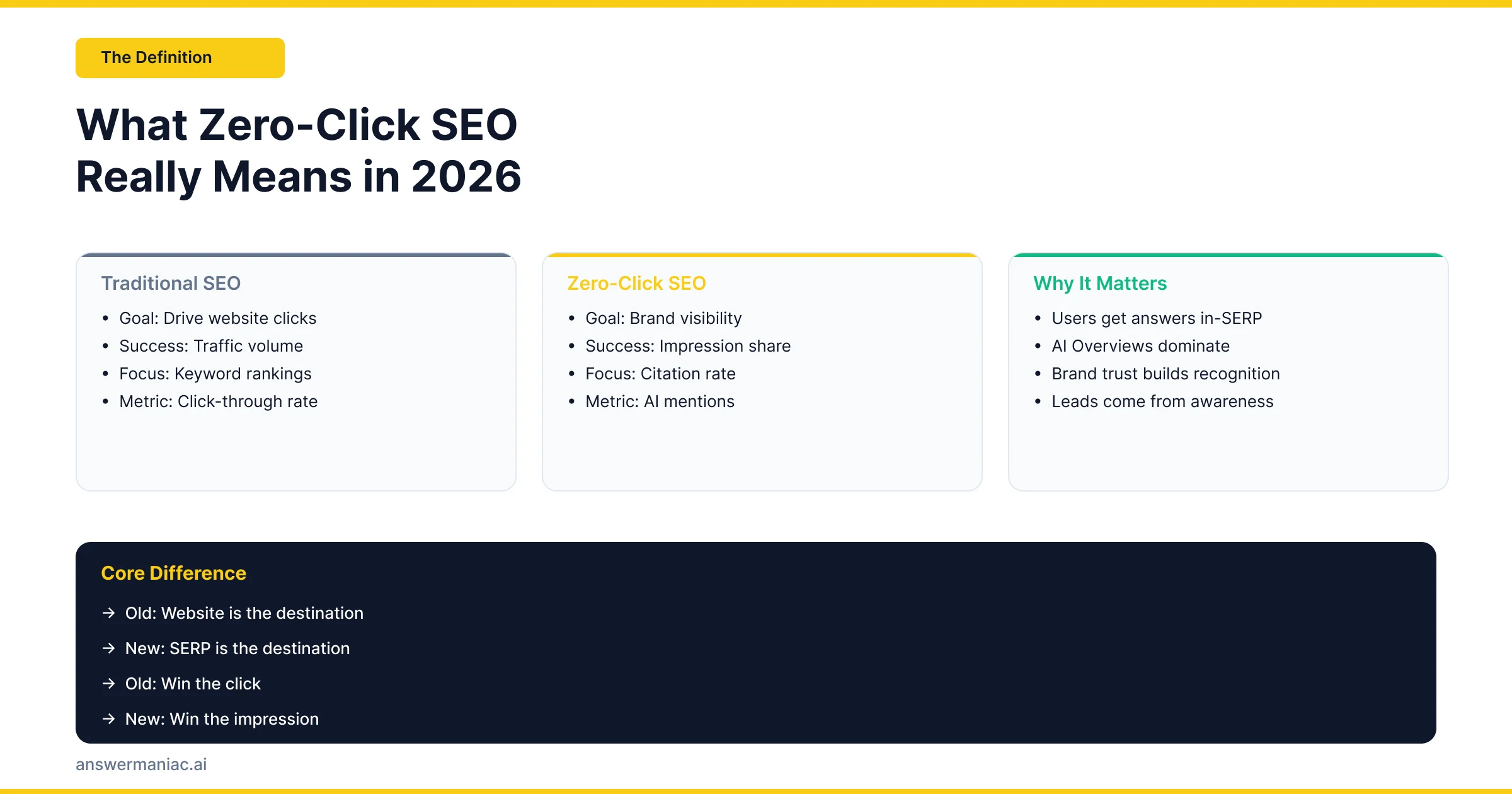
Zero-Click SEO is the practice of optimizing your online presence to be the source of information that appears directly on the search results page. This includes AI answers, featured snippets, and knowledge panels.
The user gets their answer without clicking a link. For a business, the goal is to make sure your brand provides that answer. It reflects how search engines now provide direct answers.
This approach understands a major shift in how search works. AI models are built to summarize information.
If your content isn't structured for these systems to easily use, you disappear from the most visible part of search results.
So, zero-click SEO isn't mainly about getting a click for a simple fact and increasingly overlaps with AI brand reputation management, where brands shape how they appear inside AI-generated answers and summaries. It's about positioning your brand as a source of information. When they're later ready to buy, your brand is the one they remember.
The Driving Forces Behind the Rise of Zero-Click Searches
Two forces are converging: Google is putting AI directly into search results, and users are adapting fast.
AI Overviews now appear on 20%+ of Google searches. When they do, click-through rates drop roughly 60%. Queries that trigger an AI Overview have an 83% zero-click rate, compared to 60% for non-AIO queries (Datos/SparkToro). That gap tells you everything about where this is heading.
Then there's Google AI Mode. At I/O 2026, Google announced 1 billion+ monthly users, with queries doubling every quarter. Powered by Gemini 3.5 Flash, AI Mode represents the next evolution — a fully conversational search layer. Right now, just 0.34% of searches transition into AI Mode (Jan-Apr 2026 data), but the trajectory is steep.
Here's what matters for B2B pipeline impact: only 17-54% of AI Overview citations come from top-10 organic results. That's down from 76% in mid-2025. Google's AI is pulling from a much wider pool of sources, which means ranking on page one doesn't guarantee you'll be cited.
Other factors accelerating the shift:
- SERP feature density: Modern results pages are packed with featured snippets, knowledge panels, local maps, People Also Ask boxes, and interactive carousels. Each one answers a question without requiring a click.
- Mobile-first behavior: Users expect instant answers. Scrolling past the AI summary to find a blue link feels like extra work, and fewer people are doing it.
- AI chatbot adoption: ChatGPT, Perplexity, and Claude aren't just search alternatives — they're training users to expect synthesized answers everywhere.
This means a page can rank #1 for a keyword and still lose the majority of potential clicks to an AI summary sitting above it. Traditional SEO metrics don't tell the full story anymore. The question isn't whether you rank. It's whether you get cited.
How Zero-Click SEO Fundamentally Differs from Traditional SEO
Traditional SEO and Zero-Click SEO have different main goals.
Traditional SEO is a traffic channel. Its goal is to bring users to your website by ranking high for keywords. Success is measured in clicks, visits, and on-site actions. The website is the destination.
Zero-Click SEO is about brand visibility and authority. Its goal is to have your brand appear at the exact moment of a user's search, right on the search results page. The "win" is the brand impression and being seen as an expert. Success is measured in how often you appear in special results, get cited by AI, and see growth in searches for your brand name. The search page itself is where you connect.
This shift requires different tactics. It connects with the broader GEO vs SEO comparison — understanding what each approach optimizes for helps you allocate resources correctly. It also overlaps with search everywhere optimization strategies that target visibility across search engines, AI tools, and social platforms simultaneously.
Instead of writing to keep a visitor on your page, you write to give the perfect, short answer an AI can use in seconds.
The format, structure, and technical details become most important. It's a more precise type of optimization aimed at machines first, knowing this is what gets your brand in front of people.
| Traditional SEO | Zero-Click SEO | |
|---|---|---|
| Primary Goal | Drive clicks & website traffic | Maximize visibility in SERP features |
| Content Focus | Engaging, in-depth page experience | Clear, extractable answers & data |
| Technical Priority | Site speed, mobile UX, backlinks | Structured data, entity signals, schema |
| Key Performance Indicator | Organic Traffic, Conversion Rate | Impression Share, AI Citation Rate, Branded Search Volume |
The Core Elements of a Winning Zero-Click Strategy
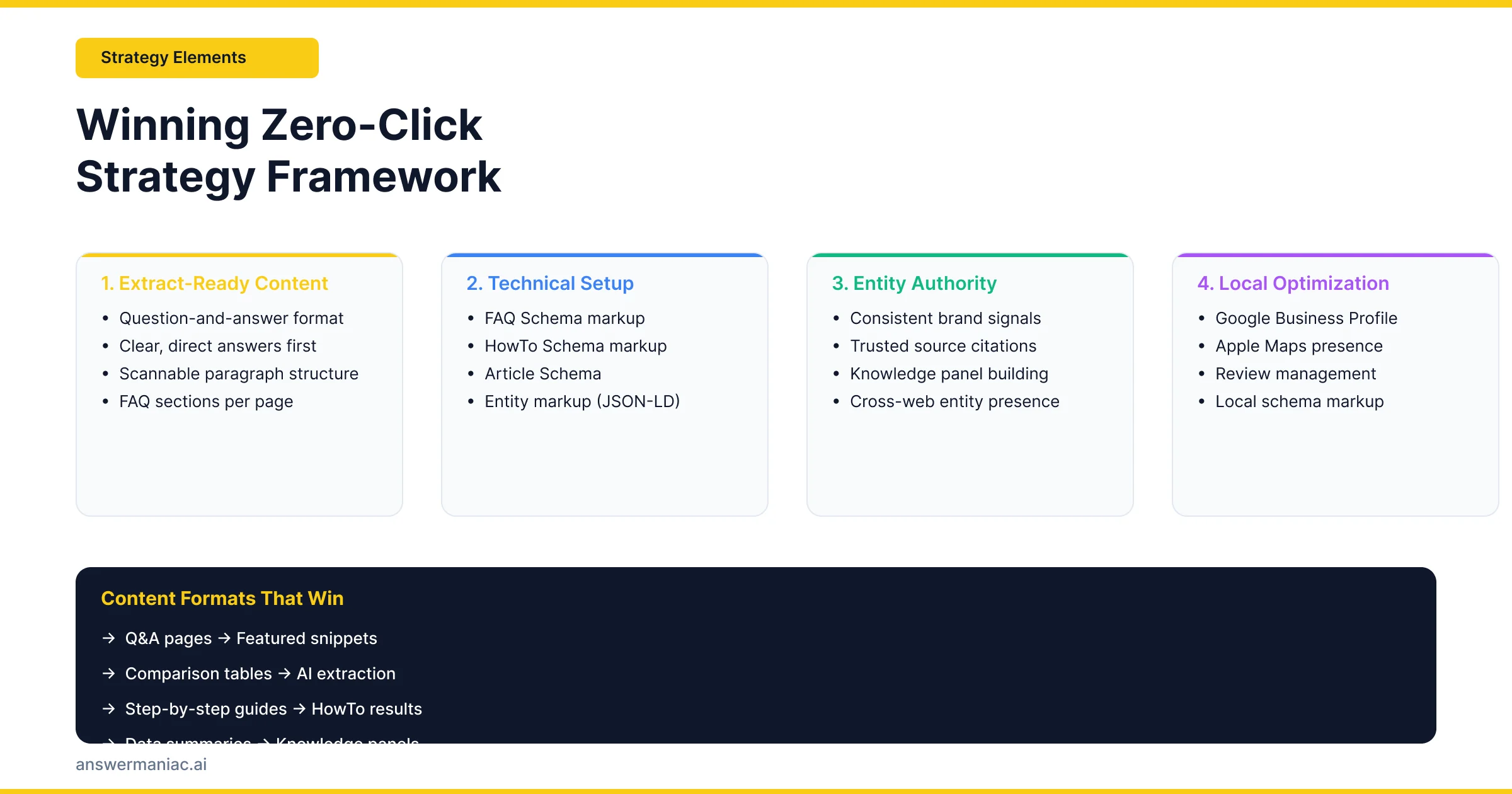
A successful zero-click SEO strategy is built on key pillars.
1. Content structured for extraction. Structure content so AI systems can extract answers easily. A question-and-answer format works best. Use subheadings as direct questions, then give a clear, short answer right below. This tells the algorithm exactly what you're answering.
2. Technical implementation with structured data. Add special code, called schema markup, to your website's backend. Using FAQ, How-To, and Article schema is critical. It labels your content for search engines, making it more likely to be picked for featured snippets and AI answers.
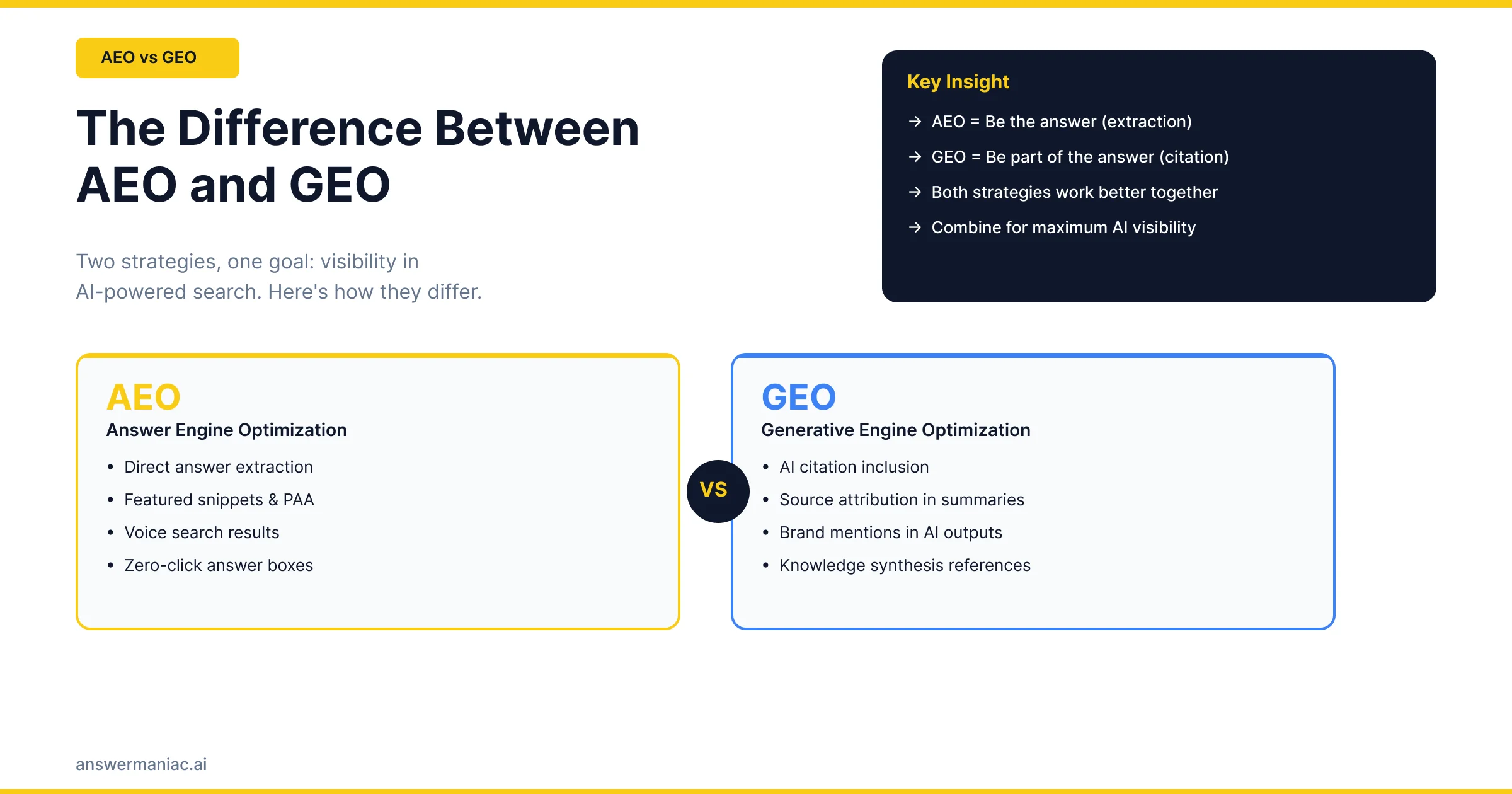
3. Entity authority. This is where the real differentiation happens — and it connects directly to understanding the difference between AEO and GEO approaches that shape how AI systems decide what to cite.
Search engines and AI models see the world through "entities" — clear concepts like brands, people, or places. Your job is to build your brand as a strong, unambiguous entity across the web. Consistent mentions, accurate business listings, and citations from trusted sources all feed this signal. The ANSWER Framework provides a structured methodology for building this entity authority systematically.
A stronger entity doesn't just rank better. It gets cited more.
4. Local optimization (for local businesses). Perfect your Google Business Profile to dominate local map results.
Content Formats That Dominate Zero-Click Results
Some content types work better for zero-click results because they are easy for AI to read and summarize.
The most effective format is a clear question-and-answer page. A well-organized FAQ that answers common, specific questions is a prime target for featured snippets. Each question should be a heading, with a short, direct answer or a bulleted list below it.
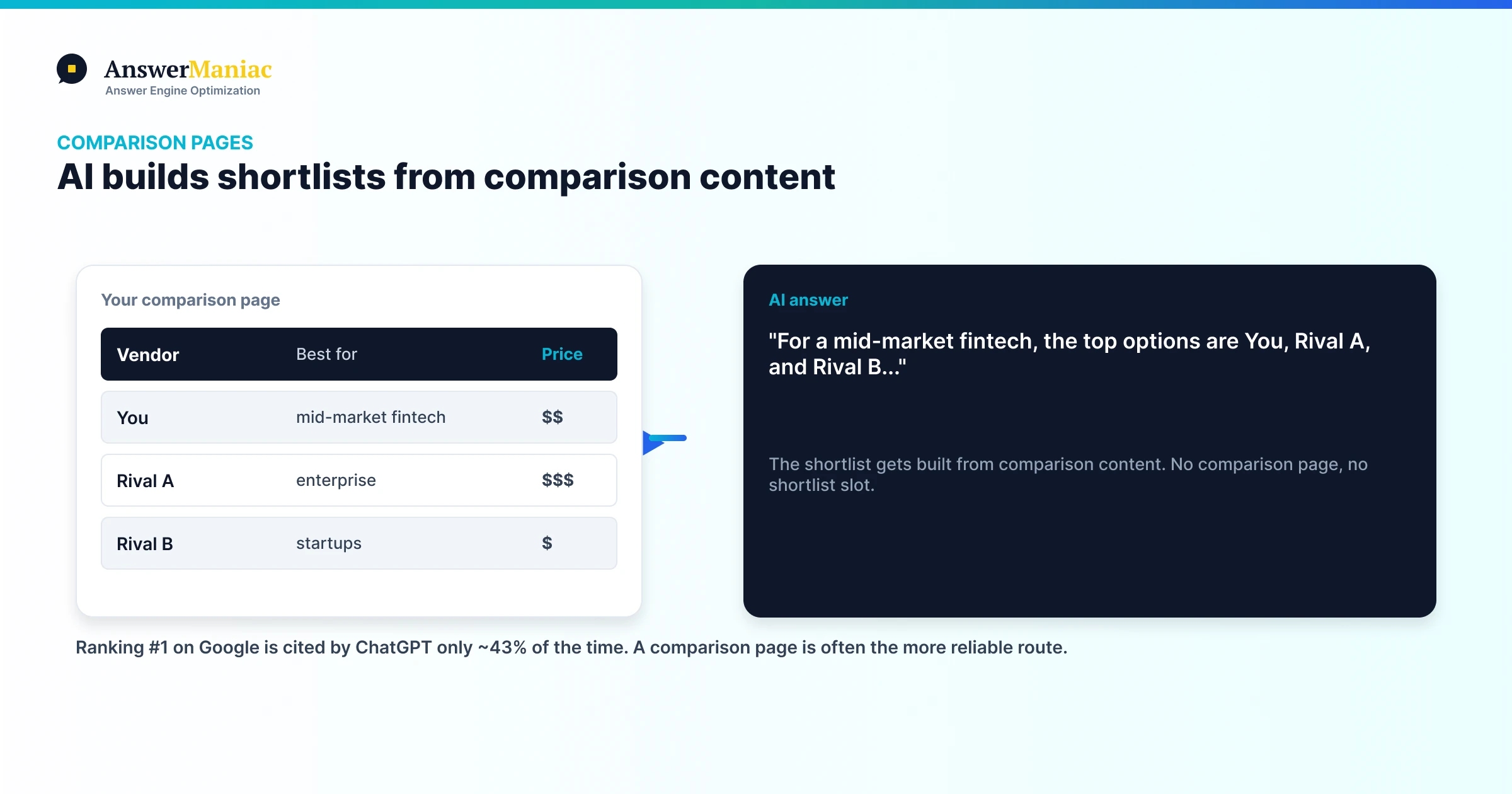
Data in structured formats is also highly favored. This includes comparison tables, lists of tools with key details, step-by-step instructions, and statistical summaries.
When you publish research or data, putting it in a clean, scannable table makes it much more likely to be cited by AI.
Another useful format is the definitive guide. The key is to structure these guides not as long stories, but as a series of clear, answer-focused sections.
A guide on a topic should be broken into clear steps, each with a brief explanation. This modular, answer-driven structure is what AI looks for when building a full response to a user's question.
The Citation as the New Click
Here's the part most B2B marketers haven't internalized yet: citations from AI systems don't just replace clicks. In some cases, they outperform them.
ChatGPT-referred B2B traffic converts at 15.9%. That's 9x higher than the Google organic baseline. When someone arrives at your site because ChatGPT recommended you by name, they're not browsing. They're buying. The AI already pre-qualified them by presenting your brand as the answer to their specific question.
This flips the entire traffic-value equation. Fewer visits, yes. But each visit from an AI citation carries dramatically more intent.
What drives AI citations isn't what you'd expect. Ahrefs studied 75,000 brands and found that brand mention correlation with AI Overview visibility sits at 0.664. Backlink correlation? Just 0.218. The strongest individual signal was YouTube mentions, at 0.737 correlation. Being talked about matters more than being linked to.
That's a fundamental break from traditional SEO logic. For 20 years, links were the currency. Now, mentions are. Specifically, being referenced in contexts that AI training data includes — forums, YouTube transcripts, industry publications, product reviews.
The GEO market reflects this shift. Industry estimates put it at $1.09-1.48 billion in 2026, projected to reach $17.1 billion by 2034. Companies are reallocating budget from link building to citation strategies because the ROI math has changed.
For B2B companies in overlooked verticals — franchise development, RegTech, fleet management — this is actually good news. You don't need a massive backlink profile to get cited by AI. You need to be the most-mentioned, most-structured, most-specific source in your category.
Measuring Success in a Zero-Click World
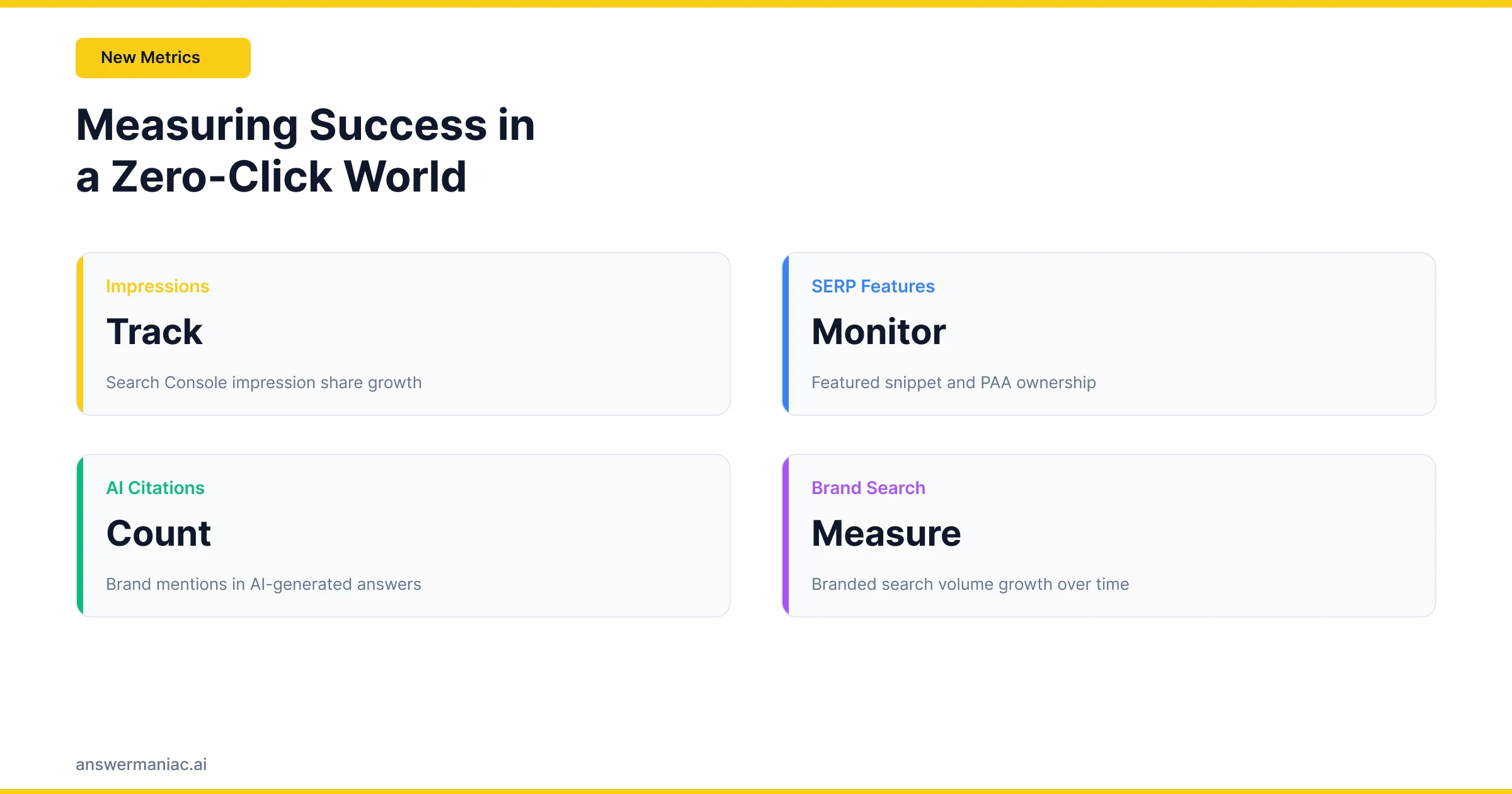
To manage zero-click SEO, you need to track the right things. The metrics you watch must change. Understanding how to measure AI search ROI becomes critical for proving the value of zero-click strategies to stakeholders.
Key metrics to track include:
- Impressions in Search Console: Your main dashboard shifts from clicks to impressions. Monitor your impression share for important queries to see if you're appearing more often, even if clicks don't change.
- Visibility in SERP features: Use tools to see when your page earns a featured snippet or appears in the "People Also Ask" box.
- AI citation rate: Periodically ask AI chatbots questions in your field and note how often they mention your brand or content. More citations mean your strategy is working.
- Downstream brand metrics: A good strategy should increase searches for your brand name. Watch for growth in branded search volume and direct traffic to your site. These are the conversions of zero-click SEO, showing users now seek you out directly.
The Real Challenges
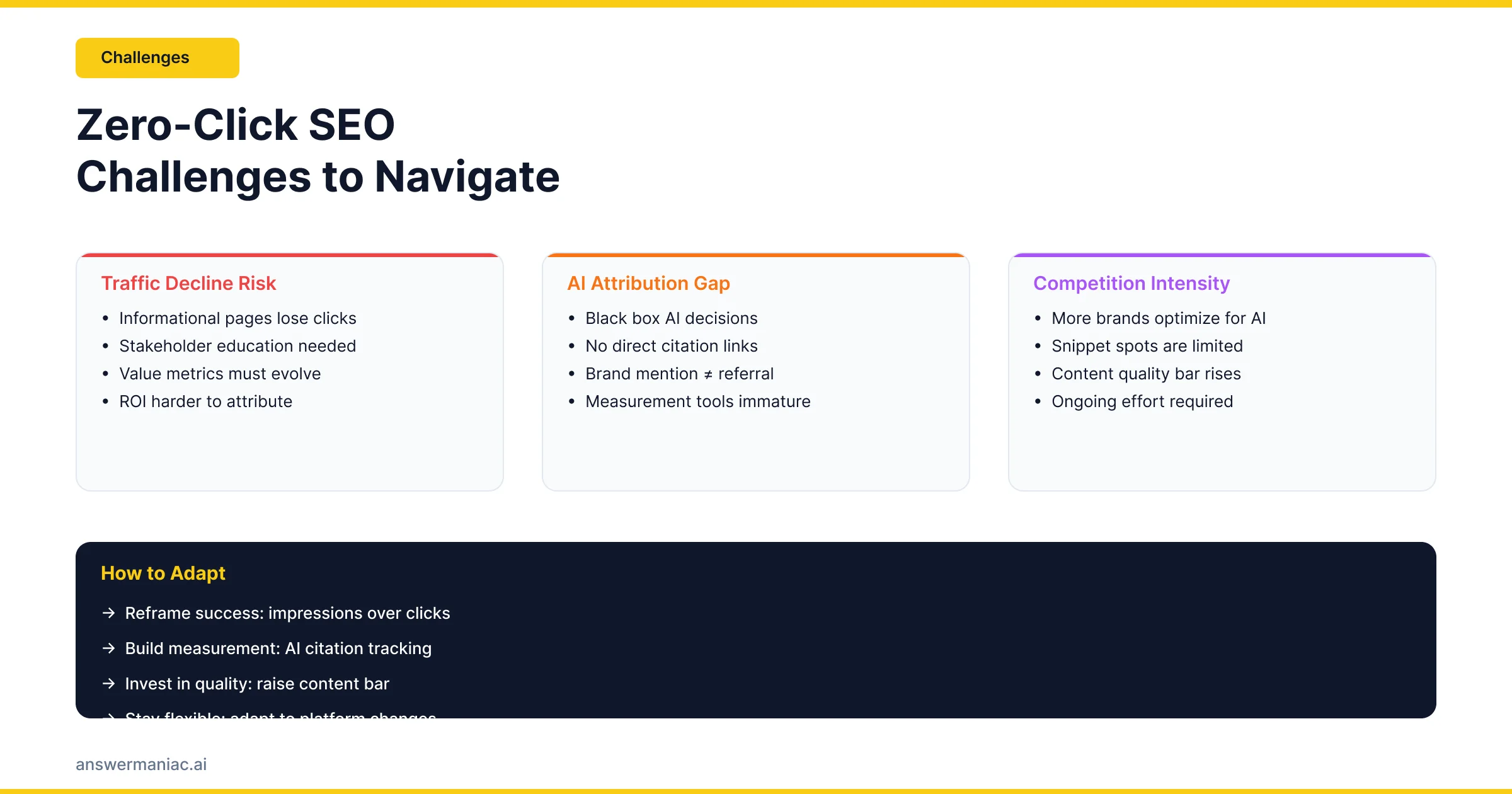
Using a zero-click SEO strategy comes with real challenges:
Potential drop in website clicks: Informational content may see fewer clicks, which can worry teams used to judging success by traffic numbers. This requires educating stakeholders to value brand impressions and authority over just visitor counts.
The "black box" of AI attribution: An AI might use your content in an answer without giving a direct citation or link. Only 17-54% of AI Overview citations come from top-10 organic results. The strategic focus should be on getting your brand name mentioned in the answer itself — even without a link, the brand impression carries value. Track this with regular AI citation audits across ChatGPT, Perplexity, and Gemini.
Increased competition and saturation: The GEO market sits at $1.09-1.48 billion in 2026 and is projected to hit $17.1 billion by 2034. More companies are optimizing for AI visibility every quarter. This demands higher quality content, more precise entity optimization, and fresh data — AI systems tend to favor recent, specific information over generic evergreen content. Success requires ongoing work, not a one-time effort.
Frequently Asked Questions
What percentage of Google searches are zero-click in 2026?
68% of US Google searches end without a click, according to SparkToro's June 2026 data. That's up from roughly 65% in 2024. When AI Overviews appear on a query — which now happens on 20%+ of searches — the zero-click rate jumps to 83%. The share of searches generating a click fell 9.51 percentage points between 2024 and 2026, a 22.9% decline.
How do AI Overviews affect website traffic?
AI Overviews reduce click-through rates by approximately 60% on queries where they appear. Only 17-54% of AI Overview citations come from top-10 organic results, down from 76% in mid-2025. This means ranking on page one no longer guarantees visibility in AI-generated answers. Businesses need to optimize for citation, not just ranking.
What is a citation strategy and why do B2B companies need one?
A citation strategy focuses on getting your brand mentioned by name in AI-generated answers — across ChatGPT, Perplexity, Google AI Overviews, and other AI tools. B2B companies need this because ChatGPT-referred traffic converts at 15.9%, which is 9x higher than Google organic baseline. Ahrefs data shows brand mention correlation with AI visibility (0.664) far exceeds backlink correlation (0.218). Being mentioned matters more than being linked to.
What's the difference between zero-click SEO and traditional SEO?
Traditional SEO optimizes for clicks and website traffic. Zero-click SEO optimizes for brand visibility inside search features and AI answers. The key metrics shift from organic traffic and conversion rate to impression share, AI citation rate, and branded search volume. Both approaches still matter, but budget allocation should reflect where your audience actually encounters your brand — increasingly, that's inside AI-generated summaries.
How can websites optimize content for zero-click results?
Structure content so AI systems can extract answers easily. Use question-based headings with concise answers directly below. Implement FAQ, How-To, and Article schema markup. Build entity authority through consistent brand mentions across the web. The strongest signal for AI citation is YouTube mentions (0.737 correlation per Ahrefs), followed by brand mentions generally (0.664). Focus on being the most-referenced source in your category, not just the best-linked one.
What is Google AI Mode and how does it affect search?
Google AI Mode launched with 1 billion+ monthly users and queries doubling every quarter (announced at I/O 2026). Powered by Gemini 3.5 Flash, it creates a fully conversational search experience. Currently, just 0.34% of searches transition into AI Mode, but the growth trajectory is steep. For B2B companies, AI Mode represents another surface where citation — not ranking — determines visibility.
Win the Visibility Game in a Zero-Click World
The math is simple. 68% of searches don't produce a click. AI Overviews push that to 83%. But the visitors who do arrive via AI citations convert at 9x the rate of organic traffic.
You don't need more traffic. You need the right citations.
That means structured content, entity authority, brand mentions across the web, and a systematic approach to getting cited by the AI systems your buyers actually use. The companies that treat citations as a strategic channel — not a nice-to-have — will own their categories in AI search.
Start with a free AI visibility audit from AnswerManiac to see where your brand stands across ChatGPT, Perplexity, Gemini, and Google AI Overviews.
References:
- SparkToro/Datos: Zero-Click Search Data, June 2026
- GrackerAI Research: GEO 2026 - Winning Zero-Click AI Search
- Ahrefs: 75,000 Brand Study - AI Overview Citation Signals
- Google I/O 2026: AI Mode Announcement
Related Articles:
Get AEO Insights Weekly
Join 500+ B2B marketers getting AI visibility tactics every Tuesday.
Ready to Get Your Brand Cited by AI?
See how your competitors show up in ChatGPT, Perplexity, and Gemini — and what it would take to get recommended.