E-E-A-T for AI Search: Building Author Authority That Gets You Cited
E-E-A-T isn't a ranking factor, it's a trust framework. Here's how B2B authors build Experience, Expertise, and Trust signals that get cited by AI engines.
Quick Answer
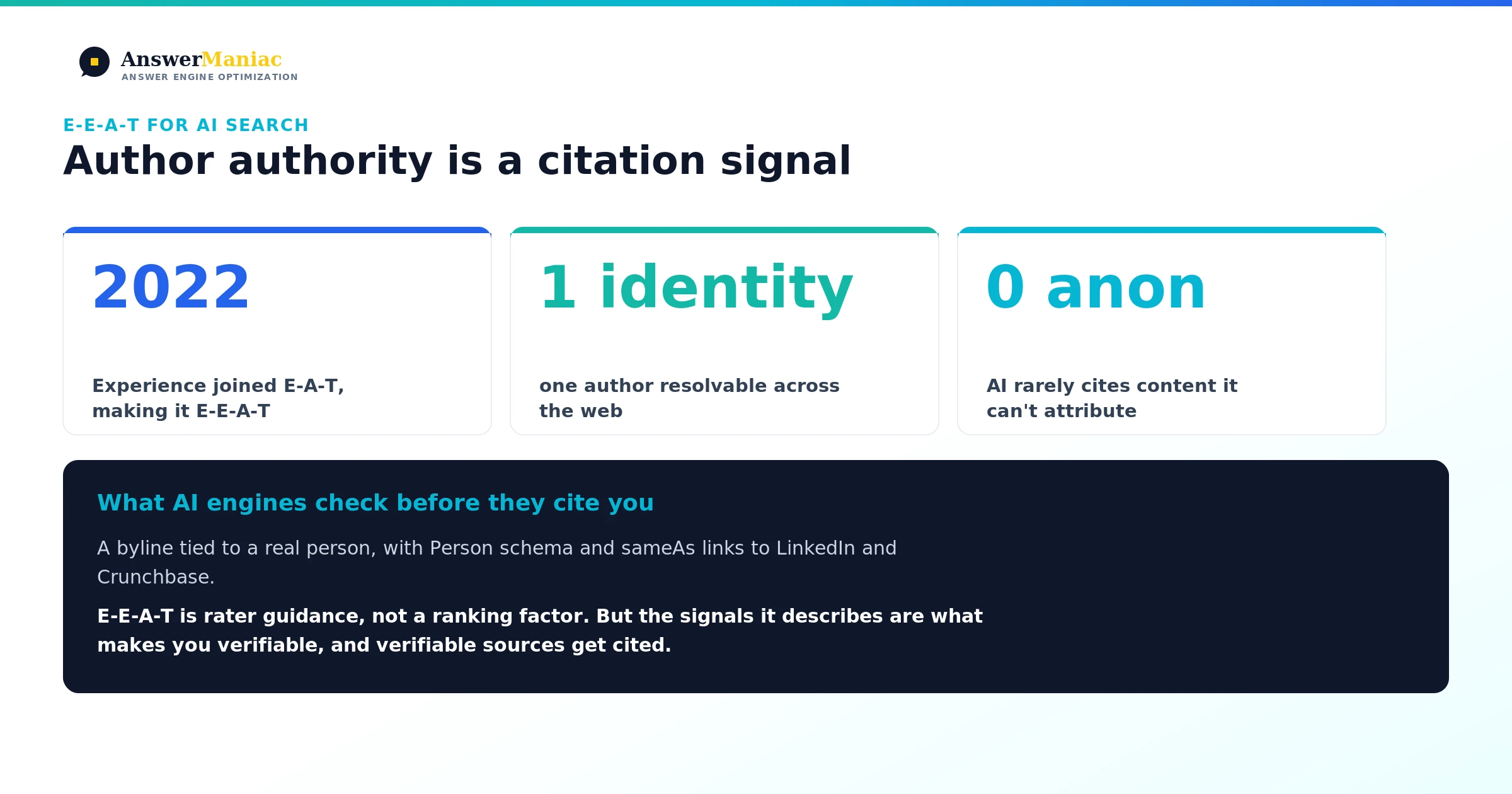
How E-E-A-T drives AI citations: E-E-A-T (Experience, Expertise, Authoritativeness, Trust) comes from Google's Search Quality Rater Guidelines. It's guidance for human raters, not a direct ranking factor, and no "E-E-A-T score" exists. But the signals it describes, verifiable authors, real credentials, consistent identity across the web, first-hand experience, are exactly the signals AI engines use to decide which sources to trust and cite. Build a resolvable author entity with a byline, Person schema, and matching profiles on LinkedIn and Crunchbase, and you give ChatGPT and Perplexity a reason to name you instead of a competitor they can verify better.
Most B2B teams treat E-E-A-T as an on-page checklist. Add an author box, drop in a bio, link to an LinkedIn profile, done. That misses the point, and it's why so much expert content still gets ignored by AI.
Here's the shift that matters in 2026. AI engines don't evaluate your author box in isolation. They try to resolve your author as a verifiable person who exists consistently across the web, and then they weigh whether that person's claimed expertise is corroborated by independent sources. Check how AI sees your business and you'll often find the problem isn't your content quality. It's that the model can't confirm who wrote it or whether that person is real.
This piece is about building author authority as an entity, not a bio. That's the version of E-E-A-T that actually moves AI citations.
Key Takeaways
- E-E-A-T is a framework from Google's Search Quality Rater Guidelines, not an algorithm or a score. The fourth signal, Experience, was added December 15, 2022.
- AI engines favor corroborated sources. A claim backed by a verifiable author with independent confirmation beats an anonymous claim every time.
- The highest-impact work is making your author resolvable as an entity: consistent name, Person schema,
sameAslinks, and matching profiles across LinkedIn, Crunchbase, and your about page. - First-hand experience is the signal most B2B content skips and the one AI rewards most, because original experience can't be scraped from a competitor.
What E-E-A-T Actually Is (and What It Isn't)
Let's be precise, because precision is the whole game here.
E-E-A-T stands for Experience, Expertise, Authoritativeness, and Trust. It lives in Google's Search Quality Rater Guidelines, the document Google gives the human contractors who evaluate the quality of search results. The original acronym was E-A-T. Google added the second E, Experience, on December 15, 2022, in a Search Central blog post titled "E-A-T gets an extra E for Experience."
Now the part most agencies get wrong. E-E-A-T is not a ranking factor. There's no E-E-A-T score inside Google's systems, and the raters who use the guidelines have no direct effect on live rankings. Their job is to help Google test and refine algorithm changes, not to grade your pages in production. Google's own Search Liaison, Danny Sullivan, has repeatedly made this point, and Search Engine Land has documented the misconception in detail.
So why does E-E-A-T matter for AI citations at all? Because the signals the guidelines describe, who created the content, what makes them qualified, whether independent sources vouch for them, are the same signals large language models use when they decide which source to trust. Trust is the center of the framework. It's also the center of how an answer engine picks between two pages that say the same thing.
You can read a fuller definition of what counts as an AI citation in our glossary, but the short version: when ChatGPT or Perplexity names a source, it's making a bet that the source is credible. Author authority is how you win that bet.
Why LLMs Lean Toward Corroborated, Authored Sources
Language models predict what's likely true from patterns across their training data. A fact stated once by an anonymous page is weak signal. The same fact, stated by a named expert and echoed by independent sources, is strong signal, because the model has seen the corroboration.
That's why authored content outperforms faceless content in AI answers. When a claim traces back to a specific person whose expertise shows up repeatedly across LinkedIn, conference talks, and industry publications, the model treats it as better supported. The author becomes part of the evidence.
Retrieval engines like Perplexity make this even more direct. They pull live pages and weight sources partly on whether the page carries authorship signals a crawler can read. A page with a real byline, an author schema block, and links to verified profiles is machine-legible as expert content. A page with no author is just text.
In our Q3 2026 study of 332 B2B companies, roughly half were never cited by ChatGPT or Perplexity at all. Perplexity cited 158 of them; ChatGPT cited just 52. When we dug into the gap, a recurring pattern on the invisible side was content that read as expert but couldn't be verified as expert. No resolvable author, no corroboration, nothing for the engine to confirm. Good writing, invisible source.
The Author Entity: Your Highest-Impact E-E-A-T Work
Here's the reframe. Stop thinking of your author as a bio and start thinking of them as an entity, a specific, resolvable node the models can pin down.
An entity is something the knowledge graph can identify and connect: a person, with a canonical name, a set of attributes, and relationships to other known entities. When your author is a clean entity, the model knows who they are and can tie their content to their verified expertise. When your author is fuzzy, the model can't resolve them, and unresolvable authors don't earn trust.
We audited a RegTech client last year whose head of compliance wrote genuinely sharp content. Original takes, real regulatory depth, the kind of thing a buyer would trust. And she was invisible to AI. The reason was almost dumb in hindsight: her name appeared four different ways across the web. "Jennifer M. Walsh" on the company site, "Jen Walsh" on LinkedIn, "Jennifer Walsh" on a webinar page, "J. Walsh" on a byline at an industry publication. To a human, obviously the same person. To an entity resolver, four weak, disconnected signals instead of one strong one. We standardized the name, added Person schema, wired up the sameAs links, and within a couple of months her content started surfacing in Perplexity answers about compliance tooling. Same expertise. Finally resolvable.
That's the work. It's unglamorous and it compounds.
Building Author Authority That AI Can Verify
Here's the practical sequence, in priority order.
1. Lock down one canonical author identity
Pick one name format and use it everywhere. Your site byline, LinkedIn, Crunchbase, conference bios, guest posts, all identical. Inconsistency is the single most common self-inflicted wound we see. Every variant splits the entity and weakens it.
2. Add Person schema to author pages
Mark up each author with schema.org Person structured data on their author page and in article bylines. Include name, jobTitle, worksFor, and knowsAbout for their areas of expertise. This is machine-readable content that tells a crawler exactly who the author is and what they're qualified to discuss, rather than leaving it for the engine to infer from prose.
3. Wire up sameAs links
The sameAs property is how you tell the knowledge graph "this author page and this LinkedIn profile and this Crunchbase entry are all the same person." Link the author's Person schema to their LinkedIn, their Crunchbase profile, their verified social accounts, and any authoritative profile that corroborates their identity. This is what turns four weak signals into one strong, connected entity. It's the same entity-wiring logic we cover for companies in entity optimization for AI knowledge graphs.
4. Make the credentials verifiable, not just claimed
A bio that says "15 years in fintech" is a claim. A bio that links to the person's actual track record, their company role, their published work, their speaking history, is verifiable. AI engines, like the raters, weigh corroborated credentials over asserted ones. Point to proof the model can check in Google Search Console data, on LinkedIn, in industry coverage.
5. Lead with first-hand experience
This is the signal most B2B content skips, and it's the one the 2022 update was built around. Experience is knowledge gained from doing the thing. A review written by someone who used the product. An analysis built on data you actually ran. A take informed by a client engagement you actually led. Original experience is the one input a competitor can't scrape or paraphrase, which is exactly why it's strong evidence of a real, expert source. Name the specific thing you did, the number you saw, the conversation you had.
6. Earn independent corroboration
The strongest trust signal comes from outside your own domain. When independent sources, industry publications, podcasts, review sites, cite your author by name, that external confirmation is what elevates authoritativeness from self-claimed to recognized. This is where author authority and digital PR for LLM citations overlap: getting your expert quoted and named in sources the engines already read.
Where This Fits in a Full AI Visibility Program
Author authority isn't a standalone tactic. It's the Trust layer underneath your content, and it works best when the company entity is also clean. A verified expert publishing on a site with a clear organizational entity is a far stronger signal than either one alone.
That's why we treat author entity work as part of the Structure and Earn stages of The ANSWER Framework. Structure makes your authors machine-legible; Earn builds the independent corroboration that turns legibility into recognized authority.
When an engine can resolve your author, verify their expertise, and see it confirmed elsewhere, your content stops being anonymous text and becomes a citable source. That's the difference between being read and being cited.
FAQ
Is E-E-A-T a Google ranking factor for AI search?
No. E-E-A-T is a framework in Google's Search Quality Rater Guidelines, used by human raters who evaluate search quality. It's not a direct ranking factor and there's no E-E-A-T score. But the trust and expertise signals it describes, verifiable authors, corroborated credentials, first-hand experience, are the same ones AI engines use when choosing which sources to cite.
What's the fastest way to improve author authority for AI citations?
Standardize one canonical name for each author everywhere, then add Person schema with sameAs links connecting the author page to their LinkedIn and Crunchbase profiles. This makes the author resolvable as a single entity instead of several weak, disconnected signals. It's the highest-impact fix and it's fully in your control.
Does every blog post need a named author to get cited by AI?
Not strictly, but anonymous content is at a real disadvantage. Retrieval engines like Perplexity read authorship signals directly, and models weight corroborated, authored claims over faceless ones. A named, verifiable expert gives the engine a reason to trust the page. No author gives it nothing to verify.
What is the "Experience" in E-E-A-T and why does it matter for B2B?
Experience is first-hand knowledge from actually doing something, and Google added it to the framework on December 15, 2022. For B2B, it's the strongest differentiator because original experience, a client engagement you led, data you ran, a product you used, can't be scraped or paraphrased from a competitor. That originality is exactly what signals a real, expert source to an AI engine.
Can Person schema alone get my authors cited?
No. Person schema makes your author machine-readable, but schema is foundation, not a shortcut. It has to point to a genuinely consistent identity and real, corroborated expertise. Mark up an author who appears four different ways across the web and you've just structured the confusion. Fix the identity first, then the schema does its job.
Author authority is the Trust layer most B2B content skips, and it's often the gap between expert content and cited content. Run a free AI visibility check to see whether the engines can resolve your authors, or book a discovery call to map the entity work for your team.
Get AEO Insights Weekly
Join 500+ B2B marketers getting AI visibility tactics every Tuesday.
Ready to Get Your Brand Cited by AI?
See how your competitors show up in ChatGPT, Perplexity, and Gemini — and what it would take to get recommended.