Digital PR as AI Fuel: How Third-Party Mentions Become LLM Citations
Use digital PR for LLM citations to increase AI mentions, earn trusted backlinks, and strengthen your brand authority across search engines.
Direct Answer: Digital PR creates the third-party validation that LLMs treat as proof of authority, moving your brand into their trusted source set. LLMs heavily favor original data and structured content from reputable media over promotional, brand-owned materials. Success is measured by your share of citations in AI answers, not traditional rankings.
Check your AI visibility now — our free audit shows whether AI models recognize your brand as a citable entity.
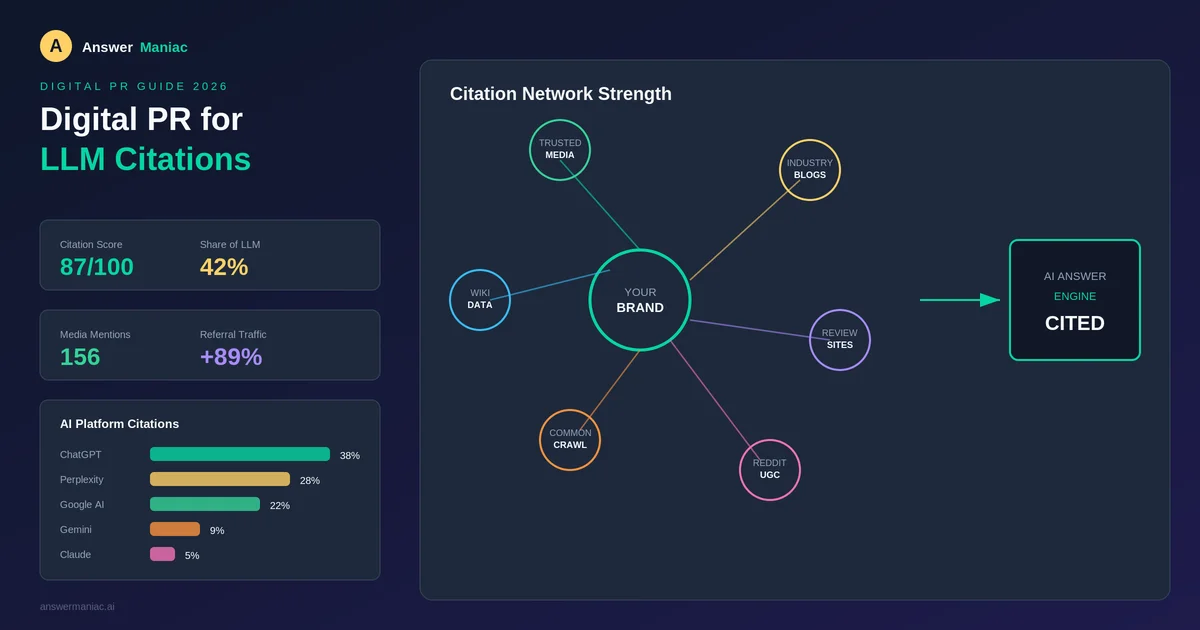
Digital PR creates the external proof that large AI models rely on to verify information. When a brand is cited by a trusted news outlet, it becomes more than data. It becomes a potential source for an AI's answer. The focus has shifted from clicks to citations.
AI systems like ChatGPT evaluate the web for authority and consensus. Your own website's announcements carry little weight. But a feature in a major publication sends a powerful signal. That signal is absorbed into the AI's knowledge base. Then, when someone asks a question, your brand can be part of the response.
This is modern visibility: becoming a cited authority, not just a search result.
AI Citation Essentials
Three things separate brands that get cited from those that don't:
- Third-party validation is the new currency. Digital PR creates the external signals that LLMs treat as proof of authority, moving your brand into their trusted source set.
- LLMs favor original data from reputable media. Original data and structured content from reputable media outweighs promotional, brand-owned materials every time.
- Measurement has changed. Success is measured by your share of citations in AI answers, not traditional rankings. This requires a new audit and targeting strategy.
How Digital PR Influences LLM Citation Algorithms
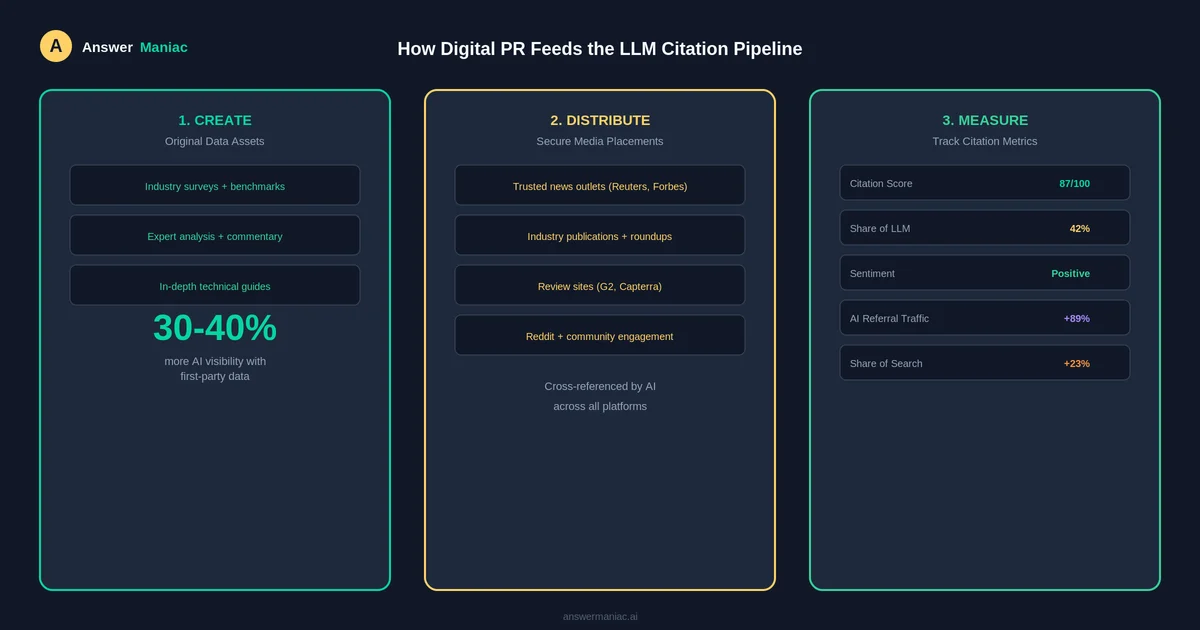
Big AI models need to check their facts. They often use a method called Retrieval-Augmented Generation (RAG). This means they pull information from outside sources to build an answer. Digital PR feeds directly into this system.
A mention on your own site isn't very convincing to an AI. But a link from a trusted news site or industry blog is a strong signal. It tells the model your information is reliable. Studies show most citations in AI answers come from these third-party sources.
The AI cross-references to build an objective answer. It looks for your brand name across several trusted places. This creates a citation network.
Key parts of this system include Common Crawl (a huge snapshot of the web used for training), Wikipedia (a common baseline for facts), and trusted media like Reuters or Forbes that act as authority markers.
A stronger network makes an AI more likely to cite you. Understanding how AI search engines choose sources is central to maintaining a dominant share of voice.
Which Content Assets Attract the Most AI Citations?
AI models look for useful, specific information. They filter out promotional posts and generic announcements. Content that provides clear value gets noticed.
Think about giving the AI a solid fact to use. Certain types of assets work much better:
- Original data and research — a unique industry survey provides the foundation for entity SEO for AI search by establishing your brand as a primary source.
- Expert analysis — a distinct perspective on a trend that offers something AI can't find in ten other places.
- In-depth guides — content that clearly explains a complex process and uses schema markup for LLM citations to help AI systems parse your expertise.
These assets act as reliable anchors. They give the AI a verifiable statement or insight from a known source. Data shows content with first-party statistics can get 30-40% more visibility in AI answers than standard articles. The key is utility, not promotion.
| Asset Type | LLM Citation Potential | Primary Value Signal |
|---|---|---|
| Original Research & Data | High | Unique, verifiable data points and benchmarks |
| Expert Analysis & Commentary | Medium | Demonstrates E-E-A-T (Experience, Expertise, Authoritativeness, Trustworthiness) |
| Product Launch Announcements | Low | Often seen as promotional with inherent bias |
How to Map and Fill LLM Citation Gaps
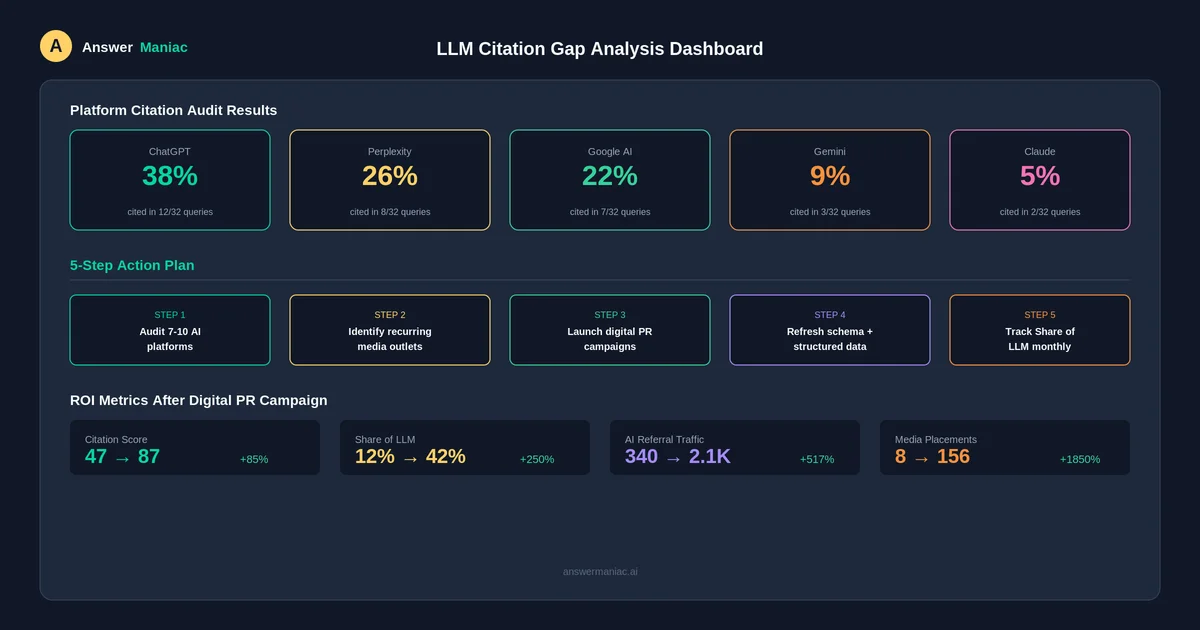
You cannot improve what you do not measure. Start with an audit focused on LLM visibility, not just keyword rankings in Google Search. Review answers across major AI platforms such as Google Gemini, ChatGPT, and Perplexity AI.
Search your priority search terms and document which brands receive brand mentions, which trusted media sites appear most, and what content format is cited (data, reviews, guides). These are your citation hubs. They shape AI Search and Google AI Overviews.
Action plan:
- Audit 7-10 AI platforms for core queries
- Identify recurring media outlets and review sites
- Launch digital PR campaigns to secure media placements there
- Refresh structured data and schema markup to support source attribution
- Track Share of LLM and share of voice monthly
This maps directly to Stage A (Audit) of The ANSWER Framework — understanding your current citation landscape before building on it.
Why Third-Party Validation Outweighs On-Site SEO
Traditional SEO focused on ranking pages. AI Search changes that. In zero-click events, users get answers inside AI systems without visiting your site. Brand visibility now depends on external validation.
Large Language Models prioritize verifiable sources from trusted media sites over brand-owned pages. Your website supports Technical SEO, structured data, and entity SEO. But AI platforms compare brand signals across the wider content ecosystem.
Independent media coverage, expert commentary, and citations from media outlets build stronger brand authority than press releases alone. These mentions influence Knowledge Graph connections and training data patterns.
On-site optimization remains important for search engines and Google AI Overviews. However, digital PR, reputation management, and media impressions now drive brand credibility inside AI systems. Semantic SEO for AI visibility works best when it's paired with consistent external validation.
How to Measure the ROI of AI-Driven Digital PR
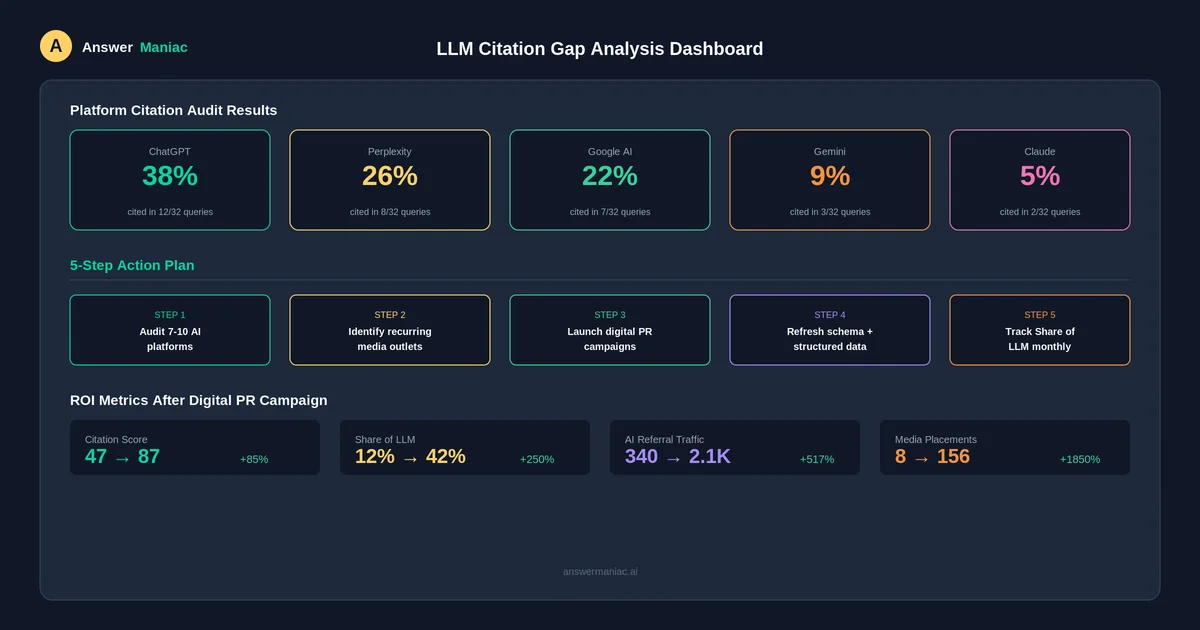
Old metrics like Domain Authority and backlink counts do not show full AI Search Visibility. Focus on citation-based metrics instead.
Key performance indicators:
- Citation Score — how often AI tools cite your brand
- Share of LLM — your share of brand citations vs competitors
- Sentiment Alignment — positive, neutral, or negative mentions
- Referral Traffic — visits from AI platforms
- Share of Search — brand discovery growth over time
Review responses from platforms like Anthropic's Claude and Meta's LLaMA to compare brand citations. Use SEO tools, manual tracking, and comparison tables. Monitor synthesized mentions without direct links.
Measure progress quarterly. In AI-driven discovery journeys, consistent brand citations matter more than short-term ranking spikes.
FAQ
How does digital PR improve LLM visibility in AI Search?
Digital PR strengthens LLM visibility by increasing brand mentions across trusted media sites and media outlets. Large Language Models rely on verifiable sources within their training data to validate facts. When your brand appears consistently in credible media coverage, AI systems recognize stronger brand signals. This improves AI Search Visibility, supports source attribution, and increases your share of voice in AI Overviews and zero-click events.
What types of media coverage influence Large Language Models most?
Large Language Models prioritize media placements that provide verifiable sources, original insights, and clear context. Coverage on trusted media sites, industry publications, and respected review sites often carries more weight than press releases alone. Strong public communications, supported by structured data and schema markup, help AI platforms connect brand citations to the Knowledge Graph and strengthen overall brand authority.
Can digital PR impact share of LLM and Share of Search?
Yes. Digital PR directly influences Share of LLM by increasing how often your brand appears in AI platforms. As brand citations grow, AI systems surface your name more frequently in AI Overviews and AI Search results. This visibility can also raise Share of Search over time, improving brand discovery, referral traffic, and brand awareness beyond traditional keyword rankings.
How do Technical SEO and structured data support digital PR?
Technical SEO ensures AI tools can properly interpret your brand signals. Structured data, Organization schema, FAQ schema, and accurate meta tags help search engines and AI systems connect media coverage to your website. This supports entity SEO, improves source attribution, and strengthens brand credibility across the content ecosystem, especially during algorithm updates affecting AI Search Visibility.
Building Your Citation Authority
Becoming a cited source in AI Search requires structure and consistency. Start with an audit, create original data assets, and secure media coverage that strengthens brand citations. Measure progress by Share of LLM, not just traffic.
This is the approach used by AnswerManiac. We help SaaS teams and marketers map LLM visibility, identify citation gaps, and build scalable, question-driven content using The ANSWER Framework.
Review your AI citation landscape and see where your brand stands.
References:
Related Articles:
Get AEO Insights Weekly
Join 500+ B2B marketers getting AI visibility tactics every Tuesday.
Ready to Get Your Brand Cited by AI?
See how your competitors show up in ChatGPT, Perplexity, and Gemini — and what it would take to get recommended.