Schema Markup That AI Actually Reads: The Technical Foundation for LLM Citations
Learn how schema markup for LLM citations helps your content get cited by AI search engines and appear in AI-generated answers.
Direct Answer: Schema markup won't directly boost how often AI cites your site. Recent research shows no solid link between structured data and citation rates. AI models care more about what your content says and how clearly it says it. But schema works like a translator — helping AI correctly identify the people, places, and facts on your page. This clarity is the technical groundwork that makes accurate citations possible.
Check your AI visibility now — our free audit shows whether AI models recognize your brand as a citable entity.
No, adding schema markup won't boost how often AI cites your site. Recent research, including a 2026 study, shows there's no solid link between structured data and citation rates. AI models care more about what your content actually says and how clearly it says it.
So what's the point of schema? It works like a translator. It helps an AI correctly identify the people, places, and facts on your page. This clarity is the technical groundwork that makes accurate citations possible when you are chosen as a source.
Schema Markup Essentials
Three things to understand about schema and AI:
- Schema clarifies, it doesn't promote. It helps AI correctly identify what and who is on your page, aiding accurate attribution when your content is selected.
- Focus beats volume. Stick to 1-2 core schema types like Organization or FAQPage that directly support your content's purpose.
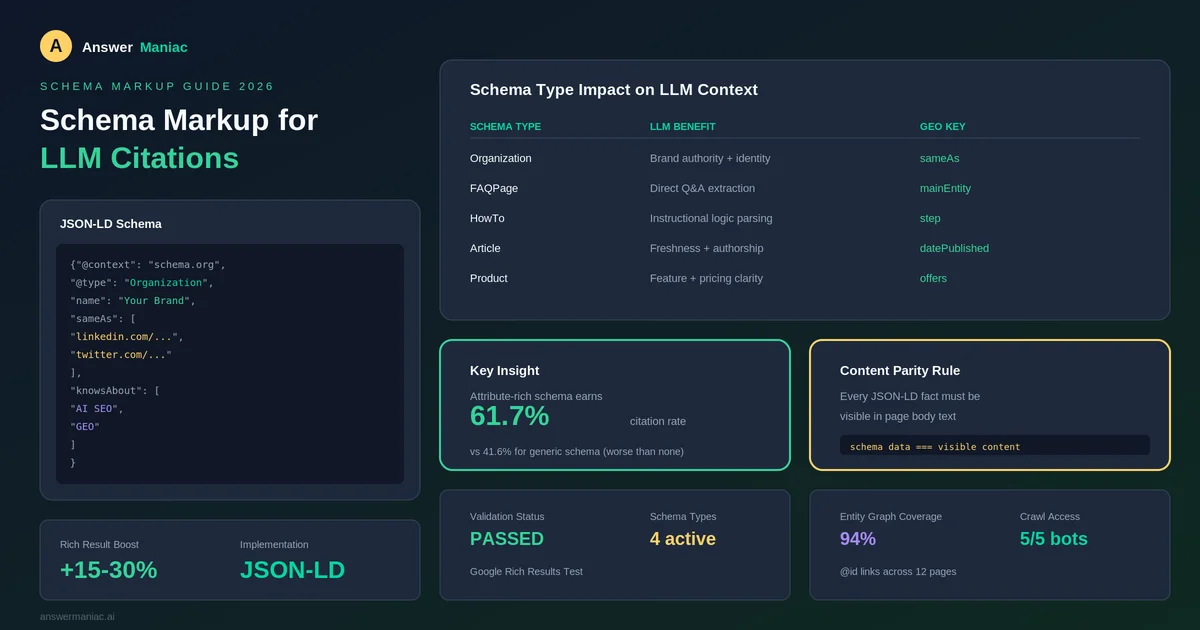
- Content parity is non-negotiable. All structured data must be visible in the page's body text. No hidden data layers.
Does Schema Markup Directly Increase AI Citation Rates?
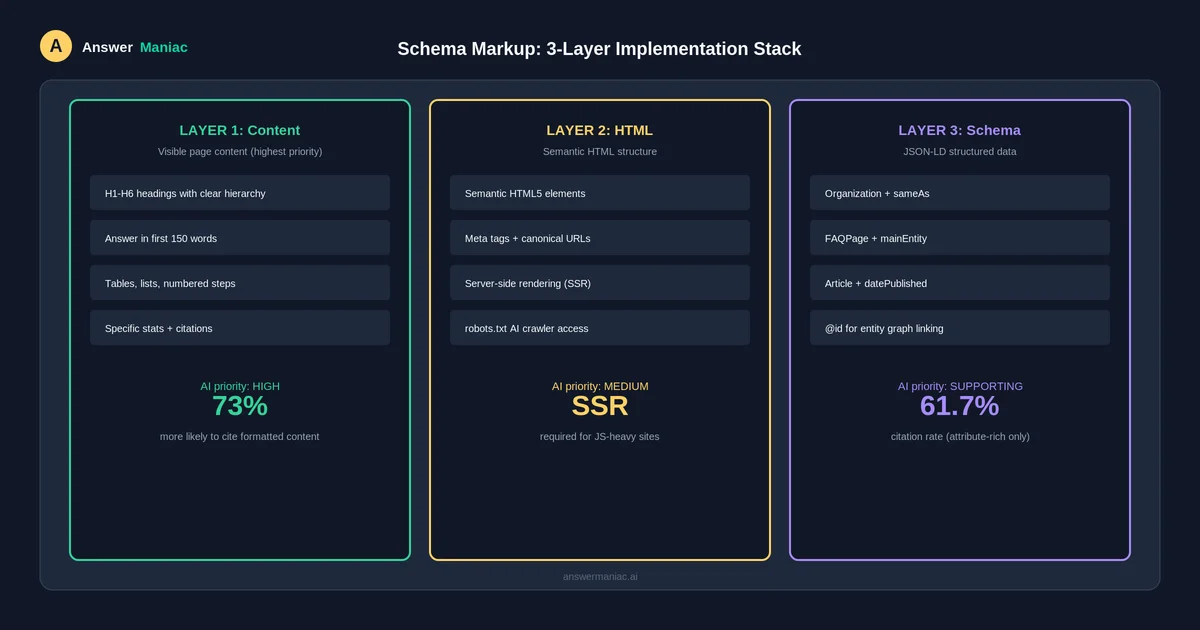
The direct answer is no. Empirical research, including a notable 2026 study by Search Atlas, has shown there is no reliable link between the amount of schema markup on a page and how frequently it gets cited by AI systems like OpenAI's models, Google Gemini, or Perplexity. These large language models are trained to understand language and context.
They look for authoritative, well-structured information that directly answers a user's query. While schema provides a clean, organized data structure, the AI's primary focus is on the semantic meaning and quality of the content itself. A page with thin content but perfect markup will likely be ignored.
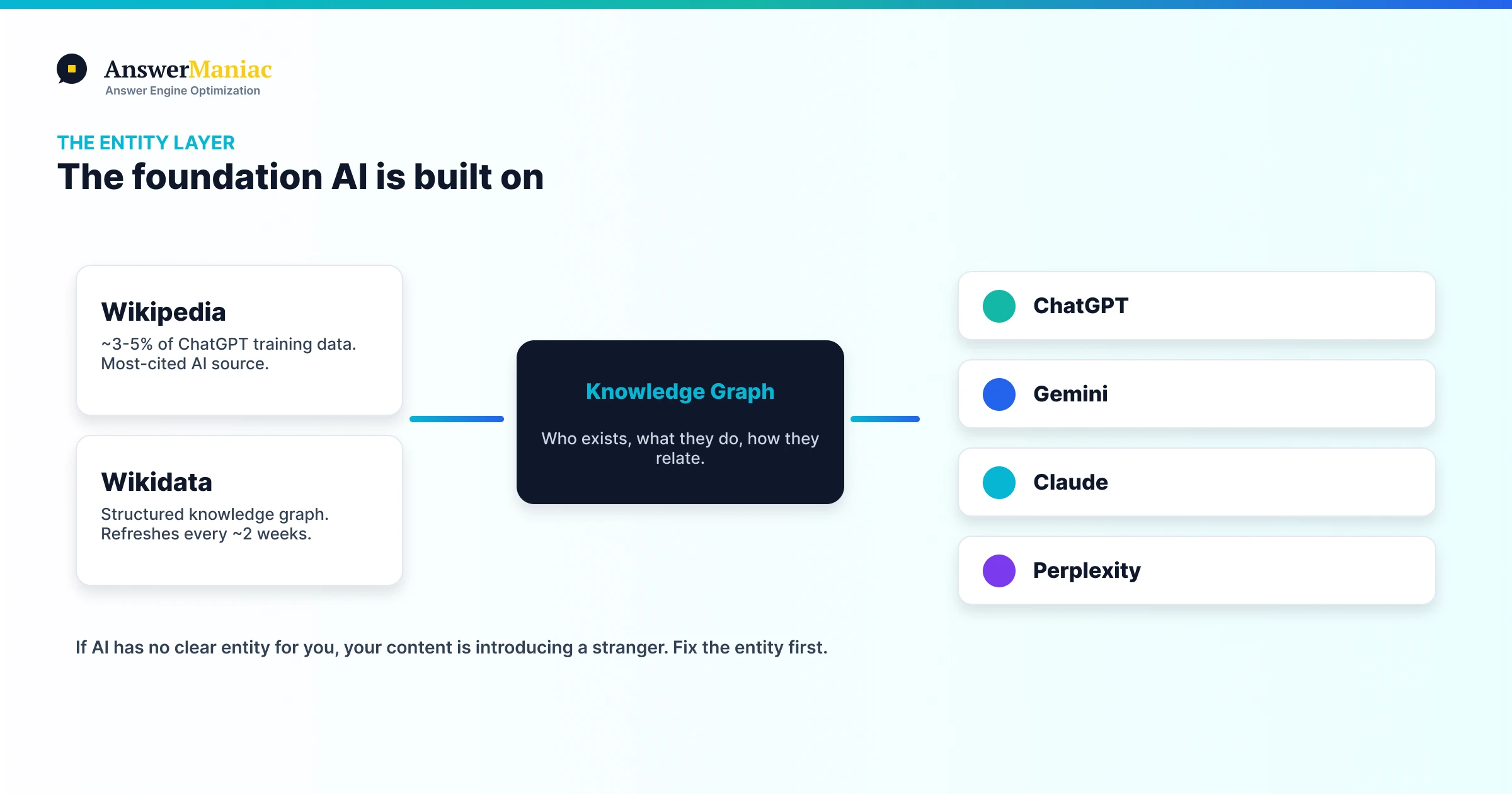
The models are seeking substance, not just signals. This aligns with the principles behind entity SEO for AI search, where clearly defined entities and contextual depth matter more than technical markup alone.
Which Schema Types Provide the Most Context for LLMs?
Not all schema is created equal for AI comprehension. The most impactful types are those that reduce ambiguity and clearly define key entities and processes. Organization schema establishes your brand's identity. FAQPage schema provides direct question-and-answer pairs that are easy to extract. HowTo schema breaks down instructional logic into clear steps. Article schema signals authorship and timeliness.
| Schema Type | Core LLM Benefit | Key Property for GEO |
|---|---|---|
| Organization | Establishes brand authority and identity | sameAs (links to official social/profiles) |
| FAQPage | Enables direct extraction of Q&A pairs | mainEntity (structured Question/Answer objects) |
| HowTo | Supports parsing of instructional logic | step (clearly defined sequential steps) |
| Article | Signals content freshness and authorship | datePublished & author |
These types help AI models resolve who is providing the information and what the information is about. That's fundamental for correct citation.
How to Implement LLM-Ready Structured Data
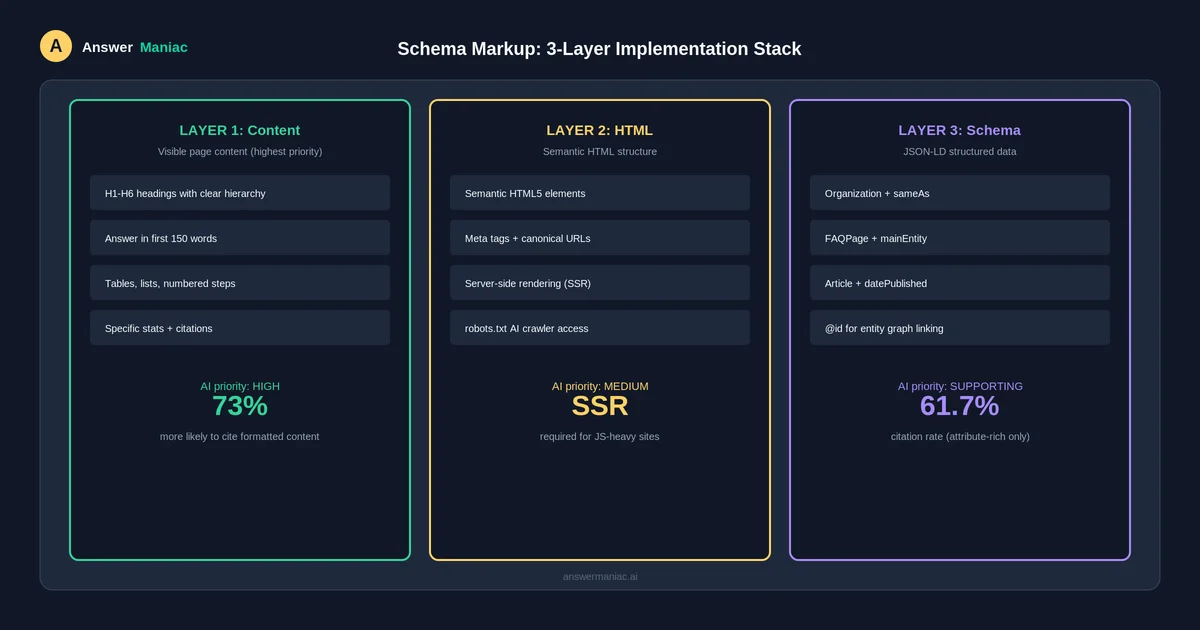
Implementation is about precision, not volume. Use the JSON-LD format, placed in your HTML page's <head> section. The most critical rule is ensuring "content parity." Every single fact, name, date, or step you define in your JSON-LD code must be visibly present in the main body text of the page.
If the AI sees a discrepancy, it may distrust the data or hallucinate incorrect attributions. This process is about reinforcing what's already clearly stated for human readers, not creating a separate, hidden data layer.
Follow these steps for a clean implementation:
- Select the primary entity that defines the page, like SoftwareApplication for a product page
- Map each JSON-LD property directly to its corresponding visible text on the page
- Use the @id property to create unique identifiers that can link entities across your site into a coherent graph
- Always validate your code using tools like the Google Rich Results Test
Why Do LLMs Sometimes Ignore Valid Schema Markup?
It can be frustrating when perfectly valid schema markup seems to be ignored. The reason often lies in the AI's processing pipeline. During the "reasoning" phase, models like ChatGPT may prioritize the textual content they extracted from headings, paragraphs, and tables.
This reflects how AI search engines choose sources — by evaluating semantic clarity, authority signals, and factual grounding within the visible content rather than relying solely on structured metadata.
If your schema describes something not well-supported by the main content, the model might treat the markup as mere plain text or disregard it altogether. Research indicates that for many models, the visible, semantic content carries more weight than structured metadata in the document head when determining relevance and truthfulness.
What Are the Community "Hard Truths" About AI SEO?
In technical communities like r/TechSEO, the consensus on schema for AI is pragmatic. It's viewed as a "table stakes" requirement — something you should do correctly because it's a best practice, not a magic bullet for visibility.
The real competitive advantage comes from what some call "duck test" SEO. If your content looks, reads, and feels authoritative to a human expert, it has a far better chance of being treated as authoritative by an AI.
This is also why digital PR for LLM citations has become increasingly important — building external validation and brand mentions that reinforce perceived expertise beyond on-page optimization alone.
The focus in these communities is overwhelmingly on creating deep, valuable content first, with technical optimization like schema serving a supporting, clarifying role.
How to Balance Traditional SEO and GEO Requirements
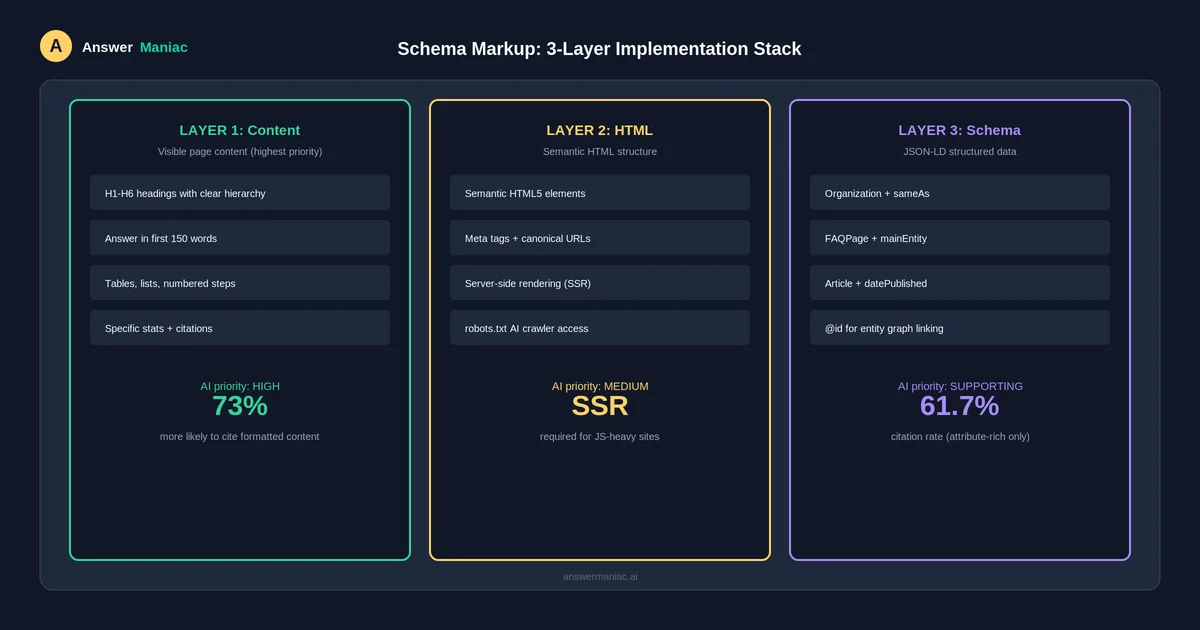
The strategy is to build in layers. Treat schema markup as a tool to win traditional rich results in Google Search, like FAQ snippets or how-to carousels. Simultaneously, structure your page content for AI retrieval using clear semantic HTML: descriptive H1-H6 headings, data tables, and concise paragraphs.
This dual approach ensures you are optimized for both the classic search engine results page and the generative answer panels of platforms like Perplexity. Your content becomes machine-readable at multiple levels, covering all bases. Semantic SEO for AI visibility works hand-in-hand with schema to create this layered foundation.
FAQ
How does structured data improve LLM citations?
Structured data helps AI systems understand what your page is about. When you use schema markup correctly, large language models can identify entities, relationships, and verifiable claims more clearly. This improves citation accuracy, even if it does not directly raise citation rate. Clear structured content supports retrieval augmented generation and increases digital visibility in AI search responses and generative answers.
Which schema types support LLM-friendly content best?
Focus on schema types that define clear entity relationships. FAQPage schema, Article schema, Organization schema, Person schema, and HowTo schema provide strong entity clarity. Product schema and Recipe schema can also help when relevant. These schema.org annotations improve structured data markup, strengthen content structure, and support entity recognition inside Knowledge Graphs used by AI models and search engines.
Can schema markup increase citation frequency in AI results?
Schema markup alone does not guarantee higher citation frequency. AI-powered search systems prioritize information density, original research, and verifiable data first. However, structured data improves entity definitions and grounding mechanisms within RAG architecture. When your content strategies combine structured content with strong semantic search signals, AI citations become more accurate and consistent over time.
How should I test schema markup for AI crawlability?
Validate your structured data using tools like the Rich Results Test and schema.org Validator. You can also review enhancements inside Search Console to confirm correct implementation. These checks ensure AI crawlability and proper entity graph mapping. Clean data tables, answer-first formatting, and platform documentation alignment strengthen structured data and support reliable AI search responses.
Building a Foundation for AI Recognition
Schema markup strengthens clarity in AI search. It doesn't guarantee citations, but it improves accurate attribution when models use your content. By selecting the right schema types, enforcing strict content parity, and prioritizing authoritative depth, you create a site machines can interpret confidently.
To see how your content performs in AI-driven search, run a free visibility audit at AnswerManiac and identify where you can improve citation readiness.
References:
- Purge Digital — What Are Schemas and How Do They Work with LLMs
- WhiteHat SEO — Schema Markup AI Search
Related Articles:
Get AEO Insights Weekly
Join 500+ B2B marketers getting AI visibility tactics every Tuesday.
Ready to Get Your Brand Cited by AI?
See how your competitors show up in ChatGPT, Perplexity, and Gemini — and what it would take to get recommended.