Entity SEO for AI Search: How Knowledge Graphs Power Brand Citations
Improve rankings with entity SEO for AI search. Structure content clearly so AI engines understand, index, and surface your brand faster.
Direct Answer: Entity SEO for AI search is the practice of structuring your brand, products, and content so AI engines like ChatGPT, Perplexity, and Gemini recognize you as a trusted, citable source. It replaces keyword-chasing with clear entity signals — schema markup, knowledge graph presence, consistent brand mentions, and semantically complete content. Companies that define themselves as machine-readable entities get cited by AI. Those that don't stay invisible.
Check your AI visibility now — our free audit shows whether AI models recognize your brand as a citable entity.
Search engines have changed. Tools like Google's AI Overviews and ChatGPT now read web pages and give users direct answers. To show up in these AI responses, you need entity SEO. That means making your brand, products, and knowledge easy for AI to understand.
It's about giving complete, factual information and clear signals about who and what you are — not chasing keywords or backlinks. By organizing your content for machines, you become a trusted source AI can use.
Want AI to recognize your expertise? Keep reading to learn how to make your online presence a trusted entity.
What Matters Most for AI Citations
Three things separate brands that get cited from brands that don't:
- AI chooses structured facts. It picks sources with clear, complete data over just popular websites.
- Define your brand for machines. Use structured data and consistent profiles so AI recognizes your business as a distinct entity.
- Give complete, correct answers. Your content must fully answer a question with verified facts to be used by AI.
This is the foundation of entity SEO for AI search. Get these right and you're ahead of 90% of B2B companies still optimizing for traditional search alone.
How AI Search Engines Choose Sources
Understanding how AI search engines choose sources involves more than counting links. These systems prioritize trustworthy, well-structured information over simple popularity.
The main criteria they use:
- Semantic Completeness: Your content must give a full, standalone answer. Partial coverage gets skipped.
- Fact Verification: AI cross-checks your claims against trusted databases in real-time. Unverifiable statements get ignored.
- E-E-A-T Signals: Your source must show clear expertise, experience, authoritativeness, and trustworthiness through consistent entity signals.
- Entity Density: Pages packed with well-defined, connected entities are favored over thin content.
- Freshness: Recently updated content gets priority, especially for evolving topics.
Traditional metrics like domain authority matter less now. Success depends on how completely and correctly your page answers a question for a machine. This is entity SEO for AI search in practice — you're optimizing for understanding, not rankings.
Schema Markup for LLM Citations
To talk directly with AI, you need to implement schema markup for LLM citations. This code provides the structural clarity these models need to identify your brand accurately.
Add it to your site to define your brand and organize your information clearly. For AI, it acts as a direct guide. The schema types that matter most:
- Organization or LocalBusiness: Defines your company as an entity with name, logo, founding date, and social profiles.
- FAQPage or HowTo: Makes your instructions easy for AI to extract and cite directly.
- Article: Shows publishing dates, author credentials, and content freshness.
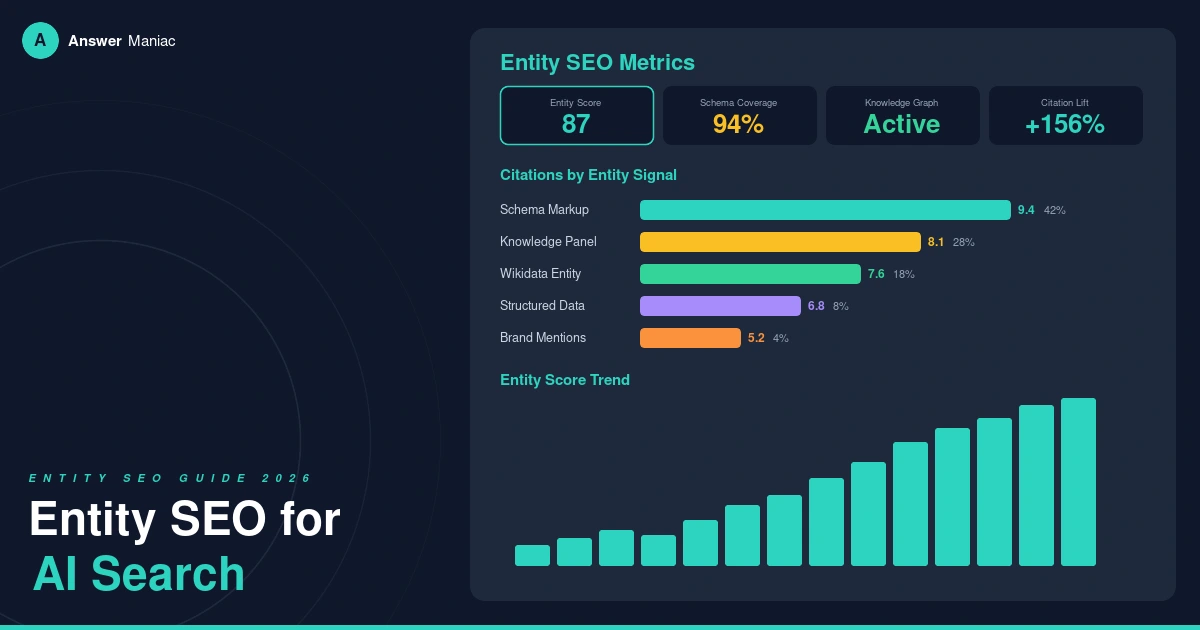
This structured data removes guesswork. Pages with strong schema often get cited by AI, even if they aren't top-ranked in regular search. You're building a machine-readable blueprint of your authority.
| Schema Type | Primary Entity SEO Purpose | Example Use Case |
|---|---|---|
| Organization | Defines your core business entity | Homepage, about page |
| LocalBusiness | Defines a physical location entity | Google Business Profile landing page |
| FAQPage | Structures Q&A for easy extraction | Product or service landing pages |
| HowTo | Defines step-by-step processes | Tutorials, guides, and recipes |
| Article | Defines published content with dates | Blog posts, news articles |
For a deeper technical walkthrough, see our guide on schema markup for AI and ChatGPT citations.
Digital PR for LLM Citations
AI systems verify brands by scanning trusted sources across the web. Digital PR for LLM citations is essential for building the external signals that confirm your credibility.
The goal is not just backlinks. It is consistent brand mentions on reputable sites. When media outlets, directories, and industry platforms reference your business, AI models use that context to confirm your credibility. These signals support E-E-A-T and increase the chance of citation in tools like ChatGPT and Perplexity AI.
What to do:
- Contribute expert insights through journalist request platforms like HARO and Connectively
- Maintain accurate profiles on Crunchbase, G2, and Capterra
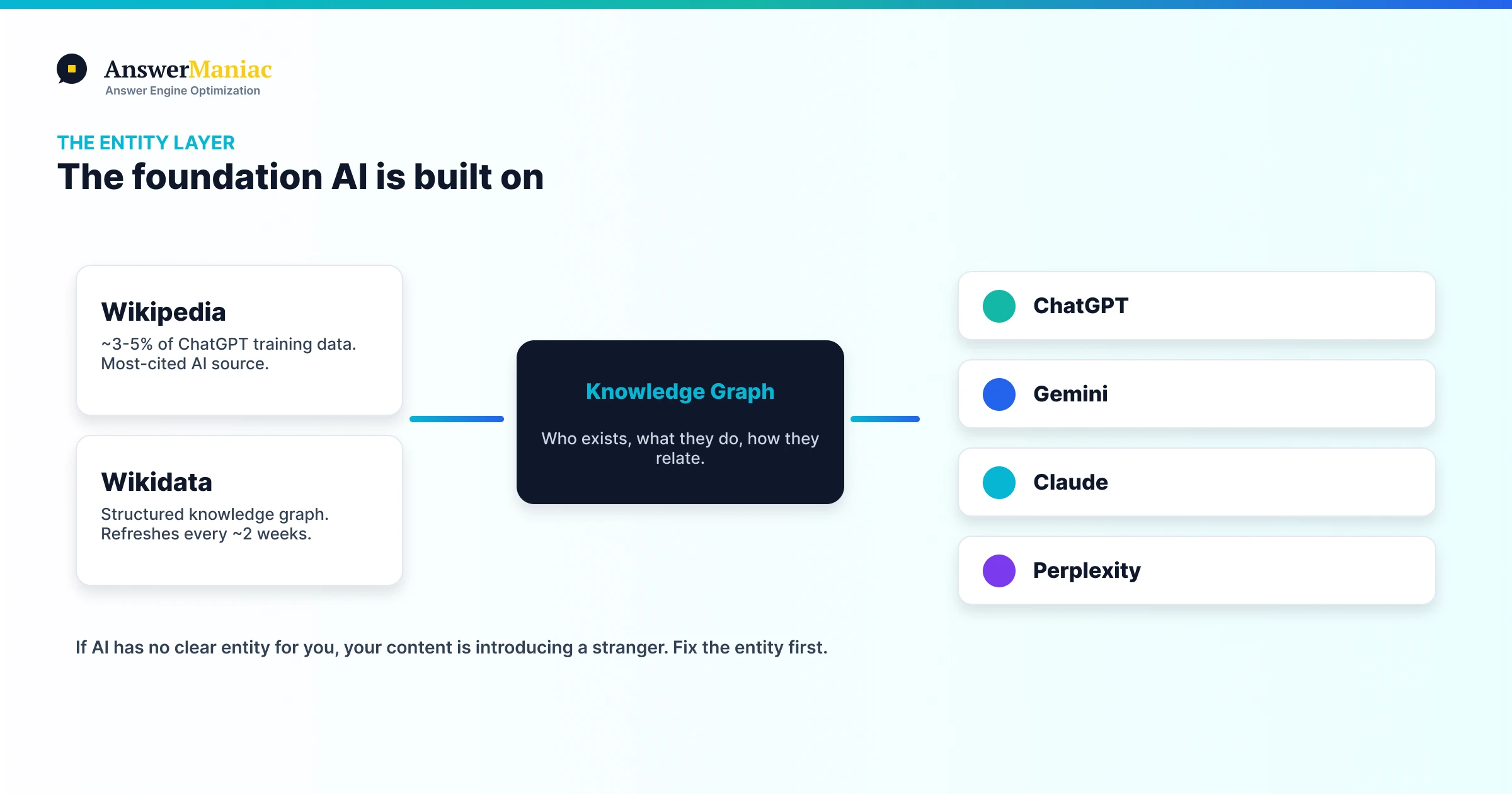
- Improve knowledge base visibility on Wikipedia and Wikidata
- Engage in relevant communities such as Reddit and Quora with substantive answers
- Get mentioned in industry roundups and "best of" lists
Consistency across platforms strengthens your entity profile. Every mention that matches your structured data reinforces who you are in the eyes of AI.
Semantic SEO for AI Visibility
Semantic SEO for AI visibility means answering a subject completely. Instead of one page per keyword, build topic clusters. Create a core page and support it with related content. Connect these pages with clear internal links.
High-growth companies succeed by using semantic SEO to define their niche clearly, ensuring AI models understand their specific context and technical authority. This is Stage W (Write) of The ANSWER Framework — building content that AI engines can parse, trust, and cite.
How to implement:
- Build a pillar page with supporting articles — cover the topic from every angle your buyer might ask about
- Link related pages clearly — use descriptive anchor text that tells AI what the linked page covers
- Answer follow-up questions within the same topic — anticipate the next question and answer it on the same page or a linked one
- Structure content for fast scanning — headings, lists, tables, and short paragraphs make extraction easier for AI
Use natural language. Cover related terms, definitions, and common questions. Keep paragraphs short. Clear structure and full coverage improve AI understanding and citation potential.
FAQ
What is the difference between entity SEO and traditional SEO?
Traditional SEO focuses on keywords, backlinks, and rankings in search engines. Entity SEO focuses on defining a business entity clearly so AI search systems understand who you are. It uses structured data, entity linking, and consistent information across the web. Instead of chasing positions in Google SERPs, you build recognition in the Knowledge Graph and support AI-generated answers.
How does structured data improve visibility in AI search?
Structured data helps search engines interpret your content with less guesswork. Using schema markup and clear schema types, you define your business entity, services, and relationships. This supports entity linking and improves accuracy in AI-generated results. When your data connects properly to the Knowledge Graph, your brand has a better chance of appearing in AI Overviews and other AI interfaces.
Why is topical authority important for AI-generated answers?
AI search evaluates depth, not just keywords. Topical authority shows that you cover a subject fully through topic clusters and strong internal links. This helps search systems understand your expertise across the buyer journey. When your content matches user intent and includes entity-rich phrases, it increases the likelihood of being referenced in AI-generated answers and answer engines.
How can a business strengthen its Knowledge Panel presence?
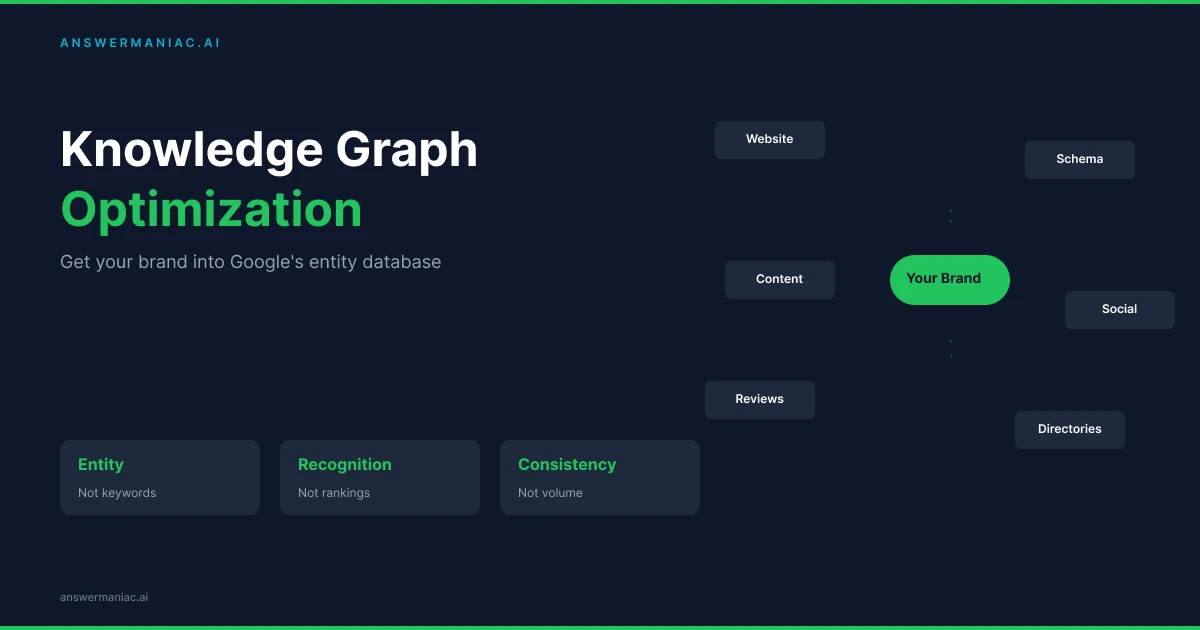
A Knowledge Panel often pulls data from Google's Knowledge Graph and other trusted sources. To strengthen it, maintain accurate structured data, a consistent Google Business Profile, and listings in reputable directories. Create a canonical entity page that clearly defines your business entity, services, and location to improve brand visibility in the search landscape.
Building Your Entity for the Future of Search
AI search favors trusted, well-defined entities over keyword-heavy pages. To stay visible, structure your content with schema, earn credible mentions, and cover topics fully. These steps help AI systems recognize and verify your brand.
If you want a practical way to scale this process, start with AnswerManiac. We help you generate structured, question-based content built for entity SEO for AI search and citation visibility across ChatGPT, Perplexity, Gemini, and Claude.
References:
- Single Grain — Entity SEO for AI Search
- The Small Biz Expert — Understanding Entities for SEO and AI Search
Related Articles:
Get AEO Insights Weekly
Join 500+ B2B marketers getting AI visibility tactics every Tuesday.
Ready to Get Your Brand Cited by AI?
See how your competitors show up in ChatGPT, Perplexity, and Gemini — and what it would take to get recommended.