Entity Optimization for AEO: How to Get Your Brand Into AI Knowledge Graphs
Entity optimization is the technical foundation of AEO. Learn how to get your brand recognized by AI knowledge graphs so ChatGPT, Perplexity, and Gemini cite you.
Direct Answer: Entity optimization is the process of ensuring AI models correctly understand and consistently recognize your brand as a distinct entity. It goes beyond schema markup (which describes your pages) to establish your brand's identity across knowledge graphs, structured databases, and cross-web references that LLMs use to decide who to cite. The core components are: entity definition (what you are), entity consistency (same data everywhere), entity authority (third-party validation), and entity connectivity (relationships to other entities). Companies that implement entity optimization see 3-5x more AI citations than those relying on schema markup alone.
Check your current AI visibility — our free audit shows whether AI models recognize your brand as a citable entity.
There's a misconception in the AEO space that won't die: "add schema markup and AI will cite you." It's not that simple. Schema markup describes your web pages. Entity optimization establishes your brand's identity in the broader knowledge ecosystem that AI models actually draw from.
This is the most technical guide on our site. Entity optimization is Stage S (Structure) of The ANSWER Framework — our 6-stage AEO methodology. If you implement what's here, you'll have a stronger entity foundation than 95% of B2B companies. (We tested this on our own site — entity work moved our AI Visibility Score 4.5x more than schema alone.)
What Entities Are in the Context of AI
When you ask ChatGPT "what's the best CRM for small businesses?", the model doesn't search the web in real-time (unless browsing is enabled). It draws from its training data — a massive corpus of text where certain concepts appear repeatedly with consistent attributes.
"HubSpot" is an entity in that training data. The model has encountered "HubSpot" thousands of times in contexts like "CRM software," "marketing automation," "free tier," "inbound marketing." These co-occurrences create an entity profile — a fuzzy but functional understanding of what HubSpot is.
Your company is either an entity in these models or it's not. And the strength of your entity — how clearly defined, how consistently described, how widely referenced — directly determines whether you get cited.
Three layers of entity recognition matter for AEO:
1. Knowledge Graph Entities
Google's Knowledge Graph, Wikidata, and similar structured databases contain formal entity definitions. If your company has a Knowledge Graph entry (you'll see a panel on the right side of Google search results), AI models have a structured understanding of your brand.
2. Training Data Entities
LLMs learn entities from their training corpus. If your brand appears frequently in diverse, authoritative sources with consistent descriptions, the model develops a strong entity representation. If your brand appears infrequently or with contradictory descriptions, the entity is weak.
3. Real-Time Entities
Models with web access (Perplexity, ChatGPT with browsing, Gemini) can discover entities in real-time. Your website's structured data, your profiles on review platforms, and your mentions in recent publications all contribute to real-time entity recognition.
The Entity Optimization Stack
Here's the technical implementation, ordered by impact.
Layer 1: Entity Definition (Your Website)
Your website is the primary source of truth for your entity. AI models give it the most weight. Here's what needs to be right:
Organization Schema (Required)
{
  "@context": "https://schema.org",
  "@type": "Organization",
  "name": "Your Company Name",
  "alternateName": ["Your Acronym", "Your Common Name"],
  "url": "https://yoursite.com",
  "logo": "https://yoursite.com/logo.png",
  "description": "One clear sentence defining what you do",
  "foundingDate": "2024",
  "founder": {
    "@type": "Person",
    "name": "Founder Name",
    "jobTitle": "CEO"
  },
  "sameAs": [
    "https://linkedin.com/company/your-company",
    "https://twitter.com/your-company",
    "https://g2.com/products/your-company",
    "https://crunchbase.com/organization/your-company"
  ],
  "knowsAbout": [
    "Answer Engine Optimization",
    "AI Visibility",
    "ChatGPT Citations"
  ],
  "areaServed": "Worldwide",
  "serviceType": "Your Primary Service Category"
}
The sameAs array is critical. It tells AI models "these are all the same entity." The knowsAbout property signals your area of expertise. Most companies skip both.
Product/Service Schema (Required for Each Offering)
Every product or service page needs its own schema connecting back to the Organization. This creates a structured entity graph on your own domain:
{
  "@context": "https://schema.org",
  "@type": "Service",
  "name": "Growth Engine - AI Visibility Optimization",
  "provider": {
    "@type": "Organization",
    "name": "Your Company Name"
  },
  "serviceType": "Answer Engine Optimization",
  "description": "Specific description of this service tier",
  "areaServed": "Worldwide",
  "hasOfferCatalog": {
    "@type": "OfferCatalog",
    "name": "Pricing",
    "itemListElement": [{
      "@type": "Offer",
      "price": "6500",
      "priceCurrency": "USD",
      "priceSpecification": {
        "@type": "UnitPriceSpecification",
        "billingDuration": "P1M"
      }
    }]
  }
}
About Page Entity Hub
Your About page should function as an entity hub — the page that ties together your Organization schema, founder Person schema, and all relevant entity connections. Think of it as the canonical reference page for your brand entity.
Layer 2: Entity Consistency (Cross-Web Presence)
This is where most companies fail. Your entity data needs to be identical — not similar, identical — across every platform. AI models cross-reference multiple sources. Inconsistencies reduce citation confidence.
Critical platforms for B2B entity consistency:
| Platform | What to verify | Why it matters for AI |
|---|---|---|
| LinkedIn Company Page | Name, description, specialties, employee count, HQ location | LinkedIn data feeds into multiple LLMs' training data |
| G2 Profile | Company name, description, category, features, screenshots | Perplexity and ChatGPT heavily reference G2 data |
| Crunchbase | Founding date, funding, category, description | Used as a structured data source by multiple AI systems |
| Google Business Profile | Name, category, description, services | Directly feeds Gemini and Google AI Overviews |
| Wikipedia/Wikidata | Entity definition, categories, attributes | The canonical structured knowledge source for all LLMs |
| Pitchbook/CB Insights | Category, description, market position | Used in AI-generated market analysis and comparisons |
The consistency checklist:
- Company name spelled identically everywhere (including capitalization)
- Description using the same primary service category term
- Founding date matching across all platforms
- Founder/CEO name and title consistent
- Service category using the same terminology (don't say "AEO" on one platform and "AI SEO" on another)
- Logo identical across all profiles
We've audited companies that had 4 different descriptions of what they do across 4 platforms. AI models seeing contradictory entity data conclude: "I'm not confident enough about this company to cite them." Fix this and citation rates increase immediately.
Layer 3: Entity Authority (Third-Party Signals)
AI models don't just check what you say about yourself. They check what others say about you. Entity authority comes from:
Structured Review Platforms G2, Capterra, TrustRadius reviews create structured entity data that AI models treat as ground truth. Review count and quality directly correlate with citation frequency in our testing.
Specific finding from our data: B2B companies with 50+ G2 reviews were cited 3.2x more often by Perplexity than companies with fewer than 10 reviews, controlling for domain authority and content quality.
Wikipedia/Wikidata Presence If your company qualifies for a Wikipedia article (you'll need to meet notability guidelines), creating one provides the strongest single entity authority signal. Wikidata entries (the structured data behind Wikipedia) are directly used by Google's Knowledge Graph and by extension, Gemini.
For companies that don't yet qualify for Wikipedia, contributing to existing Wikipedia articles in your industry (properly, following Wikipedia guidelines) helps associate your entity with your category.
Expert Citations Being quoted as an expert in industry publications creates entity authority. The key is getting cited by name — "According to [Your Name], CEO of [Your Company]..." — in publications that appear in LLM training data. TechCrunch, industry-specific publications, research reports.
Backlinks From Entity-Rich Sources Not all backlinks are equal for entity optimization. A backlink from a page that itself has strong entity markup (a G2 comparison page, an industry analyst report, a Wikipedia reference) carries more entity weight than a backlink from a random blog.
Layer 4: Entity Connectivity (Relationship Mapping)
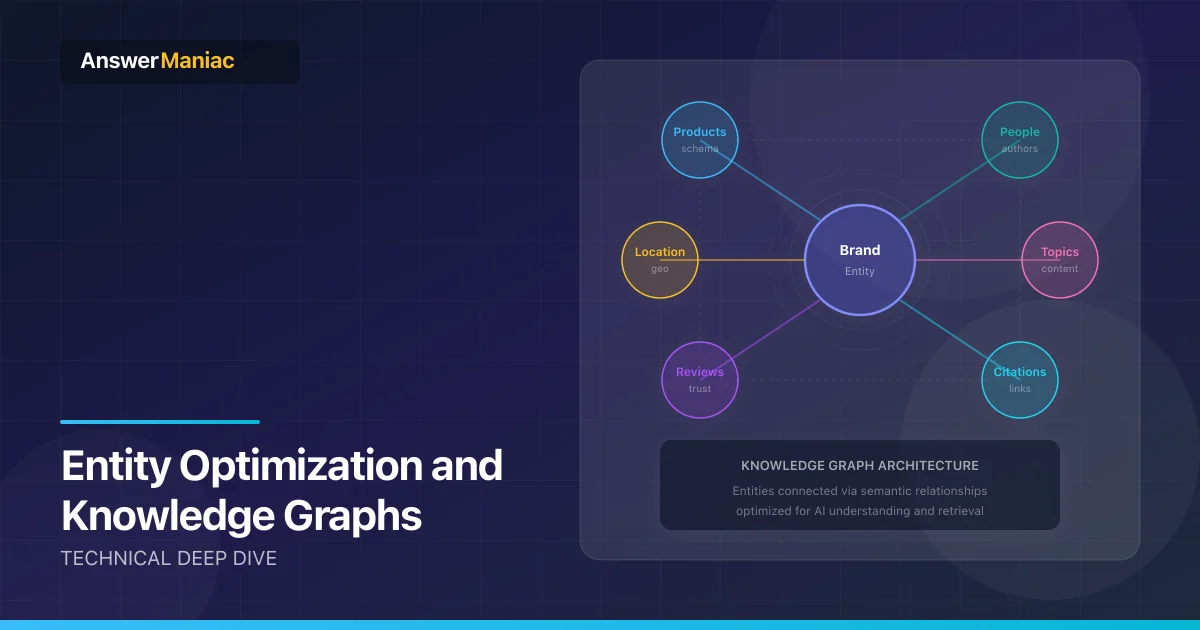
Entities don't exist in isolation. AI models understand relationships between entities. Your company is connected to:
- Category entities: "CRM software," "AEO agency," "compliance platform"
- Competitor entities: Companies AI groups you with
- Person entities: Your founders, leadership team
- Location entities: Where you're based, where you serve
- Topic entities: The subjects you have authority on
Strengthening these connections helps AI place your brand correctly in its entity graph. Practical ways to do this:
- Comparison content: Creating "Your Company vs. [Competitor]" pages explicitly links your entity to competitors in the AI's model
- Category definition content: Writing definitive guides about your category ("What is AEO?") links your entity to the category
- Leadership profiles: Ensuring founder/CEO entities on LinkedIn, company website, and speaker bios are connected to the company entity
- Location pages: Connecting your entity to geographic entities (city, state, country)
How to Verify Entity Optimization
After implementing changes, verify that AI models are picking them up:
1. Google Knowledge Panel Test
Search your company name on Google. If a Knowledge Panel appears on the right, Google recognizes you as a formal entity. If not, your entity signals need strengthening.
2. Schema Validation
Run your pages through Google's Rich Results Test and Schema.org validator. Fix all errors and warnings.
3. AI Direct Query Test
Ask each AI platform directly: "What is [Your Company]?" The response reveals how the model understands your entity. Vague or incorrect responses indicate entity confusion.
4. Category Association Test
Ask AI: "What companies offer [your service category]?" If you don't appear, your entity isn't connected strongly enough to your category.
5. Cross-Reference Test
Ask AI about your company on two different platforms. If the descriptions differ significantly, your cross-web entity consistency needs work.
Entity Optimization Timeline
| Week | Focus | Expected Impact |
|---|---|---|
| 1 | Organization schema + About page entity hub | Foundation set; no immediate citation change |
| 2 | Cross-web consistency audit + corrections | AI Visibility Score +2-5 points |
| 3-4 | G2 profile completion + review campaign start | Perplexity citations begin appearing |
| 5-8 | Citation asset creation with entity connections | ChatGPT and Gemini citations emerge |
| 9-12 | Wikipedia/Wikidata (if eligible) + expert citations | Entity authority compounding |
| Ongoing | Monitoring + new entity connections | Sustained citation growth |
Common Entity Optimization Mistakes
1. Schema-only thinking. Adding JSON-LD to your pages is necessary but not sufficient. Schema describes pages; entity optimization builds cross-web identity.
2. Inconsistent naming. "AnswerManiac" on your website, "Answer Maniac" on LinkedIn, "AnswerManiac.ai" on G2. AI models may treat these as different entities.
3. Missing sameAs links. The sameAs property in Organization schema is your entity's connection map. Omitting it leaves AI guessing about which profiles belong to you.
4. Ignoring review platforms. G2 and Capterra are structured data sources AI treats as authoritative. An empty G2 profile is a missed entity signal.
5. Founder entity neglect. Your founder/CEO is an entity too. If their LinkedIn profile, company bio, and speaker profiles don't connect to the company entity, you're leaving authority on the table.
FAQ
What's the difference between schema markup and entity optimization?
Schema markup describes the content on your web pages using structured data (JSON-LD). Entity optimization is broader — it establishes your brand's identity across the entire web (LinkedIn, G2, Crunchbase, Wikipedia, Google Knowledge Graph) so AI models recognize you as a distinct, citable entity. Schema is one component of entity optimization, not the whole thing.
How do I know if AI models recognize my brand as an entity?
Ask ChatGPT, Perplexity, and Gemini: "What is [Your Company Name]?" If they give an accurate, detailed response, your entity is recognized. If the answer is vague, incorrect, or "I don't have information about that company," your entity signals need work.
Can a small company build entity authority?
Yes. Entity authority isn't about size — it's about clarity and consistency. A 10-person company with perfect cross-web entity consistency, 50 G2 reviews, and strong category content can outperform a 1,000-person company with messy entity data in AI citations.
How long does entity optimization take to affect AI citations?
Perplexity (real-time web access) can reflect entity changes within days. Gemini typically picks up Google-ecosystem changes within 2-4 weeks. ChatGPT and Claude depend on training data updates, which can take 4-8 weeks. Full entity optimization impact usually emerges over 2-3 months.
Should I create a Wikipedia article for my company?
Only if your company meets Wikipedia's notability guidelines (significant coverage in independent, reliable sources). A premature or poorly sourced Wikipedia article can be deleted and may hurt rather than help. If you don't qualify yet, focus on building the media coverage that would eventually make you notable.
What tools do you use for entity optimization?
Google's Rich Results Test for schema validation, Google Search Console for structured data monitoring, Ahrefs for backlink entity analysis, our own AI Visibility Tracker for cross-platform entity recognition testing, and manual audits of each platform's entity representation.
Get AEO Insights Weekly
Join 500+ B2B marketers getting AI visibility tactics every Tuesday.
Ready to Get Your Brand Cited by AI?
See how your competitors show up in ChatGPT, Perplexity, and Gemini — and what it would take to get recommended.
Related Articles
Should You Block or Allow AI Crawlers? A B2B Guide to GPTBot, ClaudeBot, PerplexityBot and Google-Extended
llms.txt for B2B: What It Is, Whether It Actually Works, and How to Ship One