AI Overviews vs. ChatGPT: Why Source Selection Is Your New SEO Battlefield
Discover how Google AI Overviews and ChatGPT select sources differently. Learn what gets cited, what gets ignored, and how to optimize your content for both.
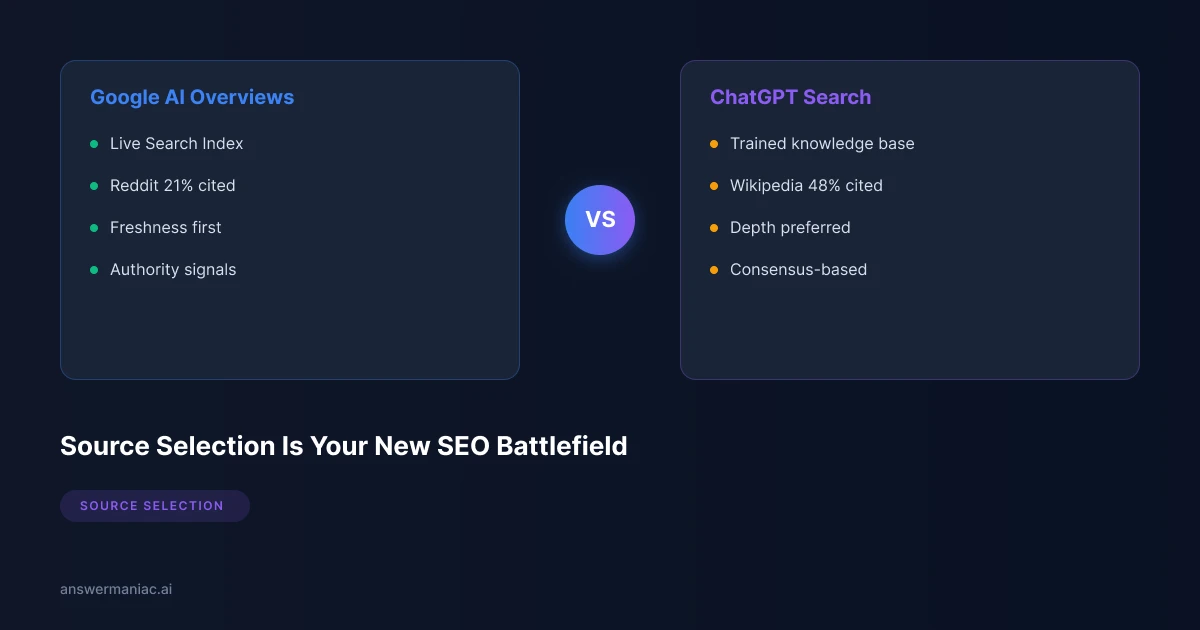
Direct Answer: Google AI Overviews pulls from its live search index, favoring top-ranked pages and fresh content, with Reddit as its most-cited single source at 21%. ChatGPT starts from its training data and leans toward authoritative reference sources, with Wikipedia cited in nearly 48% of sourced responses. Perplexity is the hybrid, mixing fresh sources with trusted references and always showing citations. To rank in all three, you need structured content, strong domain authority, and direct answers in the first 100 words.
Get a free AI visibility audit to see where your brand stands
Google AI Overviews and ChatGPT find answers differently. Google's system pulls fresh, direct answers from the live web, like a newsfeed. ChatGPT often relies on its internal knowledge and established sources, like an encyclopedia.
For creators, this means two different rulebooks. To get your content chosen by AI, you must know which engine you're talking to and what it's looking for. The rest of this article explains how each one works and what you should do about it.
Key Takeaways
- Google AI Overviews acts like a reporter, grabbing the latest, most discussed info from the current web (including Reddit and YouTube).
- ChatGPT works like a librarian, preferring established, authoritative sources for deep answers (especially Wikipedia and .edu domains).
- Perplexity is the hybrid, mixing fresh sources with trusted references and always showing its citations.
The Core Difference: Live Index vs. Trained Library
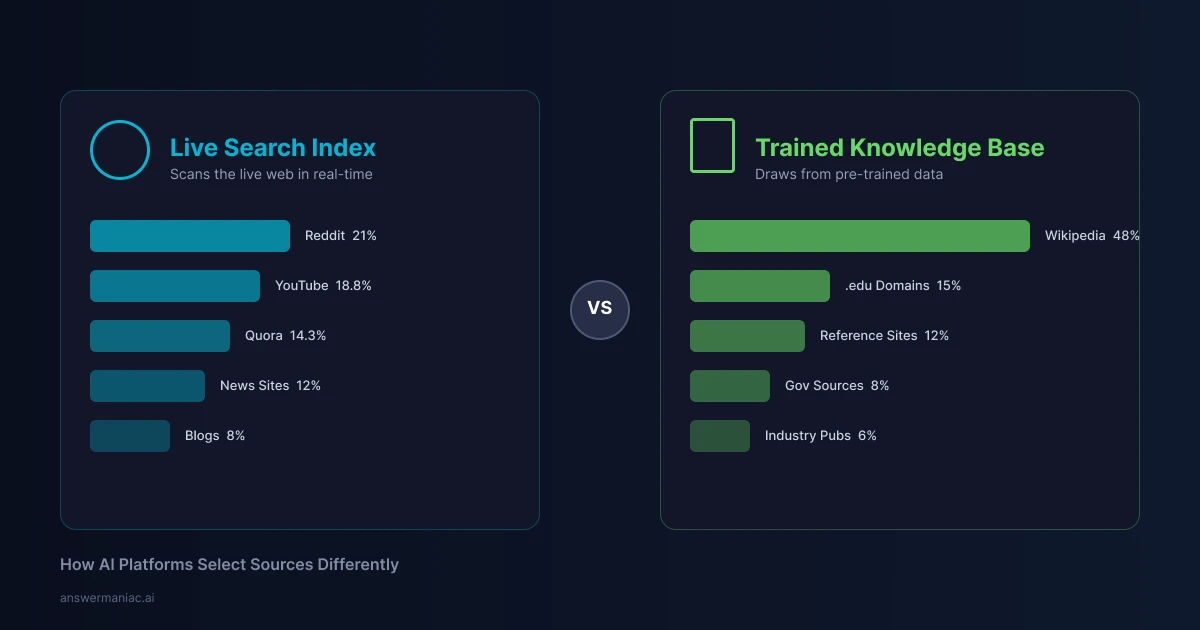
Google AI Overviews works from a live search index. When you ask a question, the system runs several related searches at once. This process, often called query fan-out, pulls fresh pages from across the web. The goal is to combine reliable sources into a short answer.
"While ChatGPT largely avoids user-generated content (less than 0.5% of its citations come from forums and social platforms), Google's AI Overviews cast a wider net. Reddit was the most cited single site for Google AI Overviews (21%), with YouTube (18.8%) and Quora (14.3%) also making the top list." - AI Boost Marketing
ChatGPT starts from a different place. It relies on patterns learned during training. That training includes books, articles, and websites, material closer to a large reference library than a live news feed.
ChatGPT may access the web through search when needed, but its main strength is summarizing knowledge it already learned. Understanding this distinction is the foundation of effective AI visibility tracking across platforms.
| Selection Driver | Google AI Overviews | ChatGPT (with Browsing) |
|---|---|---|
| Primary Source | Live Google Index | Pre-trained Data + Bing Search |
| Top Cited Source | Reddit (~21%) | Wikipedia (~48%) |
| Freshness Priority | Extremely High | Moderate (requires trigger) |
| Citation Style | Inline links and source cards | Numbered footnotes |
What Makes AI Overviews Cite a Page
AI Overviews looks for sources that are easy to verify and quote. Pages that clearly answer a question appear more often in citations. Structure helps a lot. Beyond clear headings and short explanations, content intro optimization makes it easier for the system to extract and surface your primary value proposition.
"Google provides cited, synthesized information directly from its search index in an information-first model, while ChatGPT acts as a conversational tool to complete tasks using its training data in a task-first model." - Semai AI
The system also values community discussions. Reddit, Quora, and YouTube comments can show real experiences that formal articles may miss.
Key signals include:
- Strong topical relevance to the query
- Recent updates or fresh publication dates
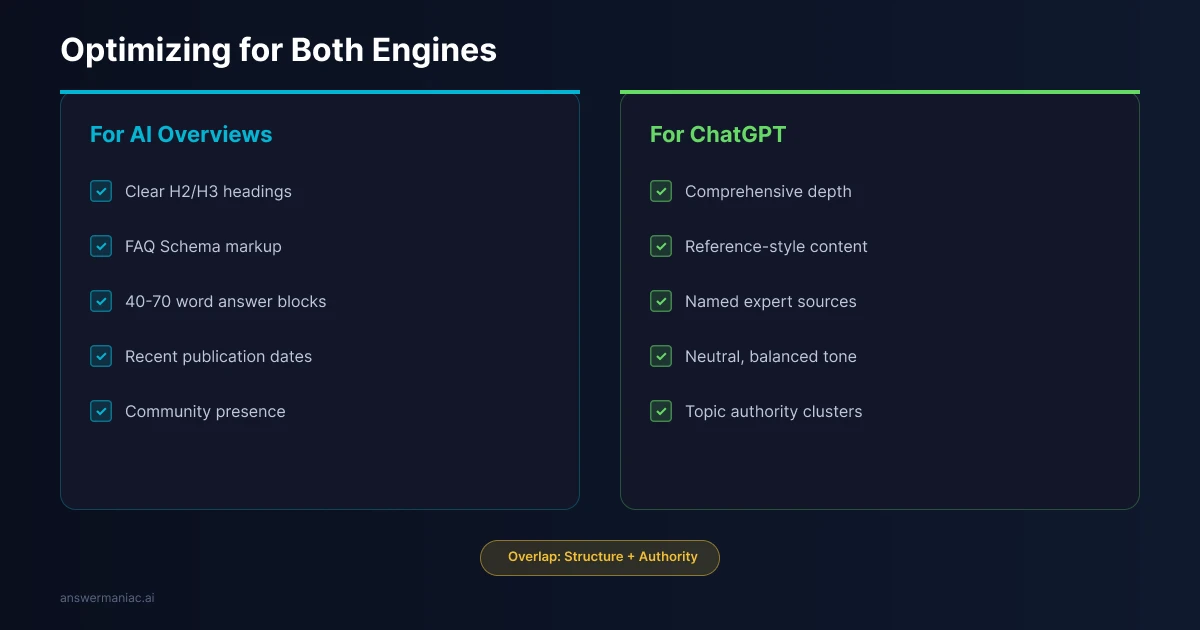
- Clear answer blocks that summarize the topic in 40-70 words
- Structured markup such as FAQ schema
- Trust signals tied to E-E-A-T (Experience, Expertise, Authoritativeness, Trustworthiness)
Because of this, discussion platforms sometimes appear in results alongside traditional publishers. The mix helps AI Overviews show both expert guidance and practical experience.
Why ChatGPT Prefers Different Websites
While Google's engine is scanning the horizon, ChatGPT consults its internal archives. Its source selection, when it does browse, is guided by a different set of priorities. It classifies your search intent and looks for the most credible, comprehensive source to match it.
This leads to a well-documented bias. ChatGPT cites Wikipedia for nearly half of its sourced responses. The platform's training emphasized authoritative, reference-style data, and that preference shows through. It looks for stability and consensus, not necessarily the latest update.
Its approach can feel less tied to traditional SEO rankings. It might bypass the number one organic result if it finds a source from a .edu domain or a specialized publication that better matches the nuanced intent of the query. For complex, multi-step questions, it excels at synthesizing information from disparate points into a single, cohesive narrative.
This is where the ANSWER Framework comes in. Building topical authority through structured content clusters helps your brand earn citations from ChatGPT's preference for depth and expertise.
The Real-World Impact: Case Studies in Citation
Different sourcing methods can lead to different answers for the same question. We tested this across 50 B2B queries in our AI citation analysis and found consistent patterns.
For a query like "best payroll software for remote teams":
AI Overviews cited:
- Recent comparison blog posts from HR publications
- Reddit threads with firsthand user reviews
- Product pages with recent feature updates
ChatGPT cited:
- Established review sites like G2 and Capterra
- Wikipedia-style category overviews
- Vendor pages with comprehensive documentation
The brand that appeared in both? The one with coverage across multiple source types, recent content, community presence, AND authoritative documentation. That's why Digital PR matters for AI visibility. It creates the multi-source footprint both platforms look for.
How to Optimize for Both Generative Engines
Modern search visibility focuses on Answer Engine Optimization (AEO), using AI citation analytics to create content that AI systems can read, verify, and quote easily.
Practical steps:
- Use clear H2 and H3 headings that match common questions buyers actually ask
- Add FAQ or HowTo schema where it fits naturally
- Write short answer blocks of about 40-70 words that directly address the query
- Update important pages regularly so both freshness-oriented (Google) and authority-oriented (ChatGPT) systems value them
- Build community presence on Reddit and Quora for Google AI Overviews coverage
- Maintain comprehensive reference pages for ChatGPT's preference for depth
Tracking AI share of voice helps measure progress, which is becoming a critical metric for maintaining AI search visibility in competitive sectors like finance and technology.
FAQ
Why do AI answers sometimes include forum discussions?
Many AI summaries include information from community discussions because they reflect real experiences. Forums contain practical advice, troubleshooting steps, and everyday insights that formal articles sometimes miss. Google AI Overviews particularly favors Reddit (21% of citations) and Quora (14.3%) as sources of authentic user experience. AI systems use them to capture real-world perspectives, especially for questions about tools, products, or daily workflows.
How does Google AI Overviews decide which page to cite?
Google AI Overviews uses a query fan-out process, running multiple related searches simultaneously and pulling from top-ranked results in its live index. Pages with strong domain authority, clear answer blocks, recent publication dates, and structured markup (FAQ schema, Article schema) have the highest citation rates. Unlike traditional search, it may synthesize information from multiple pages into a single answer, citing each source individually.
Why does ChatGPT cite Wikipedia so often?
ChatGPT's training data heavily featured authoritative, reference-style content. Wikipedia's comprehensive, neutral, well-structured format aligns with what the model learned to value. When ChatGPT browses the web, it maintains this preference for authoritative, consensus-based sources. For B2B brands, this means maintaining a Wikipedia page (if notable enough) or ensuring your content matches that level of comprehensiveness and neutrality.
Can you optimize for AI Overviews and ChatGPT with the same content?
Yes, but it requires a dual approach. Structure your content with clear, direct answers in the first 100 words (for both platforms), add structured schema markup (favored by AI Overviews), maintain comprehensive depth (favored by ChatGPT), and update regularly (favored by AI Overviews). The overlap zone is high-quality, structured, authoritative content that directly answers specific queries.
The Verdict on Source Selection
Google AI Overviews shows its sources with links. This makes its answers verifiable and tied to the current web. ChatGPT connects ideas well and offers nuance. But without its browser active, it mixes information from its training without clear citations.
Your content must meet all their rules: be authoritative, fresh, structured, and answer directly. This is what AnswerManiac is built for. We turn your expertise into the answer AI recommends.
References:
Get AEO Insights Weekly
Join 500+ B2B marketers getting AI visibility tactics every Tuesday.
Ready to Get Your Brand Cited by AI?
See how your competitors show up in ChatGPT, Perplexity, and Gemini — and what it would take to get recommended.