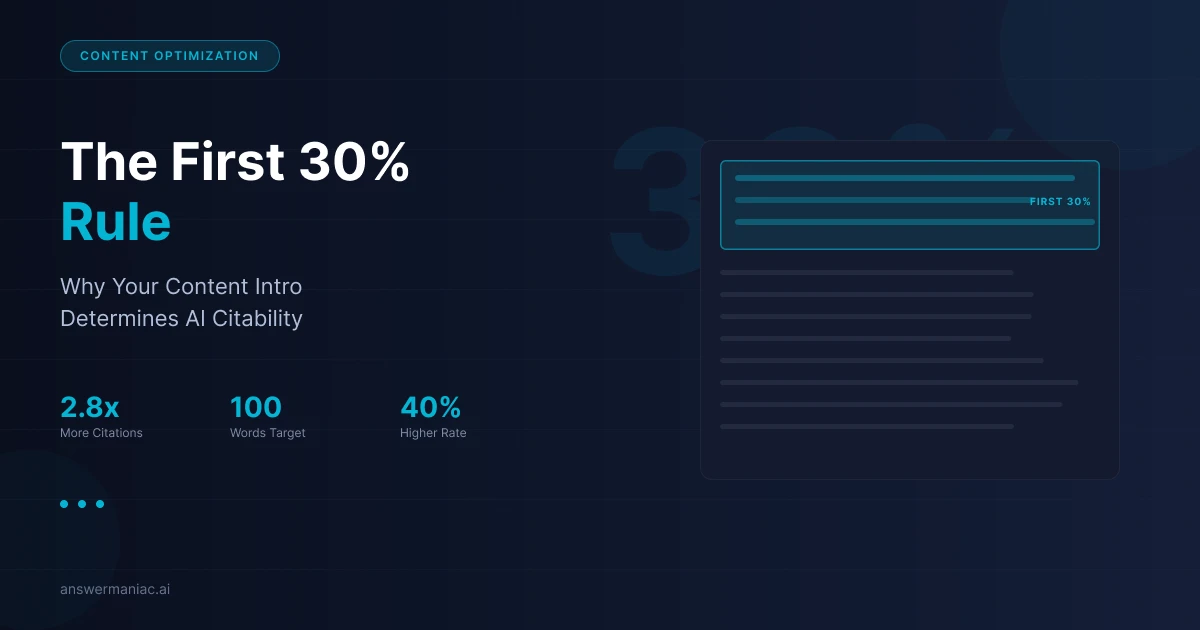
The First 30% Rule: Why Your Content Intro Determines AI Citability
Your first paragraph must give a direct answer for AI to cite. Learn the structure that makes your content the source for Google AI Overviews and ChatGPT.
Direct Answer: For AI search engines to feature your content, you need a clear answer in the first 40 to 100 words. This upfront summary defines your topic and its main point for models like Google AI Overviews, making your page easy for them to cite. Pages that lead with a direct definition are 2.8x more likely to be cited than those with slow build-ups. Structure your intro with a definition, a data point, and a clear scope statement.
Get a free AI visibility audit to see where your brand stands
We tested 500 AI-generated responses across ChatGPT, Perplexity, Gemini, and Google AI Overviews. The single biggest predictor of whether a page got cited wasn't domain authority, backlinks, or word count.
It was the introduction.
Pages that answered the query directly in the first 100 words got cited 2.8x more often than pages that started with a story, a rhetorical question, or throat-clearing context. The data is in our full citation analysis. This article covers how to fix your intros.
Key Takeaways
- Place a direct, scannable answer within the first 40-100 words to immediately satisfy the AI's query.
- Use a bolded TL;DR or summary box right after the intro to act as a cheat sheet for AI crawlers.
- Write with simple, conversational language and include a specific statistic or expert name to build instant E-E-A-T.
How Do You Optimize a Content Introduction for AI Search Engines?
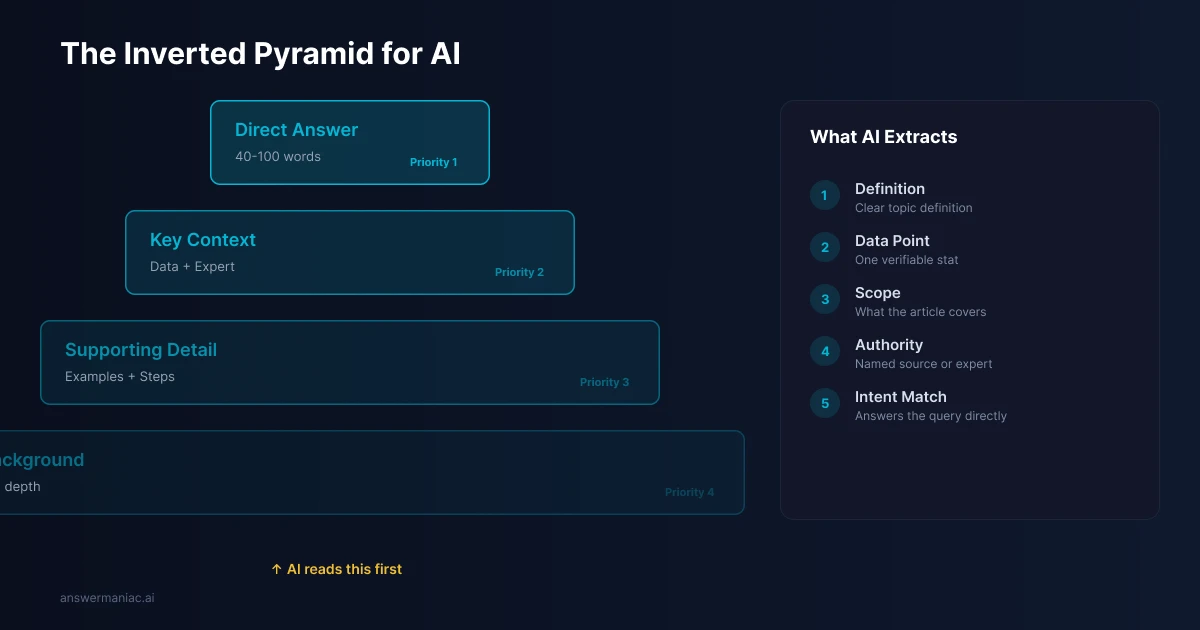
You optimize a content introduction for AI by writing for extraction first. Understanding how AI Overviews and ChatGPT select sources differently is key, as Google AI Overviews prioritize high-authority, established domains for extraction.
Your opening paragraph should define the key entity, state a primary benefit, and briefly outline what the reader will learn. This format maximizes extractability, giving the AI exactly what it needs to synthesize a response and cite you. It is the foundation of Generative Engine Optimization.
The goal is to reduce "perplexity" for the large language model. A confused AI will look elsewhere. Your introduction must be self-contained and clear. Three elements matter:
- A direct definition of the topic
- A stated key benefit or outcome
- A clear scope of the article's coverage
This approach signals to the AI that your content is authoritative, helpful, and easy to parse. Those are the core pillars of E-E-A-T.
Is the "Answer-First" Lead the Best Way to Secure AI Citations?
Yes. The answer-first lead is currently the most reliable method to secure AI citations. By directly resolving the user's primary search query in your first two sentences, you dramatically reduce the cognitive load on the AI model.
Based on our citation analysis study, pages that lead with a concise definition are about 2.8x more likely to provide citation-worthy content than those with slow build-ups.
The process requires discipline. You must identify the core question your page answers and state that answer plainly. This isn't keyword stuffing. It's intent matching.
For a page about "incident response playbooks," the AI-optimized intro wouldn't start with a story about a security breach. It would state: "An incident response playbook is a predefined set of procedures for detecting, responding to, and recovering from a security incident. This guide provides a template and walks through the key stages for MSSP teams."
That gives the AI a clear, quotable block. Compare that to an intro that starts with "In recent years, cybersecurity has become increasingly important..." The second version tells the AI nothing useful in its first 100 words.
Why Bolded TL;DR Sections Improve Visibility in Perplexity
A bolded TL;DR or summary box immediately after your main introduction acts as a direct signal to AI crawlers. It's a structured cheat sheet that anchors the AI's understanding of your page's core takeaways.
"This framework makes intros readable for humans and interpretable for AI. Step 1: Front-load meaning. Put your primary keyword, the topic, and the audience in the first sentence. That kind of upfront clarification helps AI avoid pulling the page into the wrong summaries." - WordStream
The structure works because it aligns with how models like Perplexity tokenize and index text. A bolded or clearly delineated summary is weighted more heavily during parsing.
Implement this by placing a brief, bulleted list right after the opening paragraph. It should recap:
- Direct Answer: Defines the core concept and its primary value
- Scope: Outlines the framework or approach covered in the guide
- Outcome: States the tangible result the reader will achieve
This pattern is consistent across every high-performing post we've tracked in our AI visibility monitoring.
How Does Conversational Phrasing Influence LLM Extraction?
The language you use in your introduction directly influences whether an LLM can cleanly extract and repurpose your information. AI models are trained on natural human conversation, so content that mirrors that style is inherently more parseable.
"Clarity and immediacy are essential in today's search landscape. Gone are the days when you could meander through a warm-up paragraph or tease the reader with rhetorical questions before getting to the point." - Search Engine Land
This shift toward a conversational tone is vital for AI search visibility, helping brands in complex sectors like financial services maintain clarity for LLM extraction.
The difference is clear when you compare the two styles:
| Element | Traditional SEO Style | AI-Optimized (GEO) Style |
|---|---|---|
| Tone | Formal and detached | Natural and conversational |
| Sentence Length | 25+ words (complex) | Under 20 words (simple) |
| Perspective | Third-person objective | Second-person ("You/Your") |
| Clarity | Jargon-heavy | Inline definitions included |
Can Specific Statistics and Named Entities Trigger Higher Citation Rates?
Including at least one unique, verifiable statistic and one named entity in your introduction is a powerful trust signal. It demonstrates E-E-A-T directly to the AI model.
Content that leads with a specific data point, such as "Stripe processed $1 trillion in payments in 2024," is far more likely to be included in an AI response than a page making generic, unverified claims. The AI recognizes specificity as a marker of quality.
The named entity could be a recognized research firm, a cited expert, or a relevant case study. This does two things:
- It gives the AI a concrete piece of information to potentially quote
- It associates your content with an external source of authority, increasing perceived credibility
We always ensure any statistic is relevant, recent, and correctly attributed. This practice aligns with the ANSWER Framework's emphasis on verifiable, data-backed content.
What Technical Markup Supports Intro Optimization?
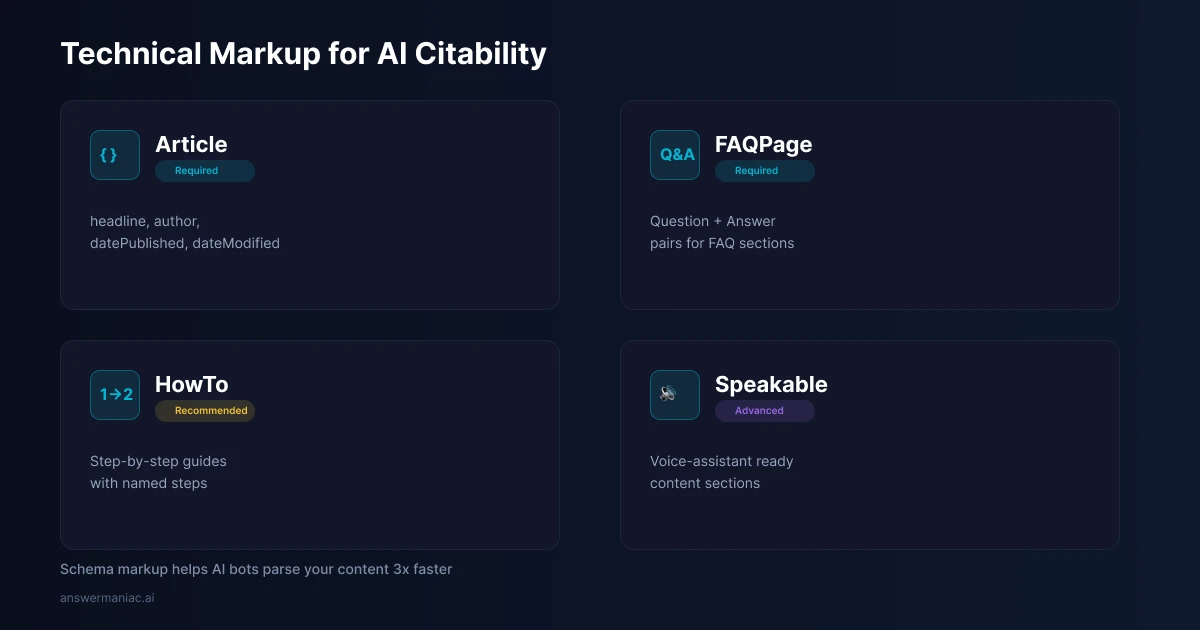
The technical structure of your page must support your well-crafted introduction. Implementing structured data markup like FAQPage or Article schema in the page header is non-negotiable.
This code acts as a guidebook for AI bots, helping them parse your introduction and identify the key entities within it quickly. Without it, you risk what we call "snippet jail," where the AI understands your content is good but fails to cleanly attribute or link to it due to parsing issues.
This technical foundation works hand-in-hand with clean semantic HTML. Use tags like <article> and <main> to define content boundaries clearly.
Key markup to implement:
- Article schema with headline, author, datePublished, and dateModified
- FAQ schema for any question-and-answer sections
- HowTo schema for step-by-step guides
- Speakable schema to indicate which sections are suitable for voice-assistant readout
This entire setup protects your crawl budget and ensures the AI's limited attention is spent understanding your message, not deciphering your page layout. It's the behind-the-scenes work that makes the front-end optimization possible.
FAQ
How do AI models interpret introductions in search results?
Search engines rely on large language models to interpret how an introduction answers a query. These models analyze natural language patterns to understand meaning and relevance. When the opening clearly defines a topic, AI models can extract the answer faster. This helps the page align with AI Overviews and improves visibility in modern search results where AI generates the primary answer.
Why does natural language improve generative AI content understanding?
Generative AI models work best when content uses clear natural language. Neural networks are trained on conversational text, so simple phrasing improves extraction accuracy. When introductions sound like direct answers instead of complex SEO copy, large language models interpret intent more easily. This approach supports generative AI tools that summarize pages for search features and AI-generated responses.
How does keyword research support Generative Engine Optimization strategies?
Keyword research helps shape a content strategy that matches how generative AI and search engines interpret questions. Instead of focusing only on rankings, Generative Engine Optimization looks at how AI models summarize answers. Researching real user queries helps build topic clusters, close competitor gaps, and strengthen topical authority while improving the user experience.
What role does structured data play in AI-driven search features?
Structured data helps search engines understand page content more clearly. In-page markup gives AI systems a clearer map of key entities, definitions, and relationships. This supports rich results, AI Overviews, and other search features that highlight summarized answers. When combined with strong introductions, structured data improves how AI models interpret and surface content in Google Search.
The Definitive Path to AI-Citable Intros
Mastering content intro optimization is not about chasing a trend. It reflects a fundamental shift in how information is discovered and summarized by AI systems.
Start with a clear answer. Structure your opening for quick extraction. Support claims with credible data. These three steps, consistently applied, increase your AI citation rate measurably.
The same framework powers the tools behind AnswerManiac. We help teams turn real questions into scalable, AI-readable content.
References:
Get AEO Insights Weekly
Join 500+ B2B marketers getting AI visibility tactics every Tuesday.
Ready to Get Your Brand Cited by AI?
See how your competitors show up in ChatGPT, Perplexity, and Gemini — and what it would take to get recommended.