How to Get Your Software Recommended in AI 'Best Tools' Answers
When a buyer asks ChatGPT or Perplexity for the best software in your category, here's how your product earns a spot on the AI shortlist over a rival.
Direct Answer: AI assistants build "best [category] software" shortlists from entity clarity and third-party corroboration, not raw market share. To get named when a buyer asks ChatGPT or Perplexity for the best tool in your category, make your product a cleanly resolved entity (one name, one category, consistent everywhere), earn mentions on sources the engines read (G2, Capterra, Reddit, independent roundups), and describe yourself in the exact category words buyers type. The smaller, clearer vendor that shows up in third-party sources often beats the bigger one that only shows up on its own site.
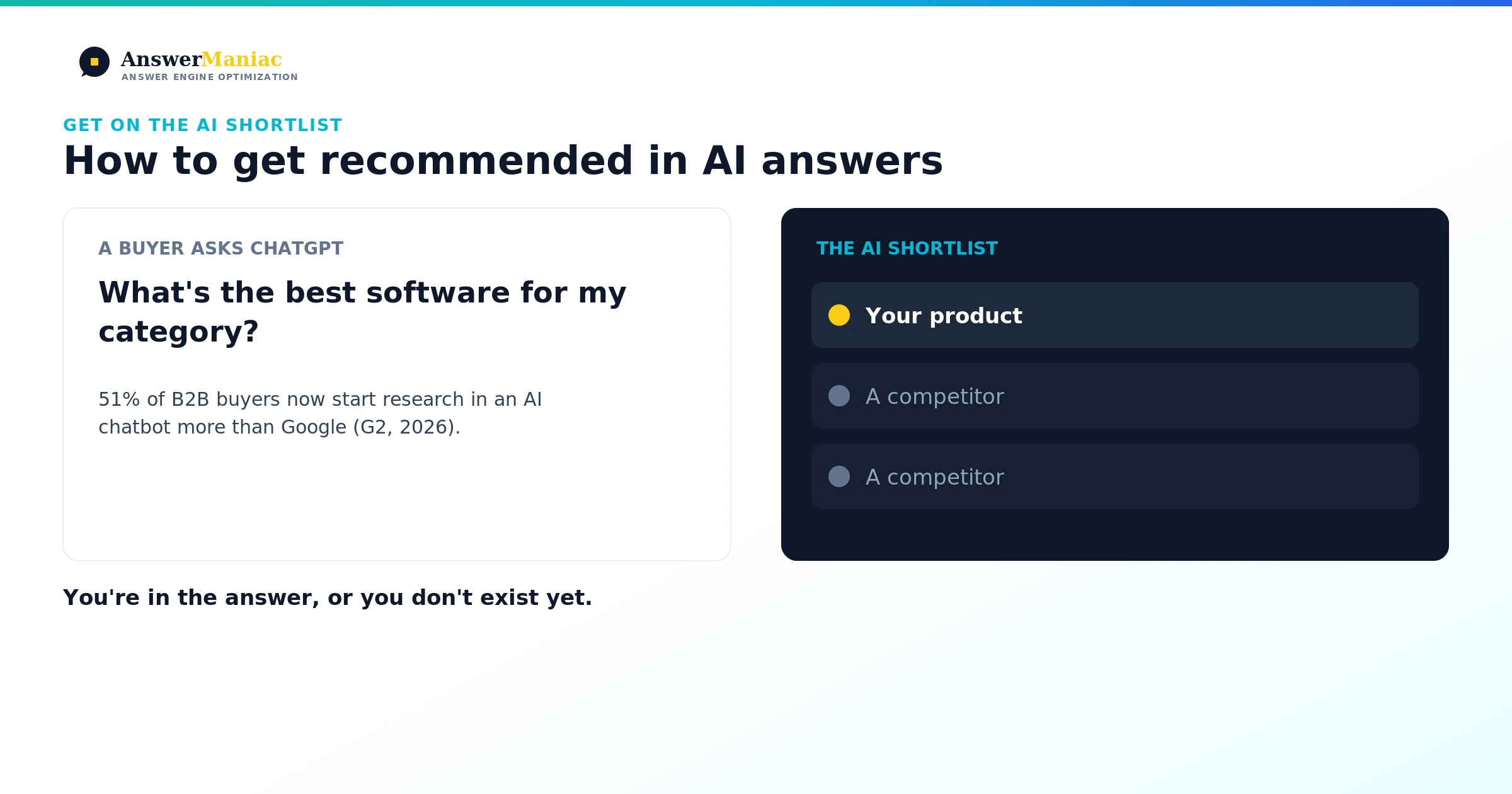
The buyer isn't going to Google first anymore. In G2's 2026 Answer Economy research, 51% of B2B software buyers said they now start research with an AI chatbot more often than with a search engine. So the first shortlist your prospect sees isn't ten blue links. It's four or five product names inside a ChatGPT answer, and you're either in it or you don't exist yet.
Check how AI sees your business — run the exact "best [your category] software" query and see who gets named.
Here's the part most vendors get wrong. They assume being the biggest player in the category means the assistant will name them. It doesn't work that way. The shortlist is assembled from what the model can confidently resolve about your company and what credible third parties say about you, and those two things are buildable even when you're not the market leader.
Key Takeaways
- AI "best tools" answers are shaped by entity clarity plus third-party corroboration, not market share. A clearly defined mid-market tool beats a fuzzy giant.
- The engine you can win first is usually Perplexity. It runs live retrieval and summarizes outside sources, so a findable external footprint moves it fast. ChatGPT leans on settled entity knowledge, which takes longer to shift.
- Review sites and community threads matter more than your homepage. G2, Capterra, Reddit, and independent roundups are where the assistant checks whether you belong on the list.
- Match the buyer's category language exactly. If you call yourself a "unified revenue intelligence studio" instead of "sales forecasting software," you match the clever phrase nobody searches and miss the query that builds the shortlist.
Why market share doesn't decide the shortlist
I ran a test last month that still bugs me. I asked ChatGPT for the best software in a niche B2B category I know well, then asked Perplexity the same question. The two shortlists barely overlapped. One named a vendor with maybe 2% market share. The other skipped the clear category leader entirely. If recommendations tracked market size, that couldn't happen.
It happens because the two systems answer the question differently. Perplexity retrieves live pages and summarizes what it finds, so it surfaces whoever has a readable external footprint right now. ChatGPT answers more from settled knowledge about which companies are distinct, authoritative entities in a category. Neither one is reading your pitch deck. They're reading the web's consensus about who does what, and reconstructing a shortlist from it.
Our own numbers make the gap concrete. In AnswerManiac's Q3 2026 study of 332 B2B companies, roughly half earned zero citations from either ChatGPT or Perplexity. Perplexity cited 158 of them and ChatGPT cited just 52, with only a small overlap cited by both. Same companies, same category queries, wildly different results by engine. If you're invisible today, the fastest path onto a shortlist is almost always Perplexity, because you can influence what it retrieves faster than you can reshape what ChatGPT already believes.
That split is the whole strategy in miniature. You're not optimizing for one ranking. You're making yourself legible to two different machines that decide inclusion in two different ways. We broke the structural differences down in cited vs invisible: the patterns that separate B2B challengers AI recommends.
Become a resolvable entity first
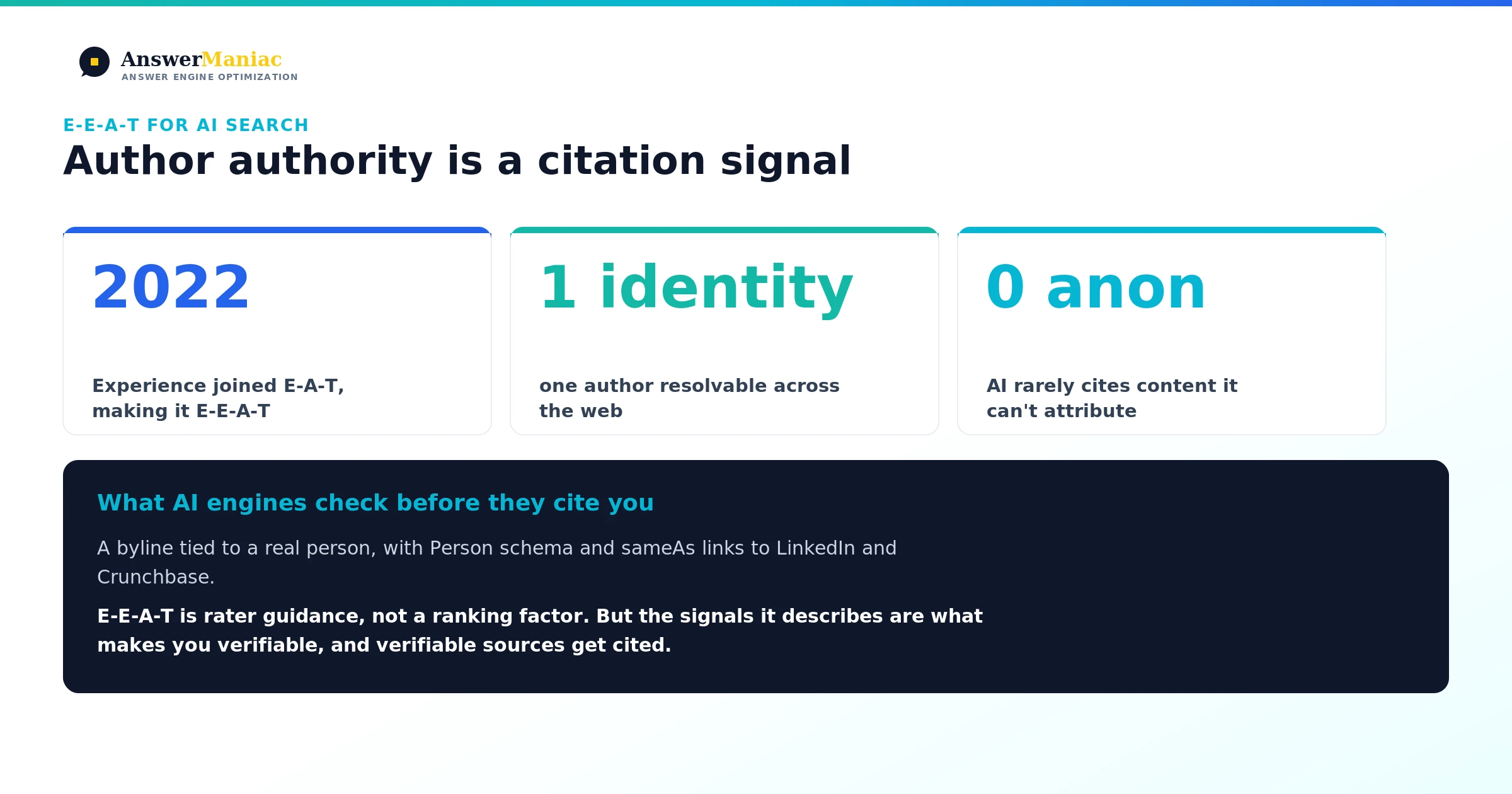
Before you earn a single new mention, fix who you are. An assistant can only put you on a shortlist if it can confidently answer "what is this company and what does it do." When your name shows up three ways across the web and your category description shifts from page to page, the model does the safe thing and names a competitor it can resolve cleanly.
Entity clarity is unglamorous and it compounds. One canonical company name, used identically on your site, your review profiles, your LinkedIn, and anywhere third parties describe you. One stable category label. One consistent one-line description of what you do and who it's for. Where possible, a structured presence (Wikidata, Crunchbase, a clean knowledge panel) that pins the entity down so the model isn't guessing.
This is the slow work that eventually unlocks ChatGPT, the engine that rewards settled knowledge. It's also the single biggest lever most teams ignore because it isn't content, it's identity. The mechanics live in entity optimization, and the broader scorecard is what we call AI visibility.
Two quick checks:
- The three-query name test. Ask three different assistants "what is [your company]." If you get three different category answers, you have an entity problem, not a content problem.
- The consistency sweep. Pull your name and one-line description from your homepage, your G2 profile, and your top two third-party mentions. If they don't match, that's your first week of work.
Earn the third-party corroboration the engines actually read
Your homepage is not the evidence. When an assistant answers "best expense management software for startups," it's weighing what independent sources say about your category and checking whether you appear in them. In our Perplexity citation data across the Q3 study, review-site URLs showed up in a meaningful share of answers, with independent editorial and roundup pages making up most of the rest.
So the highest-impact visibility work happens off your own domain. A few priorities, in rough order of speed-to-impact:
- Review platforms, kept current and specific. G2 and Capterra profiles with recent, detailed reviews give the engines a readable, structured description of what you do and who rates you. This matters more now that G2 agreed to acquire Capterra, Software Advice, and GetApp from Gartner in January 2026, consolidating the review data these answers draw on. We cover the nuance in do G2 and Capterra reviews get you cited by AI.
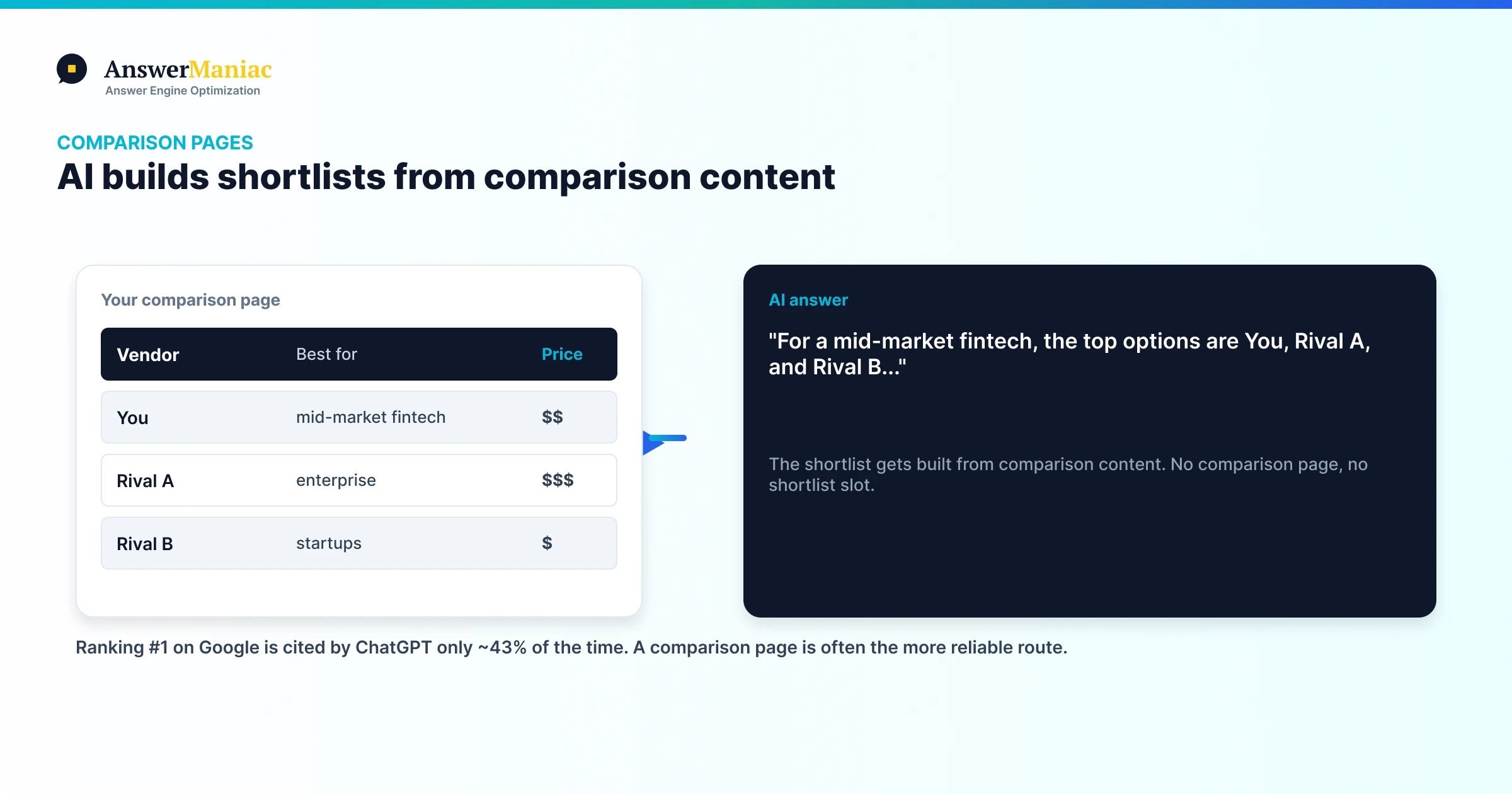
- Independent category roundups. The "best [category] software in 2026" listicles are literally the format the assistant is imitating. Being named in credible ones is close to a direct line into the AI shortlist. Our own worked examples, like best franchise development software and best fleet management software, are built exactly for this: clear category framing, named vendors, real detail an engine can lift.
- Genuine community discussion. Reddit and Quora threads where real users name tools in your category carry weight, especially on Perplexity, which pulls from forums more than ChatGPT does. You can't fake this. You can earn it by being worth mentioning and by showing up where your category gets discussed.
The goal of all of it is a simple one: when the engine goes looking for who belongs in your category, you're already in the sources it trusts. That's what turns a stray AI brand mention into a reliable shortlist slot.
Speak the category's language, then own it
The cited companies describe themselves in the exact words buyers search. The invisible ones describe themselves in words they invented. A buyer asks for a "NetSuite implementation partner for manufacturing," and the vendor that calls itself exactly that gets matched. The one that calls itself a "business transformation studio" matches nothing.
Audit your own copy for the gap. If your category page leads with a clever internal phrase instead of the plain term buyers and roundup writers use, you're optimizing for a query that doesn't exist. Lead with the category. Then differentiate inside it.
The more ambitious move is defining a sub-category you can legitimately own. If the broad category is crowded with incumbents, the "best [specific use case] software" query has fewer defensible names and a clearer path to inclusion. Pick the slice where you're genuinely the obvious answer, describe it in buyer language everywhere, and get third parties to describe you that way too. Over time that's how you build real share of voice in AI instead of fighting for scraps in a category you'll never lead.
Measure the right thing: did you get named
Rankings and traffic are the old scoreboard. The new one is binary and then proportional: first, do you get named at all for your category queries, and second, how often relative to competitors. Track the actual "best [category]" prompts your buyers use, across ChatGPT and Perplexity, and watch two numbers: your inclusion rate (what share of answers name you) and your citation share (when sources are listed, how often one is yours).
This is the measurement spine of The ANSWER Framework, our audit-to-refine method for AI visibility. You can't improve what you don't query. Run the shortlist prompts weekly, log who got named, and point your entity and corroboration work at the gaps.
FAQ
How long does it take to get recommended in AI answers? Perplexity can shift in weeks once you have real third-party sources it can retrieve, because it summarizes live pages. ChatGPT is slower, often a few months, because it relies on settled entity knowledge that updates less often. Start with the engine you can win, then let the entity work compound into the harder one.
Do I need to be the market leader to get named? No. Inclusion tracks how cleanly the model can resolve you and whether credible third parties corroborate you, not your revenue. In our Q3 study, plenty of smaller vendors got cited while larger, fuzzier ones didn't. A clear mid-market tool with strong review profiles beats an ambiguous giant with only a homepage.
Are G2 and Capterra reviews enough on their own? They're a strong foundation, not the whole job. Review profiles give the engines a readable, structured description of you, which helps a lot. But independent roundups, consistent entity data, and genuine community mentions all reinforce the signal. One source rarely carries a shortlist slot by itself.
Can I just pay to be listed in "best software" roundups? Paid placements in low-quality listicles tend not to move the engines, and they can hurt trust if they read as advertorial. What works is being named in roundups credible enough that the assistant already treats them as sources. Earn those through genuine fit and real reviews, not a line item.
What's the single fastest thing I can do this week? Fix entity clarity and refresh your top review profile. Standardize your name and one-line category description everywhere, then make sure your G2 or Capterra profile uses that same language and has recent, specific reviews. It's the highest-impact first move before any content work.
When a buyer asks ChatGPT for the best software in your category, the shortlist is already decided by signals you can build: a resolvable entity, third-party proof, and category language that matches the query. Most of your competitors haven't done this work yet, which is exactly why the window is open.
Want to know where you stand right now? Run your recommendation check to see which queries name you and which name a competitor, or book a discovery call and we'll map the gaps. If you'd rather see how we run the whole process, start with our services.
Get AEO Insights Weekly
Join 500+ B2B marketers getting AI visibility tactics every Tuesday.
Ready to Get Your Brand Cited by AI?
See how your competitors show up in ChatGPT, Perplexity, and Gemini — and what it would take to get recommended.