Comparison Pages for AI Search: The B2B 'Best X' and 'X vs Y' Playbook
AI answers name 2 to 5 vendors, and they pull heavily from comparison content. Here's how to build 'Best X' and 'X vs Y' pages that get your B2B brand cited by AI.
Quick Answer
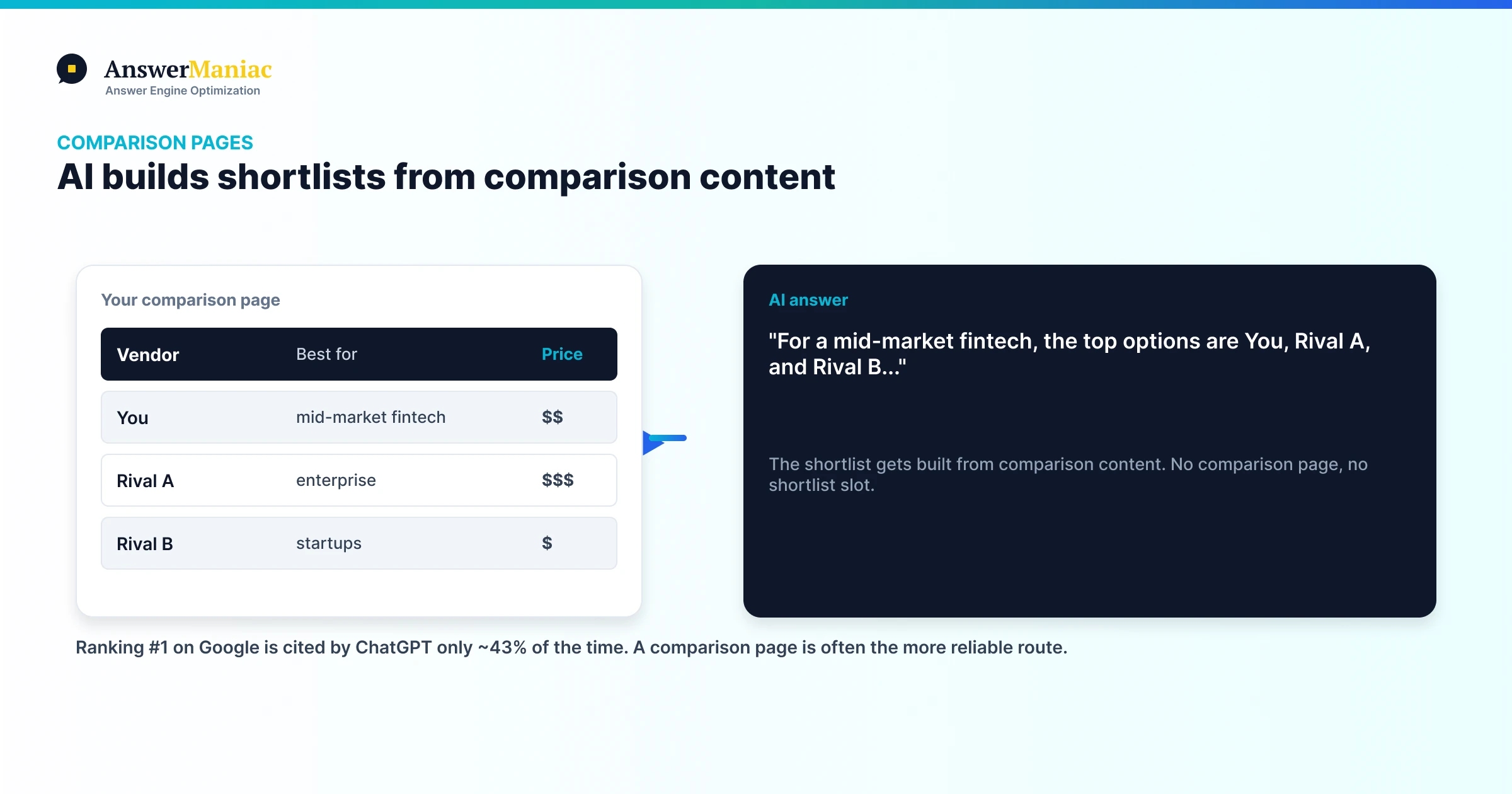
Why comparison pages win AI citations: When a B2B buyer asks AI "what is the best [category]" or "[Vendor A] vs [Vendor B]," the answer names two to five vendors and builds that shortlist largely from comparison and listicle content, because those formats are structured exactly how engines extract. Ranking number one on Google is cited by ChatGPT only about 43% of the time, so a well-built comparison page is often a more reliable path into the answer than a head-term ranking. The two page types that matter most: category listicles ("Best X for Y") and head-to-head pages ("X vs Y"). Build them with clear structure, honest criteria, and named alternatives, and you become a source the AI pulls from instead of a name it forgets.
Here is a pattern I see constantly. A B2B company has great product pages, a solid blog, and zero comparison content. Then they wonder why AI never puts them on the shortlist.
The reason is mechanical. When a buyer asks AI for the best option in a category, the AI has to assemble a shortlist. Where does it get one? Overwhelmingly from content that already compares vendors: "best X" listicles and "X vs Y" pages. If you have never published that kind of content, you are absent from the exact source the AI reaches for. Your competitors who did publish it are in the shortlist by default.
This is one of the highest-impact, most-overlooked plays in B2B AI visibility. This piece is the playbook: which comparison pages to build, how to structure them so AI pulls from them, and the honesty rules that keep them credible.
Why AI Loves Comparison Content
Two facts about how AI answers work explain the whole thing.
First, AI answers to commercial questions are shortlists. Ask "best compliance software for fintech" and you get two to five named vendors, not one and not twenty. The AI is doing the buyer's shortlisting for them.
Second, the AI builds that shortlist from sources structured for comparison. A comparison page states the category, lists the contenders, gives criteria, and often includes a table. That is exactly the shape an engine can lift into an answer. A generic product page is not.
There is a third fact that raises the stakes. Ranking number one on Google gets you cited by ChatGPT only about 43% of the time, so you cannot rely on a head-term ranking to carry you into AI answers. A purpose-built comparison page, structured for extraction, is often the more dependable route.
The Two Page Types That Matter
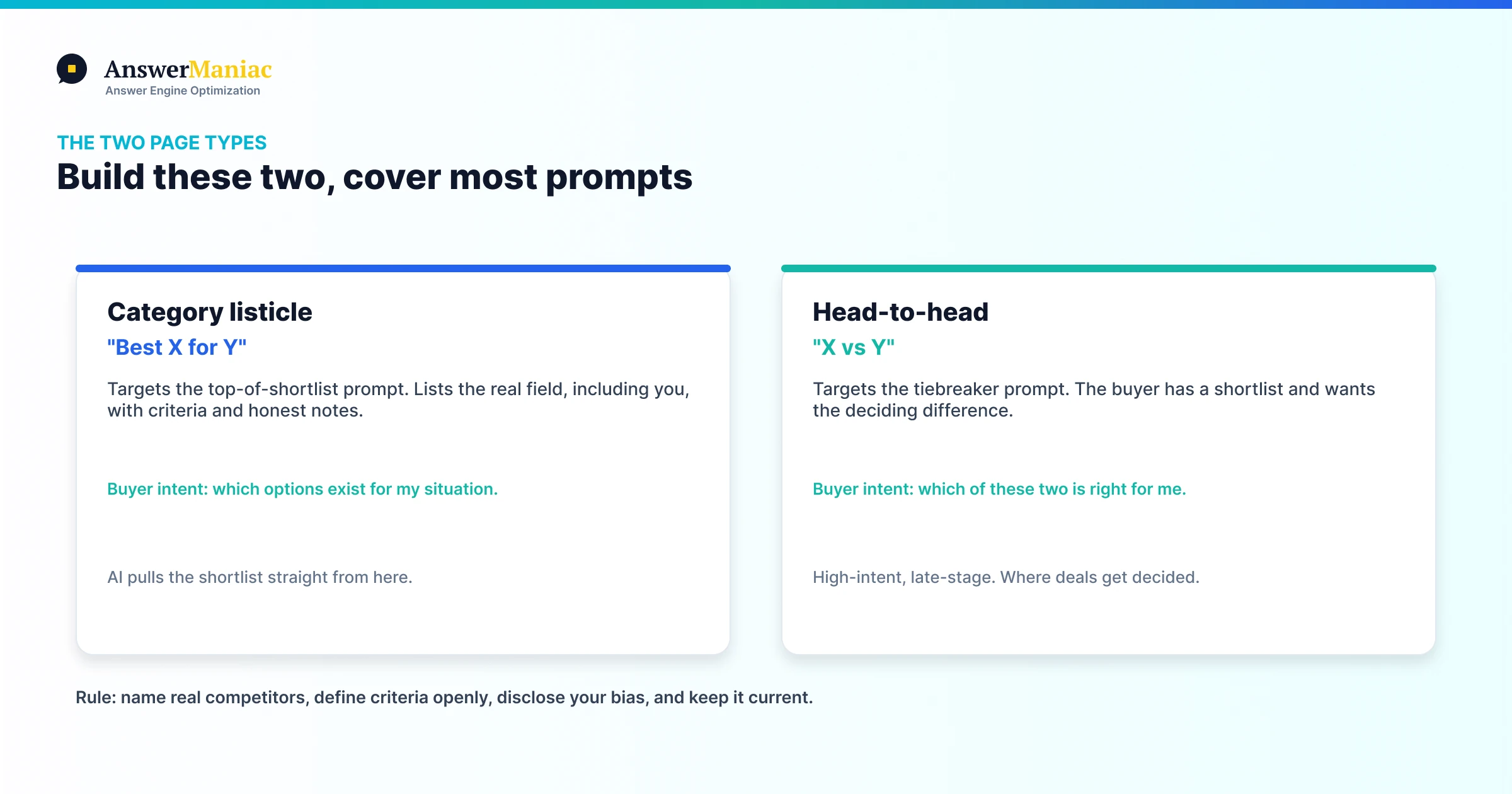
You do not need dozens of formats. Two carry most of the weight.
The category listicle: "Best X for Y." This targets the top-of-shortlist prompt. "Best fleet management software for mid-size logistics." It lists the real contenders in your category, including you, with criteria and honest notes on each. When AI assembles a shortlist for that category, this is the page it pulls from. Yes, you include competitors. That is the point: the AI trusts a list that names the field, not a page that only praises you.
The head-to-head: "X vs Y." This targets the tiebreaker prompt. "Vendor A vs Vendor B for [use case]." The buyer already has a shortlist and wants the deciding difference. These pages capture high-intent, late-stage prompts, and they are where you can honestly frame the comparison around the buyer situations where you win.
A quick note from experience: the instinct to write a "comparison" that is really just a sales page for yourself backfires. The AI, and the buyer, can tell. The pages that get cited are the ones that read like a fair guide, because fairness is what makes them a trustworthy source.
How to Structure a Comparison Page for AI Extraction
Format is not decoration here. It is what determines whether the AI can lift your content.
Open with a direct answer. State the category and name the top options in the first two lines, then expand. Engines pull cleanly from content that answers the question immediately.
Use a comparison table. A table with vendors as rows and criteria as columns (coverage, best-for, price posture, standout) is the single most extractable element you can add. It maps directly to how AI structures a shortlist.
Define your criteria openly. Say how you evaluated: the dimensions, why they matter, and how each vendor scores. Transparent criteria read as trustworthy and give the AI structured facts to cite.
Name real alternatives, including strong ones. A list that omits the obvious competitors looks biased and gets trusted less. Include them, and differentiate honestly on the buyer situations where you fit best.
Cover the follow-up questions. Add a short FAQ answering the objection, the integration question, and the "which is right for me" question, so the AI can satisfy the whole conversation from your page.
This is the Write stage of the ANSWER Framework in practice: building citation-worthy assets in the exact formats engines pull from. It pairs with the citation asset playbook, which covers the wider set of formats.
The Honesty Rules That Keep You Credible
Comparison content is powerful precisely because readers and engines expect it to be fair. Break that and you lose the advantage.
- Include competitors you would rather not mention. Their absence is a tell.
- Do not fabricate scores or criteria. Made-up numbers are the fastest way to lose trust, and they are exactly what the models are learning to discount.
- Disclose your own bias. On a page where you are one of the options, say so plainly. A disclosed bias is trusted more than a hidden one.
- Update it. Comparison content ages fast. Stale pricing or missing new entrants makes the page, and you, look unreliable.
Fairness is not a constraint on comparison content. It is the source of its power.
Frequently Asked Questions
Do comparison pages really get cited by AI more than product pages? Yes, for shortlist and tiebreaker prompts. AI builds vendor shortlists from comparison and listicle content because those formats are structured the way engines extract. Product pages rarely provide that structure.
Should I include competitors on my own comparison pages? Yes. A list that names the real field is trusted far more than a page that only promotes you. Include strong competitors and differentiate honestly on the buyer situations where you fit best.
Isn't ranking on Google enough to get cited? No. Ranking number one on Google gets cited by ChatGPT only about 43% of the time. A purpose-built comparison page structured for extraction is often a more reliable path into AI answers.
What is the most important element on a comparison page? A clear comparison table with vendors as rows and criteria as columns, plus a direct answer at the top. Those are the most extractable elements for AI.
How many comparison pages should a B2B company have? Enough to cover your main category listicle ("Best X for Y") and the head-to-head pages for the competitors your buyers actually weigh you against. Depth across your real buyer questions beats volume.
The Takeaway
AI answers to commercial questions are shortlists, and shortlists get built from comparison content. If you have no "Best X" or "X vs Y" pages, you are missing from the exact source the AI reaches for, and a Google ranking will not reliably save you. Build the two page types, structure them for extraction with clear tables and open criteria, name real competitors, and keep them honest and current. Fair comparison content is how you get pulled into the answer instead of forgotten.
Want to see which comparison prompts name you versus your competitors? Run a free AI visibility audit and start with your real buyer questions.
Sources
- Independent AI citation analysis, 2026: number-one Google results cited by ChatGPT about 43% of the time
- Reporting on AI answers naming two to five vendors and drawing on comparison and listicle formats
- AnswerManiac benchmark research: 100 B2B SaaS companies across 42 buyer-intent queries (ChatGPT cited 32 of 100)
Related Reading
Get AEO Insights Weekly
Join 500+ B2B marketers getting AI visibility tactics every Tuesday.
Ready to Get Your Brand Cited by AI?
See how your competitors show up in ChatGPT, Perplexity, and Gemini — and what it would take to get recommended.