How B2B Buyers Actually Prompt AI (and How to Match Your Content to It)
The average AI query runs 7 to 20+ words, and 65 to 85% of ChatGPT prompts have no matching keyword. Here's how B2B buyers really prompt AI and how to write for it.
Quick Answer
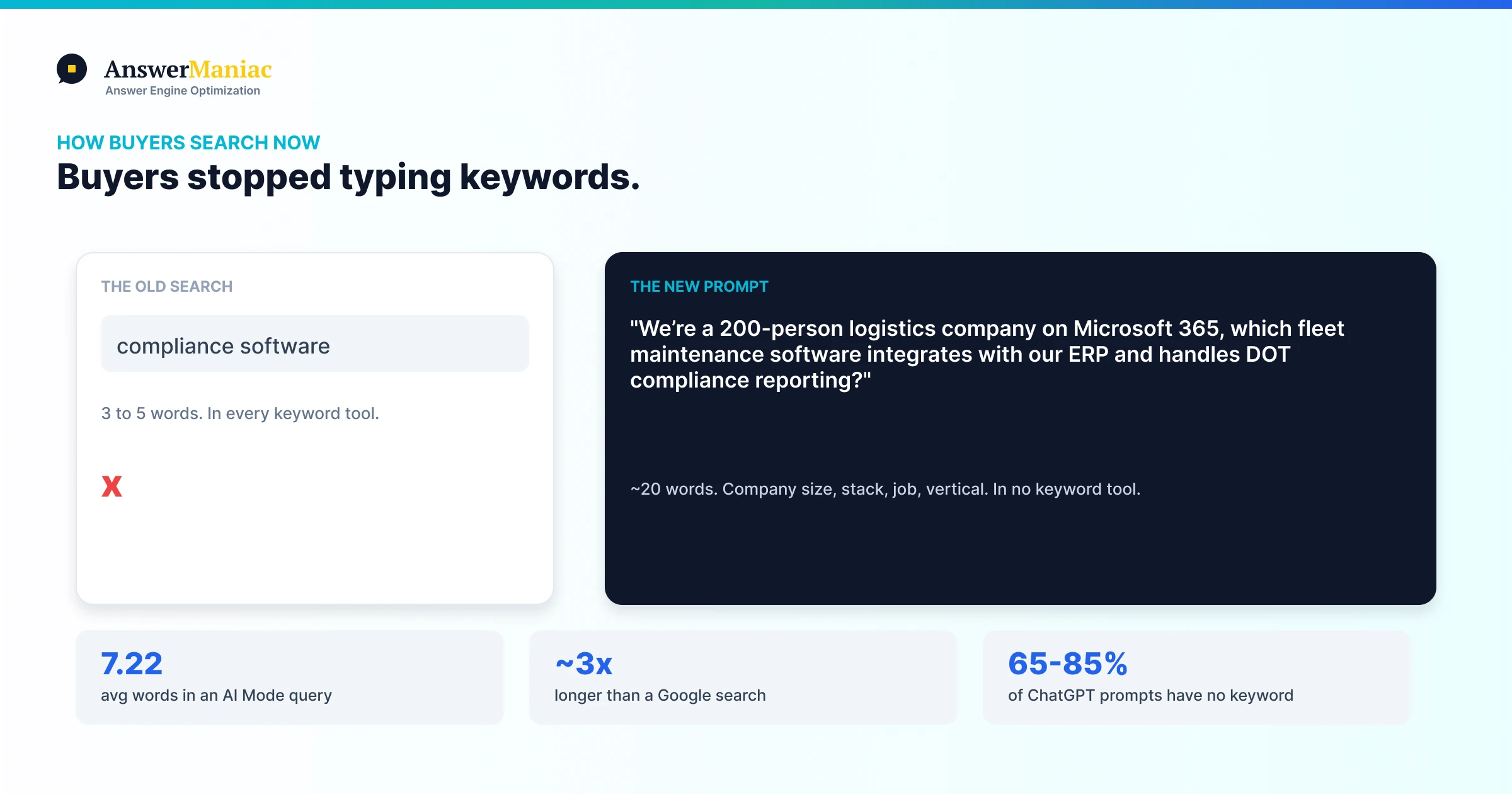
How B2B buyers prompt AI: They ask full questions, not keywords. The average AI Mode query runs about 7.22 words, roughly 3x a traditional Google search, and ChatGPT prompts often run 20 or more words with context and follow-ups. Between 65% and 85% of ChatGPT prompts have no matching keyword in traditional keyword databases (Semrush, 2026). For B2B content, that means writing for specific buyer questions with intent and constraints, not short head terms, because the query your buyer types no longer exists in your keyword tool.
Here is a small thing that changed everything, and most B2B marketers missed it.
Your buyer stopped typing "compliance software." They now type "what is the best compliance automation tool for a mid-market fintech that already uses NetSuite and needs SOC 2 by Q2." Same person, same need. Completely different query.
I noticed this the hard way. We were tracking a client against their keyword list and their rankings looked fine. Then we watched how their actual buyers phrased things inside ChatGPT, and none of it matched the keywords. The buyer's real question had a company size, a tech stack, a deadline, and a compliance framework baked in. No keyword tool had it. No page answered it.
That gap is the whole game now. This piece breaks down how B2B buyers actually prompt AI in 2026, backed by the data, and how to structure your content so you are the answer to the long question, not the short one nobody types anymore.
The Data: Prompts Got Longer, and Left Keyword Tools Behind
The behavior shift is measurable, not vibes.
| Signal | Figure | Source |
|---|---|---|
| Average AI Mode query length | ~7.22 words (about 3x a Google search) | Reported 2026 |
| Typical ChatGPT prompt | Often 20+ words, conversational | Reported 2026 |
| ChatGPT prompts with no matching keyword | 65% to 85% | Semrush, 2026 |
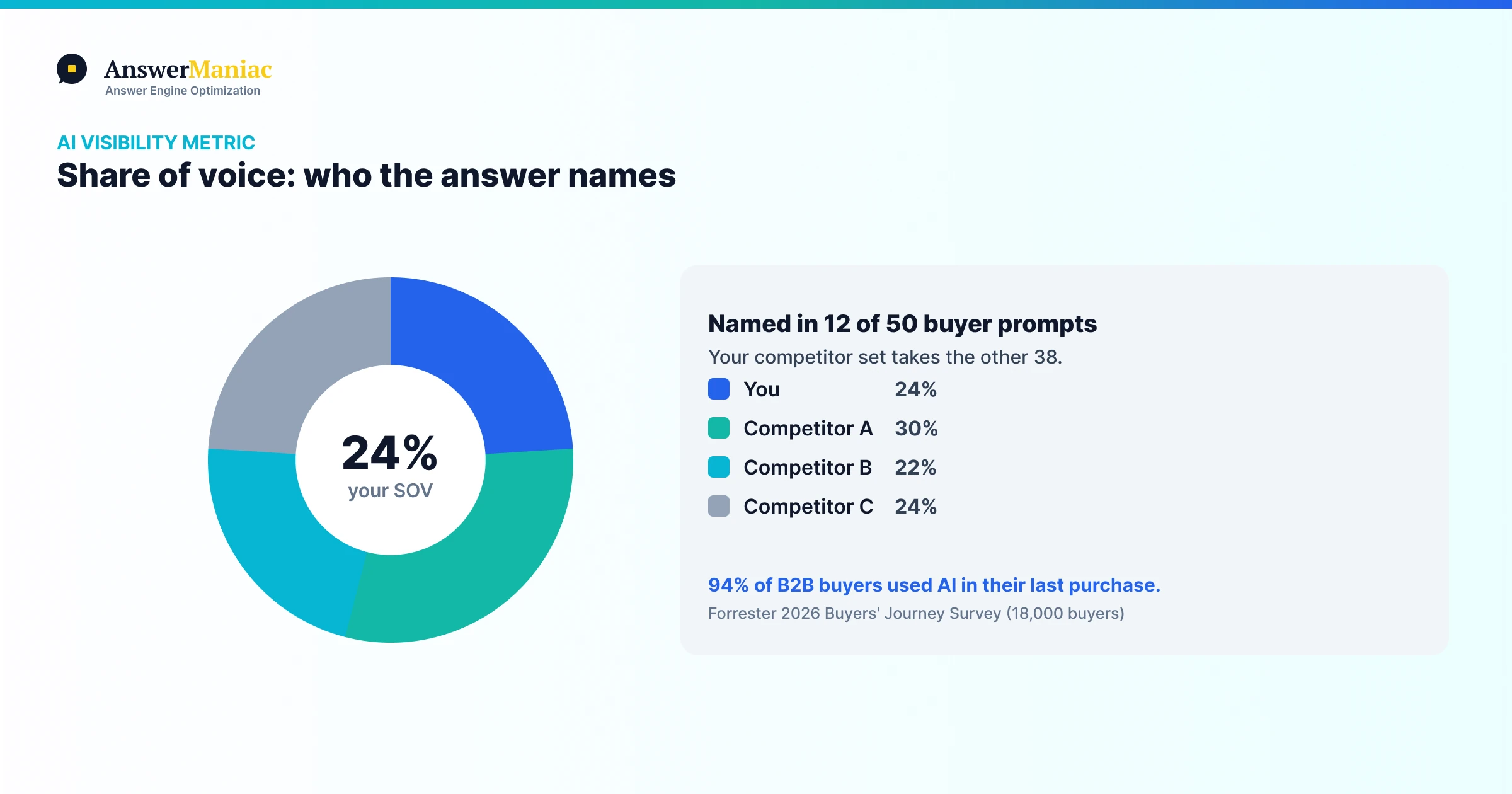
| B2B buyers who used AI in their last purchase | 94% | Forrester 2026 |
| B2B buyers using AI tools for vendor research | 71% | G2 2026 |
Read those together and the conclusion is uncomfortable for anyone still living in a keyword planner. Most of what your buyers ask AI is invisible to the tools that have guided SEO for fifteen years. The short head term you rank for is not the query anymore. The query is a sentence.
There is a reason for this. A search box trained you to strip your thought down to two or three words because that is what worked. A chat box does the opposite. It invites the full thought: the context, the constraint, the comparison. Buyers give it willingly because the answer gets better when they do.
What a Real B2B AI Prompt Looks Like
Break a typical buyer prompt into parts and you can see why generic content misses it.
Take: "We're a 200-person logistics company on Microsoft 365, which fleet maintenance software integrates with our ERP and can handle DOT compliance reporting?"
Inside that one question:
- Category: fleet maintenance software
- Company size: 200 people
- Tech stack: Microsoft 365, an ERP
- Job to be done: integration plus DOT compliance reporting
- Vertical: logistics
A page titled "Fleet Maintenance Software" answers roughly none of that. The AI is looking for a source that speaks to that specific combination, and it will name the two or three vendors whose content clearly addresses the size, the stack, and the compliance job. If your content never mentions the constraint your buyer carries, you are not in the answer.
This is the core of the shift the ANSWER Framework is built around. The Navigate stage exists precisely to map these real buyer questions, with their constraints, before any content gets written.
Five Prompt Patterns B2B Buyers Use
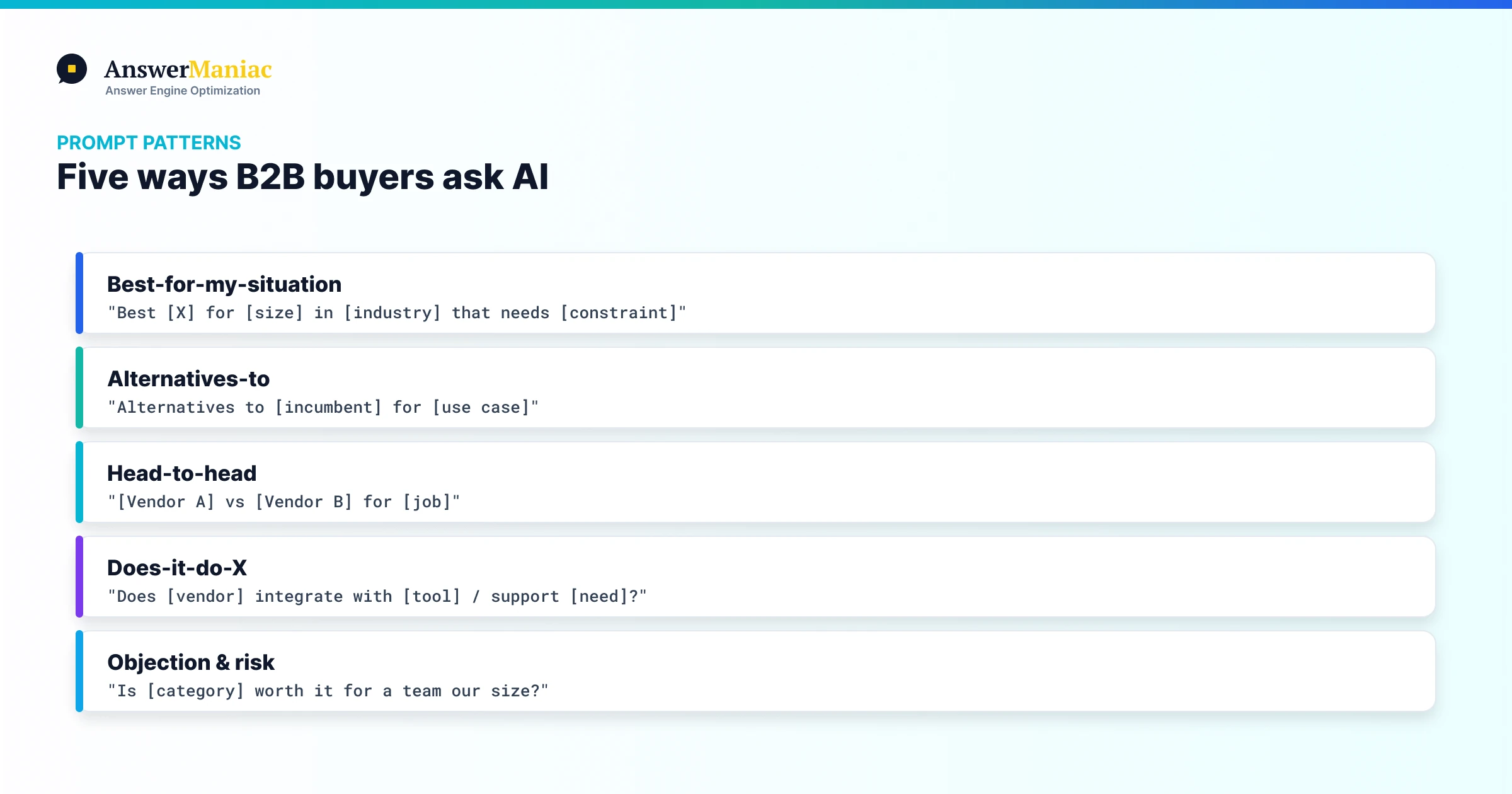
Across the buyer questions we track, most cluster into five shapes. Write for these and you cover the majority of real prompts.
- Best-for-my-situation. "Best [category] for [company size] in [industry] that needs [constraint]." The most common commercial prompt, and the one keyword content misses most.
- Alternatives-to. "Alternatives to [incumbent] for [use case]." High intent, often mid-switch. Your comparison and displacement content lives here.
- Head-to-head. "[Vendor A] vs [Vendor B] for [job]." The buyer has a shortlist and wants a tiebreaker.
- Does-it-do-X. "Does [vendor] integrate with [tool] / support [requirement]?" Feature and integration verification, usually late-stage.
- Objection and risk. "Is [category or vendor] worth it for a team our size?" or "What are the downsides of [approach]?" The buyer is de-risking before they commit.
Notice what these have in common: every one carries context. The winning content answers the specific version, not the generic one.
How to Write for Long, Conversational Prompts
You do not need a new content team. You need to change what a page is built to answer.
Lead with the exact question. Use the buyer's real phrasing as an H2 or a direct-answer block at the top of the page. If the prompt is "best X for mid-market fintech," that sentence should appear on the page, answered in the first two lines. Engines pull cleanly from content that states the question and answers it immediately.
Bake in the constraints. Name the company sizes, tech stacks, verticals, and jobs your buyers actually carry. A single "who this is for" section that says "mid-market fintech on NetSuite that needs SOC 2" will get matched to prompts a generic page never will.
Answer the follow-ups on the same page. Buyers refine and follow up. Cover the objection, the integration question, and the alternative in the same piece so the AI can satisfy the whole conversation from one source.
Structure for extraction. Comparison tables, clear definitions, and short direct answers are what engines lift into responses. Prose that buries the answer in paragraph four does not get pulled. We break this down further in the citation asset playbook.
Stop optimizing only for head terms. Keep them, but understand they are now the smallest part of the picture. The pages that win AI citations are the ones that answer the sentence, not the keyword.
How to Find Your Buyers' Real Prompts
You cannot write for prompts you have not seen. Three ways to find them without guessing.
- Ask your sales and support teams. The questions buyers ask reps are almost verbatim the questions they ask AI. Mine call notes and support tickets for the exact phrasing.
- Run the prompts yourself. Take your category and add real constraints, then ask ChatGPT, Perplexity, and Gemini. See who gets named and how the question is answered. This is the Audit stage in practice.
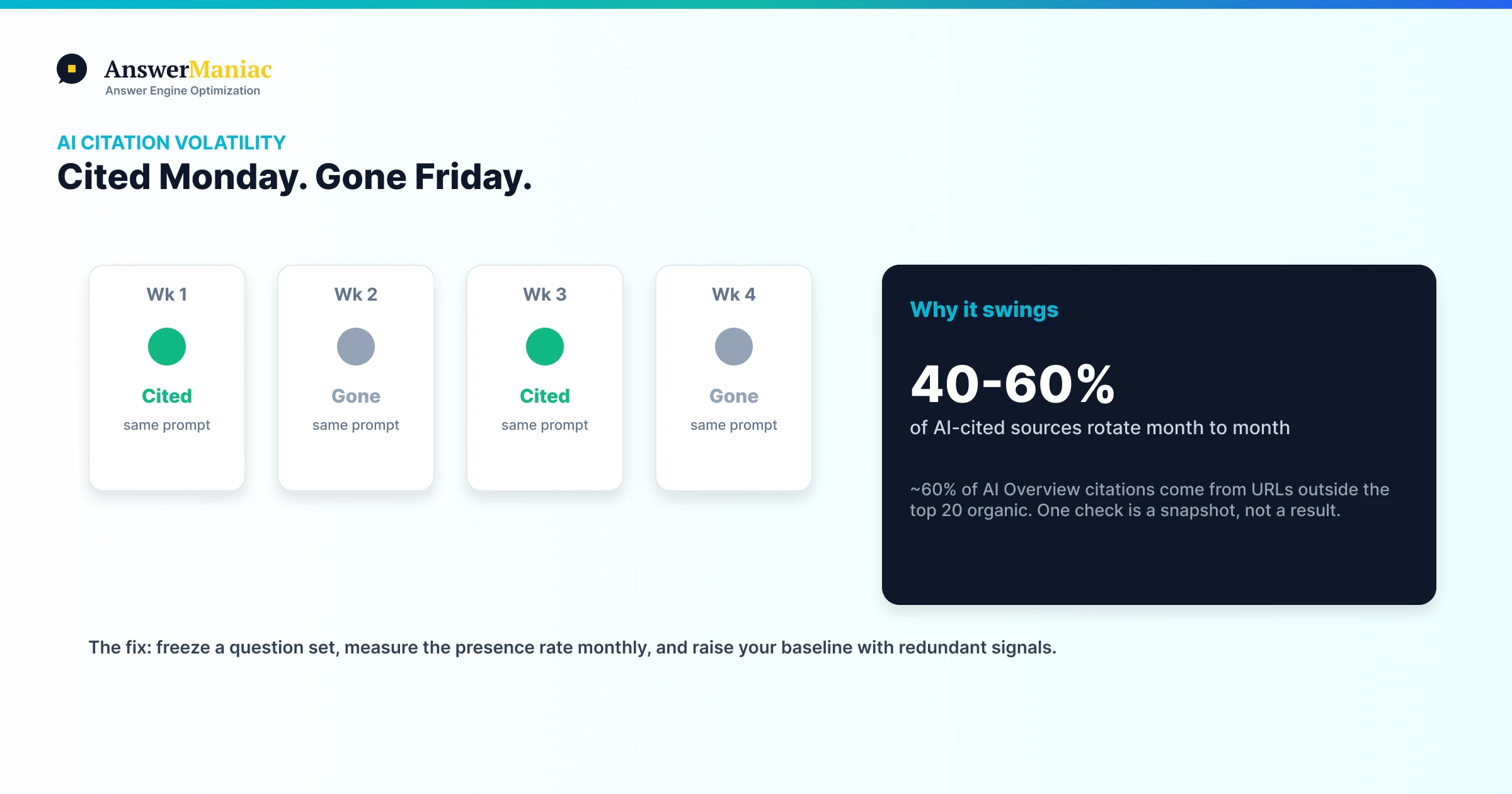
- Track a frozen set over time. Pick 30 to 50 real buyer questions, run them monthly, and watch whether you are named. That is how you turn prompt research into a measurable program rather than a one-off exercise.
Frequently Asked Questions
How long are AI search prompts compared to Google searches? AI prompts are much longer. The average AI Mode query is around 7.22 words, roughly three times a traditional Google search, and ChatGPT prompts often run 20 or more words with context and follow-ups.
Why don't my keyword tools show these prompts? Because most AI prompts are new, conversational phrasings. Semrush reported that 65% to 85% of ChatGPT prompts have no matching keyword in traditional databases, so keyword tools simply do not capture them.
Should I stop doing keyword research? No. Keywords still feed rankings, and ranking pages often feed AI answers. But treat head terms as one input, not the whole strategy. The higher-value work is mapping the full buyer questions, with their constraints, that AI actually receives.
What content format wins long AI prompts? Content that states the buyer's exact question and answers it immediately, names the specific constraints (size, stack, vertical, job), and uses extractable formats like comparison tables and direct-answer blocks.
How do I find the prompts my buyers use? Mine sales calls and support tickets for real phrasing, run those prompts across ChatGPT, Perplexity, and Gemini yourself, and track a frozen set of 30 to 50 buyer questions monthly to see where you are named.
The Takeaway
Your buyers traded keywords for questions. The average AI prompt is several times longer than a Google search, and the majority never appear in a keyword tool. If your content is still built to answer three words, you are optimizing for a behavior that is fading. Map the real questions your buyers ask, with the size, stack, and job they carry, and write pages that answer the sentence. That is what gets you named in the AI answer.
Want to see which buyer questions AI answers with your name versus a competitor's? Run a free AI visibility audit and start with your real prompt set.
Sources
- Semrush and industry 2026 reporting on AI query length (AI Mode ~7.22 words; ChatGPT prompts 20+ words) and the 65% to 85% no-matching-keyword finding
- Forrester 2026 Buyers' Journey Survey (18,000 buyers; 94% used AI during most recent purchase)
- G2 2026 survey of B2B decision-makers (71% use AI search tools for vendor research)
- AnswerManiac benchmark research: 376 B2B companies across five verticals
Related Reading
Get AEO Insights Weekly
Join 500+ B2B marketers getting AI visibility tactics every Tuesday.
Ready to Get Your Brand Cited by AI?
See how your competitors show up in ChatGPT, Perplexity, and Gemini — and what it would take to get recommended.