AI Share of Voice: The B2B Visibility Metric That's Replacing Keyword Rankings
Keyword rankings tell you less every quarter. AI share of voice measures how often ChatGPT, Perplexity, and Gemini pick you over competitors. Here's how to calculate and grow it.
Quick Answer
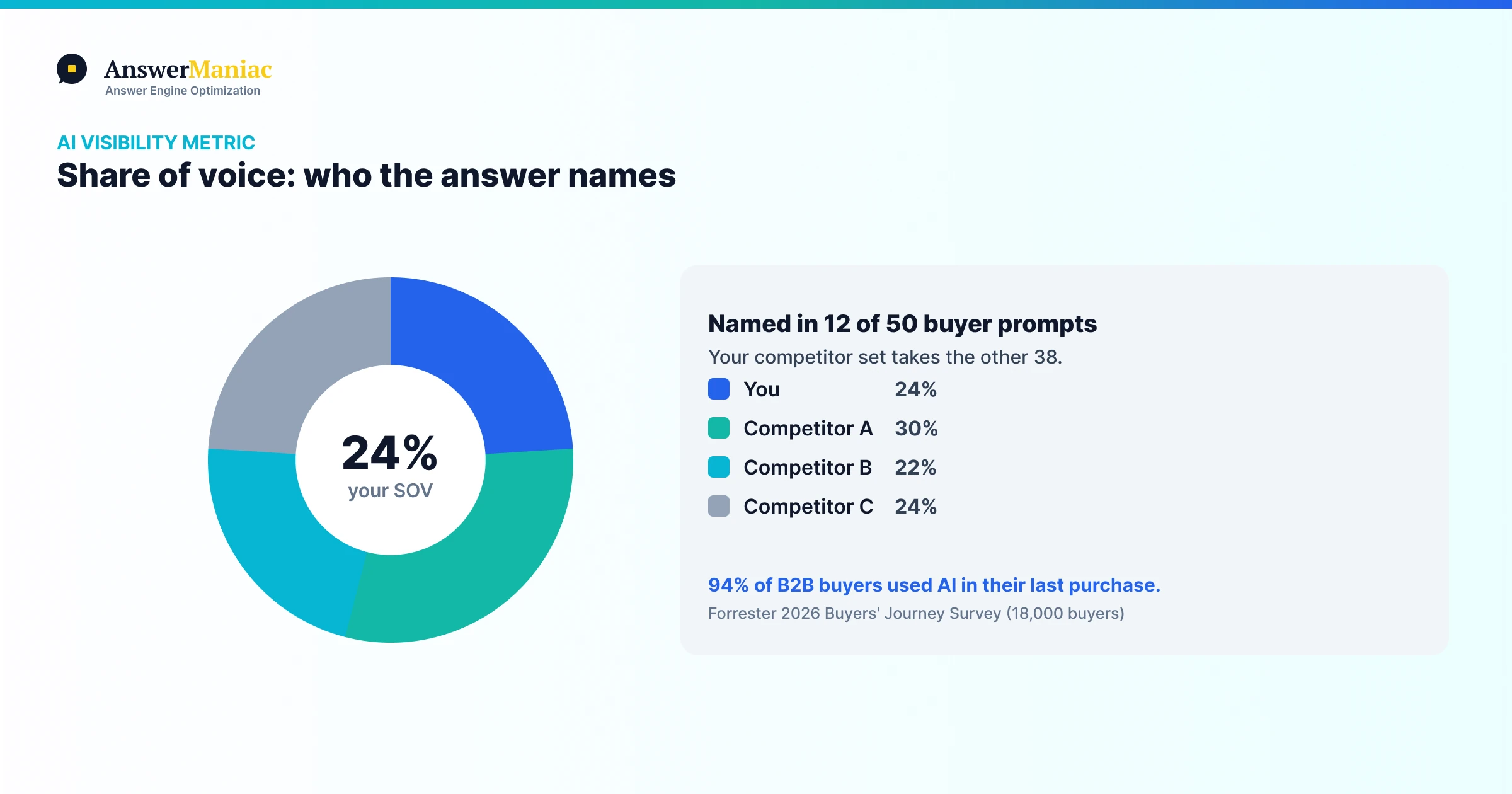
AI share of voice (SOV): The percentage of AI answers, across a defined set of buyer questions, where your brand is mentioned or cited compared to your named competitors. If ChatGPT, Perplexity, and Gemini name you in 12 of 50 tracked buyer prompts and your competitor set gets named in the other 38, your AI share of voice is 24%. It matters because 94% of B2B buyers used AI during their most recent purchase (Forrester 2026), so being named in the answer now predicts pipeline better than a keyword ranking does.
Keyword rankings answered a question that mattered for twenty years: when someone searches, do we appear near the top? In 2026 that question is quietly losing its grip, because a growing share of your buyers never see a list of ten blue links. They ask ChatGPT or Perplexity and read one answer that names a few vendors.
So the question changed. It is no longer "do we rank?" It is "when the AI answers, does it say our name or the competitor's?"
AI share of voice is the metric that captures that. I started tracking it for clients because a keyword report kept telling a client they were "winning" while their ChatGPT answers never mentioned them once. The ranking was green. The visibility was zero. Share of voice closed that gap.
Why Rankings Stopped Telling the Whole Story
The behavior data is not subtle. Forrester's 2026 Buyers' Journey Survey of 18,000 global buyers found 94% used AI during their most recent purchase. G2's 2026 survey of B2B decision-makers found 71% use AI search tools specifically for vendor research. Buyers now spend the majority of their research time away from sales reps, forming shortlists before a vendor knows they exist.
Two things follow from that.
First, a top ranking on a page nobody clicks is worth less than it used to be. Second, the AI answer that does get read usually names two to five vendors, and if you are not one of them, you were never in the consideration set. There is no page two in an AI answer. You are in the sentence or you are invisible.
Rankings still matter, because the pages that rank often feed the answers. But they are now an input, not the outcome. The outcome is share of voice.
How to Calculate AI Share of Voice
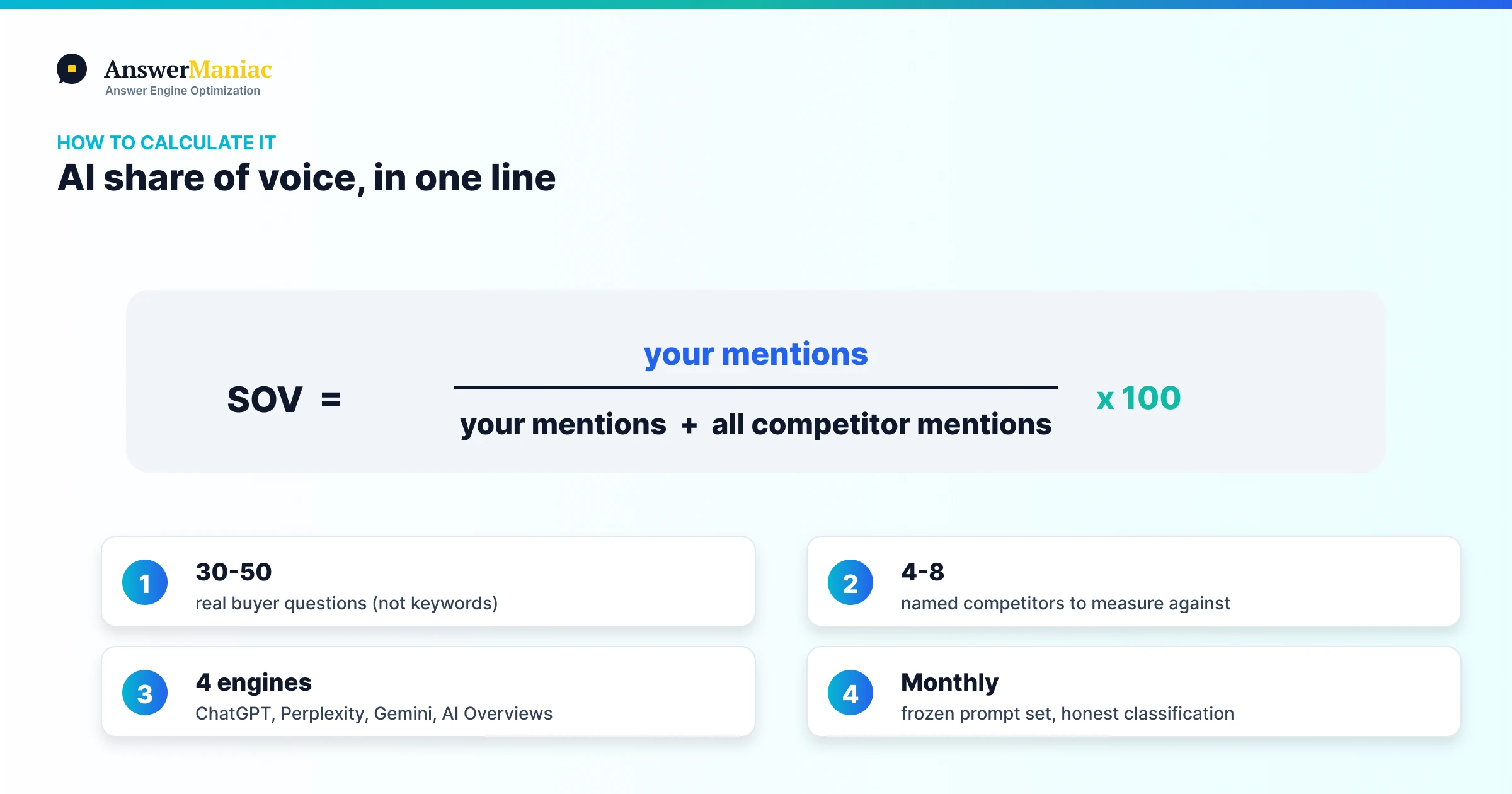
The concept is simple. The discipline is in doing it consistently.
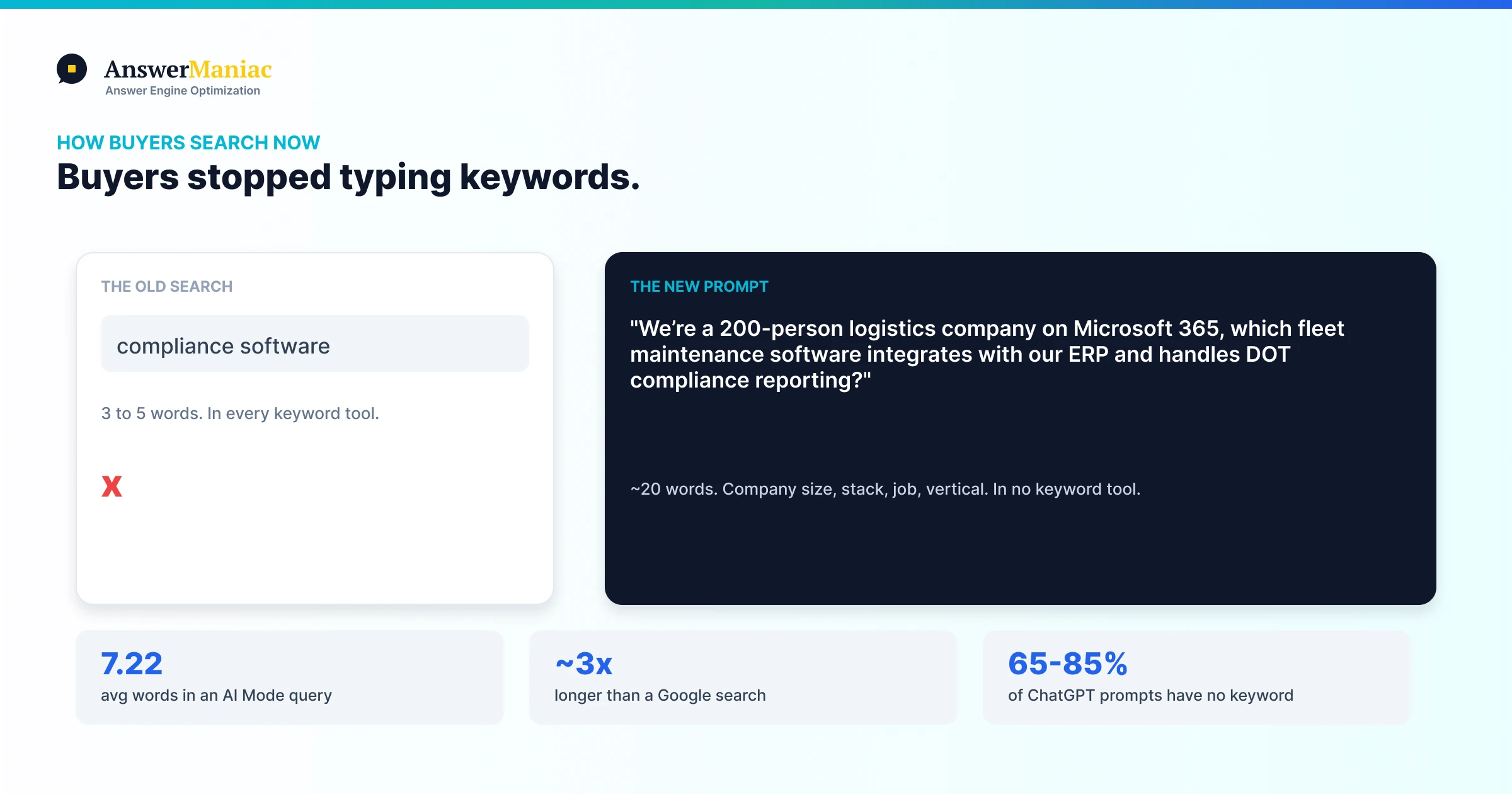
Step 1: Define your prompt set. Write 30 to 50 real buyer questions for your category. Not keywords, questions. "What is the best compliance management software for a mid-market fintech?" "Alternatives to [incumbent] for fleet tracking?" These are the prompts your buyers actually type.
Step 2: Define your competitor set. List the 4 to 8 companies you compete with in those answers. This is who you measure against.
Step 3: Run the prompts across engines. Ask each prompt on ChatGPT, Perplexity, Gemini, and Google AI Overviews. Record who gets named and who gets cited.
Step 4: Do the math. The simplest version:
AI Share of Voice = (your mentions) / (your mentions + all competitor mentions) x 100
If you are named 18 times across the set and your competitors are named 82 times combined, your SOV is 18%. Run it monthly and the trend line is what you manage.
Step 5: Split mention SOV from citation SOV. Track both. Mention share of voice is how often the engine says your name. Citation share of voice is how often it links your actual page. A brand can lead on mentions while a competitor quietly wins citations and gets all the traffic. Both numbers tell you different things.
Mention Share of Voice vs Citation Share of Voice
This distinction trips up a lot of teams, so it is worth its own beat.
| Metric | What it measures | What it means |
|---|---|---|
| Mention SOV | How often your name appears in answers | Brand awareness inside AI answers |
| Citation SOV | How often your page is linked as a source | Whether AI sends buyers your content |
You want both, but they come from different work. Mentions grow through entity authority, off-site presence, and community consensus, the things that teach a model your name belongs in the category. Citations grow through citation-worthy content structured the way engines pull from. If your mention SOV is healthy but your citation SOV is near zero, the engines know you but your content is not extraction-ready. That is a fixable, specific problem.
What Moves AI Share of Voice
In our work across 376 B2B companies in five verticals, the levers that move share of voice cluster into four groups.
Entity authority. Consistent brand information across your site, Wikipedia-adjacent sources, LinkedIn, Crunchbase, and structured data. Models pull from a web of signals, and inconsistency dilutes you. This is foundational entity optimization.
Citation-worthy content. Original data, clear answers, and formats engines extract cleanly: comparison tables, direct-answer blocks, defined terms. Summaries of what everyone already knows do not earn a mention. New information does.
Off-site presence. Reviews on G2 and Capterra, earned media, and genuine community discussion on Reddit and Quora. When a model sees your category discussed, it learns who belongs in the answer.
Competitive displacement. Share of voice is zero-sum within a prompt set. Every answer names a finite list, so growing your share often means taking a slot a competitor currently holds. That means studying which prompts they win and why.
Where This Fits in the ANSWER Framework
AI share of voice is the headline number in the Refine stage of the ANSWER Framework. Audit gives you the first reading. Navigate defines the prompt set that makes the number meaningful. Structure, Write, and Earn are the work that moves it. Refine is where you re-measure monthly, classify the outcome honestly, and decide the next move.
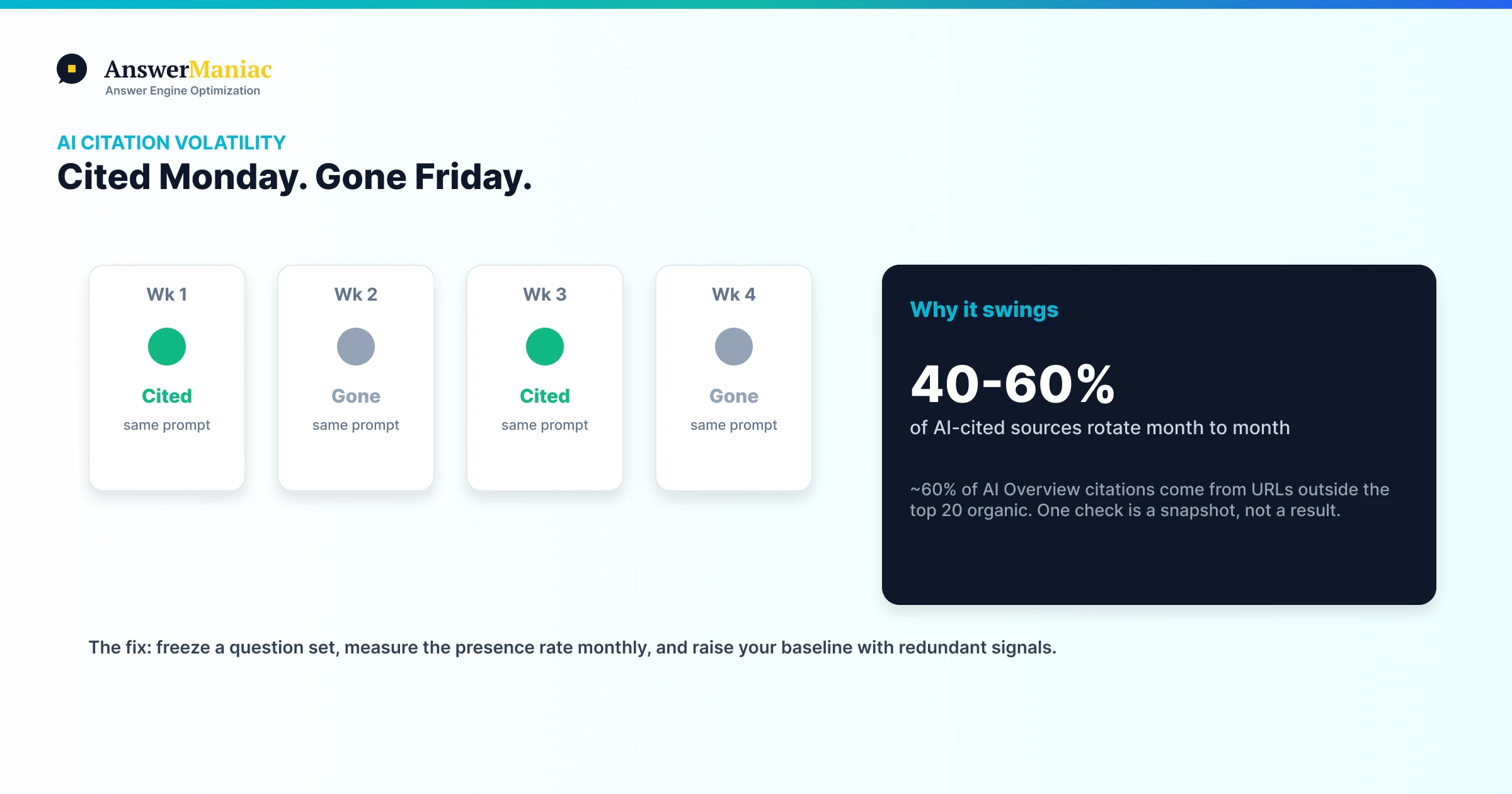
One discipline we hold: freeze the prompt set and competitor set before you start, and do not quietly swap in easier prompts later to make the trend look better. A share-of-voice number you can move by changing the questions is a vanity metric. A frozen protocol is what makes it real. We classify every outcome as positive, negative, inconclusive, or invalid rather than cherry-picking the good months.
Frequently Asked Questions
What is a good AI share of voice? It depends on your competitive set and category maturity. Most B2B companies start in the single digits or at zero. The useful target is not an absolute number, it is a rising trend against a frozen prompt and competitor set over time.
How is AI share of voice different from traditional share of voice? Traditional SOV usually measures ad spend, impressions, or keyword coverage. AI share of voice measures how often AI answers name or cite you versus competitors for real buyer questions. It reflects the consideration set inside AI answers, not paid reach.
Do I need a tool to measure it? You can calculate it manually with a spreadsheet and a fixed prompt set. A tool like Profound, Peec AI, or Otterly automates the tracking and competitor comparison. See our AI visibility tools comparison.
How often should I measure AI share of voice? Monthly is the practical cadence. AI answers shift week to week, so monthly smooths the noise while staying responsive enough to catch real movement.
Does keyword ranking still matter? Yes, as an input. Ranking pages often feed AI answers, so rankings still contribute. But the outcome buyers experience is the answer itself, which is what share of voice measures.
The Takeaway
When almost every B2B buyer runs their research through AI, the metric that predicts pipeline is not where you rank, it is whether the answer names you. AI share of voice measures exactly that: your presence versus competitors across the buyer questions that matter. Track mention and citation SOV separately, freeze your prompt set so the number stays honest, and manage the trend monthly. Rankings tell you about a page. Share of voice tells you about the answer your buyer actually reads.
Want your starting share of voice across ChatGPT, Perplexity, and Gemini? Run a free AI visibility audit and see where you stand against your competitors today.
Sources
- Forrester 2026 Buyers' Journey Survey (18,000 global business buyers; 94% used AI during most recent purchase)
- G2 2026 global survey of B2B decision-makers (71% use AI search tools for vendor research)
- AnswerManiac benchmark research: 376 B2B companies across five verticals (cybersecurity, MSP, Microsoft integrators, NetSuite integrators, B2B SaaS)
Related Reading
Get AEO Insights Weekly
Join 500+ B2B marketers getting AI visibility tactics every Tuesday.
Ready to Get Your Brand Cited by AI?
See how your competitors show up in ChatGPT, Perplexity, and Gemini — and what it would take to get recommended.