Competitor Displacement: How to Steal AI Citations from Category Leaders
Your competitors are being cited by AI. Here's the aggressive playbook to displace them and take their recommendations in ChatGPT, Perplexity, and Gemini.
AI engines like ChatGPT, Perplexity, and Gemini recommend a limited number of brands per query. Competitor displacement is the strategic process of identifying why rivals earn those citations, creating objectively superior content and authority signals, and systematically taking their recommended slots through content superiority, schema advantage, and sustained citation velocity.
Key Takeaway
AI search is a zero-sum game. When ChatGPT recommends three project management tools, your competitor is either on that list or you are — rarely both. Unlike traditional SEO where ten blue links offered room for everyone on page one, AI citations compress entire categories into a handful of named brands. Every citation your competitor holds is one you don't. The good news: these positions are not permanent. With the right intelligence, superior content, and relentless execution, you can systematically displace the brands that AI currently favors and install yourself as the new default recommendation.
Run a free AI Visibility Audit to see exactly where your competitors are being cited and you're not.
Why Competitors Are Getting Cited (And You're Not)
Before you can take a competitor's citation, you need to understand why they earned it in the first place. AI models don't pick favorites arbitrarily. They synthesize patterns from training data, real-time retrieval sources, and structured signals to decide which brands deserve mention. If your competitor keeps appearing and you don't, specific and diagnosable reasons are driving that gap.
What Cited Competitors Are Doing Right
Brands that consistently earn AI recommendations share a recognizable set of behaviors:
- They answer questions directly. Their content leads with clear, structured answers rather than burying insights under walls of marketing copy. AI models extract and cite content that resolves a query in the first few sentences.
- They dominate third-party sources. Cited brands don't just publish on their own blog. They appear in industry roundups, comparison articles, expert interviews, and review platforms that AI models treat as high-trust retrieval sources.
- They use structured data aggressively. Rich schema markup — FAQ, HowTo, Product, Review — gives AI models machine-readable signals that unstructured competitors simply don't provide.
- They maintain freshness. AI models favor recently updated, currently relevant content. Competitors who refresh their pages quarterly outperform those who publish and forget.
- They build topical authority. Rather than writing one article about a topic, cited brands create interconnected content clusters that signal deep expertise to AI models during training and retrieval.
Common Gaps That Keep You Invisible
If you're absent from AI recommendations, one or more of these gaps is likely responsible:
- No direct-answer content. Your pages talk about your product but never directly answer the questions users ask AI.
- Thin third-party presence. You have minimal mentions on the review sites, comparison pages, and industry publications that AI models pull from during retrieval.
- Missing or basic schema. Your pages lack the structured data that helps AI models parse and prioritize your content over competitors.
- Stale content. Key pages haven't been updated in months, signaling to AI models that the information may be outdated.
- Fragmented authority. You've published scattered content across many topics without building the depth in any single area that AI models associate with genuine expertise.
Identifying which of these gaps applies to your situation is the first step. The competitive citation audit gives you the precise map.
The Competitive Citation Audit
Before launching any displacement campaign, you need a clear picture of the battlefield. A competitive citation audit maps exactly where your rivals appear across all major AI platforms and where they're vulnerable.
Step 1: Define Your Query Universe
Start by building a list of 30 to 50 queries that matter most to your business. These should include:
- Category queries — "best [your category] tools," "top [your category] software 2026"
- Comparison queries — "[competitor] vs alternatives," "[competitor] vs [other competitor]"
- Problem queries — "how to solve [problem your product addresses]"
- Recommendation queries — "what [product type] should I use for [use case]"
Step 2: Run Each Query Across Five Platforms
Test every query on ChatGPT, Perplexity, Gemini, Claude, and Microsoft Copilot. For each response, document:
- Which brands are mentioned by name
- The position of each mention (first cited, second cited, etc.)
- Whether the citation includes a direct link or just a brand mention
- The context of the citation (recommended, mentioned as alternative, or listed neutrally)
- The source URL the AI model appears to be pulling from
Step 3: Build the Competitive Citation Matrix
Organize your findings into a matrix with queries on the vertical axis and platforms on the horizontal axis. Each cell should contain the brands cited. This matrix reveals:
- Your competitor's strongholds — queries where they appear across all five platforms
- Contested territory — queries where different platforms cite different brands
- Undefended gaps — queries where no competitor has consistent citations
- Your existing footholds — queries where you already appear on some platforms
Step 4: Identify Source Pages
For every competitor citation, trace it back to the source. What specific page or content piece is the AI model drawing from? This is critical because you're not competing against a brand in the abstract — you're competing against a specific piece of content that the AI model considers authoritative.
An AI visibility audit automates much of this process and gives you the baseline metrics you need to measure displacement over time.
The 5-Phase Displacement Strategy
With your competitive citation matrix in hand, you can execute a systematic displacement campaign. Each phase builds on the previous one, creating compounding pressure that eventually forces AI models to update their recommendations in your favor.
Phase 1: Intelligence — Map Competitor Citations and Identify Weak Spots
Deep intelligence separates strategic displacement from blind content creation. In this phase, you go beyond the audit to understand the structural reasons behind each competitor citation.
Analyze their cited content in detail. For every page that earns a competitor a citation, document the word count, structure, heading hierarchy, use of data and statistics, inclusion of expert quotes, freshness date, and schema markup present. You're building a blueprint of what AI models consider citation-worthy in your category.
Identify their weakest citations. Not all competitor citations are equally defensible. Look for:
- Citations based on outdated content (published more than six months ago without updates)
- Citations from thin or superficial pages that lack depth
- Citations where the competitor appears on only one or two platforms, not all five
- Citations in categories adjacent to their core expertise where their authority is shallow
Prioritize displacement targets. Rank competitor citations by a combination of business value (how much revenue that query could drive) and vulnerability (how defensible the competitor's position is). Start with high-value, low-defense targets.
Phase 2: Content Superiority — Create Content That's Objectively Better
Displacement requires content that is not marginally better but unmistakably superior to what the competitor has published. AI models are pattern-matching engines. When a clearly more comprehensive, more current, and more structured piece of content exists, it eventually wins.
The 2x Rule. Whatever the competitor's cited page offers, yours should deliver at least twice the value. If their guide is 1,500 words with five sections, yours should be 3,000 words with ten sections, original data, expert perspectives, and actionable frameworks. This isn't about word count padding — it's about genuine depth.
Structure for AI extraction. Every page you create should follow content strategy principles built for AI visibility:
- Open with a direct answer in the first 50 words
- Use clear H2 and H3 headings that mirror how users phrase questions
- Include structured lists, comparison tables, and step-by-step processes
- Add an FAQ section targeting long-tail variations of the primary query
- Provide specific numbers, data points, and named examples rather than vague generalizations
Create content clusters, not isolated pages. A single superior page can win a citation, but a cluster of interconnected content on the same topic signals the kind of topical authority that makes displacement permanent. For every displacement target, plan a primary pillar page supported by three to five related articles that link back to it and to each other.
Phase 3: Authority Outflanking — Build More and Better Authority Signals
Content quality gets you into consideration. Authority signals determine whether AI models trust you enough to recommend you over an established competitor.
Third-party mention acquisition. Systematically get your brand mentioned on the sources AI models trust most:
- Contribute expert commentary to industry publications
- Get listed on major comparison and review platforms (G2, Capterra, TrustRadius, and category-specific directories)
- Pursue guest contributions on authoritative blogs in your space
- Seek inclusion in "best of" roundup articles and annual industry reports
- Build relationships with analysts and journalists who write about your category
Review and social proof amplification. AI models weight review signals heavily in product recommendation queries. Actively build your review profile on platforms that surface in AI retrieval results. Aim to surpass your competitor's review count and rating on every major platform.
Brand mention consistency. Ensure your brand is described consistently across the web. AI models build brand understanding from the aggregate of mentions. If your brand is described differently on every platform, the signal is diluted. Create a brand positioning statement and work to get it reflected consistently across third-party sources.
Consult the comprehensive AI visibility guide for a full breakdown of authority signals that influence AI recommendations.
Phase 4: Schema Advantage — Implement Richer Structured Data Than Competitors
Structured data is one of the most underutilized displacement levers because most competitors implement only basic schema or none at all. Gaining a schema advantage gives AI models more structured information about your content than they have for your competitor's.
Audit competitor schema first. Use Google's Rich Results Test or Schema.org validators to check what structured data your competitors have implemented on their cited pages. Most companies stop at basic Organization and Article schema, leaving enormous room for advantage.
Implement comprehensive schema types:
- FAQ Schema on every page with a question-and-answer section
- HowTo Schema on every tutorial, process, or step-by-step guide
- Product Schema with detailed attributes on all product and pricing pages
- Review and AggregateRating Schema to surface social proof in structured format
- Comparison Schema on versus and alternative pages
- Speakable Schema to flag content optimized for voice-based AI assistants
Go beyond the basics. Implement nested schema, breadcrumb markup, and sameAs properties linking your brand across platforms. The richer and more interconnected your structured data, the more ammunition AI models have to understand and cite your content.
For a deep dive on implementation, read Schema Markup for AI: How to Get ChatGPT Citations.
Phase 5: Sustained Pressure — Maintain Citation Velocity Advantage
Displacement is not a one-time event. AI models continuously re-index, retrain, and update their retrieval sources. If you displace a competitor but then stop investing, they can reclaim their position within weeks.
Establish a content refresh cadence. Update every displacement-targeted page at least monthly with new data, examples, or sections. Freshness signals are among the strongest factors in AI retrieval systems.
Monitor citation velocity continuously. Track how frequently your brand appears in AI responses relative to competitors over time. Citation velocity — the rate at which you gain or lose mentions — is the leading indicator of displacement success or regression.
Expand your query footprint. Once you've displaced a competitor on your initial target queries, expand to adjacent queries. Each new citation strengthens your overall topical authority, making existing citations more defensible and new ones easier to win.
Respond to competitor counter-moves. Expect competitors to notice and respond. When they update their content, publish new authority signals, or implement new schema, you need to match and exceed their moves within days, not months.
Quick Wins: 3 Displacement Tactics You Can Start Today
You don't need to wait for a full displacement campaign to start taking ground. These three tactics can begin shifting AI citations in your favor within weeks.
1. Publish a Superior "Versus" Page
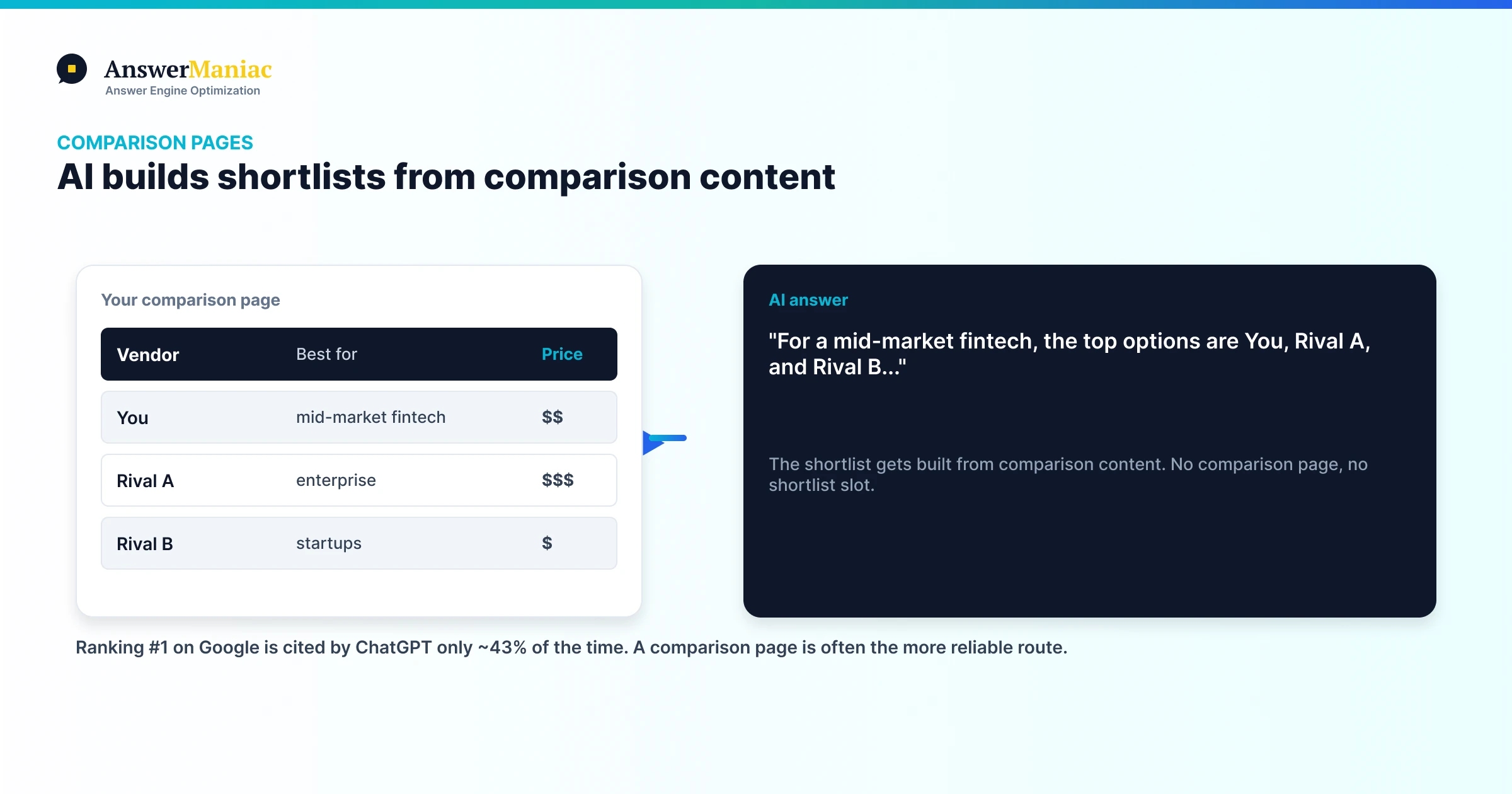
Find the comparison query where your competitor is most frequently cited — typically "[competitor name] vs alternatives" or "[competitor] vs [your brand]." Create a comprehensive, genuinely balanced comparison page that covers features, pricing, use cases, strengths, and limitations for both products. AI models favor balanced, detailed comparison content over one-sided marketing pages. When your page is objectively more useful than what exists, AI models will start citing it.
2. Flood the FAQ Gap
Review the questions AI models answer about your category and identify questions where your competitor is cited but you have no content. Create a dedicated FAQ page or add FAQ sections to existing pages that directly answer these questions with clear, specific, structured responses. Implement FAQ schema on every answer. This is often the fastest path to new citations because FAQ content is easy for AI models to extract and cite.
3. Claim Uncovered Review Platforms
Identify review and directory platforms where your competitor has a profile but you don't. Create or claim your profile on every platform, fill it completely, and begin actively collecting reviews. AI models use these platforms as retrieval sources. If your competitor is the only option listed, the AI has no choice but to recommend them. Showing up gives the model a reason to include you.
When Displacement Doesn't Work (And What to Do Instead)
Displacement is powerful, but it's not always the right strategy. Honest assessment of when it won't work saves you from wasting resources on unwinnable battles.
Deeply entrenched category creators. If your competitor literally created the category and their brand is synonymous with it (think Slack for team messaging or Figma for collaborative design), direct displacement on category-defining queries may be impractical. AI models have absorbed years of content associating that brand with the category.
Massive authority gaps. If a competitor has ten times your domain authority, thousands more backlinks, and decades of content, displacement on head terms will be slow and expensive. The gap may be too wide for content quality alone to overcome.
What to do instead:
- Target long-tail queries where the category leader hasn't invested. Niche use cases, specific industries, and emerging sub-categories often have weak or no incumbent citations.
- Win the "alternative to" position. Instead of displacing the leader from first citation, aim to be the consistently recommended alternative. "If [leader] doesn't fit your needs, [your brand] is the best alternative for..." is a valuable citation position.
- Build a flanking strategy. Create authority in an adjacent topic where you can be the undisputed leader, then expand from that base into the competitor's territory over time.
- Invest in AEO and GEO services that accelerate authority building and help you compete even against established players.
The goal is always progress. Even partial displacement — moving from zero citations to appearing on two out of five platforms — represents meaningful business value.
Frequently Asked Questions
How long does it take to displace a competitor from AI citations?
Displacement timelines vary significantly based on the authority gap and the competitiveness of the query. For weakly defended citations where the competitor's content is thin or outdated, you can see displacement in four to eight weeks after publishing superior content and schema. For well-defended citations from authoritative competitors, expect three to six months of sustained effort. The key variable is citation velocity — how quickly AI models update their retrieval indexes and how frequently they encounter your improved signals during re-indexing cycles.
Can a smaller company displace a larger competitor in AI search?
Yes, and this is one of the most significant opportunities in AI search. Unlike traditional SEO where domain authority and backlink volume create nearly insurmountable advantages for larger competitors, AI models evaluate content quality, structured data, and answer relevance on a more level playing field. A smaller company with a perfectly structured, deeply comprehensive, and consistently updated page can outperform a larger competitor's thin or outdated content. Focus on queries where the large competitor hasn't invested in AI-optimized content and you can establish superiority before they respond.
Should I mention competitors by name in my content?
Yes, strategically. AI models need to understand the competitive landscape in your category, and content that references competitor names in a balanced, informative context provides the comparative signals AI models use when generating recommendation responses. Create honest comparison pages, mention competitor products when listing alternatives, and reference them in "versus" and "best of" content. Avoid being negative or dishonest — AI models are trained to favor balanced, objective analysis. Content that unfairly disparages competitors often gets filtered out of recommendations entirely.
How do I know if my displacement strategy is working?
Track three metrics consistently. First, monitor your citation frequency across all five major AI platforms on a weekly basis by running your target queries and documenting which brands appear. Second, measure citation velocity — the rate of change in your citation count versus your competitor's over a rolling 30-day window. Third, track source page rankings in traditional search as a leading indicator, since pages that rank well organically are more likely to be included in AI retrieval indexes. Displacement is working when your citation frequency is rising, your competitor's is stable or declining, and your citation velocity outpaces theirs consistently over multiple weeks.
Competitor displacement in AI search is not a gamble — it's a structured, repeatable process. Map the battlefield, build superior content, outflank on authority and schema, and maintain pressure. The brands that execute this playbook systematically will own the citations that drive the next generation of discovery and revenue.
Get AEO Insights Weekly
Join 500+ B2B marketers getting AI visibility tactics every Tuesday.
Ready to Get Your Brand Cited by AI?
See how your competitors show up in ChatGPT, Perplexity, and Gemini — and what it would take to get recommended.