Citation Velocity: The Secret Metric That Gets AI Assistants to Recommend You
Citation velocity is the hidden metric that determines how fast AI assistants start recommending your brand. Learn how to measure and accelerate it.
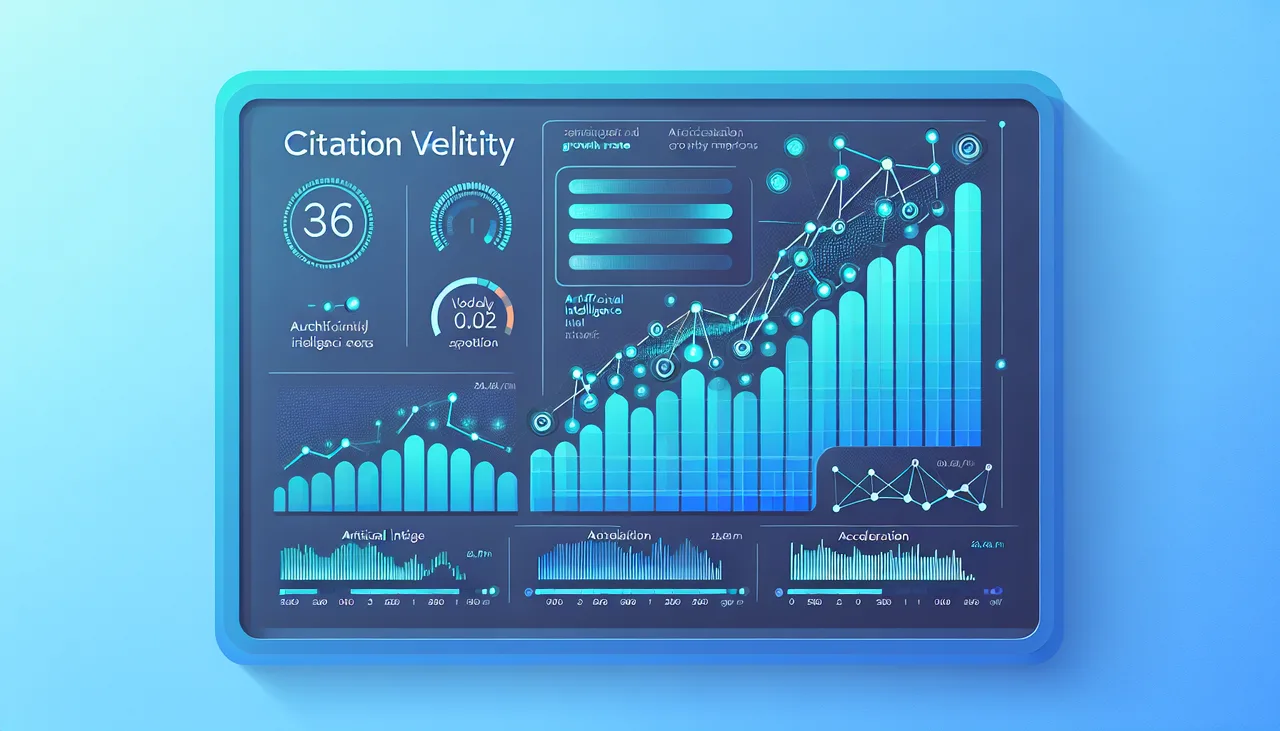
Direct Answer: Citation velocity is the rate at which new AI citations for your brand accumulate across AI engines like ChatGPT, Perplexity, Gemini, Claude, and Microsoft Copilot over a defined time period. It is calculated as the number of new citation appearances per period divided by the total number of tracked queries. High citation velocity signals to AI engines that your brand is an active, authoritative source -- which triggers a compounding feedback loop where more citations generate even more citations. Brands that achieve a citation velocity above 0.15 (15% of tracked queries returning a new citation each month) typically reach stable AI recommendation status within 90 days. Unlike domain authority, which measures historical link equity, citation velocity measures forward momentum -- making it the single most predictive metric for AI visibility growth.
Get your citation velocity baseline with a free AI Visibility Audit
Every growth team has a dashboard. Traffic, conversions, MQLs, pipeline -- the numbers that drive weekly standups and quarterly reviews. But there is one metric missing from almost every dashboard in 2026, and it is the one that determines whether AI assistants recommend your brand or your competitor's.
That metric is citation velocity.
If domain authority was the metric that predicted Google ranking success for the last fifteen years, citation velocity is its AEO equivalent -- the leading indicator that predicts how quickly your brand becomes a default recommendation in AI-generated answers. And unlike domain authority, which took years to build, citation velocity can shift in weeks if you know the levers to pull.
This guide breaks down what citation velocity is, how to calculate it, what good looks like, and the five factors that accelerate it fastest.
Key Takeaway
- Citation velocity measures forward momentum, not historical position -- it tells you how fast your AI visibility is growing, not just where you stand today
- The formula is simple: new citations per period / total tracked queries -- and it can be calculated manually or with dedicated AEO tools
- Brands with citation velocity above 0.15 reach stable AI recommendation status within 90 days, while brands below 0.05 stagnate or decline
- Five factors drive acceleration: content publishing frequency, schema markup coverage, authority signal density, cross-platform presence, and content freshness
- Early movers compound their advantage -- every month of delay makes it harder to catch up, because AI engines develop citation inertia that favors established sources
What Is Citation Velocity?
Citation velocity is the rate at which your brand gains new citations across AI-powered search engines and assistants over a measured time interval. Think of it as the speed of your brand's adoption into the knowledge base that AI systems draw from when generating answers.
In traditional SEO, your ranking position at any given moment is a snapshot. It tells you where you are but not how fast you are moving. Citation velocity is the derivative -- the rate of change. A brand can have moderate AI visibility today but high citation velocity, meaning it is on a steep upward trajectory. Conversely, a brand with strong current visibility but declining citation velocity is about to lose ground.
Here is why that distinction matters: AI engines do not rank pages the way Google does. They synthesize answers from sources they have learned to trust, and that trust is built incrementally through repeated, consistent citation across multiple contexts. Each time your content is cited by an AI engine in response to an industry query, the probability that it will be cited again increases. Citation velocity measures how fast that probability is climbing.
Why It Matters More Than Raw Citation Count
Raw citation count -- "we were cited 47 times this month" -- is a vanity metric without context. It does not tell you whether you are gaining ground or losing it. It does not account for the total number of relevant queries in your space. And it does not help you forecast when you will reach critical mass.
Citation velocity normalizes for all of these factors. It answers the question every growth team actually needs answered: at our current rate, how long until AI engines consistently recommend us?
A comprehensive AI visibility audit gives you the raw citation data. Citation velocity tells you what that data means for next quarter's pipeline.
How AI Engines Build Citation Momentum
To understand citation velocity, you need to understand the mechanics of how AI engines decide which brands to cite. This is not a black box -- there are observable patterns that explain why some brands accelerate faster than others.
Training Data Cycles
Large language models are trained and fine-tuned on periodic cycles. When OpenAI updates ChatGPT's training data, new content that meets their quality thresholds enters the model's knowledge base. Content that was already being cited reinforces its position. Content that was absent gets another chance to break in -- but only if it has accumulated enough external signals (links, mentions, structured data) to register as authoritative.
This means citation velocity is partially gated by training data refresh cycles. You cannot force your way into a model's knowledge between training updates. But you can ensure that when the next update happens, the evidence for your brand's authority is overwhelming.
Index Freshness and Retrieval-Augmented Generation
Engines like Perplexity and Gemini use retrieval-augmented generation (RAG), which pulls from live or near-live web indexes rather than static training data. For these engines, citation velocity responds much faster to changes in your content and authority signals. A new, well-structured page can appear in Perplexity results within days of publication.
This creates a dual-speed dynamic: your citation velocity in RAG-based engines (Perplexity, Gemini, Copilot) is a leading indicator of where your citation velocity in training-based engines (ChatGPT, Claude) will be in the next cycle.
Authority Compounding
AI citation follows a power law, not a linear progression. The first citations are the hardest to earn. But once an AI engine has cited your brand in response to several related queries, it develops what we call "citation inertia" -- a tendency to continue citing you because your content has proven reliable across multiple contexts.
This is the mechanism behind the compounding effect. Brands with high citation velocity do not just grow linearly. They grow exponentially, because each new citation increases the probability of future citations. The practical implication: the gap between a brand at 0.15 citation velocity and a brand at 0.05 citation velocity does not stay 3x. It widens to 10x, then 20x, within two to three quarters.
Understanding this compounding dynamic is central to building a content strategy designed for AI visibility.
The Citation Velocity Formula
Citation velocity is straightforward to calculate once you have the underlying data. Here is the formula:
Citation Velocity (CV) = New Citation Appearances in Period / Total Tracked Queries
Let's break that down.
Defining "New Citation Appearances"
A new citation appearance is any instance where your brand is mentioned, linked, or explicitly referenced in an AI-generated answer for a query where it was not previously cited. If you were already being cited for "best CRM for startups" last month and you are still cited this month, that is not a new citation -- it is a retained citation. New citations represent expansion into queries where you previously had no presence.
Defining "Total Tracked Queries"
Your tracked queries are the set of industry-relevant, non-branded questions that your ideal buyers ask AI assistants. These should be the same queries you test during your AI visibility audit. A typical B2B company should track between 50 and 200 queries across their core buying categories.
Calculation Example
Suppose you track 100 industry queries across five AI engines (ChatGPT, Perplexity, Gemini, Claude, Copilot). In January, your brand appeared in AI answers for 12 of those queries. In February, you appeared in 20 of them -- meaning 8 were new citations that did not exist in January.
Citation Velocity = 8 new citations / 100 tracked queries = 0.08
That is a citation velocity of 0.08, or 8%. At this rate, you are gaining visibility on roughly 8 new queries per month. Whether that is good or needs improvement depends on your stage and niche, which we cover in the benchmarks section below.
Monthly vs. Weekly Measurement
For most brands, monthly measurement provides the right balance of signal and noise reduction. Weekly measurement can be useful during an active AEO campaign push, but AI citation data is inherently lumpy -- RAG-based engines update frequently, while training-based engines update on longer cycles. Monthly intervals smooth out this variance and give you a reliable trend line.
5 Factors That Accelerate Citation Velocity
Citation velocity is not random. It is driven by specific, controllable factors. Here are the five with the highest impact, ranked by the magnitude of their effect on acceleration.
1. Content Publishing Frequency
Brands that publish high-quality, AI-optimized content at least twice per week see citation velocity gains 2.4x faster than brands publishing once per week or less. The key qualifier is "AI-optimized" -- volume alone does not move the needle. Each piece must follow the structural patterns that AI engines prefer: direct answers first, data-dense paragraphs, tables and lists for extraction, and clear entity definitions.
What to do: Establish a publishing cadence of 2-4 pieces per week, alternating between citation assets (comprehensive, fact-dense pages designed for AI extraction) and supporting content (blog posts, case studies, and data reports that build topical authority). Your content strategy for AI should map every piece to a specific cluster of tracked queries.
2. Schema Markup Coverage
Schema markup is the translation layer between your content and machine understanding. Brands with comprehensive schema coverage (Organization, Article, FAQ, HowTo, Product, and Review schemas deployed across relevant pages) see 35-40% faster citation velocity gains compared to brands with no schema or partial implementation.
What to do: Audit your schema coverage across every page type. Prioritize Organization schema (site-wide), Article schema (all editorial content), FAQ schema (all pages with question-answer content), and Product/Service schema (all commercial pages). The AI visibility guide covers the specific schema types that matter most for AI citation.
3. Authority Signal Density
AI engines assess authority through a combination of signals: backlinks from high-authority domains, mentions in industry publications, author credentials (E-E-A-T signals), and consistency of information across sources. Brands that actively build authority signals -- through digital PR, expert bylines, industry report publication, and co-marketing with recognized entities -- accelerate citation velocity by compressing the time it takes for AI systems to classify them as trusted sources.
What to do: Launch a monthly digital PR campaign targeting industry publications and data-driven outlets. Publish original research at least once per quarter. Ensure all content includes clear author attribution with verifiable credentials. Build backlinks from .edu, .gov, and high-authority industry domains.
4. Cross-Platform Presence
AI engines do not just evaluate your website. They evaluate your brand's presence across the entire web ecosystem -- LinkedIn, YouTube, GitHub, industry forums, review platforms, Wikipedia, and third-party comparison sites. Brands with consistent, active presence across 5+ platforms show 60% higher citation velocity than brands that concentrate all content on their own domain.
What to do: Maintain active, content-rich profiles on LinkedIn (company and key executives), YouTube (video content with transcripts), relevant industry forums and communities, and at least two third-party review platforms (G2, Capterra, TrustRadius). Ensure your brand messaging, entity descriptions, and key claims are consistent across all platforms.
5. Content Freshness
Content freshness is a direct trust signal for AI engines. Pages with visible publication dates, "last updated" timestamps, and regular content refreshes earn citations at a higher rate than static pages. Brands that update their core content at least every 90 days see 25-30% higher citation velocity than brands with stale content.
What to do: Add visible publication and last-updated dates to every page. Implement a 90-day content refresh cycle for your top 20 pages. When updating, add new data points, current-year statistics, and recent examples -- not just cosmetic changes. AI engines can distinguish between substantive updates and superficial edits.
Benchmarks: What Good Citation Velocity Looks Like
Citation velocity benchmarks vary significantly by company stage, niche competitiveness, and the breadth of your tracked query set. The following table provides reference ranges based on aggregated data from AEO campaigns across B2B SaaS, professional services, and e-commerce verticals.
| Company Stage | Niche Competitiveness | Citation Velocity (Monthly) | Interpretation |
|---|---|---|---|
| Startup (pre-Series B) | Low | 0.02 - 0.05 | Expected baseline; focus on content foundation |
| Startup (pre-Series B) | High | 0.01 - 0.03 | Difficult to break through without authority signals |
| Growth-stage (Series B-D) | Low | 0.08 - 0.15 | Strong trajectory; on track for stable AI visibility |
| Growth-stage (Series B-D) | High | 0.04 - 0.10 | Competitive; requires sustained multi-channel effort |
| Enterprise / Market leader | Low | 0.15 - 0.30 | Dominant position; focus on defense and expansion |
| Enterprise / Market leader | High | 0.08 - 0.20 | Strong but contested; competitors actively investing |
How to Read These Benchmarks
- Below 0.05: Your AI visibility is growing too slowly to reach meaningful scale within two quarters. You likely need to increase both content volume and authority signals. Conduct a full AI visibility audit to identify the bottlenecks.
- 0.05 - 0.10: You are moving in the right direction but still below the threshold for compounding effects. Focus on the five acceleration factors above, particularly schema coverage and content freshness.
- 0.10 - 0.20: You are in the acceleration zone. Citation compounding is beginning to work in your favor. Maintain your current cadence and expand your tracked query set to capture adjacent opportunities.
- Above 0.20: You are building a durable moat. At this velocity, AI engines are actively incorporating your content into their citation patterns. Shift focus to retention (ensuring existing citations persist) and expansion (entering new query categories).
How to Track Citation Velocity
Tracking citation velocity requires two components: a consistent set of tracked queries and a repeatable measurement process. Here are three approaches, ranging from manual to fully automated.
Manual Tracking (Free, Time-Intensive)
This approach works for teams with limited budgets or those just starting their AEO efforts.
- Build your query list: Identify 50-100 non-branded industry queries your buyers ask. Include category questions ("What is the best X?"), comparison questions ("X vs. Y"), problem questions ("How to solve Z?"), and recommendation questions ("What tools do experts recommend for Q?").
- Query each AI engine monthly: Run every query through ChatGPT, Perplexity, Gemini, Claude, and Copilot. Record whether your brand appears in each answer.
- Track in a spreadsheet: Create a matrix with queries as rows and AI engines as columns. Mark each cell as "cited" or "not cited" for each measurement period.
- Calculate: Count new citations (queries where you appeared this month but not last month). Divide by total tracked queries.
Time required: 4-6 hours per month for 100 queries across 5 engines.
Semi-Automated Tracking (Moderate Cost)
Use a combination of tools to reduce manual effort.
- Perplexity and Gemini: These engines provide source links in their answers, making it possible to set up alerts or scrapers that detect when your domain is cited.
- ChatGPT with browsing enabled: Monitor for instances where ChatGPT links to your content in web-browsing mode.
- Brand mention monitoring tools: Tools like Mention, Brand24, or BrandWatch can capture some AI-related brand mentions, though coverage is incomplete.
- Custom scripts: A simple Python script using the APIs of supported AI engines can automate query execution and citation detection.
Time required: 1-2 hours per month after initial setup.
Dedicated AEO Platforms (Recommended)
Purpose-built AEO and GEO platforms, including AnswerManiac's AEO and GEO services, automate the entire citation velocity tracking workflow. These platforms continuously query AI engines with your tracked query set, detect citation appearances and losses, calculate citation velocity automatically, and provide trend dashboards that show acceleration or deceleration over time.
Time required: 15 minutes per month to review dashboards and adjust strategy.
Dashboard Metrics to Track Alongside Citation Velocity
Citation velocity is the primary growth metric, but it gains context when paired with:
| Metric | What It Tells You |
|---|---|
| Citation retention rate | Percentage of existing citations that persist month-over-month |
| Citation breadth | Number of distinct AI engines citing your brand |
| Query coverage | Percentage of tracked queries where you appear in at least one AI engine |
| Citation sentiment | Whether AI engines describe your brand positively, neutrally, or negatively |
| Competitor citation velocity | How fast your direct competitors are gaining citations |
Tracking these alongside citation velocity gives your growth team a complete picture of AI visibility health and competitive dynamics.
The Snowball Effect: Why Early Movers Win
If there is one takeaway from citation velocity data that should drive urgency, it is the compounding advantage of early investment.
AI citation follows the same power-law dynamics as early-stage network effects. The first mover into a query category does not just get cited first -- they get cited most, because their content becomes the reference point that AI engines default to. Each subsequent citation reinforces their position, making it progressively more expensive for a competitor to displace them.
Here is what the compounding curve looks like in practice:
- Month 1-3: The foundation phase. You are publishing AI-optimized content, deploying schema markup, and building authority signals. Your citation velocity is 0.02-0.05. AI engines are beginning to discover your content but have not yet developed strong citation patterns for your brand.
- Month 4-6: The inflection phase. Your citation velocity climbs to 0.08-0.12. RAG-based engines (Perplexity, Gemini) are citing you regularly. Training-based engines (ChatGPT, Claude) begin incorporating your content as their models are updated.
- Month 7-12: The compounding phase. Your citation velocity reaches 0.15-0.25+. AI engines have developed strong citation inertia for your brand. New content you publish gets cited faster because your domain has established trust. Competitors entering the space now face a significantly higher barrier to displacement.
The gap between a brand that starts in January and a brand that starts in July is not six months of linear progress. It is six months of compounding advantage that translates to a 5-10x difference in AI visibility by year-end.
This is why the AI visibility guide emphasizes starting with an audit and moving to implementation immediately. Every week of delay increases the cost of catching up.
FAQ
How is citation velocity different from traditional SEO metrics like domain authority?
Domain authority measures historical backlink equity and predicts Google ranking potential. Citation velocity measures the rate at which your brand is being adopted into AI-generated answers. They are complementary but distinct: a high domain authority can contribute to faster citation velocity (because AI engines consider backlink profiles as one authority signal), but many brands with strong domain authority have zero AI visibility because their content is not structured for AI extraction. Citation velocity is a forward-looking metric that predicts where your AI visibility will be in 90 days, while domain authority is a backward-looking metric that reflects years of accumulated link equity.
How many queries should I track to get a reliable citation velocity measurement?
For a meaningful measurement, track at least 50 queries. Below that threshold, individual query fluctuations create too much noise in the data. For growth-stage B2B companies, 100-150 queries across 3-5 core buying categories provides a reliable signal. Enterprise companies with broader product portfolios should track 200+ queries organized by product line or business unit. The key is consistency -- track the same queries every month to ensure your velocity calculation reflects genuine gains, not changes in your query set.
Can citation velocity decrease, and what does that signal?
Yes. Declining citation velocity means you are being cited in fewer new queries each month -- and in severe cases, it can indicate that existing citations are being replaced by competitor content. The most common causes of declining citation velocity are content staleness (your pages have not been updated in 90+ days), a competitor launching an aggressive AEO campaign that displaces your citations, or a change in your site's technical health (broken schema, reduced crawlability, or domain authority loss). If your citation velocity drops below your baseline for two consecutive months, treat it as an urgent signal and conduct a fresh AI visibility audit to identify the cause.
How long does it take to see results from a citation velocity improvement campaign?
Results depend on your starting point and which AI engines you are targeting. For RAG-based engines like Perplexity and Gemini, improvements can appear within 1-2 weeks of publishing optimized content. For training-based engines like ChatGPT and Claude, results typically lag by 4-8 weeks depending on model update cycles. Most brands see measurable citation velocity improvement within 30-60 days of starting a structured AEO and GEO program, with the compounding effects described above becoming visible by month three. The fastest results come from brands that already have strong domain authority and a content library that simply needs restructuring for AI extraction -- these brands can see citation velocity double within the first month of optimization.
Start Measuring Your Citation Velocity Today
Citation velocity is not a theoretical metric. It is a measurable, trackable, and improvable number that directly predicts your brand's trajectory in AI-powered search. Every day you are not measuring it is a day your competitors might be accelerating past you.
The first step is establishing your baseline. You need to know your current citation velocity before you can improve it -- and a structured audit gives you both the number and the roadmap to accelerate it.
See our pricing to get started with professional citation velocity tracking and AEO optimization
Get AEO Insights Weekly
Join 500+ B2B marketers getting AI visibility tactics every Tuesday.
Ready to Get Your Brand Cited by AI?
See how your competitors show up in ChatGPT, Perplexity, and Gemini — and what it would take to get recommended.