AI Visibility Score: How to Audit Your Website for ChatGPT Citations
Learn how to audit your website for AI visibility. Step-by-step framework to measure your ChatGPT, Perplexity, and Gemini citation score and fix gaps.
Direct Answer: An AI visibility audit is a structured process for measuring how often your brand is cited by AI engines like ChatGPT, Perplexity, Gemini, Claude, and Microsoft Copilot. To audit your site, query the Big 5 AI engines with your core industry questions, check your schema markup implementation, evaluate your content structure for machine readability, assess your E-E-A-T authority signals, and score yourself on a 0-100 scale. Most B2B companies score below 20 on their first audit -- but a clear framework and targeted fixes can move the needle fast.
Get your free AI Visibility Score at answermaniac.ai -- it takes less than 10 minutes and shows you exactly where your competitors are being cited instead of you.
If you run marketing at a B2B SaaS company, you already know that search is changing. What you may not know is how invisible your brand is inside the AI answers your buyers are reading right now. The audit framework below gives you a concrete, repeatable method to measure your AI visibility and fix the gaps before your competitors do.
Key Takeaway
- 80% of B2B buyers now use AI-powered search to evaluate vendors, meaning your brand needs to be cited in AI-generated answers -- not just ranked in traditional results
- Most B2B companies score below 20 out of 100 on their first AI visibility audit, revealing massive gaps in how AI engines perceive their content
- A structured 5-step audit framework lets you measure your ChatGPT citation score, identify specific weaknesses, and prioritize fixes that drive measurable improvements within weeks
Why Most B2B Companies Are Invisible to AI
Here is the uncomfortable reality: your company probably has zero meaningful AI visibility. Not low visibility. Zero.
When a VP of Operations asks ChatGPT "What is the best project management tool for remote teams?" or a CFO asks Perplexity "How do I choose an ERP system for a mid-market SaaS company?" -- your brand is almost certainly not in the answer. Your competitor might be. A comparison site might be. But you are not.
This matters more than most marketing leaders realize, for three reasons.
The numbers are already decisive
- 80% of B2B buyers now use AI-powered search tools during their vendor evaluation process
- AI search usage has grown 500%+ year-over-year, and that curve is steepening
- Companies that appear in AI-generated answers see up to 5x higher conversion rates compared to traditional organic traffic
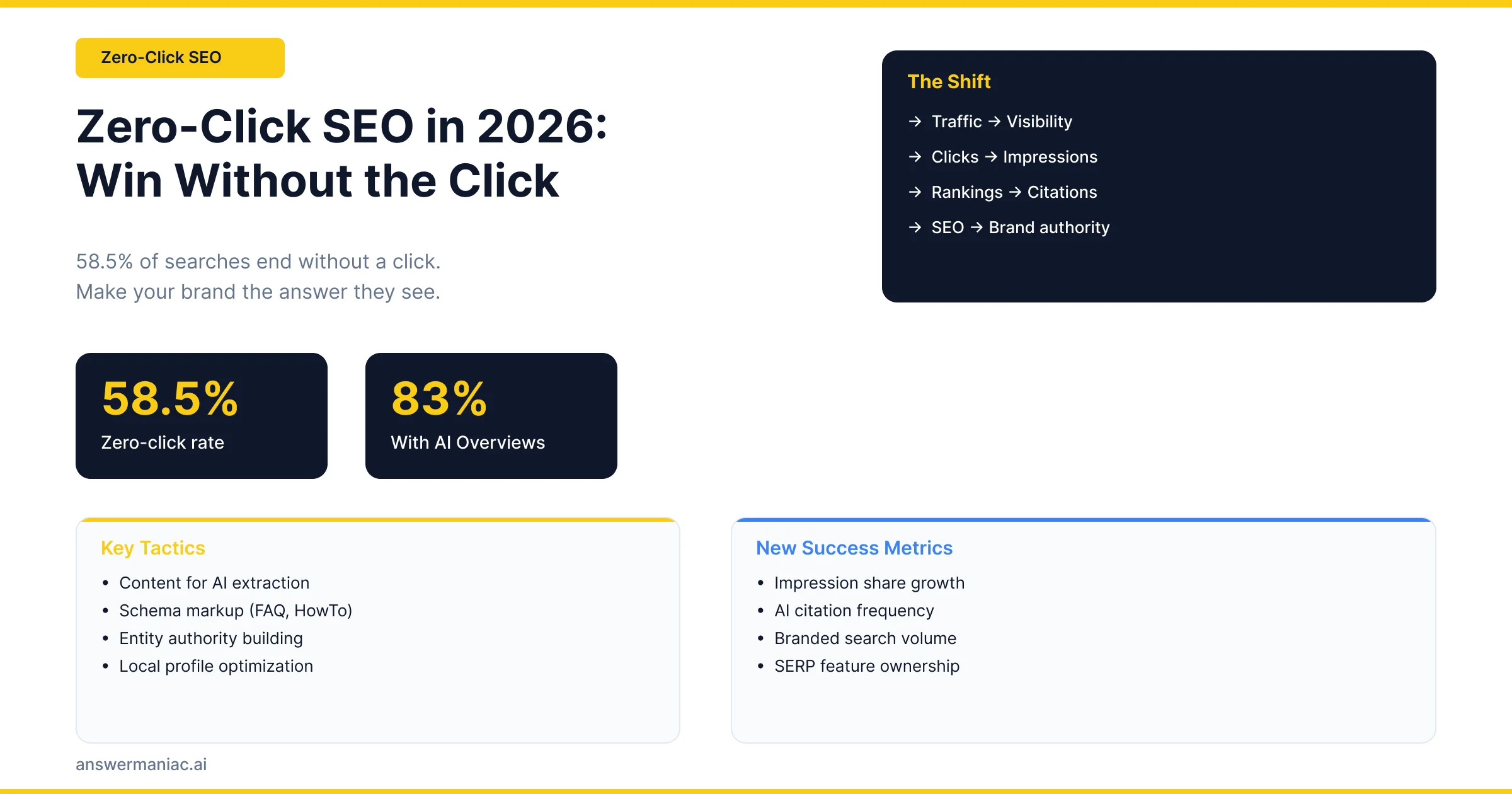
- Over 65% of Google searches now end without a click, meaning AI Overviews and direct answers are absorbing the attention that used to flow to your website
Traditional SEO no longer covers it
You can hold position #1 for your primary keyword and still be invisible in AI search. That is because AI engines like ChatGPT and Perplexity do not simply mirror Google's rankings. They evaluate content differently -- prioritizing structure, authority signals, entity clarity, and whether your content is formatted in a way that machines can extract and cite with confidence.
A strong organic ranking is necessary but no longer sufficient. You need a separate audit specifically for AI visibility.
Your competitors are moving now
Early movers in AI visibility optimization are locking in citation positions that compound over time. AI engines develop a kind of "memory" -- the more frequently your content is cited, the more likely it is to be cited again. Waiting six months means competing against brands that have already built citation momentum you will need to overcome.
This is why a structured audit is the first step. You need to know your baseline before you can plan improvements.
The 5-Step AI Visibility Audit Framework
This framework takes approximately 10 minutes for an initial pass and gives you a concrete score you can track over time. For each step, you will gather data, assign a score, and identify specific gaps to fix.
Step 1: Query the Big 5 AI Engines Directly
This is the most important step and the one most teams skip. You need to see exactly what AI engines say about your category -- and whether your brand appears in those answers.
The Big 5 AI engines to test:
- ChatGPT (OpenAI) -- the dominant conversational AI with the largest user base
- Perplexity -- the fastest-growing AI search engine, heavily used by researchers and decision-makers
- Gemini (Google) -- integrated into Google's ecosystem and AI Overviews
- Claude (Anthropic) -- increasingly used by technical and enterprise buyers
- Microsoft Copilot -- embedded in Bing, Edge, and the Microsoft 365 suite
How to run the test:
Prepare 10 industry-relevant queries that your ideal buyer would ask. These should not be branded queries (like "Is [Your Company] good?") -- they should be category-level and problem-level questions.
Examples for a B2B SaaS company:
- "What is the best [your category] software for mid-market companies?"
- "How do I evaluate [your category] vendors?"
- "What should I look for in a [your category] platform?"
- "[Your category] vs [competitor category] -- which is better for [use case]?"
- "Top [your category] tools for [specific industry or team size]"
For each query, enter it into all 5 AI engines and record:
| Data Point | What to Record |
|---|---|
| Your brand mentioned? | Yes/No for each engine |
| Position of mention | First cited, mentioned in a list, or absent |
| Accuracy of mention | Is the information about your brand correct? |
| Competitor mentions | Which competitors appear and in what context? |
| Source cited | Does the AI link to your content, a third-party review, or no source? |
Scoring (0-25 points):
- 20-25 points: Your brand is cited in 3+ engines for most queries, often in first or second position
- 10-19 points: Your brand appears in 1-2 engines for some queries, usually in a list format
- 1-9 points: Your brand appears only in 1 engine for 1-2 queries, or only for branded searches
- 0 points: Your brand does not appear in any AI-generated answer for any non-branded query
Most B2B companies score 0-5 on this step. That is the gap you are measuring.
Step 2: Check Your Schema Markup
Schema markup is the technical layer that helps AI engines understand what your content is and how to categorize it. Without proper schema, even well-written content may be overlooked because machines cannot parse it efficiently.
What to audit:
Use Google's Rich Results Test or the Schema Markup Validator to check your key pages. For a thorough audit, test your homepage, top 5 landing pages, and top 10 blog posts.
Critical schema types for AI visibility:
| Schema Type | Where to Use It | AI Visibility Impact |
|---|---|---|
| Organization | Homepage, About page | Establishes your brand as a known entity |
| FAQPage | FAQ sections, knowledge base articles | Directly extractable Q&A pairs for AI answers |
| HowTo | Tutorial and guide pages | Step-by-step content AI engines can cite verbatim |
| Article | Blog posts, thought leadership | Signals authoritative, citable content |
| Product | Product pages, pricing pages | Helps AI engines compare and recommend |
| Review / AggregateRating | Testimonial and review pages | Trust signal that increases citation confidence |
Scoring (0-20 points):
- 16-20 points: Organization, FAQPage, Article, and at least one additional schema type are implemented correctly across relevant pages
- 10-15 points: Basic Article or Organization schema is present, but FAQPage and HowTo are missing
- 1-9 points: Schema exists on some pages but has validation errors or is incomplete
- 0 points: No structured data is implemented on any page
For a deep dive on fixing schema issues, see our guide on schema markup for AI and ChatGPT citations.
Step 3: Evaluate Your Content Structure
AI engines do not read your content the way humans do. They scan for clear hierarchies, direct answers, and extractable blocks of information. Content that buries answers in long paragraphs or relies on clever formatting that does not translate to machine parsing will be ignored.
Content structure checklist:
- H1 mirrors a real user question -- The page title is written as (or closely matches) a question your buyer would ask
- Direct answer in the first 150 words -- A clear, self-contained answer appears immediately after the heading
- Logical H2/H3 hierarchy -- Sections follow a predictable structure that a machine can navigate
- Extractable content blocks -- Key facts are in bullet points, numbered lists, or tables rather than buried in paragraphs
- One topic per page -- Each page focuses on a single question or closely related cluster rather than covering everything
- Comparison tables present -- Where relevant, tabular data makes it easy for AI to surface structured comparisons
- Statistics are clearly stated -- Numbers and data points are presented in standalone sentences, not hidden in narrative paragraphs
- Content is self-contained -- A reader (or machine) can get the full answer without clicking to another page
Scoring (0-20 points):
- 16-20 points: 6-8 checklist items are consistently met across your top content pages
- 10-15 points: 4-5 items are present, but direct answers and extractable blocks are inconsistent
- 1-9 points: Content is primarily long-form narrative without clear structure for AI extraction
- 0 points: Pages lack clear headings, direct answers, and any structured formatting
For a complete breakdown of how to restructure your content for AI engines, see our content strategy guide for AI visibility.
Step 4: Assess Your Authority Signals (E-E-A-T)
AI engines use authority signals to decide which sources to trust and cite. E-E-A-T -- Experience, Expertise, Authoritativeness, and Trustworthiness -- is the framework that governs this evaluation. Without strong authority signals, even perfectly structured content will be passed over in favor of a less well-structured page from a more trusted source.
Authority signals audit:
| Signal | What to Look For | Present? |
|---|---|---|
| Author attribution | Named authors with credentials and bios on content pages | Yes/No |
| External citations | Your brand is mentioned or linked from reputable industry publications, directories, or research reports | Yes/No |
| Inbound links from authority sites | Backlinks from recognized industry sources, not just directories and press releases | Yes/No |
| Original data or research | You publish proprietary data, case studies, benchmarks, or survey results | Yes/No |
| Consistent entity presence | Your brand name, description, and key information are consistent across LinkedIn, Crunchbase, G2, Capterra, and your own site | Yes/No |
| Content freshness | Key pages have been updated within the last 6 months with current data and dates | Yes/No |
| Customer proof | Testimonials, case studies, or reviews from named customers are publicly visible | Yes/No |
| Active industry participation | Team members contribute to industry publications, podcasts, conferences, or open-source projects | Yes/No |
Scoring (0-20 points):
- 16-20 points: 6-8 authority signals are strong and verifiable
- 10-15 points: 4-5 signals are present, but external citations and original data are weak
- 1-9 points: Author attribution and basic profiles exist, but no meaningful external authority
- 0 points: No author attribution, no external mentions, no original data
Step 5: Score Yourself (0-100 Framework)
Add up your scores from the four steps above to get your raw audit score. Then add the final 15 points based on your competitive position.
| Component | Max Points |
|---|---|
| Step 1: AI Engine Query Results | 25 |
| Step 2: Schema Markup | 20 |
| Step 3: Content Structure | 20 |
| Step 4: Authority Signals (E-E-A-T) | 20 |
| Step 5: Competitive Position | 15 |
Competitive position scoring (0-15 points):
For each of the 10 queries you tested in Step 1, count how many times your brand is cited versus your top 3 competitors.
- 12-15 points: You are cited more frequently than your top competitor across most queries
- 8-11 points: You and your top competitor appear with roughly equal frequency
- 4-7 points: Your competitor is cited 2-3x more often than you
- 0-3 points: Your competitors dominate AI citations and your brand is rarely or never mentioned
Your total AI Visibility Score: ______ / 100
How to Interpret Your Score
Your score places you in one of four bands. Each band comes with a different priority set.
| Score Range | Band | What It Means | Priority Actions |
|---|---|---|---|
| 80-100 | Excellent | Your brand is a recognized AI source. Competitors are chasing you. | Defend positions. Monitor for new competitors. Expand into adjacent topics. |
| 50-79 | Competitive | You appear in some AI answers but have significant gaps. | Fix schema and content structure. Build authority in weak topic areas. Target competitor citation positions. |
| 20-49 | Emerging | You have foundational elements but are largely invisible to AI engines. | Implement schema markup across all key pages. Restructure top 20 content pages. Launch a digital PR campaign for external mentions. |
| 0-19 | Invisible | AI engines do not recognize your brand as a citable source. | Start with a complete AEO and GEO engagement. Every element needs attention -- schema, content, authority, and entity optimization. |
The median score for B2B SaaS companies running this audit for the first time is between 10 and 25. If that is where you land, you are not behind -- you are at the starting line alongside most of your market. The companies that act first will pull ahead.
Common AI Visibility Gaps (And Quick Fixes)
These are the issues we see most frequently when auditing B2B SaaS companies for AI visibility. Each one has a concrete fix.
| Gap | Why It Hurts AI Visibility | Quick Fix | Time to Implement |
|---|---|---|---|
| No FAQPage schema | AI engines cannot extract your Q&A content as structured data | Add FAQPage schema to all pages with FAQ sections | 1-2 hours per page |
| Answers buried in paragraphs | Machines skip content that requires complex parsing to find the answer | Add a direct answer in the first 150 words of every key page | 30 minutes per page |
| No author attribution | AI engines cannot verify expertise, reducing trust score | Add named author bios with credentials to all content pages | 1-2 hours total |
| Stale content with old dates | AI engines deprioritize outdated content, especially when fresher alternatives exist | Update dates, statistics, and references on top 20 pages quarterly | 2-3 hours per quarter |
| Inconsistent brand entity | AI engines cannot confidently connect mentions of your brand across the web | Standardize your company name, description, and key claims across all platforms | Half a day |
| No original data | Without proprietary insights, your content is a commodity any source can replicate | Publish one original data report, benchmark, or case study per quarter | Varies |
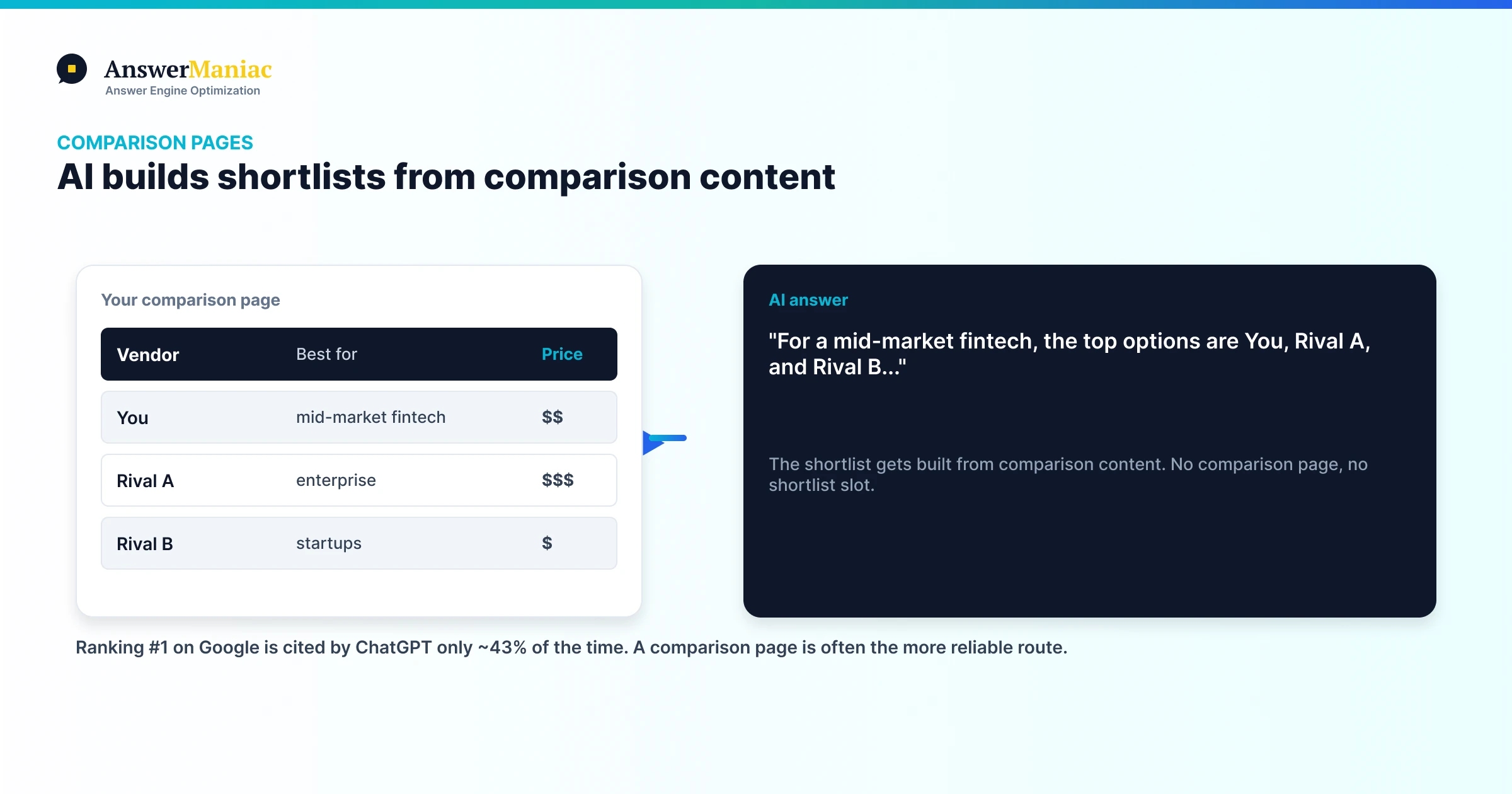
| Missing comparison content | Buyers ask AI to compare tools, and your brand is not in the comparison set | Create structured comparison pages for your top 5 competitors | 1-2 days per page |
| No external citations | AI engines weigh third-party mentions heavily when deciding which sources to trust | Launch a digital PR campaign targeting 3-5 industry publications | Ongoing |
What Companies With 80+ AI Visibility Scores Do Differently
After auditing hundreds of B2B companies, the patterns that separate high-scoring brands from the rest are consistent. These are not theoretical best practices -- they are observable behaviors of companies that AI engines cite regularly.
They treat AI visibility as a channel, not a project
Companies with high AI visibility scores do not run a one-time optimization sprint. They monitor AI citations weekly, track which queries they appear for, and adjust their content calendar based on citation gaps. AI visibility gets the same operational attention as paid search or email marketing.
They structure every page for extraction
Every key page follows a predictable format: question-based heading, direct answer block, structured supporting content, and clear entity definitions. This is not a style preference -- it is a systematic content architecture that makes machine extraction reliable and consistent.
They invest in authority outside their own site
High-scoring companies have active digital PR programs that earn mentions in industry publications, analyst reports, and comparison sites. They contribute guest articles, participate in industry research, and ensure their brand appears in the third-party sources that AI engines trust most.
They publish original data
Proprietary research, benchmark reports, and customer case studies with real numbers create content that cannot be replicated by competitors. AI engines prefer citing original data because it reduces the risk of surfacing inaccurate or derivative information.
They maintain schema markup rigorously
Schema is not implemented once and forgotten. High-scoring companies audit their structured data quarterly, add new schema types as they publish new content formats, and validate that existing schema remains error-free after site updates.
They align traditional SEO and AI visibility
These companies do not treat SEO and AEO as separate disciplines. Their content strategy serves both channels simultaneously -- building organic rankings that feed AI engine trust while structuring content in ways that maximize citation probability.
FAQ
What is an AI visibility audit?
An AI visibility audit is a structured assessment of how your brand appears across AI-powered search engines and assistants, including ChatGPT, Perplexity, Gemini, Claude, and Microsoft Copilot. The audit measures whether your brand is cited in AI-generated answers, evaluates your schema markup and content structure for machine readability, and scores your authority signals. The result is a numeric score (0-100) that quantifies your current AI visibility and identifies specific gaps to fix. Unlike a traditional SEO audit, an AI visibility audit focuses on citation presence rather than keyword rankings.
How long does an AI visibility audit take?
An initial audit using the 5-step framework takes approximately 10 minutes for a quick pass. A thorough audit -- testing 10+ queries across all 5 AI engines, validating schema on 15+ pages, and conducting a full content structure review -- takes 2-4 hours. Many companies choose to use an automated tool for the initial score and then conduct a deeper manual review of the gaps identified. You can get a free automated AI Visibility Score at answermaniac.ai to start with a baseline in under 2 minutes.
How often should I run an AI visibility audit?
Run a full audit quarterly, with lighter monthly check-ins on your core queries. AI engines update their models and retrieval systems regularly, which means your citation presence can shift even if you have not changed your content. Quarterly audits catch these shifts early and give you time to respond. Monthly check-ins -- querying your top 5 industry questions across 2-3 AI engines -- take about 10 minutes and help you spot trends before they become problems.
What is a good AI visibility score for a B2B SaaS company?
For B2B SaaS companies in the $5M-$50M ARR range, a score of 50 or above is competitive, and 80 or above is excellent. The median first-audit score is between 10 and 25. If you score above 30 on your first audit, you are ahead of most of your market. The goal is consistent improvement -- moving from the "Invisible" or "Emerging" band into the "Competitive" band within one quarter, and reaching "Excellent" within 6-12 months of focused optimization.
Can I improve my AI visibility score without a complete website redesign?
Yes. Most AI visibility improvements do not require a redesign. The highest-impact fixes are adding schema markup, restructuring the first 150 words of key pages to include direct answers, adding author attribution, and updating stale content with current data. These changes can be made page by page, starting with your highest-traffic and highest-intent content. Companies that focus on their top 20 pages first typically see measurable improvements in AI citation frequency within 4-8 weeks.
Start Your AI Visibility Audit Today
AI search is not a future trend. It is the current behavior of your buyers. With 80% of B2B decision-makers using AI tools during their evaluation process and AI search growing at 500%+ year-over-year, the window for early-mover advantage is closing.
The 5-step framework above gives you a concrete, repeatable method to measure where you stand. But if you want your score calculated automatically -- with competitor benchmarking, specific gap identification, and a prioritized action plan -- you can get that in under 2 minutes.
Get your free AI Visibility Score at answermaniac.ai and see exactly where your brand stands across ChatGPT, Perplexity, Gemini, and Google AI Overviews. No forms. No sales calls. Just your score and a clear path forward.
Related Articles
- The ANSWER Framework: Our 6-Stage AEO Methodology — auditing is Stage A. Here's what comes after.
- How We Applied The ANSWER Framework to Our Own Site — we started at 34/100. See the full results.
- The Complete Guide to AI Visibility for B2B Companies
- Schema Markup for AI: How to Get Cited by ChatGPT
- Content Strategy for AI Visibility: How to Structure Content That AI Engines Cite
- Entity Optimization for AEO: Knowledge Graph Presence
- Explore AEO & GEO Services
- View Pricing & Free Audit Tools
Get AEO Insights Weekly
Join 500+ B2B marketers getting AI visibility tactics every Tuesday.
Ready to Get Your Brand Cited by AI?
See how your competitors show up in ChatGPT, Perplexity, and Gemini — and what it would take to get recommended.