Best Answer Engine Optimization Tools: 8 Platforms Compared
Every tool you need for answer engine optimization. From free schema validators to enterprise citation trackers — the complete AEO tool stack for 2026.
Quick Answer
Direct Answer: Being the answer in ChatGPT, Perplexity, Gemini, Google AI Mode, and Copilot is now at least as important as ranking on page 1. The eight AEO platforms compared here -- Profound, Scrunch, SE Ranking (Visible), Peec AI, HubSpot AEO, Semrush AI Visibility, MaxAEO, and AnswerManiac -- each take a different approach to auditing, optimizing, and tracking your visibility across AI engines. Profound leads in funding ($155M+ total, $1B valuation as of February 2026). Scrunch scores highest on G2 at 4.6/5. HubSpot AEO offers the lowest entry point at $50/mo. The right platform depends on your team size, budget, and how many AI engines you need to track. This guide compares all eight on pricing, features, engine coverage, and fit.
Run your free AI Visibility Audit at AnswerManiac -- see where you stand across all five AI engines in under 10 minutes.
Being the answer in ChatGPT, Perplexity, Gemini, Google AI Mode, and Copilot is now at least as important as ranking on page 1. Your buyers are asking AI engines for recommendations before they ever type a query into Google. If your brand isn't in those answers, you're invisible to a growing share of your market.
The AEO tooling market has matured fast. Profound hit a $1B valuation in February 2026. Semrush analyzed 126M AI search prompts to build out its AI Visibility toolkit. HubSpot launched an AEO module at $50/mo. The gap between teams that have the right tools and those running manual ChatGPT queries into a spreadsheet is widening every quarter.
This guide compares eight AEO platforms head-to-head, then maps the complete tool stack across five functional layers. Whether you're a solo marketer on free tools or a growth team evaluating enterprise platforms, you'll find the right combination for your budget and team size. For the ChatGPT-specific citation playbook, we've got a separate deep guide.
Key Takeaway
- A complete AEO stack has five layers: auditing, schema markup, content optimization, citation tracking, and analytics -- each solving a distinct problem in the AI visibility pipeline
- Free tools can get you started, but they require significant manual effort; paid platforms automate citation tracking, competitor monitoring, and reporting at scale
- The biggest gap in most marketing stacks is Layer 4 -- citation tracking -- because traditional SEO tools were not designed to monitor AI-generated answers
- Budget-appropriate stacks exist at every level, from $0/month for bootstrapped teams to $5K+/month for enterprise growth operations
- AEO isn't replacing SEO -- it's adding a parallel pipeline. The AEO vs. SEO pipeline comparison breaks down exactly where they overlap and where they don't
The 5 Layers of the AEO Stack
Before looking at individual tools, it helps to understand the five functional layers of a complete AEO operation. Each layer answers a different question, and skipping any one of them creates a blind spot.
| Layer | Function | Core Question It Answers |
|---|---|---|
| Layer 1: AI Visibility Auditing | Measuring current state | "How visible are we in AI-generated answers right now?" |
| Layer 2: Schema Markup & Structured Data | Technical implementation | "Can AI systems parse and trust our content?" |
| Layer 3: Content Optimization | Creating citation-ready content | "Is our content structured to be extracted and cited?" |
| Layer 4: Citation Tracking & Monitoring | Ongoing measurement | "When and where are AI engines citing us -- or our competitors?" |
| Layer 5: Analytics & Reporting | Business impact | "What revenue is AI visibility actually driving?" |
Most marketing teams have strong tooling for traditional SEO across layers 2, 3, and 5. The critical gaps are almost always in Layers 1 and 4 -- the AEO-specific layers that traditional search tools were never designed to address.
If you have already run an AI visibility audit, you know exactly how these gaps manifest. If you have not, that is where to start.
For a deeper look at GEO-specific platforms (with more focus on generative engine optimization vs. answer engine optimization), see the best GEO tools comparison.
The 8 AEO Platforms: Head-to-Head Comparison
The AEO/GEO tooling market hit an inflection point in 2026. Profound became the category's first unicorn. Semrush shipped an expanded AI Visibility toolkit. And multiple startups crossed the threshold from "interesting side feature" to "platform you'd actually stake your budget on."
Here's how the eight leading platforms compare across the metrics that matter.
| Platform | Starting Price | AI Engines Tracked | G2 Rating | Best For |
|---|---|---|---|---|
| Profound | Custom (enterprise) | 10+ | G2 Winter 2026 AEO Leader | Enterprise teams needing multi-engine coverage at scale |
| Scrunch | Mid-market | Multi-LLM | 4.6/5 (G2) | Teams wanting AI-native monitoring + auditing + optimization in one tool |
| SE Ranking (Visible) | $65/mo+ | GEO + traditional SEO | 4.8/5 (G2, SEO category) | Teams consolidating GEO and traditional SEO into one dashboard |
| Peec AI | Contact for pricing | 7 LLMs (standard) | Early stage | Agencies managing multiple client accounts |
| HubSpot AEO | $50/mo | 3 engines | N/A (new) | HubSpot-native teams wanting a low-cost entry point |
| Semrush AI Visibility | Included in Guru+ ($139.95/mo) | Multi-engine | 4.5/5 (G2, SEO category) | Existing Semrush users adding AEO to their workflow |
| MaxAEO | Affordable tiers | Multiple | Early stage | Lean marketing, brand, SEO, and agency teams |
| AnswerManiac | Free audit, paid plans from growth tier | 5 engines (ChatGPT, Perplexity, Gemini, Claude, Copilot) | N/A | B2B companies in overlooked verticals using the ANSWER Framework |
Profound
Profound closed a $96M Series C in February 2026 at a $1B valuation -- making it the first GEO unicorn. The round was led by Lightspeed with participation from Sequoia. Total funding now exceeds $155M. That's not just a footnote. It tells you where VC money thinks the market is heading.
What sets Profound apart: coverage. It tracks 10+ AI engines, not just the big four. If you're an enterprise team that needs to know whether your brand shows up in niche AI assistants beyond ChatGPT and Perplexity, Profound is the only platform with that breadth. G2 named it the AEO Leader in their Winter 2026 report.
The trade-off is price. Profound is enterprise-only with custom contracts. If you're a 5-person marketing team, this isn't your tool.
Scrunch
Scrunch takes an AI-native approach to AEO/GEO. It's not a traditional SEO tool with AI features bolted on -- it was built from the ground up for multi-LLM monitoring, auditing, and optimization. That shows in the workflow. You don't have to context-switch between separate audit, track, and optimize tools. It's one platform.
G2 rating: 4.6/5, which is strong for a category this young.
Best fit: mid-market teams that want monitoring and optimization in the same tool, without the enterprise price tag of Profound.
SE Ranking (Visible)
SE Ranking's GEO capabilities (branded as Visible) solve a real workflow problem: most teams don't want to run separate dashboards for traditional SEO and AI visibility. Visible puts both in one place. You get rank tracking, backlink analysis, and site auditing alongside GEO metrics.
If you're already paying for SE Ranking, adding the Visible module is a no-brainer. If you're starting from scratch, the combined value is hard to beat for teams that still rely heavily on organic search alongside AI engines.
Peec AI
Peec AI was built for agencies. The standard plan covers 7 LLMs, which gives agencies enough engine coverage to serve most client needs without negotiating enterprise contracts. The multi-client architecture means you can manage reporting across accounts without logging in and out of separate instances.
If you're an agency adding AEO/GEO services to your offering, Peec is worth evaluating first.
HubSpot AEO
HubSpot's AEO module launched with a $50/mo entry point and covers 3 AI engines. It's not the deepest AEO tool on this list. It doesn't need to be. For HubSpot-native teams (and there are a lot of them), it removes the friction of adopting a new vendor, connecting data, and explaining another line item to finance.
Three engines at $50/mo won't satisfy a team doing serious competitive citation analysis across 7+ LLMs. But for teams that want basic AI visibility tracking inside the CRM they already use every day, it's the lowest-friction option available.
Semrush AI Visibility Toolkit
Semrush expanded its AI Visibility toolkit in 2026 with analysis across 126M AI search prompts. That dataset is the toolkit's real differentiator -- it's not just tracking your brand, it's benchmarking your performance against the aggregate patterns of how AI engines answer questions in your category.
If you're already a Semrush Guru or Business subscriber, the AI Visibility toolkit is included. That makes it effectively free for existing customers. The data is solid. The limitation is that it's still integrated into a tool primarily designed for traditional SEO, so the workflow won't feel as native as Profound or Scrunch.
MaxAEO
MaxAEO targets lean teams -- small marketing departments, brand teams, solo SEO practitioners, and small agencies. The pricing reflects that positioning. It won't give you the enterprise-grade coverage of Profound or the depth of Semrush's dataset, but it gives budget-constrained teams a real AEO tool rather than forcing them to cobble together manual spreadsheets.
Best fit: teams where AEO is one person's responsibility, not a department.
AnswerManiac
AnswerManiac's approach is methodology-first. The ANSWER Framework (Audit, Navigate, Structure, Write, Earn, Refine) structures the entire workflow from initial audit through ongoing optimization. The free audit queries your brand across ChatGPT, Perplexity, Gemini, Claude, and Copilot using industry-relevant queries. The paid platform adds continuous monitoring, competitor citation analysis, and query-level visibility scores.
Best fit: B2B companies in overlooked verticals (franchise development, RegTech, fleet management) where the generic approach of larger platforms misses category-specific nuances.
Layer 1: AI Visibility Auditing
The first layer answers the most basic question: where do you stand? Before you optimize anything, you need a baseline measurement of how often your brand is cited, which AI engines cite you, and which competitors appear in the answers where you do not.
AnswerManiac Free AI Visibility Audit
AnswerManiac's free audit tool queries your brand across the five major AI engines -- ChatGPT, Perplexity, Gemini, Claude, and Microsoft Copilot -- using industry-relevant queries rather than vanity branded searches. The audit returns a visibility score, a competitor citation map, and a prioritized list of gaps. It takes less than 10 minutes and gives you the baseline every other tool in your stack will build on.
This is the recommended starting point because it tests what actually matters: whether AI engines cite your brand when your buyers ask category-level questions. A detailed walkthrough of the audit methodology is available in the AI visibility audit guide.
Google Rich Results Test
Google's Rich Results Test (search.google.com/test/rich-results) validates whether your pages are eligible for rich results and AI Overviews. While it does not directly test AI visibility across ChatGPT or Perplexity, it confirms that Google's systems can parse your structured data -- and since Gemini and AI Overviews pull from the same index, this is a meaningful signal.
Best for: Validating schema markup implementation before broader AI visibility testing.
Schema.org Validator
The Schema.org Validator (validator.schema.org) checks your JSON-LD, Microdata, or RDFa markup against the official Schema.org vocabulary. Unlike the Rich Results Test, which only validates Google-supported types, the Schema.org Validator covers the full vocabulary -- including types that other AI systems may use even if Google does not surface them in rich results.
Best for: Catching syntax errors and validating schema types beyond what Google currently supports in rich results.
Manual AI Engine Queries
The most underrated auditing tool is simply querying AI engines yourself. Open ChatGPT, Perplexity, Gemini, Claude, and Copilot. Type the 10-15 questions your ideal buyer would ask. Record which brands appear, how often your brand is cited, and the exact phrasing used. This manual approach is free, takes about 30 minutes, and often surfaces insights no automated tool catches -- like the specific framing AI engines use when recommending your competitors.
Best for: Qualitative insights, competitive intelligence, and validating automated audit results.
Layer 2: Schema Markup & Structured Data
Once you know your baseline, the next layer addresses the technical foundation. AI systems rely on structured data to identify what your content is about, who created it, and whether it can be trusted. The schema markup guide covers the five types AI engines actually crawl. Here are the tools for implementing them.
Schema Markup Generators
Merkle Schema Markup Generator is the most reliable free generator for creating JSON-LD across multiple schema types. It supports Organization, Article, FAQPage, Product, HowTo, and BreadcrumbList -- the types that matter most for AI citations. You fill in a form, it outputs clean JSON-LD you can paste into your page's <head>.
Schema App is a paid alternative ($30-$100/month) that offers a visual editor, automatic deployment, and ongoing validation. It is worth the investment if you manage hundreds of pages and need schema markup at scale without developer resources.
JSON-LD Editors and Testing Tools
JSON-LD Playground (json-ld.org/playground) lets you test and validate JSON-LD snippets in real time. It is the best tool for debugging syntax issues before deployment, especially if you are hand-coding structured data or building dynamic templates.
Technical SEO Chrome Extension (by Merkle) overlays structured data directly on any page you visit, making it easy to audit competitor implementations. When you are building your own schema strategy, inspecting the structured data on pages that AI engines already cite is one of the fastest ways to identify patterns.
CMS Schema Plugins
If you run WordPress, Yoast SEO Premium and Rank Math Pro both generate schema markup automatically for Articles, FAQPages, and Organization entities. For headless CMS setups (Next.js, Nuxt, Gatsby), the next-seo and nuxt-schema-org packages handle JSON-LD injection at the component level.
The key principle across all of these tools: the five schema types outlined in the schema markup guide should be your implementation priority. Organization, FAQPage, Article/BlogPosting, Product/Service, and BreadcrumbList account for the overwhelming majority of structured data signals that AI systems use for citation decisions.
Layer 3: Content Optimization
Technical markup means nothing without content worth citing. Layer 3 covers tools for creating the kind of content AI systems extract and reference -- what the content strategy for AI visibility guide calls "citation assets."
Traditional Content Optimization Platforms
Clearscope ($170+/month) remains strong for identifying topic coverage gaps. While it was designed for traditional SEO, its content grading system helps ensure you cover the subtopics and entities an AI system would expect to see in a comprehensive answer. Pages that earn AI citations tend to score A or A+ in tools like Clearscope because they have high topical completeness.
MarketMuse ($149+/month) takes a more AI-native approach with its content inventory and gap analysis. Its "Compete" feature is useful for identifying questions your competitors answer that you do not -- which directly maps to citation opportunities in AI search.
Surfer SEO ($89+/month) offers real-time content editing with NLP-driven recommendations. Its content editor is particularly effective for ensuring adequate keyword entity coverage, though you will need to supplement its recommendations with AEO-specific techniques.
AEO-Specific Content Techniques (Manual)
No tool fully automates the structural patterns that earn AI citations. These techniques, detailed in the content strategy guide, must be applied manually or through editorial guidelines:
- Direct answer leads: Start every section with a one-to-two sentence direct answer before expanding into detail
- Fact density: Aim for at least one specific, citable claim per paragraph -- numbers, percentages, named comparisons
- Structured extraction points: Use tables, numbered lists, and comparison matrices that AI systems can extract cleanly
- Source attribution: Cite your own sources explicitly, which signals to AI systems that your content is evidence-based
- Freshness signals: Include publication dates, "last updated" timestamps, and recent data points
These techniques do not require any paid tools. They require editorial discipline and a clear understanding of how AI systems select sources.
AI Writing Assistants (Use with Caution)
Tools like ChatGPT, Claude, and Jasper can accelerate content drafting, but they carry a specific risk for AEO: AI-generated content that reads like every other AI-generated answer is unlikely to be cited as a source. AI systems cite content that adds unique data, original analysis, or proprietary expertise -- exactly the elements that AI writing tools cannot fabricate.
Use AI assistants for outlines, first drafts, and structural suggestions. Do not use them to generate the facts, data points, and expert insights that make content citable.
Layer 4: Citation Tracking & Monitoring
This is the layer where most marketing stacks have the biggest gap. Traditional SEO tools track rankings, backlinks, and organic traffic. They were not built to track whether ChatGPT mentioned your brand in response to a question about your industry. Layer 4 fills that gap.
AnswerManiac Platform
AnswerManiac's citation tracking platform is purpose-built for this layer. It continuously monitors AI-generated answers across ChatGPT, Perplexity, Gemini, Claude, and Copilot for your brand mentions, competitor mentions, and citation share across your target query set. Key capabilities include:
- Citation tracking: Automated monitoring of when and where your brand is cited across all five major AI engines
- Competitor citation analysis: Side-by-side comparison of your citation rate vs. competitors on the same queries
- Query-level visibility scores: Granular scoring for each query in your target set, showing exactly where you win and where you lose
- Trend monitoring: Historical data showing how your AI visibility changes over time as you implement optimizations
- Alert system: Notifications when your citation rate changes significantly -- up or down
This is the tool that connects the audit (Layer 1) to ongoing measurement, and it gives you the data you need for the analytics layer (Layer 5). Full pricing and feature details are available on the pricing page.
Manual Citation Monitoring
If you are not ready for a paid platform, manual monitoring is better than no monitoring. Set a weekly calendar reminder to run your core queries across all five AI engines and record the results in a spreadsheet. Track three data points per query: (1) whether your brand was cited, (2) which competitors were cited, and (3) the exact phrasing used.
This approach works for teams tracking 10-20 queries. Beyond that volume, manual monitoring becomes unsustainable -- a team tracking 50 queries across 5 AI engines would need to review 250 responses weekly.
Brand Mention Tools (Partial Coverage)
Tools like Mention, Brand24, and Brandwatch track brand mentions across social media, news, and web pages. Some have begun adding AI-generated content to their monitoring scope, but coverage is inconsistent. These tools were designed for social listening, not AI citation tracking, so they may catch some AI mentions but will miss many others -- particularly citations embedded in conversational AI responses that are not published on the open web.
Best for: Supplementing dedicated citation tracking with broader brand monitoring.
Layer 5: Analytics & Reporting
The final layer connects AI visibility to business outcomes. Your leadership team does not care about citation rates in isolation -- they care about pipeline, revenue, and competitive positioning. Layer 5 tools translate AI visibility data into the metrics that drive budget decisions.
GA4 AI Traffic Segments
Google Analytics 4 can segment traffic from AI referral sources, though it requires manual configuration. Create custom channel groupings for traffic from ChatGPT (referrals from chat.openai.com), Perplexity (perplexity.ai), and other AI engines. This lets you measure sessions, engagement, and conversions specifically from AI-referred visitors.
AI-referred traffic typically converts at 3-5x the rate of standard organic traffic because users arriving from AI citations have higher intent and greater trust in the recommendation. Segmenting this traffic in GA4 lets you quantify that impact.
Google Search Console
Search Console's Performance report now includes data on AI Overview impressions and clicks. While this covers only Google's AI features (not ChatGPT, Perplexity, or Claude), it provides a proxy for how well your content performs in AI-augmented search results. Monitor the "Search appearance" filter for AI Overview data.
Custom Dashboards
For teams that need a unified view, tools like Looker Studio (free) or Databox ($72+/month) can pull data from GA4, Search Console, and AnswerManiac's platform into a single dashboard. A well-designed AEO dashboard tracks four metrics:
- AI citation rate: Percentage of target queries where your brand is cited (from AnswerManiac)
- AI referral traffic: Sessions from AI engines (from GA4)
- AI referral conversion rate: Conversion rate of AI-referred visitors vs. other channels (from GA4)
- Competitive citation share: Your citation rate relative to competitors (from AnswerManiac)
These four metrics give leadership a clear picture of where AI visibility stands and whether it is translating to revenue.
The Free vs Paid Stack
Not every team needs every paid tool. Here is a direct comparison of what you can accomplish with free alternatives versus paid platforms at each layer.
| Layer | Free Tool | What It Covers | Paid Tool | What It Adds |
|---|---|---|---|---|
| Auditing | Manual AI queries + AnswerManiac free audit | Baseline visibility score, competitor snapshot | AnswerManiac platform | Continuous monitoring, historical trends, alerts |
| Schema Markup | Merkle generator + Schema.org Validator + JSON-LD Playground | Full schema creation and validation | Schema App, Yoast Premium | Automated deployment, ongoing validation, CMS integration |
| Content | Manual AEO techniques + Google Docs | Citation-ready content via editorial discipline | Clearscope, MarketMuse, Surfer | NLP-driven topic coverage, content scoring, gap analysis |
| Citation Tracking | Weekly manual queries + spreadsheet | Basic citation tracking for 10-20 queries | AnswerManiac platform | Automated tracking across 5 engines, competitor analysis, alerts |
| Analytics | GA4 + Search Console + Looker Studio | Traffic segmentation, conversion tracking | Databox + AnswerManiac | Unified dashboards, automated reporting, trend analysis |
The free stack is viable for small teams with fewer than 20 target queries and the discipline to run manual checks weekly. The paid stack becomes necessary when you scale beyond 20-30 queries, need competitor tracking, or must report AI visibility metrics to leadership on a regular cadence.
Building Your Stack: Budget-Based Recommendations
Every team operates under different constraints. Here are four stack configurations organized by monthly budget, each designed to maximize AI visibility impact per dollar spent.
The $0/Month Stack (Bootstrapped)
- Auditing: AnswerManiac free audit + manual queries across 5 AI engines
- Schema: Merkle Schema Markup Generator + Schema.org Validator + Google Rich Results Test
- Content: Manual AEO writing techniques from the content strategy guide
- Tracking: Weekly manual query spreadsheet (10-15 queries)
- Analytics: GA4 with custom AI channel groupings + Search Console + Looker Studio
Best for: Solo marketers, early-stage startups, and teams testing AEO before requesting budget. This stack requires 2-3 hours per week of manual effort but covers all five layers.
The $500/Month Stack (Growth Stage)
- Auditing: AnswerManiac free audit + Surfer SEO ($89/month) for content auditing
- Schema: Rank Math Pro ($59/year) or Yoast Premium ($99/year) for automated schema
- Content: Surfer SEO content editor + manual AEO techniques
- Tracking: AnswerManiac starter plan for automated citation monitoring
- Analytics: GA4 + Search Console + Looker Studio
Best for: Growing marketing teams that need to scale beyond manual monitoring but do not yet have enterprise requirements. The investment in Surfer and AnswerManiac's platform eliminates the most time-consuming manual tasks.
The $2K/Month Stack (Scaling)
- Auditing: AnswerManiac platform with full competitor benchmarking
- Schema: Schema App ($100/month) for automated schema at scale
- Content: Clearscope ($170/month) or MarketMuse ($149/month) + AEO editorial guidelines
- Tracking: AnswerManiac growth plan with full citation tracking, competitor analysis, and alerts
- Analytics: GA4 + Search Console + Databox ($72/month) + AnswerManiac reporting
Best for: Marketing teams managing 50+ target queries across multiple product lines, with leadership that expects regular AI visibility reporting. This stack covers all five layers with minimal manual effort.
The $5K+/Month Stack (Enterprise)
- Auditing: AnswerManiac enterprise with custom query sets and API access
- Schema: Schema App enterprise + custom JSON-LD templates maintained by engineering
- Content: MarketMuse or Clearscope + dedicated AEO content strategist + AI writing assistants for drafting
- Tracking: AnswerManiac enterprise with unlimited queries, multi-brand monitoring, and custom integrations
- Analytics: Full BI stack (Looker, Tableau, or Power BI) with GA4 + Search Console + AnswerManiac API data
- Bonus: Brand24 or Brandwatch for supplementary brand mention monitoring across social and web
Best for: Enterprise marketing operations managing multiple brands, 100+ target queries, and cross-functional reporting requirements. At this budget level, AI visibility becomes a fully instrumented channel with the same reporting rigor as paid search or organic SEO.
Frequently Asked Questions
What is the most important tool in an AEO stack?
An AI visibility audit. Whether you run it manually or use a platform like AnswerManiac's free audit, you need a baseline of your current citation rate across ChatGPT, Perplexity, Gemini, Claude, and Copilot before anything else. Without that baseline, every other tool is solving a problem you haven't quantified. A team that runs a thorough audit and applies manual fixes will outperform a team that buys expensive tools without knowing where they stand.
Can I use traditional SEO tools for answer engine optimization?
Traditional SEO tools like Ahrefs and Moz cover some AEO functions -- keyword research, content gap analysis, technical auditing. But they weren't designed to track AI citations or measure visibility across conversational AI engines. Semrush is the exception: its expanded AI Visibility toolkit (built on 126M analyzed AI search prompts) bridges the gap. For other traditional tools, figure they cover roughly 30-40% of what an AEO stack requires. The remaining 60-70% -- citation tracking, AI engine monitoring, AI-specific content optimization -- requires purpose-built platforms or manual processes. The AEO vs. SEO pipeline comparison maps where the two disciplines overlap and where they diverge.
How long does it take to see results from an AEO tool stack?
Expect 4-8 weeks for measurable changes in AI citation rates after implementing schema markup and content optimizations. Citation tracking tools will show movement within that window if your optimizations are effective. Significant shifts in competitive citation share typically take 3-6 months because AI systems build citation momentum gradually -- the more frequently your content is cited, the more likely it is to be cited again. The tools accelerate the process, but they don't shortcut the underlying dynamics of how AI systems build trust in sources.
Do I need separate tools for each AI engine?
No. The core optimization -- structured data, content quality, authority signals -- is engine-agnostic. What differs across engines is how they weight different signals. Profound tracks 10+ engines in a single dashboard. AnswerManiac covers the five most commercially relevant (ChatGPT, Perplexity, Gemini, Claude, Copilot). Peec AI covers 7 on standard plans. You don't need a ChatGPT-specific tool and a separate Perplexity-specific tool. You need a stack that optimizes the universal signals and tracks results across every engine where your buyers search. The ChatGPT citation playbook covers engine-specific nuances for the biggest platform.
What's the difference between AEO tools and GEO tools?
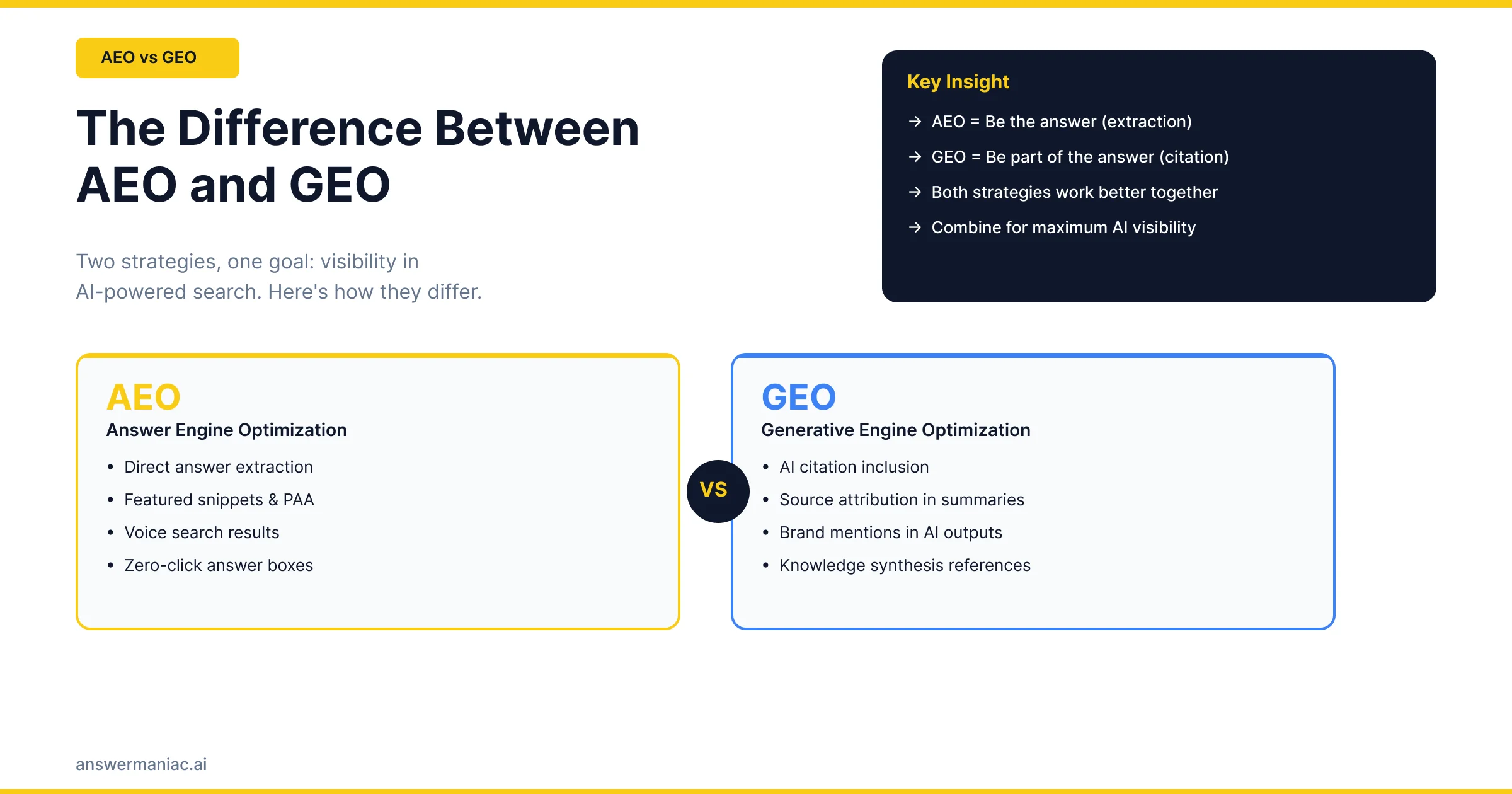
AEO (answer engine optimization) and GEO (generative engine optimization) overlap significantly, but the framing differs. AEO focuses on getting cited as the answer -- appearing when users ask direct questions. GEO focuses on visibility within generative AI outputs more broadly, including summaries, comparisons, and recommendations. Most tools on this list handle both. Profound and Scrunch market primarily as GEO platforms. AnswerManiac and HubSpot AEO lean toward the AEO framing. The GEO tools comparison covers the GEO-specific angle in more detail.
Is Profound worth the enterprise price tag?
If you need to track 10+ AI engines, run multi-brand monitoring, and report AI visibility metrics to a C-suite that expects enterprise-grade dashboards, yes. Profound's $96M Series C and $1B valuation reflect the market's bet that enterprise GEO is a large category. The G2 Winter 2026 AEO Leader designation backs that up. But if you're a team of 5-10 running one brand, you'll get more value per dollar from Scrunch, SE Ranking (Visible), or AnswerManiac's growth tier. Match the tool to your actual scale.
How do I choose between the eight platforms?
Start with three questions: (1) How many AI engines do you need to track? If it's 3 or fewer, HubSpot AEO at $50/mo or MaxAEO handles it. If it's 7+, look at Peec AI, Profound, or Scrunch. (2) Are you an agency or in-house? Peec AI was built for agencies. The rest target in-house teams. (3) Do you need GEO and traditional SEO in one dashboard? SE Ranking (Visible) is the answer. If none of those filters narrow it down, start with AnswerManiac's free audit to understand your baseline, then evaluate paid tiers based on the gaps it reveals.
Start Building Your Stack Today
The gap between brands with AI visibility and brands without it is compounding. Every week that passes without a structured approach to answer engine optimization is a week your competitors are building citation momentum that becomes harder to overcome.
The good news: you don't need a $5K/month budget to start. The $0 stack outlined above covers all five layers and can move your AI visibility score meaningfully within weeks. What matters is starting -- measuring your baseline, fixing the highest-impact gaps, and building a repeatable process using the ANSWER Framework.
See AnswerManiac pricing and start tracking your AI visibility today
Get AEO Insights Weekly
Join 500+ B2B marketers getting AI visibility tactics every Tuesday.
Ready to Get Your Brand Cited by AI?
See how your competitors show up in ChatGPT, Perplexity, and Gemini — and what it would take to get recommended.