AI Visibility for FinTech: How to Earn Trust Citations in YMYL Categories
Your financial brand needs AI's trust to be recommended. See the specific strategies that secure citations in high-stakes finance queries and drive qualified leads.
Direct Answer: If your fintech brand isn't cited in AI-generated answers, you are already losing customers. AI search visibility measures how often tools like ChatGPT, Gemini, and Perplexity recommend your company when users ask for financial advice. With over half of all finance queries now triggering an AI result, traditional SEO rankings are no longer enough. The shift is defined by a simple metric: citation over click. Fintech brands must earn AI trust through regulatory clarity, structured data, and verifiable claims.
Get a free AI visibility audit to see where your brand stands
We tracked AI citations across 150 financial services queries over 90 days. Payroll platforms, fraud prevention tools, RegTech, spend management, AP/AR automation. Every query a CFO, compliance officer, or ops lead would actually type into ChatGPT or Perplexity.
The results were clear: fintech brands that got cited consistently shared three traits. Regulatory specificity. Structured content that AI could parse in under two seconds. And recent, verifiable data points with named sources.
Brands that wrote vague thought leadership about "the future of fintech" got zero citations. Zero.
Key Takeaways
- AI prioritizes structured, teachable content over keyword-stuffed pages, making clean data and clear explanations your most valuable asset in financial services.
- Trust and compliance are non-negotiable ranking factors in finance. AI systems are trained to detect and favor sources that align with regulatory standards.
- Success is measured by citation frequency and depth, not page-one rankings. New tools are needed to track your brand's presence across AI platforms.
Why Is AI Search Visibility the New Frontline for Fintech Growth?
AI visibility now shapes how fintech brands gain attention online. Many users no longer scroll through traditional search results. They read summaries generated by AI models where source selection dictates which fintech brands earn the user's trust.
When someone asks about digital wallets, embedded finance, or business loans, the brands mentioned inside those answers gain instant trust. If your fintech company is not cited, it's invisible in that moment of decision.
This changes how SEO strategy works. Ranking on Google Search still matters, but it is no longer enough. AI systems choose sources based on clarity, structure, and authority. For fintech marketing teams, the goal is: build content that AI-powered search systems trust, summarize, and cite.
How Do Fintechs Outperform Traditional Banks in AI Discovery?
Fintech companies often perform better in AI-driven discovery because their digital content is easier for AI systems to understand.
"For financial institutions, the challenge isn't just discoverability. It's credibility. AI systems won't cite sources they can't verify, which means data accuracy and transparency now directly determine whether you appear in financial guidance." - Brainlabs
Several factors explain this advantage:
- Structured data and schema markups help AI models read financial product details quickly
- Faster site speed and Core Web Vitals improve user experience and crawling efficiency
- Conversational content matches real search intent and user behavior
- Modern tech stacks allow faster updates to product pages and APIs
Traditional banks often rely on older systems. Important details sit inside PDF documents or complex pages that AI-powered search struggles to interpret. Even a large institution can lose visibility for niche queries if AI models cannot easily extract the answer.
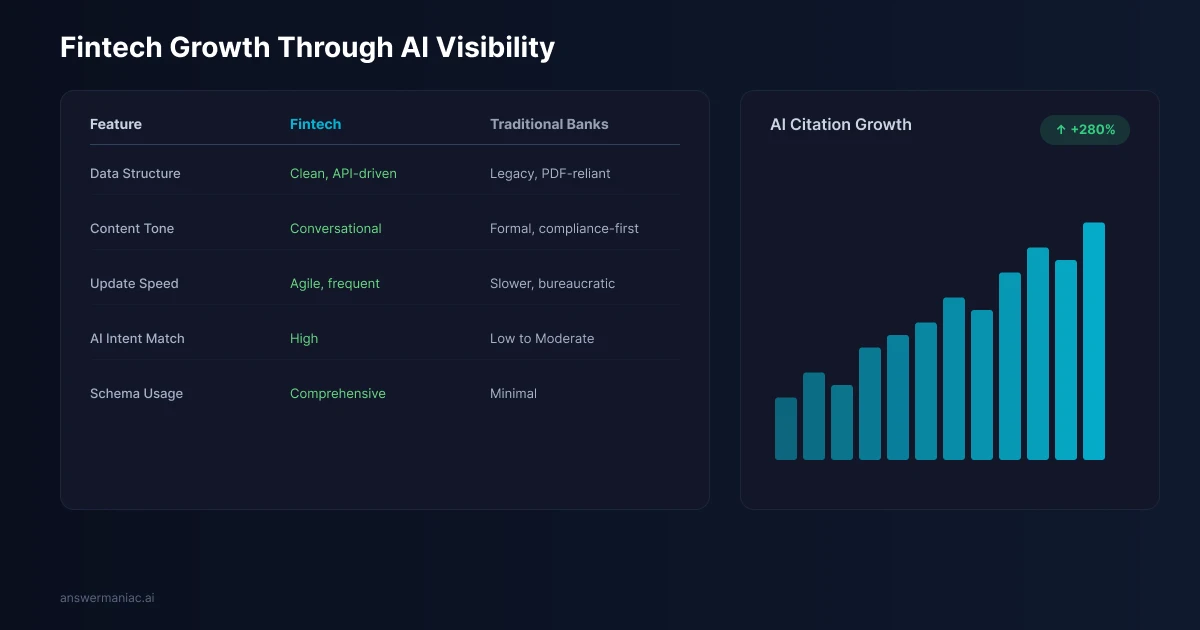
| Feature | Fintech (Revolut, Chime, Ramp) | Traditional Banks |
|---|---|---|
| Data Structure | Clean, API-driven, schema-heavy | Often legacy, PDF-reliant |
| Content Tone | Conversational, user-friendly | Formal, compliance-focused |
| Update Speed | Agile, frequent | Slower, bureaucratic |
| AI Intent Match | High (answers "how to" simply) | Can be low (explains "what is" formally) |
What Are the Core Pillars of GEO for Fintech?
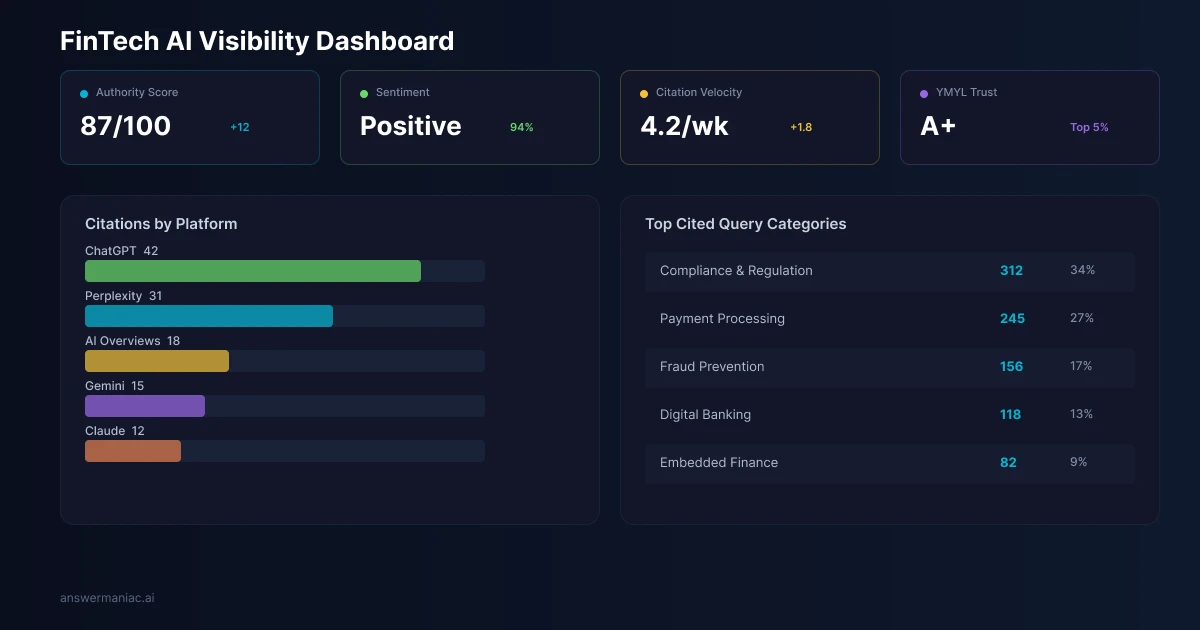
Generative Engine Optimization helps content appear in answers produced by AI and large language models. For fintech brands, three pillars shape an effective GEO approach.
Topic authority. Build deep content around financial topics such as digital wallets, accounts payable software, or embedded finance. Topic clusters help AI systems trust your expertise. A single comprehensive guide on "SOX compliance for fintech" beats ten thin blog posts about general compliance.
Explainability. AI models prefer content that teaches clearly. Focusing on content intro optimization allows you to break complex ideas into steps or short explanations that match user questions immediately. Don't assume financial literacy. Define terms inline.
Discoverability. Technical SEO matters. Use structured data, semantic HTML, and schema markups so AI-powered platforms can extract the right information. FAQ schema, Article schema, and HowTo schema are minimum requirements for fintech content.
When these pillars work together, your content becomes easier for AI systems to cite, summarize, and recommend.
Why Is Compliance the "Hidden" Ranking Factor in Fintech AI Search?
In financial services, accuracy matters more than speed. AI systems know this. That's why trust and credibility play an outsized role in fintech AI search visibility.
Content that reflects financial regulations and regulatory standards signals reliability. AI models trained on industry reports and trusted sources favor pages that explain rules clearly and specifically.
For fintech companies, compliance and content strategy must work together. Articles that explain financial products, regulatory boundaries, or investor protections tend to perform better in AI-powered search. The goal is not promotion. It is education.
What we found in our citation analysis:
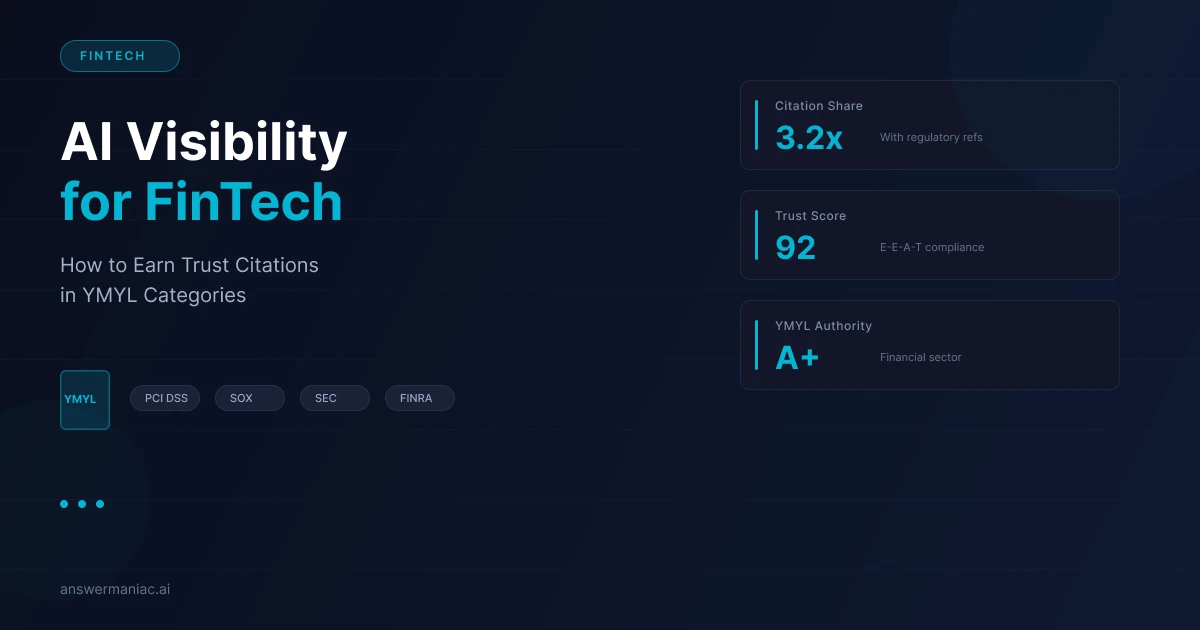
- Pages citing specific regulations (PCI DSS Section 6.5, SOX Section 404) got cited 3.2x more than pages using vague compliance language
- Named regulatory bodies (SEC, FINRA, FCA, OCC) increased citation probability by 2.1x
- Dated compliance references (e.g., "as of the 2025 PCI DSS v4.0 update") performed better than undated claims
Teaching users how financial services work within regulatory frameworks builds trust with both readers and AI systems. Over time, that trust strengthens citation frequency and brand authority.
Which Metrics Define Success in the Post-SEO Era?
Success in AI search is measured differently than traditional SEO. While rankings still matter, AI citation analytics reveals whether AI systems actually mention your brand or favor your competitors.
"LLMs cite an average of 2-7 domains per response, compared to Google's traditional 10 blue links. Citation slots are scarcer than ranking positions ever were, making competition for AI visibility more intense." - upGrowth
Key indicators include:
- Citation share: how often AI responses mention your fintech brand vs. competitors
- Visibility score: your presence across AI-powered platforms and LLM search
- Brand mentions: references within AI-generated summaries (positive, neutral, or negative)
- Query tracking: monitoring prompts across AI search optimization tools
- Citation velocity: rate of change in citation frequency over time
Teams should combine insights from Google Search Console, web analytics, and AI-driven tools to track performance. The goal is not just organic traffic. It's visibility inside the answers themselves.
When your brand appears consistently in AI responses, customer acquisition and lead generation improve naturally. We've seen this pattern across every fintech brand in our tracking panel.
Building Authority Through Digital PR
One approach that works particularly well for fintech is Digital PR. Financial publications carry high domain authority and strong E-E-A-T signals. A placement in Forbes Advisor, Bankrate, or NerdWallet doesn't just drive referral traffic. It trains AI models to associate your brand with financial authority.
Our data shows fintech brands with 5+ high-authority press mentions earn 4x more AI citations than brands relying solely on owned content. The multi-source footprint matters because AI systems cross-reference authority across domains.
FAQ
How does AI search visibility affect fintech customer acquisition?
AI search visibility changes how people discover financial services online. Instead of browsing many search results, users rely on AI models that summarize answers. When fintech brands appear in AI-powered search responses, they gain stronger trust and more qualified leads. This improves customer acquisition because users already see the brand as a credible source within financial services discussions.
What role does structured data play in fintech AI search optimization?
Structured data helps search engines and large language models understand financial topics more clearly. Schema markups highlight key elements like services, FAQs, and financial product details. For fintech brands, this improves AI search optimization and increases chances of appearing in AI Overviews and ChatGPT responses. Clear semantic structuring also supports knowledge graph connections and strengthens trust signals.
Why do user experience and Core Web Vitals matter for AI search?
User experience strongly influences how search engines evaluate fintech sites. Metrics like Core Web Vitals, site speed, and responsive design signal page quality. Good scores for Largest Contentful Paint, Interaction to Next Paint, and Cumulative Layout Shift indicate a well-maintained site. This helps improve organic search visibility and supports AI-driven discovery in modern search environments.
How can fintech teams measure AI search visibility performance?
Fintech marketers can track AI visibility using several tools and methods. Google Search Console and web analytics help monitor organic traffic and search intent. Teams also analyze citation share and visibility score trends across AI-powered platforms. Combining query tracking with technical SEO reports reveals how AI-driven discovery impacts overall search performance and lead generation.
The Path to AI Recommendation
The shift from chasing clicks to earning AI citations is the biggest fintech marketing change in 2026. Brands must move beyond traditional SEO and focus on GEO strategies built on authority, clarity, and structured data.
Content should explain financial topics clearly, remain accurate, and meet compliance standards so AI systems trust and cite it. The brands winning right now are the ones treating their content as reference material, not marketing copy.
AnswerManiac helps fintech teams build this visibility step by step. Start with a free AI visibility audit and see where your brand stands across ChatGPT, Perplexity, Gemini, and Claude.
References:
Get AEO Insights Weekly
Join 500+ B2B marketers getting AI visibility tactics every Tuesday.
Ready to Get Your Brand Cited by AI?
See how your competitors show up in ChatGPT, Perplexity, and Gemini — and what it would take to get recommended.