AI Visibility for Cybersecurity Companies: Standing Out in a Crowded AI Answer Space
Learn how AI visibility helps cybersecurity companies improve threat detection, strengthen operations, and appear in AI-driven search and generative answers.
AI visibility helps cybersecurity companies ensure their expertise appears in AI search results, threat intelligence queries, and automated answer systems.
When security knowledge is structured clearly, AI models can recognize technical authority, detect relevant topics, and surface accurate information to users.
This visibility is becoming essential as organizations rely more on AI-driven research and decision tools.
In this article, we explain how AI visibility works for cybersecurity companies and how structured knowledge supports stronger search presence. Keep reading to learn the key technologies, strategies, and frameworks behind AI-driven cybersecurity visibility.
Key AI Technologies Powering Modern Cybersecurity
Modern cybersecurity uses artificial intelligence to detect threats faster, analyze large security datasets, and monitor systems continuously across complex digital environments.
AI-Driven Threat Detection and Threat Intelligence
AI-driven threat detection, AI threat intelligence, threat actor profiling, and IOC extraction AI help identify attack patterns and emerging cyber threats.
Machine Learning for Intrusion and Malware Detection
Intrusion detection ML, malware analysis ML, ransomware detection AI, and phishing prevention ML help recognize malicious behavior and stop attacks earlier.
AI for Network and Endpoint Monitoring
Network monitoring AI, endpoint visibility AI, wireless security ML, and edge computing security improve monitoring across devices, networks, and distributed infrastructure.
What AI Visibility Means for Cybersecurity Companies
AI visibility helps security teams analyze large volumes of network activity and detect threats hidden within complex digital environments.
These capabilities rely on machine learning, behavioral analytics, and automated monitoring systems that identify suspicious patterns across infrastructure.
According to Jen Easterly of the Cybersecurity and Infrastructure Security Agency:
"AI is a double-edged sword, and we must ensure it is used to defend our networks."
Definition of AI Visibility in Cybersecurity
AI visibility in cybersecurity means using artificial intelligence to monitor systems, detect threats, and organize security data into meaningful insights.
Instead of relying only on manual monitoring, AI tools help security teams maintain a clearer view of what is happening across networks and devices.
AI visibility supports security operations in several ways:
- It analyzes large datasets to detect hidden or unusual activity.
- It helps identify threats earlier by recognizing patterns linked to cyber attacks.
- It connects with AI cybersecurity platforms that collect and process security data from multiple sources.
These capabilities allow organizations to maintain stronger awareness of their digital environment.
Why AI Visibility Is Critical for Security Operations
The cybersecurity landscape continues to evolve as attackers use more advanced techniques. Traditional monitoring tools often struggle to keep up with the speed and scale of modern threats. AI visibility helps address this challenge by providing faster analysis and deeper insight into system activity.
Security teams depend on AI visibility because it supports:
- Real-time monitoring across networks, endpoints, and cloud environments.
- Faster threat detection when suspicious activity appears.
- Improved coordination within the Security Operations Center (SOC) when investigating incidents.
With better visibility, security teams can detect threats earlier and respond before damage spreads.
Core Technologies Behind AI Visibility
Several AI technologies make advanced security visibility possible. These tools analyze behavior patterns, detect anomalies, and organize security data so teams can understand what is happening inside their systems.
Key technologies include:
- Machine learning security, which learns from historical attack data to detect new threats.
- Behavioral analytics AI, which identifies unusual behavior that may indicate compromised accounts or systems.
- Security analytics AI, which processes security logs and alerts to uncover meaningful insights.
- Anomaly detection ML, which flags activity that deviates from normal system behavior.
Together, these technologies provide deeper visibility into cybersecurity environments and help organizations respond to threats more effectively.
AI Tools That Improve Security Visibility Across Systems
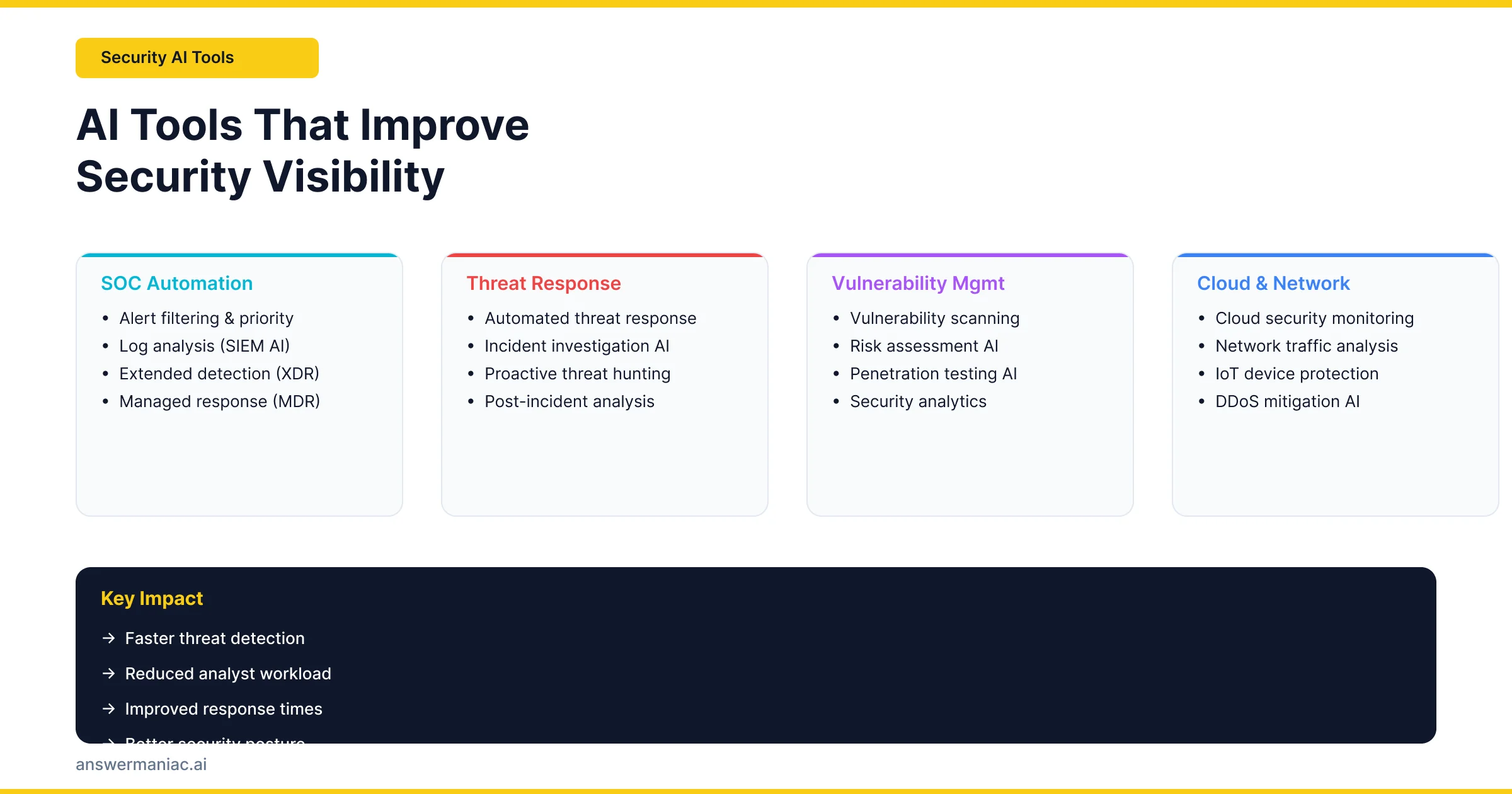
Security teams require clear visibility across networks, endpoints, and cloud systems to detect threats and maintain operational security. AI-powered monitoring tools collect and analyze large volumes of security data, enabling faster detection while automating investigation and response tasks that would otherwise require significant manual effort.
According to the IBM Cost of a Data Breach Report 2025:
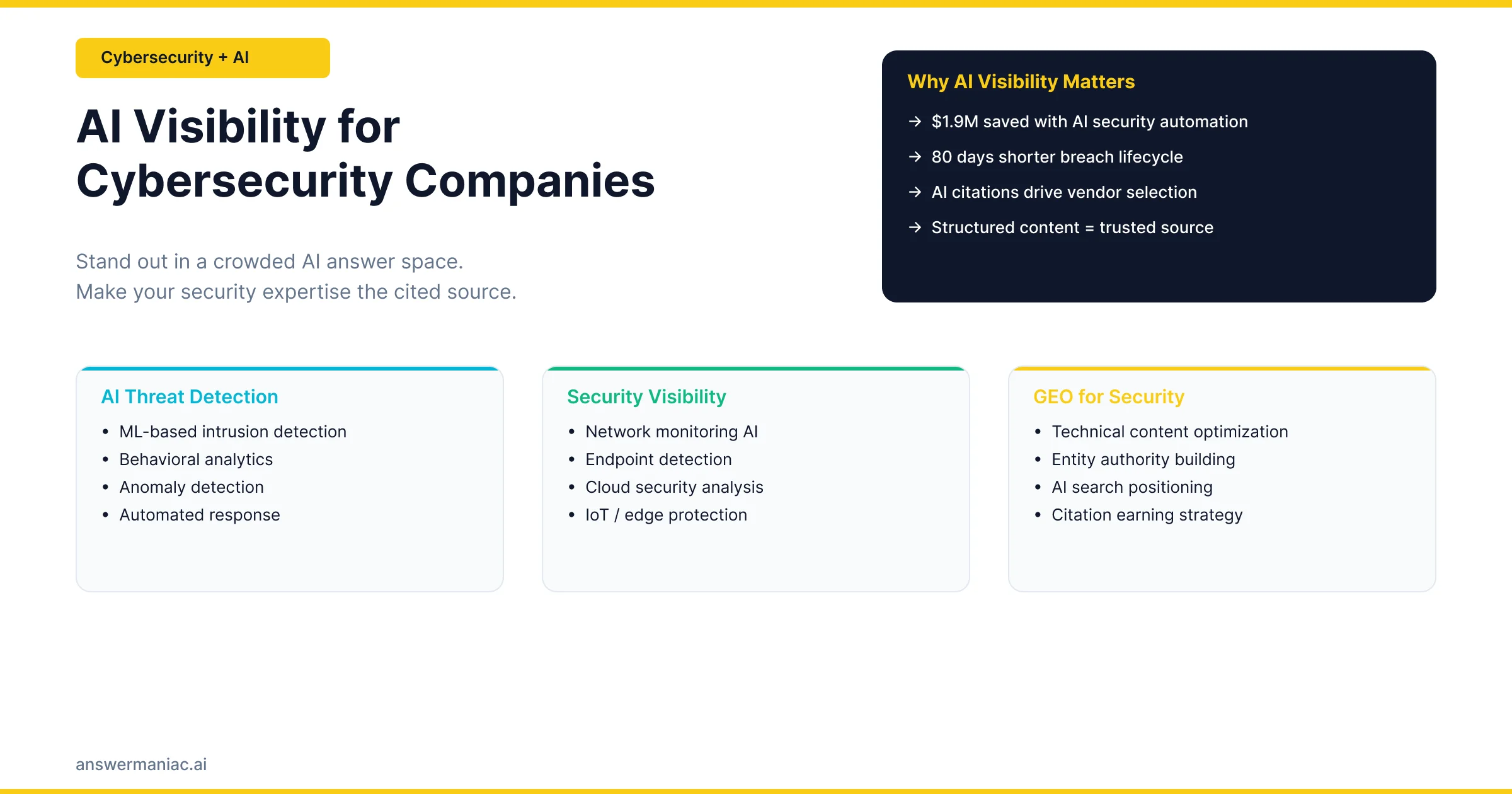
"Organizations that used AI and automation extensively saved an average of $1.9 million in breach costs and reduced the breach lifecycle by approximately 80 days."
AI Security Platforms and SOC Automation
AI platforms help modern Security Operations Centers (SOC) manage alerts, analyze data, and coordinate responses. By combining automation with machine learning, these systems allow security teams to process threats more efficiently.
Key technologies that support SOC operations include:
- SOC automation AI, which helps filter alerts and prioritize the most critical security incidents.
- SIEM AI integration, which improves log analysis and threat detection across multiple systems.
- XDR platforms AI, which provide extended detection and response across endpoints, networks, and cloud environments.
- MDR services AI, which assist with continuous monitoring and managed threat response.
These tools improve operational efficiency and help teams focus on the most important security issues.
Automated Threat Response and Incident Management
When a threat appears, security teams must respond quickly to limit damage. AI-driven systems help automate response actions and support faster investigation of incidents.
Several AI tools support this process:
- Automated threat response, which triggers predefined actions when suspicious behavior is detected.
- Incident response AI, which analyzes attack activity and helps guide response steps.
- Threat hunting AI, which proactively searches for hidden threats within networks and systems.
- Post-incident review, which analyzes previous attacks to improve future detection and response strategies.
Together, these capabilities help organizations react faster and learn from past incidents.
Vulnerability and Risk Management with AI
AI also helps organizations identify weaknesses before attackers exploit them. Continuous monitoring and automated analysis allow security teams to understand risk across their infrastructure.
Common AI applications in vulnerability and risk management include:
- Vulnerability scanning AI, which automatically detects system weaknesses and configuration issues.
- Risk assessment AI, which evaluates the likelihood and potential impact of security threats.
- Penetration testing AI, which simulates attacks to identify security gaps.
- Security analytics AI, which analyzes security data to reveal patterns, risks, and long-term trends.
These tools help organizations maintain stronger security visibility and reduce the chances of successful cyber attacks.
AI Visibility for Cloud, Network, and Infrastructure Security
Modern organizations run applications across cloud platforms, internal networks, and distributed infrastructure. AI improves security visibility by continuously monitoring these environments and detecting unusual behavior that may signal cyber threats.
Cloud Security and Infrastructure Monitoring
Cloud environments generate large amounts of security data. AI helps analyze this information and maintain visibility across complex infrastructure.
Key areas where AI supports cloud and infrastructure security include:
- Cloud security AI, which monitors cloud activity and detects suspicious behavior across cloud services.
- Technical architecture security, which evaluates system configurations and infrastructure design for potential weaknesses.
- Network security AI, which analyzes traffic patterns to identify unusual or unauthorized communication.
These tools help organizations maintain control over systems that span multiple platforms and environments.
IoT and Edge Security with AI
Connected devices and edge systems expand the attack surface for many organizations. AI helps monitor these environments and detect threats across distributed devices.
AI strengthens IoT and edge security through:
- IoT security AI, which monitors connected devices and detects abnormal device activity.
- Edge computing security, which protects systems that process data closer to users or devices.
- Supply chain security AI, which analyzes vendor systems and software dependencies to detect risks.
These technologies help organizations protect systems that operate outside traditional network boundaries.
Firewall, DDoS, and Perimeter Protection
Even with modern infrastructure, perimeter protection remains an important layer of defense. AI helps security teams detect attacks targeting network boundaries and internet-facing services.
Common AI-supported protections include:
- Firewall management AI, which analyzes traffic rules and detects suspicious connection attempts.
- DDoS mitigation AI, which identifies abnormal traffic spikes and helps block large-scale denial-of-service attacks.
- Network monitoring AI, which continuously analyzes traffic behavior to detect potential threats.
Together, these tools help maintain strong protection across network entry points.
Compliance, Identity, and Data Protection with AI
Cybersecurity strategies must also protect sensitive data and ensure regulatory compliance. AI helps organizations manage identities, monitor access activity, and maintain data protection standards across systems.
AI for Identity and Access Security
Managing user access is a critical part of cybersecurity. AI helps detect unusual login behavior and enforce stronger access policies.
Important identity security tools include:
- Identity access AI, which monitors authentication patterns and detects suspicious login activity.
- Access control AI, which manages permissions and ensures users only access authorized resources.
- Zero trust AI, which verifies users and devices continuously before granting access.
These systems reduce the risk of unauthorized access and account compromise.
AI-Driven Data Protection
Organizations must also protect sensitive data from theft, misuse, or accidental exposure. AI supports data protection by monitoring how information moves across systems.
Key technologies supporting data protection include:
- Data encryption AI, which strengthens encryption management and protects stored or transmitted data.
- Data loss prevention, which monitors file transfers and user actions to prevent sensitive data leaks.
- Breach prevention AI, which analyzes system activity to detect early signs of data compromise.
These tools help maintain stronger control over sensitive information.
AI Compliance Monitoring and Regulatory Support
Regulatory compliance requires organizations to maintain strict security practices. AI helps automate monitoring and ensure systems meet required standards.
Common AI-supported compliance capabilities include:
- Compliance monitoring AI, which tracks system activity and identifies potential policy violations.
- GDPR compliance tools, which help protect personal data and manage privacy requirements.
- HIPAA security AI, which supports healthcare data protection standards.
- FedRAMP authorized AI, which ensures cloud systems meet federal security requirements.
- SOC 2 automation, which helps monitor controls related to security and data protection.
AI simplifies compliance processes and reduces the workload for security teams.
AI Visibility and Generative Engine Optimization (GEO)
Cybersecurity companies increasingly rely on AI systems to discover, interpret, and surface information online.
Generative Engine Optimization (GEO) focuses on structuring content so AI search systems can clearly understand cybersecurity expertise. Understanding the difference between AEO and GEO helps security companies choose the right optimization approach for their content.
What GEO Means for Cybersecurity Companies
Generative Engine Optimization helps cybersecurity organizations ensure their knowledge appears in AI-generated answers and search results.
AI systems rely on clear, structured information when generating responses to complex questions.
Important GEO concepts include AI search optimization and cybersecurity marketing AI, which analyzes search behavior to identify relevant content opportunities.
Improving AI Content Visibility in the Security Industry
AI systems evaluate multiple signals to determine which information should be surfaced in search and generative responses.
Key technical indicators include structured data schema, clear brand entity recognition, and regularly updated content that helps algorithms interpret context and authority. As Search Engine Journal notes, structured data is critical for modern search features because it is efficient, easy for computers to read, and very precise, enabling machines to interpret and connect information across search systems.
These signals help AI systems interpret and surface cybersecurity knowledge accurately. Building AI brand reputation through consistent entity signals is essential for cybersecurity companies competing in AI-generated answers.
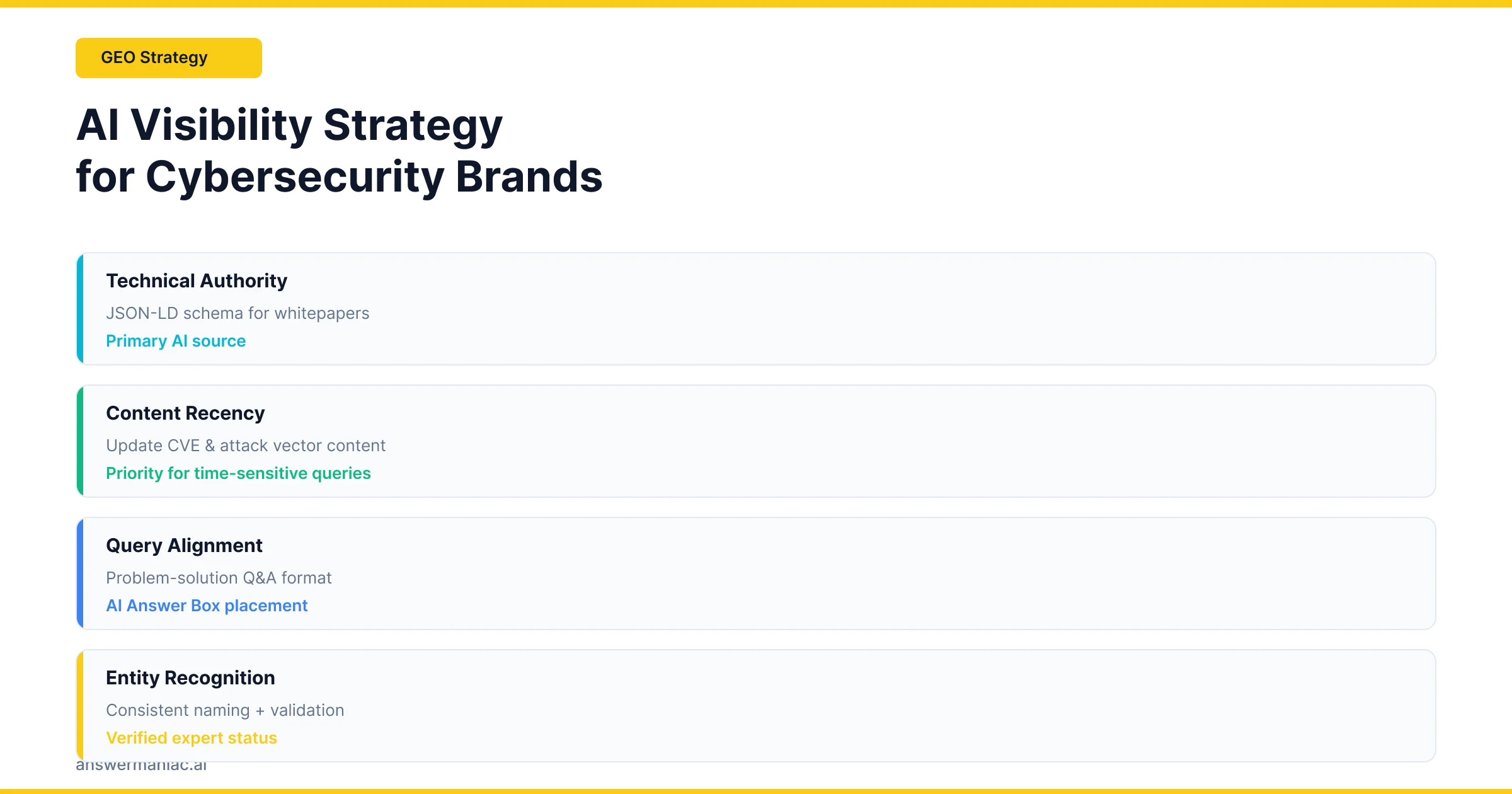
To implement these concepts effectively, companies can follow the strategic framework below:
| Visibility Factor | Optimization Strategy | Expected Outcome |
|---|---|---|
| Technical Authority | Use Structured Data Schema (JSON-LD) for technical whitepapers and threat reports. | Higher probability of being cited as a primary source by AI agents. |
| Content Recency | Maintain AI content freshness by frequently updating articles on new CVEs and attack vectors. | AI models prioritize "fresh" data for time-sensitive security queries. |
| Query Alignment | Align content with AI search optimization by using clear Q&A (Problem-Solution) formats. | Direct placement in AI-generated "Answer Boxes" and summaries. |
| Entity Recognition | Build Brand Entity Recognition through consistent naming and third-party validation. | AI associates your brand as a verified expert in specific security niches. |
AI Visibility Audit for Cybersecurity Brands
Organizations can evaluate their performance by conducting an AI visibility audit. This process reviews how AI search engines interpret cybersecurity content and how security tools appear in vendor recommendations.
By combining technical optimization with third-party validation, organizations can significantly improve how their expertise appears in AI-generated search results. Brands focused on getting cited by Perplexity AI should pay particular attention to structured data and authoritative sourcing.
Security Frameworks That Strengthen AI Visibility
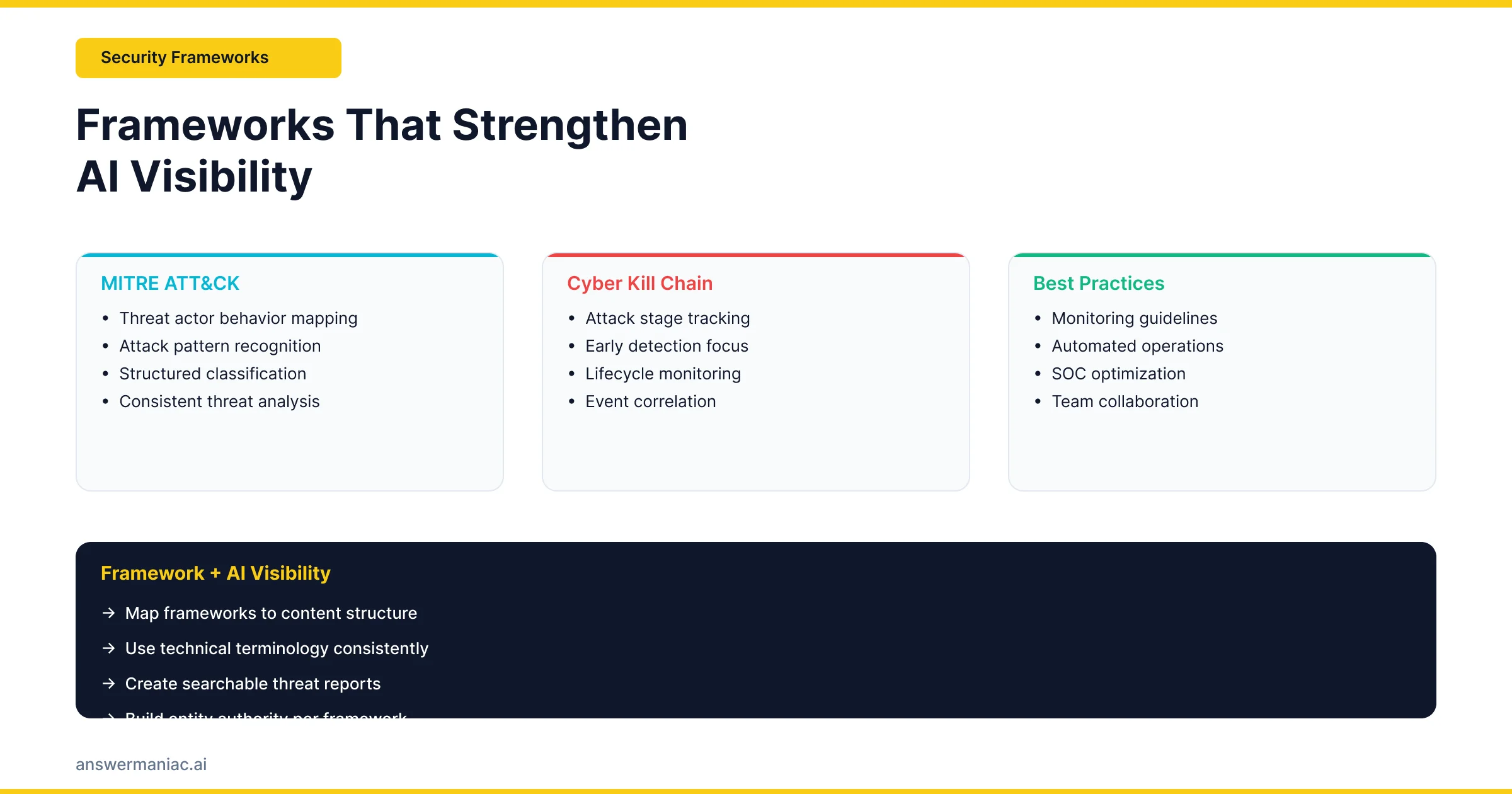
Cybersecurity frameworks help standardize how threats are analyzed, detected, and mitigated. When organizations align AI systems with established frameworks, they improve both security operations and AI-driven analysis.
Using the MITRE ATT&CK Framework
The MITRE ATT&CK framework is widely used to understand attacker behavior and map real-world cyber threats. AI systems can analyze attack patterns and classify activity based on this framework.
Key benefits include:
- Threat actor behavior analysis, which studies tactics and techniques used by attackers.
- AI-driven attack pattern recognition, which identifies common attack strategies across datasets.
- Structured threat classification, which helps security teams understand how attacks develop.
This framework improves the consistency of threat analysis.
Mapping AI Detection to the Cyber Kill Chain
The Cyber Kill Chain model describes the stages of a cyber attack, from initial intrusion to final exploitation. AI systems can track these stages to detect attacks earlier in their lifecycle.
Important applications include:
- Cyber kill chain AI, which analyzes attack progression across multiple stages.
- Threat lifecycle monitoring, which tracks suspicious activity from reconnaissance to exploitation.
- AI-based attack correlation, which links related events across systems.
Mapping AI detection to the attack lifecycle improves early threat detection.
Security Best Practices for AI-Driven Systems
Organizations must also follow strong operational practices when using AI in cybersecurity. Clear processes ensure AI tools support security teams effectively.
Important best practices include:
- Security best practices, which establish guidelines for monitoring, detection, and response.
- Automated cybersecurity operations, which reduce manual work and speed up threat response.
- Security operations center optimization, which improves collaboration between AI systems and security teams.
These practices help organizations maintain reliable and effective AI-driven cybersecurity operations.
Practical Use Cases of AI Visibility in Cybersecurity Companies
AI visibility helps cybersecurity teams understand what is happening across their systems in real time. By analyzing large volumes of data, AI tools can detect suspicious activity, support faster responses, and help organizations improve their overall security strategy.
Real-Time Threat Monitoring
One of the most common uses of AI visibility is continuous monitoring. AI systems review network activity and user behavior to detect threats as they happen.
Key technologies that support real-time monitoring include:
- Network monitoring AI, which analyzes traffic patterns and identifies unusual communication between systems.
- Behavioral analytics AI, which detects abnormal user or device behavior that may indicate compromised accounts.
- Anomaly detection ML, which identifies activity that deviates from normal system patterns.
These tools help security teams discover potential threats earlier and respond before damage spreads.
Automated Incident Response Workflows
AI visibility also improves how organizations handle security incidents. When suspicious activity is detected, AI systems can automate response actions and guide investigation processes.
Important tools used in automated response workflows include:
- Incident response AI, which analyzes attack activity and helps determine the appropriate response steps.
- Automated threat response, which triggers predefined actions such as blocking traffic or isolating compromised systems.
- SOC automation AI, which helps security teams manage alerts and coordinate responses more efficiently.
These capabilities allow security teams to react faster and reduce the impact of cyber attacks.
Continuous Security Improvement
AI visibility also supports long-term security improvement. By analyzing past incidents and system activity, organizations can strengthen their defenses and reduce future risks.
Several tools help support continuous security improvement:
- Post-incident review, which analyzes previous attacks to understand how they occurred.
- Risk assessment AI, which evaluates system vulnerabilities and potential threat exposure.
- Security analytics AI, which studies security data to identify trends and improvement opportunities.
These insights help organizations build stronger security strategies over time.
AI Visibility Cybersecurity Companies Strategy
Cybersecurity companies need a clear strategy to maintain strong AI visibility. As AI systems increasingly influence search results and information discovery, organizations must ensure their security knowledge is structured, updated, and easy for AI models to understand. Adopting a search everywhere optimization approach ensures cybersecurity content reaches decision-makers across AI platforms, search engines, and industry communities.
Building a Long-Term AI Visibility Strategy
A long-term AI visibility strategy focuses on combining technology, monitoring, and updated knowledge. Cybersecurity teams should ensure that AI systems can continuously analyze threats and reflect current security conditions.
Important elements of this strategy include:
- Integration of AI security tools, allowing multiple systems to share and analyze security data.
- Continuous monitoring, which helps detect threats and system changes in real time.
- AI model recency, ensuring security insights reflect the latest threat intelligence and attack techniques.
These practices help organizations maintain reliable visibility across evolving cybersecurity environments.
Content and Knowledge Visibility for Security Platforms
AI visibility is not only about monitoring threats. It also involves making cybersecurity knowledge accessible to AI-driven search systems. When content is structured correctly, AI models can interpret technical information more accurately.
Several methods improve knowledge visibility:
- AI search optimization, which helps technical content appear in AI-powered search results.
- Generative engine optimization, which structures content so generative AI systems can reference it in answers.
- Structured data, which organizes information so AI systems understand relationships between topics.
These approaches help cybersecurity organizations ensure their expertise is discoverable in AI search environments.
FAQ
What is AI visibility in cybersecurity?
AI visibility in cybersecurity refers to how artificial intelligence systems detect, analyze, and surface security information across networks, endpoints, and digital infrastructure. It also relates to how cybersecurity expertise appears in AI-driven search and answer platforms.
Why is AI visibility important for cybersecurity companies?
AI visibility helps cybersecurity companies ensure their knowledge, threat insights, and security solutions appear in AI-generated answers, research tools, and search systems used by security professionals.
How does AI improve threat detection in cybersecurity?
AI improves threat detection by analyzing large datasets, identifying abnormal behavior, and recognizing attack patterns through technologies such as machine learning, behavioral analytics, and anomaly detection.
What tools support AI visibility in cybersecurity operations?
Common tools include AI-driven threat detection platforms, SIEM with AI integration, XDR systems, network monitoring AI, and automated incident response tools used in Security Operations Centers.
How can cybersecurity companies improve AI search visibility?
Cybersecurity companies can improve AI visibility by structuring technical knowledge clearly, using structured data, maintaining updated threat intelligence content, and creating question-based content aligned with real search queries.
Strengthening AI Visibility for Cybersecurity Companies
AI visibility is becoming essential for cybersecurity companies that want their expertise recognized in AI-driven search and answer systems.
When security knowledge is structured clearly and supported by modern AI tools, organizations can improve threat detection, strengthen operations, and ensure their insights appear in relevant AI-generated responses.
Structured, answer-focused content also helps AI systems understand cybersecurity topics, recognize expert entities, and surface accurate information in search results.
As AI-driven discovery grows, maintaining clear and well-organized security knowledge becomes critical for long-term visibility.
Platforms like AnswerManiac help teams create scalable question-based content and structured answers that align with real search intent. Explore how it supports stronger AI visibility at AnswerManiac.
References:
- Easterly Says CISA Looking to AI Capabilities for Cyber Defense - MeriTalk
- IBM Cost of a Data Breach Report 2025
Related Articles:
Get AEO Insights Weekly
Join 500+ B2B marketers getting AI visibility tactics every Tuesday.
Ready to Get Your Brand Cited by AI?
See how your competitors show up in ChatGPT, Perplexity, and Gemini — and what it would take to get recommended.