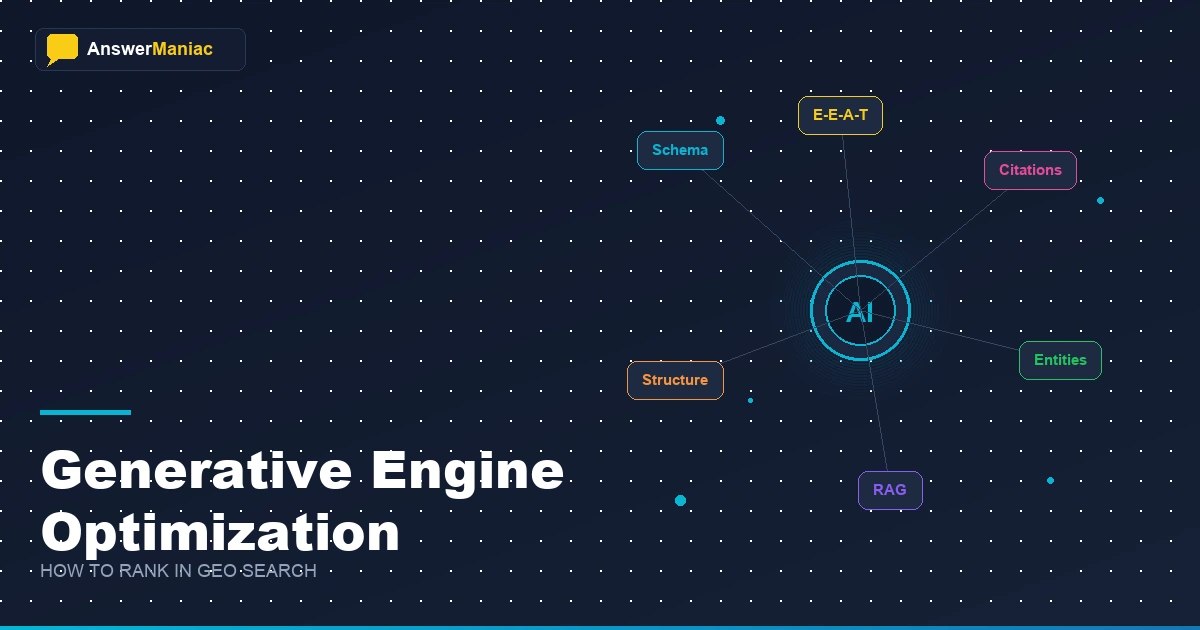
GEO Optimization Guide: How to Dominate Generative Engine Search in 2026
Master Generative Engine Optimization (GEO) to earn AI citations in ChatGPT, Perplexity, and Google AI Overviews. Learn answer-first content structure, external authority building, and LLM discoverability strategies.
Direct Answer: Generative Engine Optimization (GEO) is the practice of structuring your content so AI systems (ChatGPT, Perplexity, Google AI Overviews) cite your brand in their responses. Key strategies include: creating unique data-rich content, building external authority through mentions on other sites, using answer-first content structure, implementing schema markup, and strengthening E-E-A-T signals. Unlike traditional SEO which focuses on clicks, GEO success is measured by citation frequency in AI answers.
Generative Engine Optimization (GEO) is the process of shaping content so AI tools, like Google AI Overviews, ChatGPT, and other assistants, see it as a trusted source and cite it in their answers.
Instead of only trying to get clicks from search results, GEO aims to have your brand, data, or explanations named inside the AI's response.
That requires clear, well-structured, original content that AI can easily read, understand, and reuse. For a simple, step-by-step way to make your content more "AI-ready," keep reading.
Key Takeaways
- GEO focuses on earning brand citations within AI answers, not just website clicks
- Success requires creating unique, data-rich content that AI can easily extract and trust
- Building external authority through mentions on other sites is a critical ranking signal
- Answer-first content structure makes your content more likely to be cited by AI models
- E-E-A-T signals (Experience, Expertise, Authoritativeness, Trustworthiness) are essential for GEO success
How GEO Differs From Traditional Search Strategies
Most people understand SEO as a race for clicks. GEO changes that race.
Traditional SEO tries to rank high on a results page so users click through to your site. You judge success with keyword rankings, organic traffic, and how well the page keeps human readers engaged.
Generative Engine Optimization has a different goal. The aim is to structure content so it can be reliably referenced or used by the AI in its generated response.
That shift changes both content and metrics. With GEO, content is built to be a clean, reliable source that AI models can learn from, reuse, and reference directly, which requires a clearly defined AEO strategy rather than treating AI visibility as a side effect of traffic-focused optimization.
AEO vs GEO: Key Differences
| Feature | AEO Focus | GEO Focus |
|---|---|---|
| Primary Goal | Direct answers and featured snippets | AI citations and brand mentions |
| Content Type | Structured question-and-answer pages | Unique data, research, and named entities |
| Key Signals | On-page schema markup and site structure | External mentions and E-E-A-T signals |
| Success Metric | Winning snippet positions | Frequency of brand attribution in AI answers |
While AEO (Answer Engine Optimization) focuses on winning featured snippets and direct answers, GEO goes further by aiming for brand citations and mentions within AI-generated responses across multiple platforms.
The Core Pillars of LLM Discoverability
For your content to be discovered and used by large language models (LLMs), it must be built on specific foundational pillars. AI engines are designed to find accurate and trustworthy information. They prioritize content that demonstrates clear signals of expertise and reliability.

This visual depicts an AI-powered GEO optimization framework, highlighting the importance of relevance, authority, and clarity as key pillars for improving local search visibility.
1. Factual Density
Include clear facts, specific numbers, and verifiable data so AI can lift concrete statements instead of vague opinions. For example:
- Instead of: "Many companies use AI tools"
- Use: "73% of Fortune 500 companies implemented AI-powered analytics tools in 2025, according to a McKinsey study"
2. Entity Recognition
Use consistent terminologies and entity references to improve machine recognition and retrieval of facts. This means:
- Consistently using your brand name, product names, and key terms
- Properly marking up entities with schema.org structured data
- Using clear, unambiguous language that AI can parse
3. Cross-Web Consistency
Keep core details the same across your site, social profiles, and trusted directories so AI sees your information as stable and reliable. This includes:
- Consistent NAP (Name, Address, Phone) information
- Uniform brand messaging across platforms
- Matching entity information in directories like Google Business Profile, LinkedIn, and industry-specific directories
How to Build an Answer-First Content Structure
Creating GEO content starts with structure. Pages need to be easy for both humans and AI systems to scan, so the main answer and key data stand out immediately.

This visual showcases the answer-first content blueprint, demonstrating how to structure content with conversational H1 questions, direct 40-60 word answers, and supporting details with bulleted lists and data tables.
The Answer-First Blueprint
Step 1: Use the user's exact question as the H1
For example, if users search "How does GEO optimization improve brand visibility?", your H1 should be exactly that question.
Step 2: Write a short, complete answer (40-60 words)
Directly under the H1, write a concise answer that includes the most important fact or statistic. This block is the primary extraction point for AI.
Step 3: Add supporting details with clear H2 and H3 subheadings
Below the answer, structure supporting information using:
- Bulleted lists for features, steps, or benefits
- Simple tables for comparisons or key data points
- Short paragraphs (2-3 sentences max) for explanations
"The key to GEO-friendly content is extractability. Pages should be structured so AI systems can effortlessly lift and cite insights, using clear H2 and H3 hierarchies, short paragraphs, and comparison tables that are easy for generative engines to parse." - Directive Consulting
By reducing clutter and surfacing key facts early, you make your content far more likely to be selected and cited by AI models.
Why External Authority is Critical for AI Citations
A site that only talks about itself rarely looks like a real authority. AI engines scan the wider web to see whether other sources confirm what a brand claims.

This visual showcases a GEO optimization framework highlighting diverse content, user reviews, and authoritative sources to enhance local search visibility.
Because of that, building external authority is not just helpful for GEO; it is a core requirement for brands that want to rank in answer engines consistently instead of appearing only sporadically or indirectly.
Building External Authority: Key Strategies
The focus is on earning mentions and links from reputable websites. When an industry publication, trusted forum, review site, or high-authority directory cites a brand or research, it signals independent validation.
This supports the E-E-A-T pillars, especially Authoritativeness and Trustworthiness. Methods include:
- Offering expert commentary to journalists - Respond to HARO (Help a Reporter Out) requests
- Writing guest posts for relevant blogs - Share expertise on industry publications
- Keeping accurate profiles in key directories - Ensure consistent information across platforms
- Encouraging genuine customer reviews - Build trust through authentic testimonials
"Quoting credible experts and adding statistics are powerful ways to increase AI visibility. Studies suggest that expert quotes and inline citations can boost how often you're cited by up to 40%, because generative engines favor sources with verifiable expert support over generic summaries." - Frase.io Blog
Each external mention becomes a quiet vote of confidence that AI systems can detect and weigh.
The Step-by-Step GEO Optimization Process
Here is a practical, step-by-step path for putting a GEO strategy in place.
Step 1: Conduct a Visibility Audit
Start by checking your current presence. Manually search for your brand and key topic questions in AI tools like ChatGPT, Perplexity, and Google's AI Overviews. Note if you are cited, how you are mentioned, and which competitors appear instead.
Tools for Visibility Auditing:
- Manual searches in ChatGPT, Perplexity, Google AI Overviews
- AnswerManiac's LLM Rankings Tool - Track where your domain ranks in AI responses
- Brand monitoring tools to track mentions across platforms
Step 2: Identify Target Questions and Gaps
Use search data, "People Also Ask," and forums to find real conversational questions. Focus on questions where you can add something unique: a data point, a well-supported viewpoint, or a clear comparison that others do not offer.
Sources for Finding Target Questions:
- Google Search Console data
- "People Also Ask" sections in search results
- Industry forums and Q&A platforms (Reddit, Quora, Stack Overflow)
- Customer support inquiries
- Social media discussions
Step 3: Create or Optimize Pillar Content
For each top question, build or refine a "pillar" page. Use an answer-first structure, then add unique insights, original data (such as surveys or case studies), and clear references to key entities. Aim for the most complete, accurate resource on that topic.
Pillar Content Checklist:
- ✅ H1 matches the exact user question
- ✅ 40-60 word direct answer immediately after H1
- ✅ Clear H2/H3 structure for supporting information
- ✅ Original data, statistics, or research
- ✅ Bulleted lists and comparison tables
- ✅ Proper schema markup (FAQPage, Article, HowTo, etc.)
Step 4: Implement Technical SEO and Schema
Keep the technical base strong. Ensure fast load times, mobile-friendly layouts, and clean site structure, which becomes increasingly important as teams optimize for LLM behavior rather than relying solely on traditional crawling and indexing patterns.
Technical SEO Essentials for GEO:
- Page Speed: Optimize for Core Web Vitals
- Mobile Responsiveness: Ensure perfect mobile experience
- Schema Markup: Implement relevant structured data types
- Clean URL Structure: Use descriptive, keyword-rich URLs
- Internal Linking: Create logical content hierarchies
Key Schema Types for GEO:
ArticleorBlogPostingfor blog contentFAQPagefor question-answer contentHowTofor step-by-step guidesOrganizationfor brand informationPersonfor author/expert information
Step 5: Run an Authority-Building Campaign
Work to earn mentions on other reputable sites. Share original research with journalists, respond to expert requests on platforms like HARO, write guest posts, and secure accurate listings in relevant directories. These external references act as proof of expertise.
Authority-Building Tactics:
- HARO (Help a Reporter Out): Respond to journalist queries with expert insights
- Guest Posting: Write for industry publications and blogs
- Original Research: Conduct surveys and studies, then share with media
- Directory Listings: Ensure accurate profiles in industry directories
- Expert Roundups: Participate in industry expert discussions
- Case Studies: Share success stories that others can reference
Step 6: Monitor, Measure, and Refine
Check AI platforms regularly to see whether citations are growing. Watch branded search traffic, since AI mentions can drive more users to search for your name. Use these insights to adjust your target questions, refresh content with new data, and spot fresh authority-building chances.
Key Metrics to Track:
- AI Citation Frequency: How often your brand is mentioned in AI responses
- Branded Search Growth: Increase in searches for your brand name
- Referral Traffic from AI: Users clicking through from AI answers
- Share of Voice: Your brand's visibility compared to competitors
- Citation Context: How your brand is being mentioned (positive, neutral, negative)
How to Monitor and Iterate on GEO Performance
Measuring GEO success means watching for AI citations, not just website traffic. The main goal is simple: check whether AI systems are actually using and referencing your content in their answers.

This illustration highlights the importance of data-driven decision-making in a GEO optimization framework, emphasizing the analysis of performance metrics.
Manual Monitoring Methods
Use real AI interfaces to check whether your content appears or influences answer output, while recognizing visibility may vary by model and version.
Citation signals to look for:
- Direct quotes from your content
- Named statistics that match your data
- Paraphrased lines that clearly match wording or data from your pages
- Brand mentions in AI-generated answers
Automated Monitoring Tools
AI impression and answer-tracking tools: Use analytics tools that report impressions or mentions inside AI-generated answer boxes when these features are available.
Branded and direct search traffic: Track growth in searches for your brand name or direct visits. This can show that users first saw your name inside an AI answer, then came to learn more.
Iteration Based on Results
Identify which pages earn citations and create more content in that style. For pages that do not get cited, strengthen data, clarify structure, and improve E-E-A-T signals. This review and update cycle should stay ongoing.
Iteration Checklist:
- ✅ Analyze which content gets cited most often
- ✅ Identify patterns in successful citations
- ✅ Update underperforming content with better data
- ✅ Strengthen E-E-A-T signals on key pages
- ✅ Create new content based on successful patterns
GEO vs Traditional SEO: Understanding the Shift
GEO focuses on how generative engines create AI answers, not just how pages rank. Traditional SEO targets search engines and organic traffic, while GEO targets AI-powered search and AI-generated responses.
Key Differences:
| Aspect | Traditional SEO | GEO |
|---|---|---|
| Primary Goal | Rank high, get clicks | Get cited in AI answers |
| Content Structure | Keyword-optimized for rankings | Answer-first for AI extraction |
| Success Metrics | Organic traffic, rankings | AI citations, brand mentions |
| Authority Signals | Backlinks, domain authority | External mentions, E-E-A-T |
| Content Type | Long-form, comprehensive | Structured, extractable |
GEO uses answer-first content, citation authority, and source quality so AI platforms trust and reuse content in AI responses instead of only listing links.
FAQ: Common Questions About GEO Optimization
What is GEO optimization, and how does it affect modern AI search results?
Generative Engine Optimization focuses on helping content appear clearly in AI search results. It improves how generative AI engines pull information to form AI-generated answers.
GEO emphasizes user intent, answer-first content, and structured data. These elements help search engines and AI platforms present accurate, reliable answers instead of relying only on traditional ranking signals.
How does GEO optimization improve brand visibility and user trust?
GEO optimization increases brand visibility by helping content get cited in AI responses more often.
When content comes from reputable sources and shows clear expertise, AI engines treat it as more trustworthy. Consistent citations improve credibility scoring, strengthen brand awareness, and drive referral traffic from AI-powered search experiences.
What content strategy works best for Generative Engine Optimization?
The best GEO content strategy focuses on content quality, clear answers, and user intent. Short, direct Q&A pairs perform better than promotional or filler content.
Helpful content supported by reliable sources improves AI response quality, boosts citation authority, and reduces the risk of being ignored or flagged as low-value AI-written content.
How does structured data support AI-generated answers and AI responses?
Structured data helps AI engines understand meaning, context, and accuracy more easily. Proper schema markup supports AI answer engines by clarifying key facts and relationships.
This improves eligibility for AI-generated answers, featured snippets, and citation traffic while maintaining a strong search quality experience for users.
How can GEO success be measured beyond traditional SEO metrics?
GEO success goes beyond rankings and search volume. Key indicators include referral traffic from AI, brand mentions, citation frequency, share of voice, and branded search lift.
Tracking visibility score, AI citation presence, and user trust signals gives a clearer picture of performance within generative AI search systems.
How does GEO differ from traditional SEO and technical SEO practices?
GEO focuses on how generative engines create AI answers, not just how pages rank. Traditional SEO targets search engines and organic traffic, while GEO targets AI-powered search and AI-generated responses.
GEO uses answer-first content, citation authority, and source quality so AI platforms trust and reuse content in AI responses instead of only listing links.
What role do AI citations and referral traffic play in GEO optimization?
AI citation is a key GEO signal. When AI engines reference your content, it builds credibility and visibility. Citation traffic shows how often AI-generated answers send users to your site.
High citation frequency, strong source verification, and trusted content increase referral traffic from AI and improve overall GEO success.
How can brands avoid GEO spam and low-quality AI-written content issues?
Avoid black-hat tactics, content farms, and automated AI-written content with no value. GEO favors credibility scoring, reputable sources, and original insights.
Clear user intent, strong content quality, and accurate information reduce spam detection risks. This approach protects user trust and improves visibility across AI search engines and generative AI chatbots.
What metrics help track GEO performance inside AI search platforms?
Useful GEO metrics include visibility score, share of voice, branded search lift, and citation frequency.
Monitoring AI response quality, referral traffic, and brand mentions gives better insight than rankings alone. These metrics show how well content performs inside AI answer engines and across evolving generative search results.
Implementing Your GEO Optimization Strategy
Mastering Generative Engine Optimization means adjusting to how people now get answers: through AI. As AI tools become a primary way to search, visibility depends on being a trusted source they quote. That calls for a shift from content built mainly for clicks to content built as a clear reference, with answer-first structure, original data, and strong external authority.
The work starts with honest measurement. You need to see where you are cited today, and where competitors show up instead. For a detailed view of your current AI visibility and a practical, prioritized action plan, you can start with a free audit at AnswerManiac or use our comprehensive SEO/AEO Audit Tool.
Related Articles
- AEO Optimization Strategy: 10 Tactics to Rank in Answer Engines
- How to Rank in Answer Engines: Complete Step-by-Step Guide
- Complete Guide to Perplexity AI Search Engine 2026
- AI Adoption Statistics 2026
- AEO & GEO Services
- AI Search Ranking Services
- SEO Services
References
- Directive Consulting - A Guide to Generative Engine Optimization (GEO) Best Practices
- Frase.io - The GEO Strategy Workbook: A Step-by-Step Guide to Getting Cited by Generative AI
Ready to dominate generative engine search? Start by auditing your current AI visibility with AnswerManiac's LLM Rankings Tool or explore our comprehensive SEO/AEO Audit Tool to identify optimization opportunities.
Get AEO Insights Weekly
Join 500+ B2B marketers getting AI visibility tactics every Tuesday.
Ready to Get Your Brand Cited by AI?
See how your competitors show up in ChatGPT, Perplexity, and Gemini — and what it would take to get recommended.