AEO Optimization Strategy: 10 Tactics to Rank in Answer Engines 2026
AEO optimization strategy with 10 proven tactics for getting your content cited by Google AI Overviews, ChatGPT, and Perplexity. Covers direct answers, schema markup, E-E-A-T, and AI citation tracking.
Direct Answer: An effective AEO optimization strategy includes: (1) structuring content with direct answers first, (2) implementing FAQPage, HowTo, and QAPage schema markup, (3) building E-E-A-T signals, (4) targeting conversational long-tail queries, (5) creating extractable content blocks, (6) maintaining technical SEO basics, (7) building topical authority, (8) using clear formatting with lists and tables, (9) citing authoritative sources, and (10) regularly updating content with fresh data.
Answer Engine Optimization (AEO) is a method for structuring your content so AI systems, like Google AI Overviews, Bing Copilot, and chat-based assistants, can easily find, understand, and quote it.
Instead of only trying to win clicks on a search results page, AEO focuses on getting your brand cited inside the AI-generated answer itself. That means clear, factual, well-structured information that's simple for machines to extract.
It's a shift from writing mainly for human skimmers to writing for both humans and AI parsers at the same time. If you want to learn the specific tactics and implementations, keep reading.
Key Takeaways
- AEO prioritizes direct, factual answers structured for AI extraction over long-form content designed for human readers.
- Technical basics like Schema Markup, clean HTML, and site speed are essential to make your content easy for machines to parse.
- Success may include metrics like how often content is cited in AI responses, alongside traditional SEO metrics.
How AEO Fundamentally Differs From Traditional SEO
You can't build a real AEO strategy if you treat it as old SEO with a new name. The goal has changed, and so have the signals that matter.
Traditional SEO aims to rank pages on the search results page for chosen keywords. The main objective is to earn the click, bring the user to your site, and convert on-page. You judge success by where you appear on the SERP and how much organic traffic you get.
Answer Engine Optimization works from a different angle. Here, the goal is to deliver answers so clear, specific, and trustworthy that AI systems choose to quote your content directly in their responses.
Which is why brands focused on ranking in answer engines care less about clicks and more about whether their wording becomes part of the answer itself. The user may get what they need without ever visiting your site.
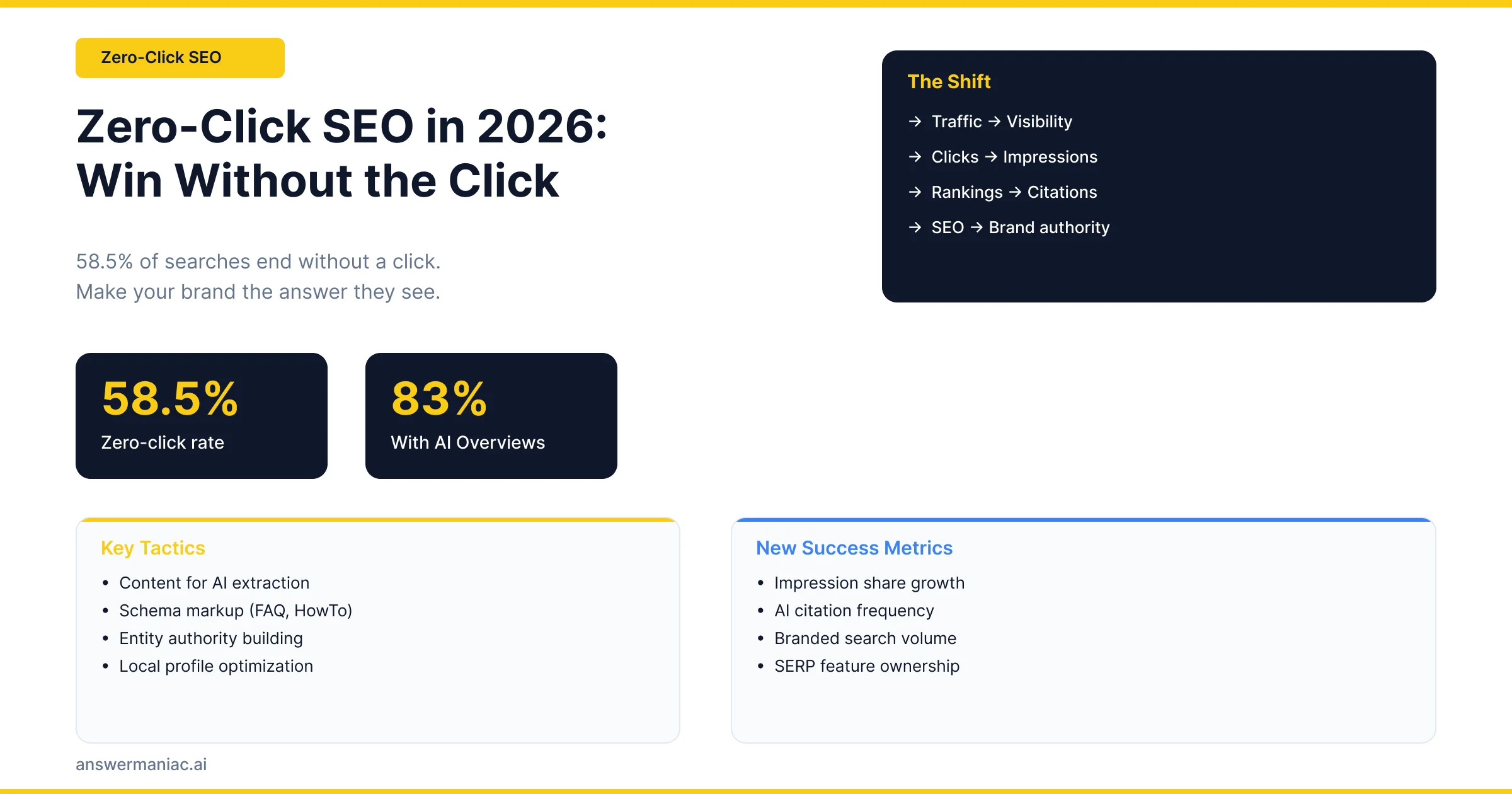
That creates a zero-click outcome for you, but it can still build brand visibility and authority because your name appears inside the answer.
This reflects a broader strategic shift in how success is defined. "Visibility now depends on whether models cite you in their answers. Success shifts from rankings to citations, from single pages to ecosystem authority. To appear in AI responses, your brand must show up across the trusted sources models rely on, not just on your own site." - HubSpot Blog[1]
With AEO, the key metrics shift. Instead of focusing only on rankings and traffic, you pay close attention to how often your brand is cited in AI overviews and chat results, and how visible those mentions are across platforms.
You are optimizing less for page visits and more for being recognized as a reliable source whenever an AI constructs an answer in your space.
| Feature | Traditional SEO | Answer Engine Optimization (AEO) |
|---|---|---|
| Primary Goal | Website clicks and page-one rankings | Direct citations within AI-generated answers |
| Content Format | Comprehensive, long-form articles and guides | Concise, structured snippets, FAQs, and data-rich lists |
| Key Metric | Organic traffic volume and keyword position | AI visibility, brand mentions in answers, and citation share-of-voice |
| Search Intent | Keyword-based queries | Conversational, question-based queries |
Why E-E-A-T is Your Non-Negotiable Foundation
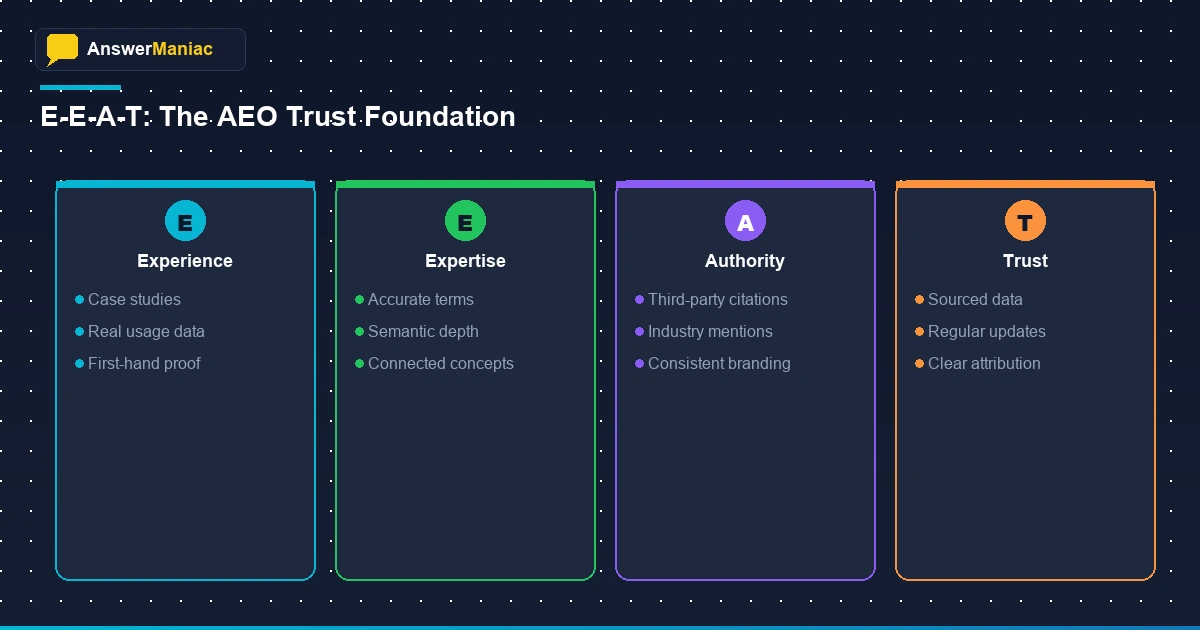
AI engines are built to reduce errors, so they lean hard on signals that a source is experienced, expert, authoritative, and trustworthy.
That E-E-A-T framework, popularized by Google, now acts as a key filter for which content gets cited inside AI answers, especially within broader GEO optimization efforts where authority signals matter as much as clarity.
We don't treat E-E-A-T as a buzzword layer on top of copy. It's baked into how content is planned, written, and maintained.
Why E-E-A-T matters for AEO
AI systems want to avoid "hallucinating" facts. To do that, they favor sources that consistently look:
- Grounded in real use - Content based on actual experience, not just theory
- Technically correct - Accurate information with proper terminology
- Recognized by others in the field - External validation and citations
- Careful with evidence - Clear sourcing and attribution
If content is clear, structured, and authoritative, supported by schema and factual evidence, it is more likely to be selected by AI systems.
Experience: Real-world use, not just theory
For experience, we focus on proof that the ideas have actually been applied:
- First-hand case studies that walk through what was done and what happened
- User testimonials that describe outcomes in concrete terms
- Real usage data where possible (even directional, as long as it's honest and labeled clearly)
To an AI system, this pattern of real-world examples suggests the content isn't just rewriting surface-level explanations.
Expertise: Correct language and connected concepts
For expertise, we write in a way that reflects real subject depth without drifting into jargon for its own sake:
- Use accurate terms and definitions for key concepts
- Bring in related phrases and entities that usually appear with the topic (the semantic "neighborhood")
- Explain how ideas connect, not just what they are
Engines read these patterns as signals that the writer understands the domain, not just the keyword. For more on how entities and knowledge graphs tie into this, see our guide on entity optimization.
Authoritativeness: Recognition beyond your own site
For authoritativeness, we work on the web of references around the brand:
- Earning citations and mentions from reputable sites in the same niche
- Being quoted or referenced in guides, reports, or industry resources
- Keeping consistent naming, branding, and profiles across platforms so engines can tie signals back to the same entity
AI systems look at this wider network to decide whose answer to trust when multiple pages say similar things.
Trustworthiness: Evidence first, style second
For trustworthiness, we treat accuracy as a hard rule, not a nice-to-have:
- Cite data with clear references to primary or high-quality sources
- Mark estimates and opinions as such, instead of blending them into facts
- Refresh content on a schedule so dates, stats, and guidelines don't quietly drift out of date
When engines see consistent, sourced, and updated information, your pages become safer to quote. That lowers the risk of an AI returning something wrong with your name on it.
The result is content that answers questions cleanly for readers and looks reliable to machines, a requirement, not a bonus, for AEO.
The Core Technical Requirements for AEO Success
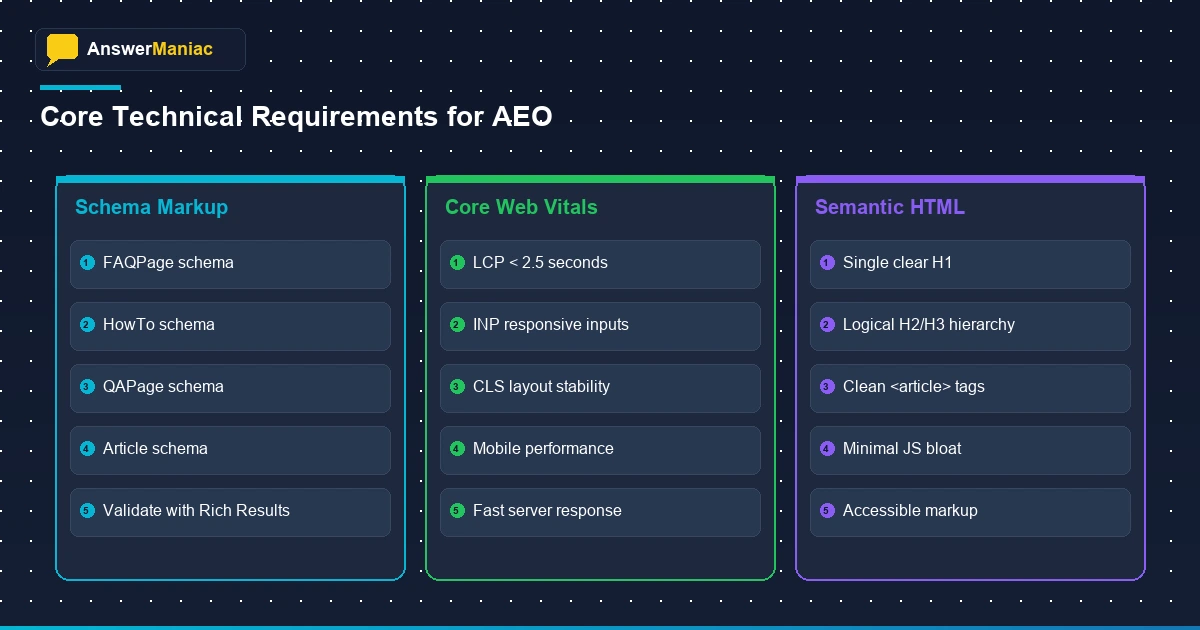
AEO doesn't work if machines struggle to read your site. Even strong writing will be ignored if the technical layer is weak, which becomes especially clear when you're trying to optimize for LLM search rather than just traditional crawlers.
Why technical structure matters
AI crawlers need a clear path to:
- Find key sections - Clear navigation and site structure
- Understand what each piece of content is - Proper semantic markup
- Extract clean answers without confusion - Clean HTML and structured data
A solid technical setup can dramatically raise the chances that your content is selected and quoted.
Schema Markup: the core signal
Structured data is the first priority.
Schema Markup is code you add in the backend that tells AI (and search engines) exactly what a page or block is about. For AEO, three schema types are especially important:
- FAQPage - for question-answer lists
- HowTo - for step-by-step instructions
- QAPage - for single questions with clear answers
When these are implemented properly, AI systems can pull your answers almost directly from the schema, instead of guessing from the page layout. For the full list of schema types AI actually crawls, see our schema markup for AI citations guide.
Site performance and Core Web Vitals
Speed and stability are not just UX concerns; they affect how often and how confidently AI uses your site.
Core Web Vitals focus on:
- How fast your page loads - Largest Contentful Paint (LCP)
- How quickly the page responds to input - Interaction to Next Paint (INP)
- How stable the layout is while loading - Cumulative Layout Shift (CLS)
Faster, more stable sites are more likely to be favored in both traditional rankings and AI Overviews, because they signal reliability and care.
Clean structure and headers
Finally, your HTML and headings need to be easy to follow:
- Use a single, clear H1 for the main topic
- Break sections with logical H2 and H3 headers
- Avoid cluttered code, unnecessary scripts, and broken markup
When the hierarchy is clean, crawlers can map questions to answers and topics to subtopics without guesswork. That clarity is what turns a regular page into an AI-ready answer source.
How to Execute a Content Audit for Generative Engines
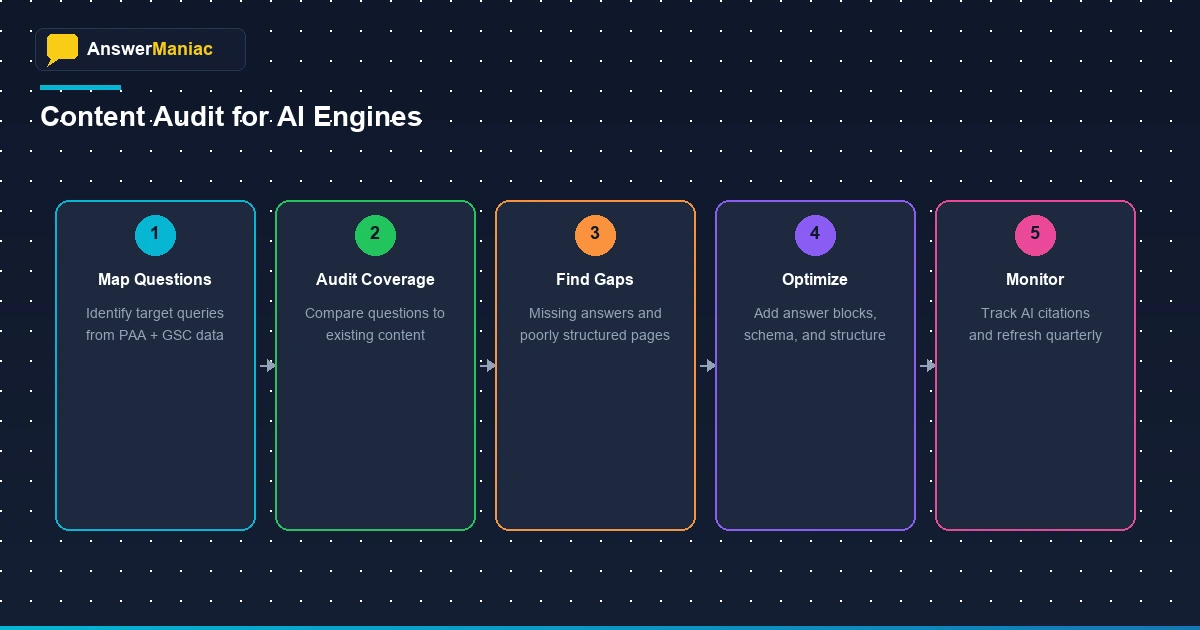
Every AEO plan starts with a clear view of where you stand. You need to know which questions you already appear for in AI-driven results, and which ones you're missing.
The first move is a structured audit of your content and the question landscape in your niche. Use real data from tools like Google Search Console and "People Also Ask" to map out clusters of related questions around your core topics, then compare that map to what your site actually covers.
Often, you'll find pages that rank but aren't formatted as clear, self-contained answers. These are quick AEO wins: refine headings, add direct answer sections, and clean up structure so AI systems can extract responses more easily.
Regular content review helps ensure answers remain accurate, up-to-date, and aligned with user intent as AI systems evolve. This iterative process is exactly what The ANSWER Framework was designed for.
Building an Optimized AEO Content Framework
When you create content for AEO, you're really designing it so an AI can lift the answer cleanly, then pull in the proof behind it. The goal is a direct, self-contained response first, with structured support right after.
You start with the heading. Your H1 or H2 should mirror the exact question a user would type or say, in natural language. Directly under that heading, you place a short answer snippet, usually one to three sentences, that fully answers the question on its own.
This "answer-first" structure is not optional. As the Elementor Blog puts it, "To be cited, your content must be 'machine-readable.' This means using clear formatting, structured data (schema), and direct 'answer-first' writing styles that AI can easily parse." - Elementor Blog[2]
Only after that do you expand with supporting detail. This is where you break information into short paragraphs, use clear emphasis for key terms, and, when helpful, rely on tables instead of dense blocks of text for comparisons.
This layout makes it easy for AI systems to spot the main answer, then grab structured details to build a reliable response.
10 Tactics for a Dominant AEO Strategy
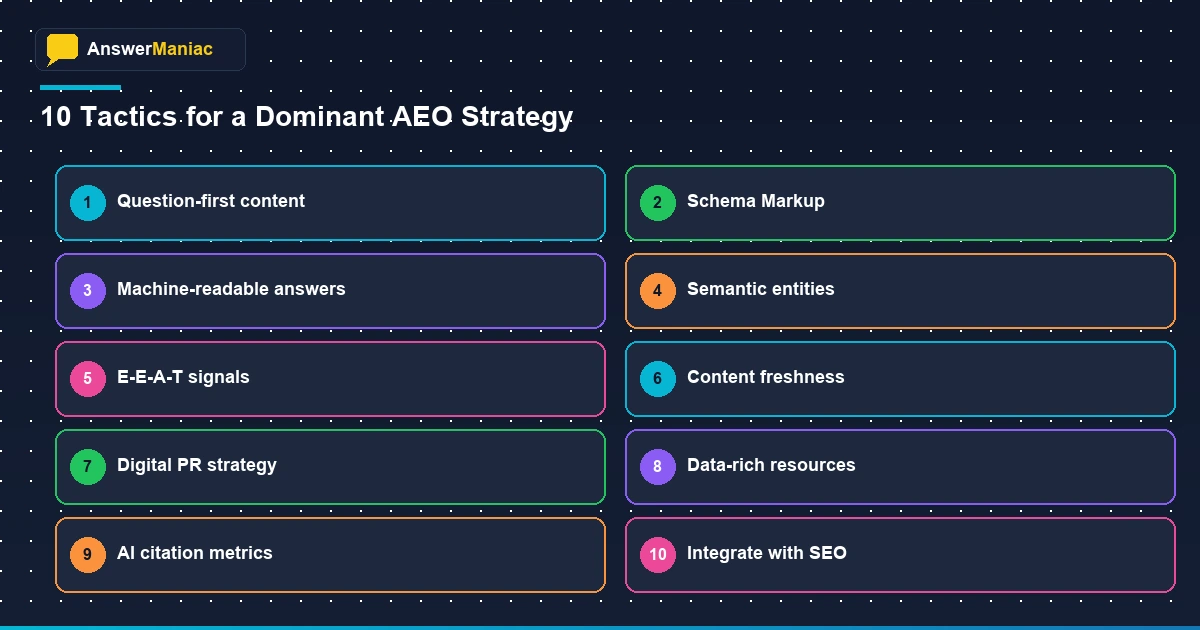
We've covered the core ideas. Now here are the practical tactics that turn AEO into a working strategy.
1. Adopt a question-first content model
Start every piece with a target question. Use tools to find the real "how," "what," and "why" questions your audience asks. Write your titles and main headings as those questions to align with conversational search.
2. Implement comprehensive Schema Markup
Add schema across your site, not just on one or two pages. Use FAQPage for common questions, HowTo for tutorials, and Article for in-depth content. Validate your markup with Google's Rich Results Test to catch errors.
3. Structure answers for machine readability
Put the direct answer in the first 150 words. Use H2 and H3 headings to break sections. Rely on bullet points or numbered lists for steps, features, and key data. Keep paragraphs short and focused.
4. Optimize for semantic relevance and entities
Look beyond exact-match keywords. Identify core entities (brands, tools, concepts, locations) tied to your topic. Use them consistently and naturally, along with related terms, so AI models can better understand context and depth.
5. Build and show E-E-A-T consistently
Add clear author bios with relevant experience. Cite and link to reputable sources. Publish case studies, data reports, or original findings where possible. Use testimonials, client logos, and trust signals where they make sense.
6. Prioritize content freshness and updates
Set a schedule to review key pages, ideally every quarter. Refresh stats, add new data, and address changes in your industry. Fresh, accurate content is more likely to be trusted and cited by AI engines.
7. Develop a focused digital PR strategy
Work to earn links and mentions from respected sites in your field. These third-party references help confirm your authority and make your brand a safer choice for AI systems to quote.
8. Create dedicated, data-rich resource pages
Build deep resource hubs around core topics rather than only short blog posts. Include multiple related questions, simple comparison tables, and any original data you have. These pages can become sources for repeated AI citations.
9. Monitor AI-specific performance metrics
Track how often your brand is cited in AI answers and overviews, where possible. Watch your share of voice for priority questions compared to competitors. Use these signals alongside traditional SEO metrics. Citation velocity is a useful metric for tracking citation growth rate over time.
10. Integrate AEO with your broader search strategy
Treat AEO as an extension of SEO, not a replacement. The same clear, structured, authoritative content can also win featured snippets and "People Also Ask" spots. One well-built page can serve both human readers and AI answer engines. For a deeper comparison, see our AI visibility vs SEO breakdown.
Tracking Performance in the Age of Zero-Click Searches
You can't measure AEO success with old SEO metrics alone. If your goal is to be cited inside AI answers, clicks and raw organic traffic are only part of the picture.
The key KPI becomes AI visibility: how often your brand or content is cited in AI Overviews and other assistant answers.
For Google, that means tracking impressions and references in AI Overviews via Search Console as those reports become available. On other platforms, you monitor citation frequency and share of voice around your core topics. For platform-specific tracking, see our guides on Perplexity AI search, Claude AI citations, and Gemini AI visibility.
Then you watch what happens downstream. Rising branded search, stronger lead quality, and better conversion rates often show that AI-driven authority is turning into real business results, even if overall traffic growth is modest.
Citation tracking is the KPI, but a citation count on its own does not tell you whether AI visibility is producing pipeline. AirOps closes that gap by tracking where a brand appears across AI search results with Insights, then unifying those citations with traditional SEO and GA4 signals inside Page360, so content health and AI visibility sit in one view instead of three separate dashboards.
With that view in place, you can watch citation share of voice for tracked topics, see which URLs AI engines are actually pulling from, and identify the specific pages moving branded search and conversion downstream. AirOps ties those signals back to pipeline attribution, which is what makes citation frequency a business metric rather than a vanity report.
The practical outcome is that when citation share of voice shifts on a priority topic, you can see which page changed, which competitor gained ground, and whether the resulting branded search is converting. That is how AI visibility earns budget alongside paid and organic channels.
Want a baseline? Run a free AI visibility audit to see how often AI platforms cite your brand today.
FAQ
How does an AEO optimization strategy differ from traditional search engine optimization?
An AEO optimization strategy focuses on getting your content cited directly inside AI-generated answers, not just ranked on a results page. Traditional SEO targets clicks and page-one rankings. AEO targets zero-click visibility: being the source AI quotes when a user asks a question. The content structure changes too: shorter, more direct answers with schema markup, rather than long-form articles built around keyword density.
Why is structured data essential for AI search and answer engines?
Structured data gives AI crawlers a machine-readable map of your content. FAQ schema connects questions to answers. HowTo schema connects steps to processes. Without it, AI has to guess what your page is about from raw HTML. With it, the system can extract your answer directly and with more confidence. Clean schema also reduces the chance of misinterpretation, which makes your content a safer source to cite.
How does content optimization help content appear in AI-generated answers?
AI systems prioritize content that answers the question quickly and clearly. That means leading with a direct answer in the first 40-60 words, using question-based headings, and breaking supporting detail into scannable lists and tables. If your content is well-organized and factually dense, AI has less work to do when extracting an answer, which raises your chances of being selected over a competitor.
What role does content strategy play in Answer Engine Optimization?
Content strategy determines which questions you answer and how you organize the responses. For AEO, that means building topic hubs (one core page + supporting pages for related questions) with strong internal linking. It also means maintaining a refresh schedule so data stays current. A clear strategy prevents scattered, overlapping content and builds the topical depth that AI systems use to evaluate authority.
How do AI answer engines impact organic traffic and click-through rates?
AI answer engines can reduce clicks for simple informational queries by answering them directly on the results screen. But well-cited content builds brand awareness even without the click. Users who see your brand recommended by AI are more likely to search for you directly later. Strong AEO often shows up as rising branded search volume and higher-quality leads, even when raw traffic numbers stay flat.
Final Thoughts on Your AEO Strategy
Search is already shifting from long result lists to AI-generated answers. If you want your brand to stay visible, you need an AEO strategy that treats machines as a second audience alongside humans. That means clear questions, direct answers, strong E-E-A-T signals, and a clean technical setup so AI systems can safely quote you.
This isn't about gaming algorithms. It's about proving real expertise in a structure new tools can read. For the complete methodology behind this approach, explore The ANSWER Framework: Audit, Navigate, Structure, Write, Earn, Refine. Or get a free AI Visibility Audit from AnswerManiac to see where you stand.
References
Get AEO Insights Weekly
Join 500+ B2B marketers getting AI visibility tactics every Tuesday.
Ready to Get Your Brand Cited by AI?
See how your competitors show up in ChatGPT, Perplexity, and Gemini — and what it would take to get recommended.