AI Visibility vs. SEO: Why Your Company Needs Both in 2026
AI visibility and SEO serve different purposes. Learn when to invest in each, how they complement each other, and why you need both for 2026.
Direct Answer: SEO and AEO (Answer Engine Optimization) are complementary disciplines, not competing ones. SEO earns you rankings and clicks on traditional search engines. AEO earns you citations and recommendations inside AI-generated answers from ChatGPT, Perplexity, Gemini, Claude, and Copilot. In 2026, 80% of B2B buyers use AI-powered search during their evaluation process, and Gartner projects a 25% decline in traditional organic traffic by the end of the year. Companies that invest in both SEO and AEO see up to 5x higher conversion rates from AI-referred traffic compared to standard organic. The right approach is not to choose one over the other -- it is to build an integrated strategy where SEO provides the content foundation and AEO ensures that content gets cited in the answers your buyers actually read.
Get your free AI Visibility Score at answermaniac.ai -- see how your brand compares to competitors across the Big 5 AI engines before you allocate a single dollar.
The debate is over. If you are a CMO, VP of Marketing, or founder deciding where to put your 2026 search budget, the question is no longer "SEO or AEO?" It is "How much of each, and in what order?" This guide gives you the framework to answer that question with data, not guesswork.
Key Takeaway
- SEO and AEO serve different stages of the buyer journey -- SEO captures intent-driven clicks while AEO influences the research and recommendation phase where 80% of B2B purchase decisions begin
- AI search traffic converts at 5x the rate of traditional organic because AI-referred visitors arrive with higher intent and pre-qualified context
- Gartner projects a 25% drop in traditional organic traffic by end of 2026, with 90% of B2B transactions intermediated by AI agents by 2028 -- making AEO investment a matter of survival, not experimentation
- The optimal budget split depends on your company stage, but most B2B companies should allocate 30-50% of their search budget to AEO by Q3 2026
The 2026 Search Landscape: Why the Ground Has Shifted
The search landscape in 2026 looks nothing like it did even 18 months ago. If your strategy was built on assumptions from 2024, it is already outdated. Here is what the data says.
AI-powered search is now the default
Over 80% of B2B buyers now use AI-powered search tools -- ChatGPT, Perplexity, Gemini, Claude, or Copilot -- as part of their vendor evaluation process. This is not a niche behavior. It is the primary research method for decision-makers evaluating SaaS platforms, professional services firms, and enterprise solutions.
AI search usage has grown 500%+ year-over-year, and the growth curve is steepening, not flattening. Every quarter, a new cohort of buyers shifts from "occasionally trying ChatGPT" to "asking AI first, then verifying on Google."
Organic traffic is declining structurally
Gartner's research projects a 25% decline in traditional organic search traffic by the end of 2026. This is not a dip. It is a structural shift driven by three converging forces:
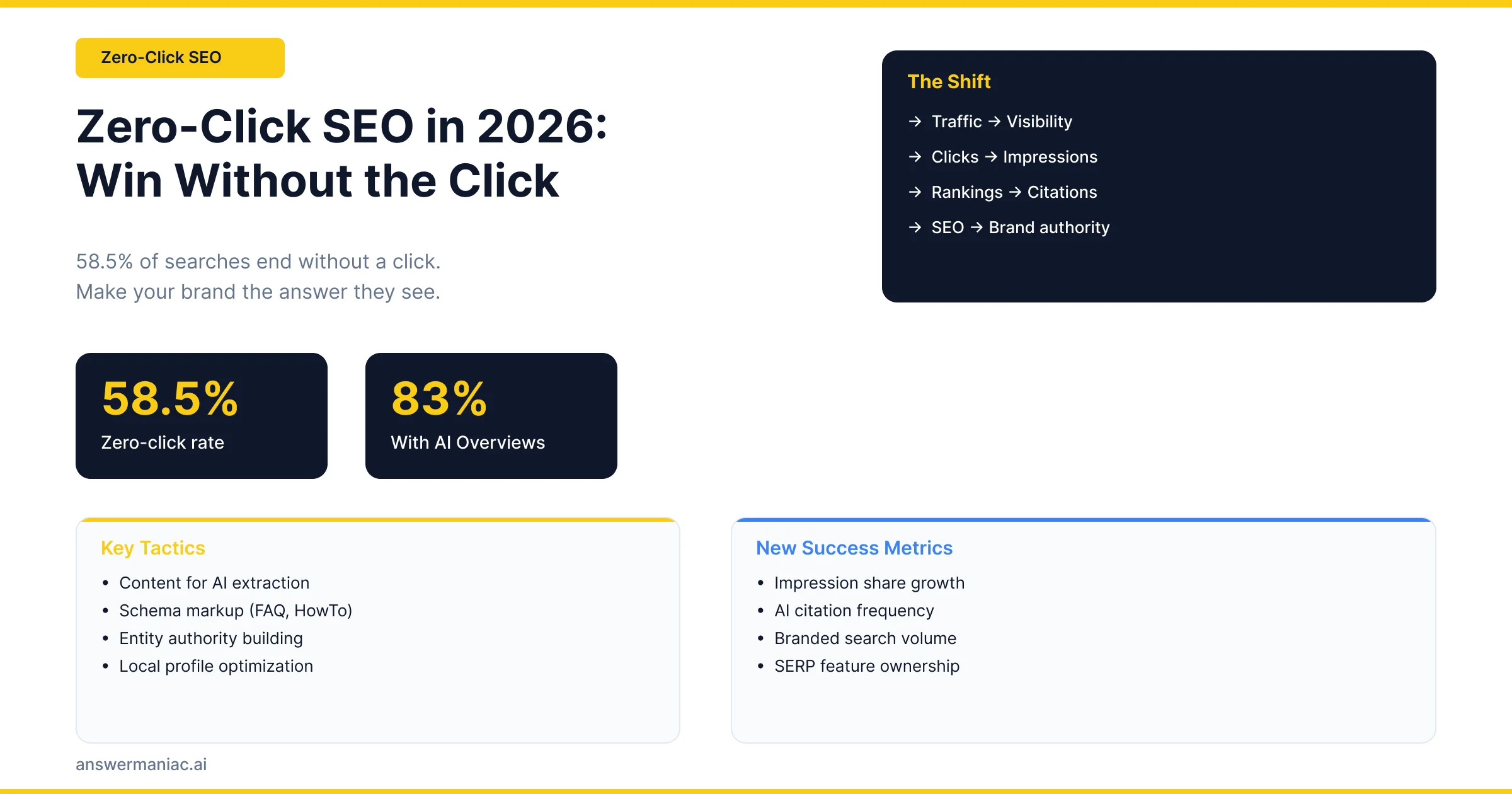
- Zero-click searches now account for over 65% of all Google queries, as AI Overviews and featured snippets absorb the clicks that used to flow to organic results
- AI-first search behavior means buyers get their answers from ChatGPT or Perplexity without ever opening a Google tab
- Agent-intermediated purchasing is accelerating -- Gartner forecasts that by 2028, 90% of B2B transactions will involve AI agents that research, compare, and recommend vendors on behalf of human buyers
The conversion gap is massive
Companies that appear in AI-generated answers see up to 5x higher conversion rates compared to traditional organic traffic. The reason is straightforward: a buyer who arrives at your site because ChatGPT recommended you is further down the funnel, has higher intent, and has already been pre-sold on your relevance. That visitor converts at 14.2% compared to 2.8% for standard Google organic traffic.
This is the context for every budget decision you make in 2026. SEO is not dead, but it is no longer the whole story. AEO is not optional -- it is the fastest-growing channel for qualified pipeline.
SEO vs. AEO: A Side-by-Side Comparison
The differences between SEO and AEO go far deeper than "one is for Google and the other is for ChatGPT." They represent fundamentally different approaches to how your brand shows up when buyers are looking for answers.
| Dimension | SEO (Search Engine Optimization) | AEO (Answer Engine Optimization) |
|---|---|---|
| Primary goal | Rank on SERPs; earn clicks to your website | Get cited in AI-generated answers; earn trust and recommendations |
| Target platforms | Google, Bing, Yahoo | ChatGPT, Perplexity, Gemini, Claude, Copilot |
| How you "win" | Position 1-3 in organic results | Named, quoted, or linked in the AI's synthesized answer |
| Traffic model | Click-through to your site | Citation-driven trust; traffic comes from users who verify the AI's recommendation |
| Content format | Blog posts, landing pages, product pages optimized for keywords | Citation assets, structured data pages, fact-dense comparison content |
| Key ranking factors | Keywords, backlinks, domain authority, page speed, Core Web Vitals | Entity clarity, schema markup, content structure, E-E-A-T signals, freshness |
| Measurement | Rankings, impressions, CTR, organic sessions | Citation frequency, brand mention rate, AI referral traffic, share of voice in AI answers |
| Time to impact | 3-6 months for new content to rank | 2-8 weeks for citation improvements; compounding effect over time |
| Competitive moat | Backlink profiles and domain authority are slow to replicate | Citation momentum compounds -- early movers get cited more, which leads to more citations |
| Buyer journey stage | Mid-to-bottom funnel: captures intent when buyers are actively searching | Top-to-mid funnel: influences the research phase when buyers are forming shortlists |
| Cost structure | Content creation + link building + technical optimization | Content restructuring + schema implementation + AI monitoring + entity optimization |
| Risk of inaction | Gradual decline in organic traffic as zero-click searches rise | Complete invisibility in the fastest-growing search channel; competitors lock in citation positions |
| Conversion rate | ~2.8% average for B2B organic traffic | ~14.2% for AI-referred traffic (5x higher) |
The table makes one thing clear: these are not competing strategies. They target different platforms, different stages of the buyer journey, and different outcomes. The question is not which one to choose -- it is how to make them reinforce each other.
Where SEO Still Wins
AEO is not a replacement for SEO. There are several categories where traditional search engine optimization remains the stronger channel, and cutting SEO investment prematurely would be a strategic mistake.
Transactional and navigational queries
When a buyer searches "buy Salesforce licenses" or "HubSpot pricing page," they are not looking for an AI-synthesized answer. They want to click through to a specific page and take action. SEO owns this intent category and will continue to own it for the foreseeable future. Transactional queries have low zero-click rates because the user's goal requires visiting a website.
Local search and maps
If your business serves a geographic market -- consulting firms, agencies, regional SaaS companies with in-person onboarding -- local SEO remains critical. Google Maps, local pack results, and "near me" searches are still dominated by traditional ranking signals: Google Business Profile optimization, local citations, reviews, and NAP consistency.
E-commerce and product search
Product searches with commercial intent ("best CRM for startups under $50/month") are increasingly answered by AI, but the actual purchase still flows through traditional search-driven product pages. SEO ensures your product pages are optimized for the click when the buyer is ready to buy, not just research.
Brand-building through content volume
SEO-driven content marketing still works for building topical authority and domain strength. Publishing 50 well-optimized blog posts on related topics creates a content ecosystem that signals expertise to both Google and AI engines. The volume play is an SEO strategy that indirectly feeds AEO performance.
Paid search integration
SEO and PPC work together in ways that AEO currently cannot replicate. Owning both the paid and organic results for a high-value keyword creates a visibility moat that AI search has not disrupted -- yet.
The bottom line: if your revenue depends on clicks, conversions, and direct-response traffic, SEO is still the engine. Do not cut it. Supplement it.
Where AEO Wins
AEO dominates in the scenarios where buyers are thinking, evaluating, and deciding -- before they are ready to click and buy. These are the moments that shape shortlists and influence six-figure purchasing decisions.
B2B research and vendor evaluation
When a VP of Engineering asks Perplexity "What are the best observability platforms for Kubernetes?" or a CFO asks ChatGPT "How do I evaluate ERP systems for a mid-market SaaS company?" -- the AI's answer becomes the starting point for the entire evaluation. If your brand is not in that answer, you are not on the shortlist. You never get the meeting. AEO ensures you are part of the conversation at the moment it matters most.
Complex, multi-faceted queries
AI engines excel at synthesizing answers to questions that do not have a single correct response. "What is the best project management approach for distributed engineering teams?" requires nuance, comparison, and context. These queries are where AI-generated answers are most trusted, and where AEO-optimized content gets cited because it provides the structured, fact-dense information AI models need.
Expert recommendations and "best of" lists
AI-generated recommendation lists are replacing the listicles and review aggregators that dominated Google results. When ChatGPT says "The top five platforms for X are..." -- that list carries enormous influence. Getting onto that list is an AEO outcome, not an SEO outcome. It requires structured content, schema markup, and entity clarity that traditional SEO does not optimize for.
Competitive differentiation conversations
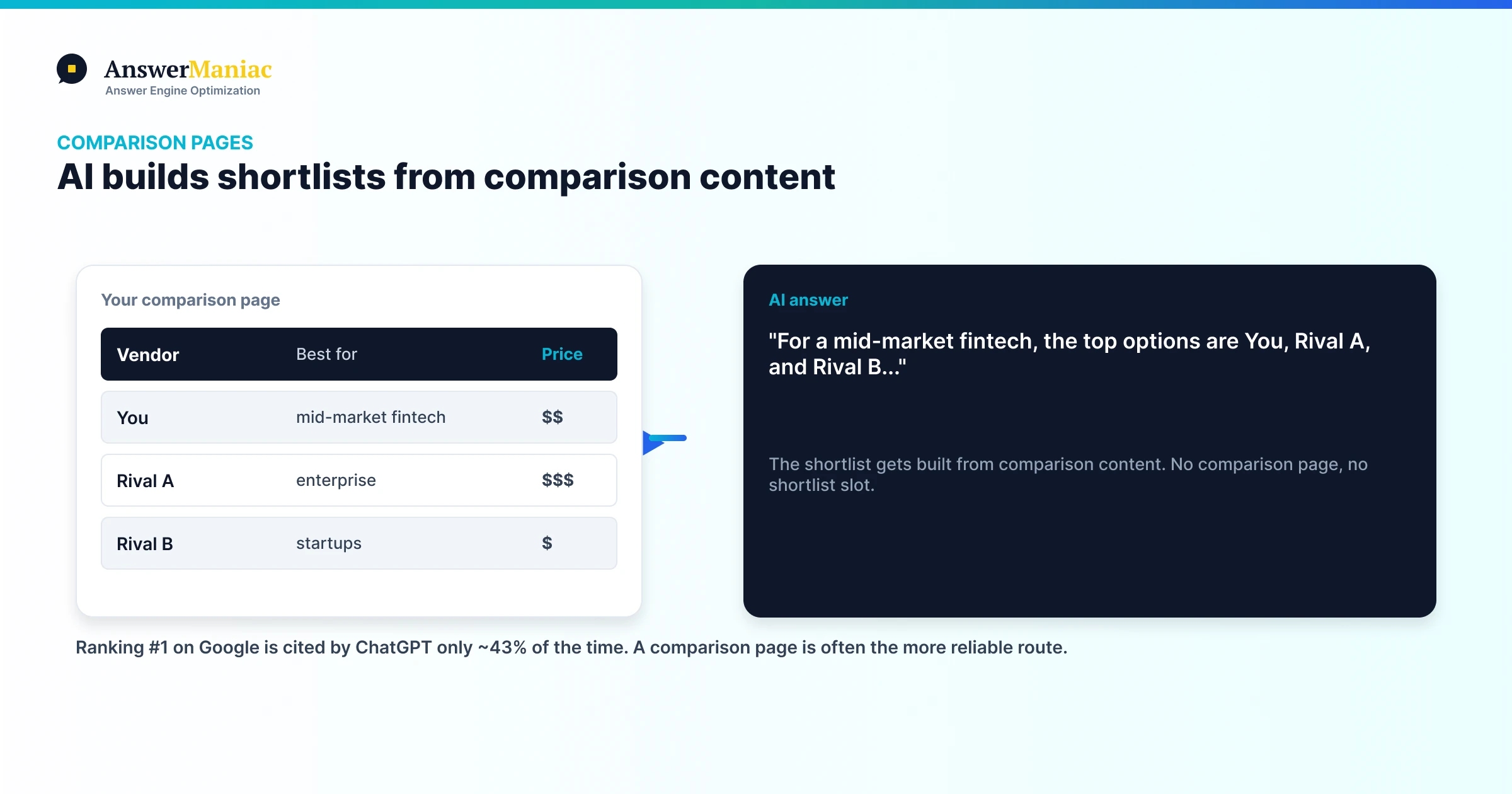
Buyers increasingly ask AI engines direct comparison questions: "How does [Your Competitor] compare to alternatives?" If your AEO strategy is strong, your brand appears as a named alternative in the answer. If it is not, you are invisible in the exact conversation where your differentiation matters most.
Agent-intermediated discovery
As AI agents begin handling procurement research -- and Gartner says 90% of B2B transactions will be agent-intermediated by 2028 -- the "buyer" making the shortlist will not be a human typing into Google. It will be an AI agent querying other AI systems. AEO is how you show up for that agent.
The Integrated Strategy: How SEO Feeds AEO
The most effective approach in 2026 is not to run SEO and AEO as separate programs. It is to build an integrated content infrastructure where each discipline strengthens the other.
Shared content foundation
Every piece of content optimized for AI visibility also performs well for SEO when done correctly. The principles overlap significantly:
- Comprehensive, authoritative content ranks well on Google and gets cited by AI engines
- Clear heading structures help Google understand page hierarchy and help AI models extract relevant sections
- Factual specificity (data points, statistics, named entities) improves both E-E-A-T signals for Google and citation likelihood for AI
- Regular content updates with visible publication and revision dates signal freshness to both systems
The key difference is structural. AEO content leads with direct answers and uses more tables, lists, and structured data. SEO content can be more narrative. The solution is to write for AEO first -- direct answer, structured format, fact-dense -- and then layer in the narrative flow that SEO rewards.
Schema markup benefits both channels
Schema markup implementation is the single highest-leverage tactic that improves both SEO and AEO simultaneously:
- For SEO: Schema generates rich snippets, FAQ dropdowns, how-to cards, and other enhanced SERP features that increase click-through rates
- For AEO: Schema provides machine-readable entity data that AI models use to understand your content's meaning, authority, and relationships
Organization schema, FAQ schema, HowTo schema, Product schema, and Review schema all serve double duty. Implementing them once creates compounding value across both channels.
Link equity builds AI authority
Backlinks remain critical for SEO, but they also influence AI visibility. AI models evaluate source authority partly based on how widely referenced a piece of content is across the web. A page with 200 high-quality backlinks is more likely to be cited by ChatGPT than an identical page with zero backlinks. Your SEO link-building investments directly improve your AEO outcomes.
Technical SEO enables AI crawling
Site speed, crawlability, XML sitemaps, and clean URL structures are SEO fundamentals. They also determine whether AI crawlers (GPTBot, PerplexityBot, ClaudeBot) can efficiently access and index your content. A technically sound website performs better for both channels.
Budget Allocation Framework: How to Split Your Investment
The right budget split between SEO and AEO depends on your company stage, industry, and revenue model. Here is a framework for making that decision.
Early-stage companies (Seed to Series A)
Recommended split: 70% SEO / 30% AEO
At this stage, you need traffic, leads, and proof points. SEO delivers measurable organic traffic faster than AEO delivers measurable citation impact. However, starting AEO early means building your content with the right structure from day one, which avoids expensive retrofitting later.
- SEO focus: Core product pages, 10-15 foundational blog posts targeting buyer-intent keywords, basic technical SEO
- AEO focus: Schema markup on all pages, AI visibility audit to establish a baseline, content structure best practices applied to all new content
Growth-stage companies (Series B to D)
Recommended split: 50% SEO / 50% AEO
You have traffic. You have ranking content. Now you need to win in the channels where your buyers are increasingly making decisions. This is the stage where AEO investment yields the highest marginal return because you are building on an existing content foundation.
- SEO focus: Competitive keyword expansion, link building at scale, technical optimization, content refresh program
- AEO focus: Citation asset creation, comprehensive schema implementation, AI monitoring and optimization, entity authority building, full AI visibility program
Enterprise and market leaders
Recommended split: 40% SEO / 60% AEO
If you already dominate organic search for your category, the marginal ROI of additional SEO investment is declining. The marginal ROI of AEO is accelerating because AI search is where your competitors are trying to unseat you. Protecting your recommendation position across AI engines is now a defensive priority.
- SEO focus: Maintain rankings, defend against competitors, optimize for conversion rather than traffic, invest in programmatic SEO for long-tail coverage
- AEO focus: Comprehensive citation monitoring, competitive citation displacement, AI agent optimization, multi-language AI visibility, thought leadership content designed for AI extraction
Industry-specific adjustments
| Industry | Lean toward SEO | Lean toward AEO |
|---|---|---|
| E-commerce / DTC | Yes -- transactional queries dominate | Lower priority unless high-consideration products |
| B2B SaaS | Balanced | Yes -- research-heavy buyer journey |
| Professional services | Balanced | Yes -- trust and expertise drive selection |
| Healthcare / Fintech | Yes -- regulatory content needs rankings | Yes -- complex queries are AI-dominant |
| Enterprise software | Lower priority for long-tail | Yes -- AI agents will dominate procurement |
| Local services | Yes -- maps and local pack are critical | Lower priority until AI local search matures |
The Transition Timeline: When to Start AEO Based on Your Industry
Not every company needs to go all-in on AEO today. But every company needs to start. Here is a realistic timeline based on how quickly AI search is disrupting different verticals.
Start now (Q1 2026) -- you are already behind
- B2B SaaS (all segments)
- Management consulting and professional services
- Enterprise software and infrastructure
- Cybersecurity and IT services
- Marketing technology
These industries have buyer populations that adopted AI search earliest and most aggressively. If you are not optimizing for AI citations today, your competitors are already capturing positions you will need to fight to reclaim.
Start by Q2 2026 -- the window is closing
- Financial services and fintech
- Healthcare technology
- Legal technology
- HR technology and recruiting platforms
- Education technology
Buyers in these industries are adopting AI search rapidly, but regulatory complexity and longer sales cycles mean the citation landscape is not yet fully locked in. You have a window, but it is narrowing.
Start by Q3 2026 -- build the foundation now
- E-commerce and retail technology
- Manufacturing and supply chain
- Real estate technology
- Construction technology
- Agriculture technology
These industries will see accelerating AI search adoption in the second half of 2026 as AI agents become more prevalent in procurement workflows. Starting your AEO foundation now -- schema markup, content restructuring, baseline audits -- positions you to scale when the wave hits.
Start by Q4 2026 -- plan and prepare
- Local services and SMB-focused businesses
- Highly regulated industries with slow tech adoption
- Markets where buyers are predominantly non-English speaking (AI search adoption varies by language market)
Even in these categories, planning should begin immediately. The technical infrastructure for AEO -- schema markup, content structure, entity optimization -- takes time to implement and benefits SEO in the meantime.
Case Study Framework: The Company That Does Both
Consider a realistic scenario based on patterns we see across B2B SaaS companies.
The company: "CloudOps Pro" (hypothetical mid-market observability platform)
Starting position (January 2025):
- 45,000 monthly organic sessions from Google
- Domain authority: 52
- Ranking for 1,200 keywords (120 in positions 1-3)
- AI visibility: near zero -- mentioned in 2 out of 50 test queries across the Big 5 AI engines
- Monthly marketing budget for search: $35,000
The problem: Despite strong organic traffic, CloudOps Pro was losing deals to competitors who were being recommended by ChatGPT and Perplexity. Sales reported that prospects were arriving at meetings saying "I asked ChatGPT and it recommended [Competitor X] -- why should I consider you instead?"
Phase 1: Audit and foundation (Months 1-2)
Budget split: 70% SEO ($24,500) / 30% AEO ($10,500)
Actions taken:
- Conducted a comprehensive AI visibility audit across all Big 5 engines
- Identified 15 high-priority queries where competitors were being cited and CloudOps Pro was not
- Implemented Organization, Product, FAQ, and HowTo schema across the entire website
- Restructured the top 10 existing blog posts to lead with direct answers and add structured comparison tables
Results after 2 months:
- AI citation rate: 2/50 queries improved to 8/50 queries
- Organic traffic: maintained (no negative impact from restructuring)
- Schema-driven rich snippets appeared for 23 keywords
Phase 2: Citation asset creation (Months 3-6)
Budget split: 50% SEO ($17,500) / 50% AEO ($17,500)
Actions taken:
- Created 12 "citation assets" -- comprehensive, structured comparison pages designed for AI extraction
- Published a definitive "Kubernetes Observability Guide" with 8,000 words of structured, fact-dense content
- Built an entity authority program: contributed expert quotes to 20 industry publications, ensuring consistent entity naming
- Continued SEO link building targeting both new citation assets and existing high-ranking content
- Implemented an AI-first content strategy for all new content
Results after 6 months:
- AI citation rate: 8/50 improved to 24/50 queries (appearing in nearly half of test queries)
- Organic traffic: grew 15% (restructured content performed better for SEO too)
- AI-referred traffic: 3,200 monthly sessions (up from ~200)
- AI-referred conversion rate: 12.8% (vs. 3.1% for organic)
Phase 3: Scale and defend (Months 7-12)
Budget split: 45% SEO ($15,750) / 55% AEO ($19,250)
Actions taken:
- Expanded citation asset library to 30 pages covering every major buyer question
- Launched competitive citation displacement campaigns targeting queries where competitors were still being cited exclusively
- Began optimizing for AI agent discovery (structured product data, API documentation with schema, machine-readable pricing)
- Invested in freshness: updated all citation assets monthly with new data points and statistics
Results after 12 months:
- AI citation rate: 24/50 improved to 38/50 queries
- Total organic + AI-referred traffic: 68,000 monthly sessions (up from 45,000 -- a 51% increase)
- AI-referred traffic: 11,500 monthly sessions
- Pipeline from AI-referred traffic: $2.1M (attributed through UTM tracking and self-reported attribution)
- Sales team reported a measurable shift: prospects were arriving saying "ChatGPT recommended CloudOps Pro"
The takeaway
CloudOps Pro did not abandon SEO. They strengthened it. But they layered AEO on top, and the combined strategy delivered results that neither discipline could have achieved alone. The SEO foundation provided the content and authority. The AEO optimization ensured that content was cited in the answers their buyers were reading.
Frequently Asked Questions
Is AEO replacing SEO entirely?
No. AEO is not replacing SEO -- it is expanding the definition of "search visibility" to include AI-generated answers alongside traditional search results. SEO remains essential for transactional queries, local search, e-commerce, and any scenario where the buyer needs to click through to a website. What is changing is that SEO alone is no longer sufficient. The buyers who matter most to B2B companies -- decision-makers researching solutions -- are increasingly getting their answers from AI engines rather than clicking on Google results. A complete AI visibility strategy includes both SEO and AEO working together.
How much does AEO cost compared to SEO?
AEO investment is typically comparable to SEO investment in its early phases. An initial AI visibility audit, schema markup implementation, and content restructuring might cost $5,000-15,000 for a mid-market company. Ongoing AEO optimization -- citation asset creation, AI monitoring, entity authority building -- runs $3,000-10,000 per month depending on scope. The key difference is that AEO tends to show results faster (2-8 weeks for citation improvements vs. 3-6 months for SEO ranking improvements), so the time-to-ROI is often shorter. See our pricing page for specific AEO and SEO service packages.
Can I do AEO without a strong SEO foundation?
Technically yes, but it is not recommended. SEO provides the content foundation, domain authority, and technical infrastructure that AEO builds on. A website with 200 well-structured, authoritative pages will see faster AEO results than a website with 10 thin pages, regardless of how well the schema markup is implemented. The ideal approach is to invest in SEO first (or simultaneously) and layer AEO optimization on top. If you are starting from scratch, build both from day one so every piece of content serves both channels.
How do I measure AEO ROI compared to SEO ROI?
SEO ROI is measured through rankings, organic traffic, and conversion from organic sessions -- tools like Google Search Console, Google Analytics, and Ahrefs make this straightforward. AEO ROI requires different measurement: citation frequency across the Big 5 AI engines, AI-referred traffic (tracked via UTM parameters and referral data), share of voice in AI-generated answers, and self-reported attribution ("How did you hear about us?" with "AI recommendation" as an option). The most meaningful AEO metric is pipeline and revenue attributed to AI-referred traffic, which typically shows a 5x conversion advantage over standard organic.
What happens if I ignore AEO and only invest in SEO?
In the short term (6-12 months), you will continue to see organic traffic, but it will likely decline as zero-click searches increase and AI Overviews absorb more clicks. In the medium term (12-24 months), you will lose competitive positioning as rivals who invest in AEO capture citation positions that compound over time. In the long term (2028+), as 90% of B2B transactions become agent-intermediated, companies without AI visibility will be functionally invisible to the AI agents that research and recommend vendors on behalf of human buyers. The risk is not sudden. It is gradual and then sudden -- similar to how companies that ignored mobile optimization in 2014 found themselves in crisis by 2016.
The Bottom Line: Build Both, Start Now
The companies that will dominate their markets in 2026 and beyond are not choosing between SEO and AEO. They are building integrated strategies that use SEO as the foundation and AEO as the growth lever.
Here is your action plan:
- This week: Run an AI visibility audit to establish your baseline citation rate across the Big 5 AI engines
- This month: Implement schema markup on your highest-value pages and restructure your top 10 content pieces to lead with direct answers
- This quarter: Create your first 5 citation assets targeting the queries where your competitors are being cited and you are not
- This half: Shift to a 50/50 budget split between SEO and AEO, with a clear measurement framework for both channels
The window for building citation momentum is open now. Early movers compound their advantage. Late movers fight an uphill battle against entrenched competitors.
Do not wait for a revenue decline to justify the investment. The data is already decisive.
See our AEO + SEO pricing packages -- or start with a free AI visibility audit to see exactly where you stand today.
Get AEO Insights Weekly
Join 500+ B2B marketers getting AI visibility tactics every Tuesday.
Ready to Get Your Brand Cited by AI?
See how your competitors show up in ChatGPT, Perplexity, and Gemini — and what it would take to get recommended.