Claude AI Integration: How to Appear in Claude.ai Projects and Artifacts
Get your brand cited by Claude AI. Learn how Anthropic's Claude selects sources, what content it prefers, and how to optimize for Claude citations.
Direct Answer: To get your brand cited by Claude AI, publish well-structured, factually dense content with clear attributions and balanced perspectives. Claude rewards clarity, intellectual honesty, and depth over keyword stuffing or promotional language. Brands that optimize for Claude now will own a channel most competitors have not even discovered yet.
Key Takeaway
Claude is not just another chatbot. It is Anthropic's flagship AI assistant, and it is quietly becoming the preferred tool for enterprise teams, researchers, and high-value B2B decision-makers. Unlike ChatGPT's broad consumer reach or Perplexity's search-first model, Claude occupies a unique position: it is the AI that professionals trust for nuanced, accurate work. If your content does not appear when Claude answers questions in your industry, you are invisible to some of the most valuable buyers in your market.
Why Claude Matters for B2B Visibility
Most B2B marketers are still fixated on ChatGPT when they think about AI visibility. That is a mistake. Claude has emerged as the AI assistant of choice for exactly the audiences that B2B companies need to reach.
The Growth Numbers
Anthropic's Claude has experienced extraordinary adoption since its initial launch. The platform crossed 100 million monthly web visits in 2025, with enterprise subscriptions growing faster than any competing AI product. Claude Pro and Claude Team plans have seen rapid uptake among consulting firms, law practices, financial services companies, and technology organizations. Anthropic itself reached a $60 billion valuation, signaling massive investor confidence in the platform's trajectory.
What makes these numbers especially relevant for B2B marketers is the demographic breakdown. Claude's user base skews heavily toward professionals, knowledge workers, and enterprise teams. These are not casual users asking for recipe suggestions. They are analysts researching vendors, consultants evaluating solutions, and executives seeking expert perspectives on complex decisions.
Enterprise Features That Change the Game
Two Claude features have fundamentally altered how professionals interact with AI, and both create new opportunities for brand visibility:
Claude Projects allow users to upload documents, set custom instructions, and build persistent knowledge bases that Claude references across conversations. When a procurement team uploads your competitor's whitepaper into a Project but not yours, you have already lost the deal before anyone picks up the phone.
Claude Artifacts generate standalone, interactive outputs such as reports, analyses, dashboards, and code. When Claude creates an Artifact that compares solutions in your category, the sources it draws from determine which brands appear in that deliverable. That Artifact may then be shared across an entire team or organization.
These are not theoretical scenarios. They are happening right now in enterprise environments, and the brands that show up in these workflows are winning deals they never even knew were in play.
How Claude Selects and Cites Sources
Understanding Claude's source selection requires understanding how it differs from other AI systems. Claude does not operate like a search engine, and it does not select sources the way ChatGPT does.
Training Data and Knowledge
Claude's training data includes a broad corpus of web content, books, academic papers, and other publicly available text. Like all large language models, Claude synthesizes patterns from this training data to generate responses. Content that appears frequently, consistently, and authoritatively across high-quality sources is more likely to influence Claude's outputs.
However, Claude also has access to web search capabilities. When users ask questions that require current information, Claude can pull from live web results, and it increasingly cites those sources directly in its responses. This means your content strategy needs to address both long-term authority building (for training data influence) and current discoverability (for web search citations).
Constitutional AI and Source Quality
Anthropic built Claude around a framework called Constitutional AI, which means the model is trained to be helpful, harmless, and honest. This has a direct impact on what content Claude prefers to cite:
- Helpful: Claude favors sources that directly and thoroughly answer the question being asked. Content that is vague, superficial, or padded with filler gets passed over.
- Harmless: Claude avoids citing sources that contain misleading claims, manipulative tactics, or unsubstantiated assertions. Hyperbolic marketing copy is a liability, not an asset.
- Honest: Claude gravitates toward content that acknowledges limitations, presents multiple perspectives, and distinguishes between established facts and opinions. If your content reads like a balanced briefing rather than a sales pitch, Claude is more likely to reference it.
This constitutional approach means that the same aggressive, keyword-stuffed, conversion-optimized content that might rank well in traditional search can actually work against you in Claude's ecosystem.
Citation Behavior
When Claude cites sources, it tends to reference the original, most authoritative version of information. If your blog post summarizes a study, Claude may cite the study itself rather than your summary. But if your content adds genuine analysis, original data, or a unique framework that the primary source does not provide, Claude will cite your content as the value-add.
What Makes Content Claude-Friendly
Based on analysis of Claude's citation patterns and Anthropic's published research on model behavior, certain content characteristics consistently perform well.
Clarity Over Cleverness
Claude responds well to content that communicates complex ideas in clear, precise language. Avoid jargon for its own sake. Define technical terms when you use them. Use short paragraphs and direct sentence structures. The goal is not to sound impressive but to be immediately useful.
Factual Density
Every paragraph should contain verifiable information. Claude's training emphasizes factual accuracy, so content that is rich in specific data points, named methodologies, concrete examples, and attributable claims gets weighted more heavily than content that relies on generalities and unsupported opinions.
Balanced Perspective
This is where Claude diverges most sharply from traditional SEO content. Claude's constitutional training makes it actively prefer sources that present balanced viewpoints. Content that acknowledges trade-offs, discusses limitations, and fairly represents alternative approaches signals higher quality to Claude's evaluation framework.
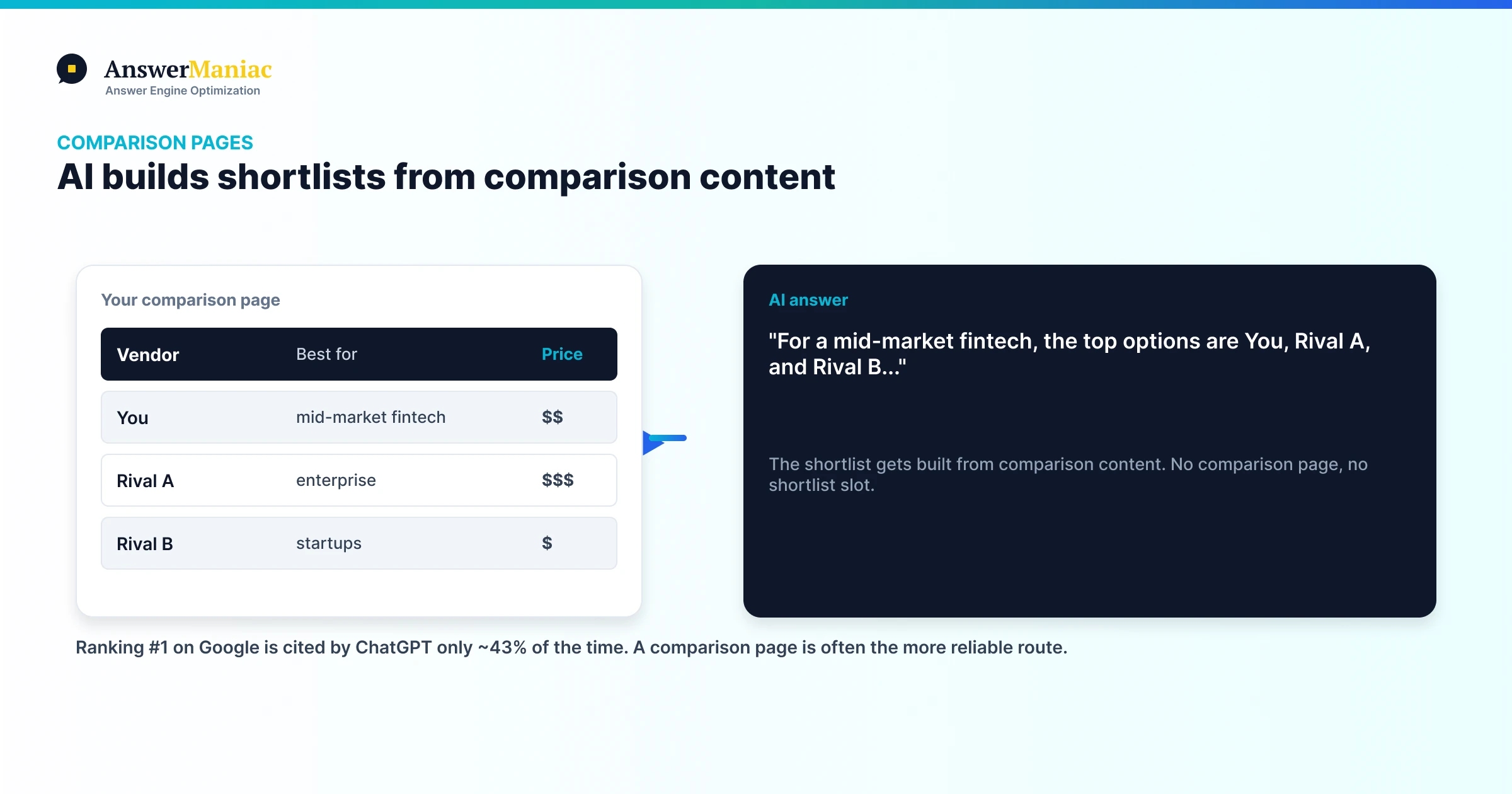
For B2B content, this means your comparison pages should honestly assess where competitors have strengths. Your product content should acknowledge which use cases you are not the best fit for. Counterintuitively, this intellectual honesty makes Claude more likely to cite you, not less.
Structured Data and Formatting
Claude processes structured content more effectively than unstructured prose. Use headers, lists, tables, and clear hierarchies. Implement schema markup to give AI systems additional context about your content. Well-structured pages are easier for Claude to parse, extract from, and cite accurately.
Claude Projects: The Hidden Opportunity
Claude Projects represent the most underappreciated opportunity in AI visibility today. Here is why.
How Enterprise Teams Use Projects
When a B2B buying team evaluates vendors, they increasingly create a Claude Project dedicated to that evaluation. They upload RFPs, vendor materials, analyst reports, and internal requirements documents. They then ask Claude to compare options, identify risks, and recommend solutions.
If your content is in that Project, Claude will reference it in every answer. If it is not, you are structurally excluded from the conversation.
Getting Into Project Workflows
You cannot directly control what users upload into their Projects. But you can create content that is so useful, so well-structured, and so comprehensive that it becomes a natural inclusion:
- Publish definitive comparison guides for your category. When someone is building a vendor evaluation Project, they search for exactly this type of content to upload.
- Create downloadable research reports with original data. These are the highest-value documents for Project uploads because they contain information available nowhere else.
- Build comprehensive FAQ pages that answer every question a buyer might ask. These serve as perfect reference documents within a Project context.
- Offer structured data sheets in clean, parseable formats. Claude processes well-formatted documents more effectively, making your content more useful inside a Project.
The key insight is that Claude Projects create a multiplier effect. Once your content is inside a Project, it influences every subsequent conversation in that workspace. Traditional content marketing gets one page view. A Project inclusion gets referenced dozens or hundreds of times across an entire evaluation cycle.
For a deeper understanding of how AI systems discover and evaluate your content, read our complete AI visibility guide.
Optimization Checklist for Claude Citations
Use this eight-point checklist to evaluate and improve your content for Claude visibility:
-
Lead with direct answers. Open every page with a clear, concise answer to the primary question. Claude pulls from content that immediately addresses the query, not content that buries the answer below three paragraphs of context-setting.
-
Include original data or analysis. Claude preferentially cites sources that contain information not available elsewhere. Proprietary research, original benchmarks, and unique frameworks give Claude a reason to cite you instead of a competitor.
-
Maintain factual accuracy with attributions. Every claim should be verifiable. Link to primary sources. Name specific studies, dates, and figures. Claude cross-references information, and unsubstantiated claims reduce your credibility in the model's evaluation.
-
Present balanced perspectives. Acknowledge limitations, trade-offs, and alternative viewpoints. Claude's constitutional AI framework actively rewards intellectual honesty and penalizes one-sided promotional content.
-
Structure content with clear hierarchies. Use H2 and H3 headers, bullet points, numbered lists, and tables. Implement schema markup for key content types. Claude extracts information more reliably from well-structured pages.
-
Write for expertise, not keywords. Claude evaluates topical depth and genuine expertise. Cover subjects comprehensively. Address edge cases. Provide the level of detail that a knowledgeable professional would expect.
-
Keep content current. Claude's web search integration means it can access recent content. Regularly update your pages with new data, revised recommendations, and current examples. Stale content loses citation priority.
-
Build topical authority across your site. Claude evaluates domain-level expertise, not just individual pages. A site with deep coverage across related topics in your niche signals higher authority than a site with one or two isolated posts.
Claude vs ChatGPT vs Perplexity: What Each Values
Understanding the differences between major AI platforms helps you prioritize your optimization efforts. Here is how the three leading systems compare in terms of what drives citations:
| Factor | Claude | ChatGPT | Perplexity |
|---|---|---|---|
| Source Selection Priority | Factual accuracy, balanced perspective, intellectual honesty | Popularity, recency, domain authority | Real-time web results, source diversity |
| Content Tone Preferred | Measured, analytical, nuanced | Conversational, comprehensive, authoritative | Journalistic, well-sourced, concise |
| Citation Style | Synthesizes with attribution when using web search | Inline citations with browsing; synthesized from training data otherwise | Always cites with numbered references |
| Structured Data Impact | High — improves extraction accuracy | Moderate — helps with featured content | High — feeds directly into search results |
| Enterprise Adoption | Strong in consulting, legal, finance, and research | Broad consumer and enterprise mix | Growing in research and media workflows |
| Original Data Value | Very high — strongly preferred over summaries | High — rewarded in detailed responses | Moderate — prefers citing primary sources directly |
| Promotional Content Tolerance | Very low — actively deprioritized | Low-moderate — diluted but not penalized as heavily | Low — prefers neutral, journalistic tone |
| Update Frequency Sensitivity | Moderate-high with web search; training data has a lag | Moderate with browsing; training data has a lag | Very high — indexes in near real-time |
The most important distinction: Claude penalizes promotional language more aggressively than any other major AI platform. Content that performs well in Claude requires genuine editorial quality, not just SEO optimization.
For a detailed analysis of how your content currently performs across all three platforms, explore our AI visibility audit for ChatGPT citations or review our full AEO and GEO services.
Frequently Asked Questions
How is Claude different from ChatGPT for brand visibility?
Claude's Constitutional AI framework places a stronger emphasis on factual accuracy, balanced perspective, and intellectual honesty than ChatGPT. In practice, this means Claude is less likely to cite content that reads as promotional, even if that content has high domain authority and strong SEO metrics. Brands that invest in genuinely informative, balanced content perform disproportionately well in Claude compared to brands that rely on traditional SEO-optimized marketing copy. Claude's Projects and Artifacts features also create unique enterprise workflows that have no direct equivalent in ChatGPT, opening additional visibility channels.
Can I optimize for Claude without hurting my Google rankings?
Yes. The content qualities that Claude rewards — factual density, clear structure, original data, balanced perspective, and comprehensive coverage — are the same qualities that Google's helpful content system increasingly prioritizes. Optimizing for Claude typically improves your Google performance because both systems are converging on the same definition of quality content. The only area of potential conflict is promotional language: Claude penalizes it more heavily, but reducing promotional tone in your content generally improves Google performance as well. For a step-by-step approach, see our AI visibility guide.
How do Claude Projects affect my content strategy?
Claude Projects fundamentally shift the value equation for B2B content. In traditional content marketing, each page view is a discrete event. In a Claude Project, your content becomes a persistent reference that influences every conversation in that workspace for weeks or months. This means downloadable assets like research reports, comparison guides, and comprehensive FAQs have dramatically more value than they did before, because a single download can lead to hundreds of AI-assisted references. Your content strategy should prioritize creating documents that buyers would naturally upload into an evaluation Project.
How often should I update content for Claude visibility?
Claude's web search integration means it can access recent content, so freshness matters. For core topic pages, review and update quarterly at minimum. For pages covering rapidly evolving topics, monthly updates are advisable. Each update should add new data points, revised statistics, or updated recommendations rather than simply changing dates. Claude evaluates substantive freshness, meaning whether the actual information has been updated, not just cosmetic freshness. A page that was last modified yesterday but contains year-old data will not fool the system.
Start Getting Cited by Claude Today
Claude's rapid growth among enterprise users means the window for early-mover advantage is closing. The brands that establish strong Claude visibility now will compound that advantage as the platform continues to grow and more buying decisions flow through AI-assisted workflows.
Every week you wait is a week your competitors might use to claim the citations that should be yours.
See our pricing plans and start optimizing for Claude and every other major AI platform today.
Get AEO Insights Weekly
Join 500+ B2B marketers getting AI visibility tactics every Tuesday.
Ready to Get Your Brand Cited by AI?
See how your competitors show up in ChatGPT, Perplexity, and Gemini — and what it would take to get recommended.