How to Rank in Answer Engines: Complete Step-by-Step Guide 2026
Learn how to rank in answer engines with this step-by-step AEO framework. Increase AI visibility, citations, and brand mentions in Google AI Overviews, Perplexity, and ChatGPT.
Direct Answer: To rank in answer engines like ChatGPT, Perplexity, and Google AI Overviews, structure your content with direct answers first, implement schema markup (FAQPage, HowTo, QAPage), build E-E-A-T signals (Experience, Expertise, Authoritativeness, Trustworthiness), and make your content easily extractable by AI systems. Success is measured by AI citations rather than traditional click-through rates.
Ranking in answer engines means your content is structured so AI systems can retrieve, synthesize, and cite it when generating responses to user queries.
Instead of only chasing blue links on a results page, you're aiming to become the reference that systems like Google AI Overviews or Perplexity quote when they build an answer.
To do that, your content has to give clear, direct responses first, then back them up with well-structured evidence and strong trust signals.
If you want a simple, practical path to get there, keep reading for a focused, step-by-step guide.
Key Takeaway
Success includes AI citation visibility alongside traditional metrics like traffic and engagement, because both contribute to visibility and value. Your content must be structured clearly with direct answers first. Building trust signals (E-E-A-T) is essential for AI to choose your site.
What Defines Success in Answer Engine Optimization?
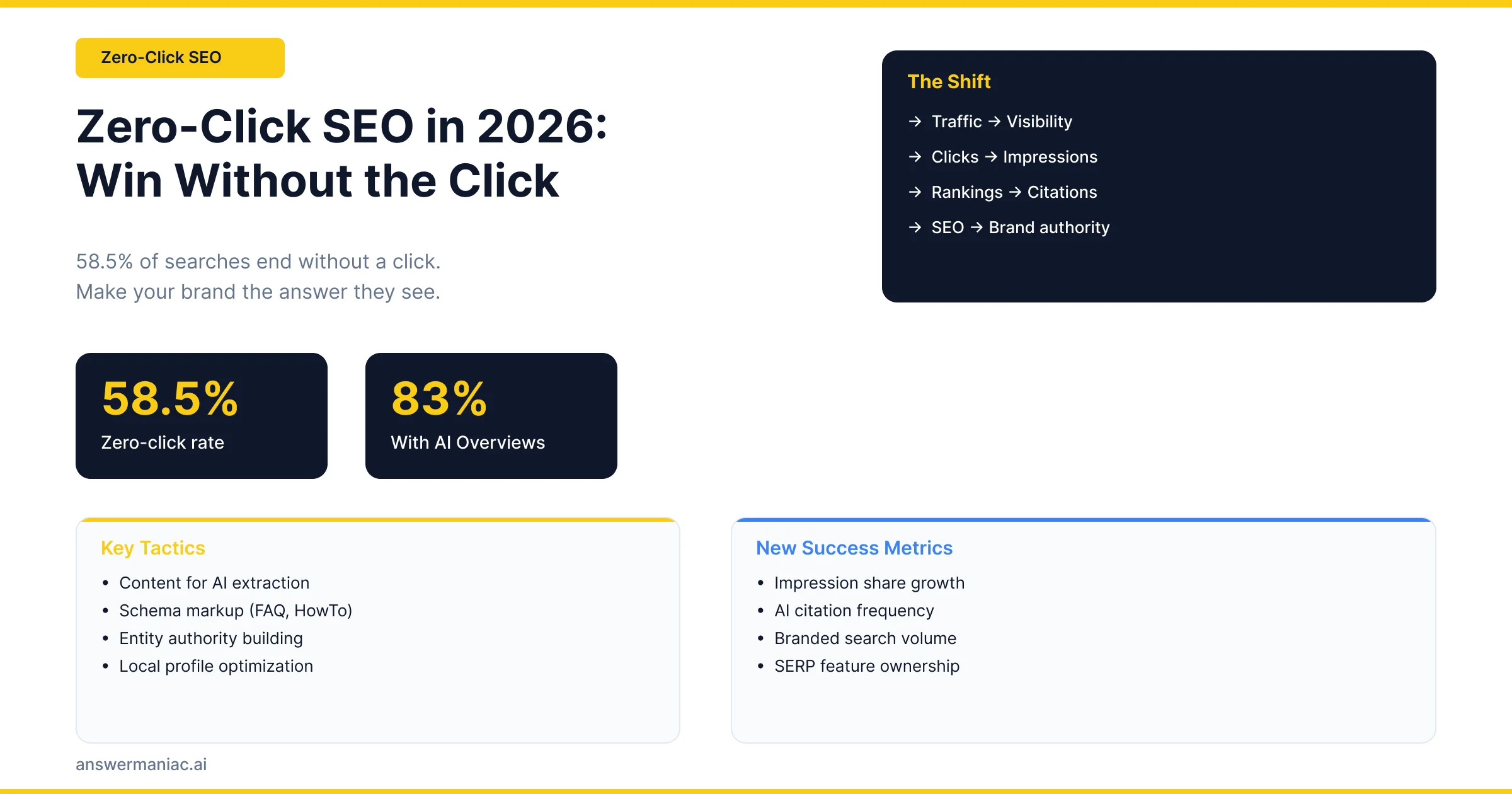
Most teams have to rethink what "winning" looks like when they move from SEO to AEO. In classic SEO, success meant climbing the SERP, earning the click, and pulling users onto your site. You watched keyword rankings, organic traffic, and click-through rates to decide if your strategy worked.
Answer Engine Optimization (AEO) shifts that target. Here, the win is the citation, not the visit. The aim is for your brand's content to be referenced or used in AI-generated answers, whether explicitly cited or implicitly integrated.
That means your main success signals become how often you're cited, how visible those mentions are, and whether the AI is representing your information accurately and consistently.
Which is why a clear AEO strategy has to define visibility and accuracy as core optimization goals, not secondary wins.
| Strategy Component | Traditional SEO | Answer Engine Optimization |
|---|---|---|
| Primary Goal | Keyword rankings and website clicks | AI citations and direct answers |
| Content Focus | Long-form articles for human readability | Structured, easily extractable data and snippets |
| Success Metric | Click-through rate (CTR) and traffic volume | Citation frequency and brand mentions in AI answers |
| Search Intent | Short-tail, keyword-based queries | Conversational, long-tail questions |
How to Identify High-Intent Questions for AI Retrieval

Most AEO work starts in the same place: finding the right questions. AI engines are built to answer user queries, so your content has to match the exact questions people actually ask, in the way they naturally phrase them.
To do that effectively, you can:
- Use real query data from Google Search Console to see which questions already bring users to your site
- Scan "People Also Ask" boxes in Google to uncover related and follow-up questions
- Check tools and forums like AnswerThePublic and Quora to study how people word problems in your niche
- Prioritize specific, high-intent questions, such as "how to configure two-factor authentication in 2026," over broad terms like "cybersecurity"
- Group related questions into clusters and cover them with clear, well-structured, and contextually rich content so AI models see your pages as complete, authoritative sources
The Ideal Content Structure for AI Extraction
Skimming is a helpful test. If a person can't scan your page quickly, an AI will likely struggle with it too.
Start by turning the main question into your H1, written the way someone would actually ask it. Immediately below, include a short, direct answer in roughly 100-150 words.
This answer block should stand on its own so an AI system can confidently lift it as a complete response, a structure that aligns closely with how GEO optimization evaluates clarity, extractability, and consistency across answers.
This approach aligns with what HubSpot describes as a "Modular Extraction" strategy, where large language models prioritize content presented in clear, self-contained blocks they can confidently cite. HubSpot notes that leading each key section with a concise, direct answer increases the likelihood of being selected as a citation [1].
After the initial answer, expand with well-labeled H2 and H3 sections. Use bullet points, numbered steps, and simple tables instead of dense paragraphs.
Clear structure reduces ambiguity and helps AI systems quickly locate definitions, comparisons, and factual details they can reuse accurately.
Why Authority Signals and E-E-A-T Matter for AEO

AI engines are designed to surface trustworthy information, which is why E-E-A-T (Experience, Expertise, Authoritativeness, and Trustworthiness) plays an outsized role in Answer Engine Optimization. It's not enough for content to be correct; it must also look reliable to a machine.
"To win in the age of generative search, you must write for 'extractive' AI. This means structuring content into clear, factual blocks that AI can lift verbatim. By prioritizing semantic clarity over fluff and using structured data to define entities, you turn your pages into an 'answer-ready' resource that engines can confidently cite." - Search Engine Journal [2].
This reinforces the shift toward semantic machine-readability, where reducing fluff and surfacing facts early makes content easier for AI models to extract and trust.
To strengthen E-E-A-T signals:
- Experience: Include real-world examples, case studies, or firsthand insights
- Expertise: Ensure content is written or reviewed by qualified experts with visible credentials
- Authoritativeness: Build mentions and links from reputable industry sources
- Trustworthiness: Keep facts updated, cite reliable sources, and maintain consistency across pages
When these signals are clear and repeatable, AI systems are more likely to view your content as a safe, authoritative reference worth citing directly.
The Step-by-Step AEO Process

Here is a clear breakdown of practical steps to improve ranking in answer engines.
Step 1: Conduct a thorough question audit
Review analytics and use external tools to collect the real questions users ask. Group them into topic clusters, such as all questions about "project management software for remote teams." This reveals gaps where new content or updates are needed.
Step 2: Create "answer-first" content pages
For each priority question, build or revise a page. Use the question as the H1, place a complete direct answer right after, then add structured supporting details. Make sure the page fully and accurately addresses the query.
Step 3: Implement structured data (Schema Markup)
Add schema markup so AI systems can interpret content correctly. Use FAQ schema for Q&A content, HowTo schema for step-based guides, and Article schema for in-depth pages. This metadata guides AI crawlers and helps AI systems interpret and extract your content more reliably.
Step 4: Optimize for technical performance
Improve loading speed, Core Web Vitals, mobile usability, and site structure. A clean, fast, error-free site is easier for AI and search crawlers to access, which becomes even more important as teams optimize for LLM behavior rather than relying only on traditional indexing.
Step 5: Build external authority signals
Earn mentions and links from reputable sites through digital PR, guest articles, relevant directory listings, and genuine customer reviews. These external references strengthen perceived authority for both users and AI engines.
Step 6: Monitor, measure, and iterate
Track when and where your brand is cited in AI-generated answers and AI Overviews. Use citation visibility and analytics along with search intent data to refine question targets and improve content structure over time.
How to Track and Iterate on AI Visibility Metrics

Success in AEO is not mainly about traffic. It's about how often AI systems pick your content and cite it in their answers.
The main metric is AI visibility. You want to know how often your pages are mentioned inside AI-generated answers, and in what context.
Right now, that usually means testing your target questions in tools like Google AI Overviews, Perplexity, and other assistants, then checking if your brand appears. Use any new reports that show AI impressions when they become available.
Branded search is another helpful signal. If more people start searching for your company name, they may have first seen it inside an AI answer and then looked you up.
AEO tracking is ongoing. Regularly review which pages are getting cited and which are not. Then update your most important answers with fresh data, clearer structure, and stronger E‑E‑A‑T so they remain trusted sources AI systems want to use.
FAQ
How do answer engines decide which content appears in AI-generated responses?
Answer engines analyze large language models, training data, and retrieval augmented generation systems to select content. They prioritize clear answers, strong trust signals, and verified source expertise.
Structured content, semantic coverage, and accurate alignment with user intent increase visibility, especially in zero-click search environments where users expect immediate, reliable answers.
What role does structured data play in Answer Engine Optimization?
Structured data helps answer engines clearly understand page context. Schema markup such as FAQ Schema, Article Schema, and HowTo Schema improves content extraction accuracy. This increases eligibility for featured snippets and AI-generated responses.
Proper structured content also supports ranking systems by improving clarity, relevance, and consistency across search engines.
How should content be written to rank better in answer engines?
Content should directly address user questions with clear, conversational answers. Writers should focus on search intent, semantic coverage, and structured explanations instead of content volume.
Filling content gaps with practical information improves Answer Engine Optimization and increases the likelihood of appearing in AI answer engines and conversational search results.
Why is user experience important for answer engine rankings?
Answer engines favor content that delivers a fast, accessible experience. Page speed, mobile responsiveness, and readable layouts help AI platforms process content efficiently.
Well-structured FAQ pages reduce friction for users and improve extraction accuracy, increasing the chances of being included in AI-generated responses.
How can businesses build trust signals for answer engines?
Businesses build trust by publishing accurate, well-sourced content with clear human attribution. Consistent content optimization, cited links, and expert-backed explanations improve credibility.
User-generated content, strong business visibility, and transparent information help answer engines evaluate authority and select reliable sources for AI responses.
How does optimizing for voice assistants improve answer engine rankings?
Answer engines favor pages that anticipate voice assistants and conversational AI platforms. Content should mirror spoken questions, use natural language, and deliver concise answers. Structuring responses for conversational queries improves zero-click visibility.
Clear headings, short paragraphs, and direct explanations help AI-generated responses perform better across emerging answer engines. This approach aligns content with evolving search behavior and user expectations today.
What is the role of llms.txt in answering engine visibility?
The llms.txt file guides large language models toward preferred content sources. When combined with structured content design and semantic coverage, it improves retrieval accuracy. This supports ranking systems that rely on cited links and human attribution.
Clear organization, trusted sources, and consistent formatting help answer engines identify authoritative information. It also reduces confusion during AI training data interpretation processes globally.
Do online reviews influence rankings in answer engines?
Answer engines assess trust through online reviews, review management, and community-driven spaces. Consistent feedback signals reliability and improves business discovery.
Structured citations, transparent responses, and active engagement increase credibility scoring. High-quality interactions help AI response quality, referral traffic, and visibility scores across answer engine ecosystems.
This trust directly influences citation frequency and long-term share of voice within competitive search landscapes.
How can analytics prevent spam risks in answer engine optimization?
Tracking performance is essential for ranking in answer engines. Use analytics to measure referral traffic, citation frequency, and visibility score.
Regular citation audits identify gaps and risks. Avoid black-hat tactics, content farms, and GEO spam.
Sustainable optimization focuses on content quality, source verification, and user trust. This approach improves long-term AI response quality and ranking stability across evolving search environments.
Getting Started with Your Answer Engine Strategy
AI-powered search is changing how people discover information. To rank in answer engines, content needs clear questions, direct answers, strong structure, and visible authority signals. A focused process, question audits, answer‑first pages, schema markup, and trust-building, helps position your brand as a reliable source that AI systems can safely cite.
The next step is knowing where you stand. You need to see which AI answers already mention you, and where competitors appear instead. For a detailed visibility snapshot and clear next steps, you can start with a free audit at AnswerManiac.
References
- HubSpot: Answer Engine Optimization Best Practices
- Search Engine Journal: AEO Guide - SEO Visibility, TAC, and SPA
Related Articles
Get AEO Insights Weekly
Join 500+ B2B marketers getting AI visibility tactics every Tuesday.
Ready to Get Your Brand Cited by AI?
See how your competitors show up in ChatGPT, Perplexity, and Gemini — and what it would take to get recommended.