Gemini AI Visibility: How Google's AI Assistant Citations Work in 2026
Get cited by Google Gemini and AI Overviews. Learn how Google's AI selects sources, the role of E-E-A-T, and how to optimize for Gemini recommendations.
Direct Answer: Google Gemini selects sources for AI-generated citations based on a combination of E-E-A-T authority signals, Knowledge Graph entity alignment, structured data quality, content freshness, and topical depth. To get cited in both Google AI Overviews and the standalone Gemini app, your content needs to be machine-readable, authoritative, and structured around the exact questions your buyers are asking. Pages with strong Organization Schema, clear entity signals, and comprehensive FAQ-style content are cited at significantly higher rates than pages relying solely on traditional SEO ranking factors.
Is your brand visible in Google's AI-generated answers? Get your free AI Visibility Score -- find out exactly where Gemini and AI Overviews are citing your competitors instead of you.
Key Takeaway
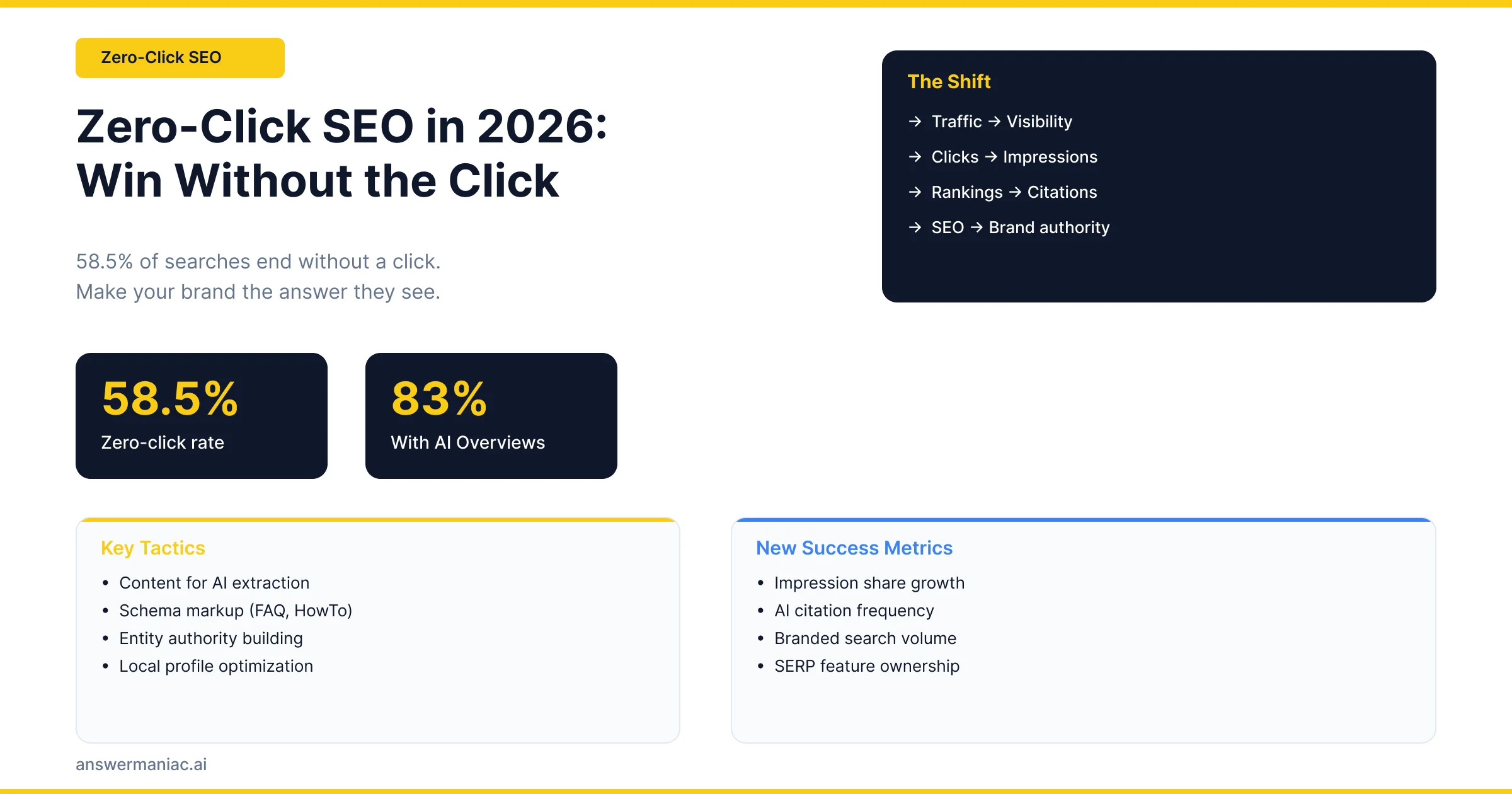
- Gartner predicts 25% of traditional organic search traffic will shift to AI-powered answers by 2026, with Google AI Overviews absorbing the largest share of that migration
- Gemini and AI Overviews use different citation pathways -- optimizing for one does not automatically optimize for the other, and each requires a distinct strategy
- E-E-A-T signals are weighted more heavily in Gemini citations than in any other AI engine, because Google controls both the quality rating framework and the AI model that consumes it
- Six specific optimization tactics can move your brand from invisible to consistently cited in Google's AI ecosystem within 60 to 90 days
The Gemini Shift: From Blue Links to AI Answers
Google search has not changed incrementally. It has changed structurally.
In early 2024, Google rolled out AI Overviews -- AI-generated summaries that appear directly at the top of search results, answering the user's question before they ever reach a traditional blue link. By mid-2025, AI Overviews appeared on more than 40% of informational queries in the United States. As of early 2026, that number continues to climb, and the standalone Gemini app has emerged as a parallel channel where buyers research vendors, compare solutions, and make purchasing decisions entirely inside an AI conversation.
The impact on organic traffic has been severe for companies that are not adapting.
The traffic shift in numbers
- Gartner projects that 25% of organic search traffic will migrate to AI-generated answers by 2026 -- a prediction that current data suggests is tracking accurately or conservatively
- Google AI Overviews now appear on an estimated 47% of commercial informational queries, the exact queries B2B buyers use during vendor evaluation
- Click-through rates to traditional organic results have declined 15 to 30% on queries where AI Overviews are present, with the steepest declines in the informational and comparison categories
- The standalone Gemini app has surpassed 300 million monthly active users, making it the second-largest AI assistant behind ChatGPT
For marketers who built their entire acquisition strategy on traditional SEO, these numbers represent an existential challenge. But for those who understand how Gemini selects and cites sources, they represent an opportunity -- because the vast majority of companies have not yet optimized for AI visibility inside Google's ecosystem.
This is the window. The brands that figure out Gemini citation mechanics now will compound that advantage as AI Overviews expand to cover more query types.
If you are still building your foundational understanding of this shift, start with our complete AI visibility guide before diving into the Gemini-specific tactics below.
How Gemini Selects Sources for Citations
Understanding Gemini's citation mechanics requires separating what Google has publicly stated from what practitioners have observed through testing. The core signals break into four categories.
1. E-E-A-T Signals: The Dominant Factor
Google's Experience, Expertise, Authoritativeness, and Trustworthiness framework has always mattered for traditional search. But in the context of Gemini and AI Overviews, E-E-A-T signals carry disproportionate weight because the stakes are higher. When Google's AI generates an answer and attributes it to a source, Google's own reputation is on the line. This means the quality bar for citation is significantly higher than the quality bar for ranking.
What this looks like in practice:
- Author entities matter. Pages with clearly identified, verifiable authors -- linked to professional profiles, credentials, and other published work -- are cited more frequently than anonymously authored content
- Domain authority is table stakes. Gemini heavily favors domains that already have strong organic authority in Google's traditional index. If you do not rank in the top 20 for a query, your chances of being cited in the AI Overview for that query are near zero
- First-party experience signals are weighted. Content that demonstrates genuine experience with a product, tool, or methodology -- case studies, original data, screenshots, process documentation -- is preferred over content that aggregates secondary sources
- Trust signals compound. HTTPS, clear contact information, privacy policies, and transparent business details all feed into the trust layer that Gemini evaluates before citing a source
2. Knowledge Graph Alignment
Google's Knowledge Graph is the backbone of entity resolution in both traditional search and AI Overviews. When Gemini processes a query, it maps the query to known entities in the Knowledge Graph before retrieving candidate sources.
This means your brand needs to exist as a recognized entity in Google's Knowledge Graph. Without that entity recognition, Gemini has no canonical reference point for your brand -- and it is far less likely to cite you.
Signals that strengthen Knowledge Graph alignment include: consistent NAP (name, address, phone) data across the web, a verified Google Business Profile, a Wikipedia or Wikidata presence, and robust Organization Schema on your website.
3. Search Console Performance Data
This is the signal unique to Google's AI ecosystem that no other AI engine can replicate. Google has direct access to how users interact with your content in traditional search -- click-through rates, dwell time, search queries that trigger your pages, and Core Web Vitals performance. There is strong evidence that this behavioral data influences which sources Gemini selects for citations.
Pages that earn high click-through rates and low bounce rates for specific queries are more likely to be cited in the AI Overview for those same queries. This creates a reinforcing loop: strong traditional search performance feeds AI citation, which drives traffic, which strengthens traditional search performance.
4. Content Freshness and Update Frequency
Gemini shows a measurable preference for recently updated content, particularly on queries where information changes over time. Pages with a clear last-modified date, regular content updates, and up-to-date statistics earn citations at higher rates than static content, even when the static content has stronger domain authority.
Google AI Overviews vs Gemini App: Two Citation Pathways
One of the most common mistakes marketers make is treating Google AI Overviews and the Gemini app as the same product. They share a model architecture, but they operate as distinct citation systems with different behaviors.
AI Overviews: Search-Integrated Citations
AI Overviews appear directly within Google Search results. They are triggered by the user's search query and displayed above (or sometimes replacing) traditional organic results.
How citations work in AI Overviews:
- Sources are drawn primarily from pages that already rank in the top 10 to 20 organic results for that query
- Citations appear as small expandable links alongside specific claims in the AI-generated text
- The AI Overview typically cites 3 to 6 unique sources per response
- Structured data -- particularly FAQPage, HowTo, and Article schema -- significantly increases the likelihood of citation
- Content that is already earning featured snippets for a query has a strong advantage in AI Overview citations
Strategic implication: AI Overview optimization is deeply intertwined with traditional SEO. You cannot shortcut your way into AI Overview citations without a strong organic foundation.
Gemini App: Conversational Citations
The standalone Gemini app (and its integrations in Gmail, Docs, and the Google ecosystem) operates differently. Users interact with Gemini through multi-turn conversations, and the citation behavior changes based on the conversation's depth and direction.
How citations work in the Gemini app:
- Gemini has broader retrieval access and is not limited to the top organic results for a single query
- Citations are generated in response to the full conversational context, not just a single search query
- The Gemini app is more likely to cite comprehensive, long-form content that covers a topic in depth
- Brand mentions in third-party sources (reviews, industry publications, comparison articles) play a larger role in Gemini app citations than in AI Overviews
- Gemini's "double-check" feature, which highlights claims that can be verified by Google Search, creates an additional incentive for Gemini to cite well-known, verifiable sources
Strategic implication: Gemini app visibility requires a broader content and digital PR strategy. You need both strong first-party content and a robust presence across third-party sources that Gemini retrieves during conversational queries.
For a deeper look at auditing your visibility across both pathways, see our AI visibility audit framework.
The Gemini Optimization Playbook
These six tactics are specific to Google's AI ecosystem. They build on a general AEO and GEO strategy but target the unique signals and behaviors of Gemini and AI Overviews.
Tactic 1: Anchor Every Page to a Single Entity
Gemini's retrieval system is entity-driven. Each page should clearly establish the primary entity it represents -- whether that is your company, a specific product, a person, or a concept. Use Organization Schema and the @id property to create a canonical entity reference that Gemini can resolve unambiguously.
Do not let a single page try to represent multiple entities. One page, one entity, one clear machine-readable definition.
Tactic 2: Build a Knowledge Graph Bridge
Actively work to establish your brand in Google's Knowledge Graph. This means: claiming and fully completing your Google Business Profile, building a Wikidata entry for your organization, ensuring consistent entity mentions across high-authority third-party sources, and implementing sameAs properties in your Organization Schema that link to your Wikipedia page, social profiles, and Crunchbase listing.
The Knowledge Graph bridge is what allows Gemini to recognize your brand as a known entity rather than an ambiguous string of text.
Tactic 3: Structure Content for AI Extraction
Format your content so Gemini can extract clean, citable passages. This means:
- Lead every section with a direct answer statement -- a one-to-two sentence summary that directly answers the question implied by the heading
- Use H2 and H3 headings that mirror natural language queries -- "How does [X] work?" is better than "Overview of [X]"
- Keep paragraphs under 100 words to create discrete, extractable units
- Use tables and comparison formats for data-heavy content -- Gemini is highly effective at parsing tabular data
- Include explicit definitions for technical terms within the body content
Tactic 4: Create Dedicated Comparison and Alternatives Pages
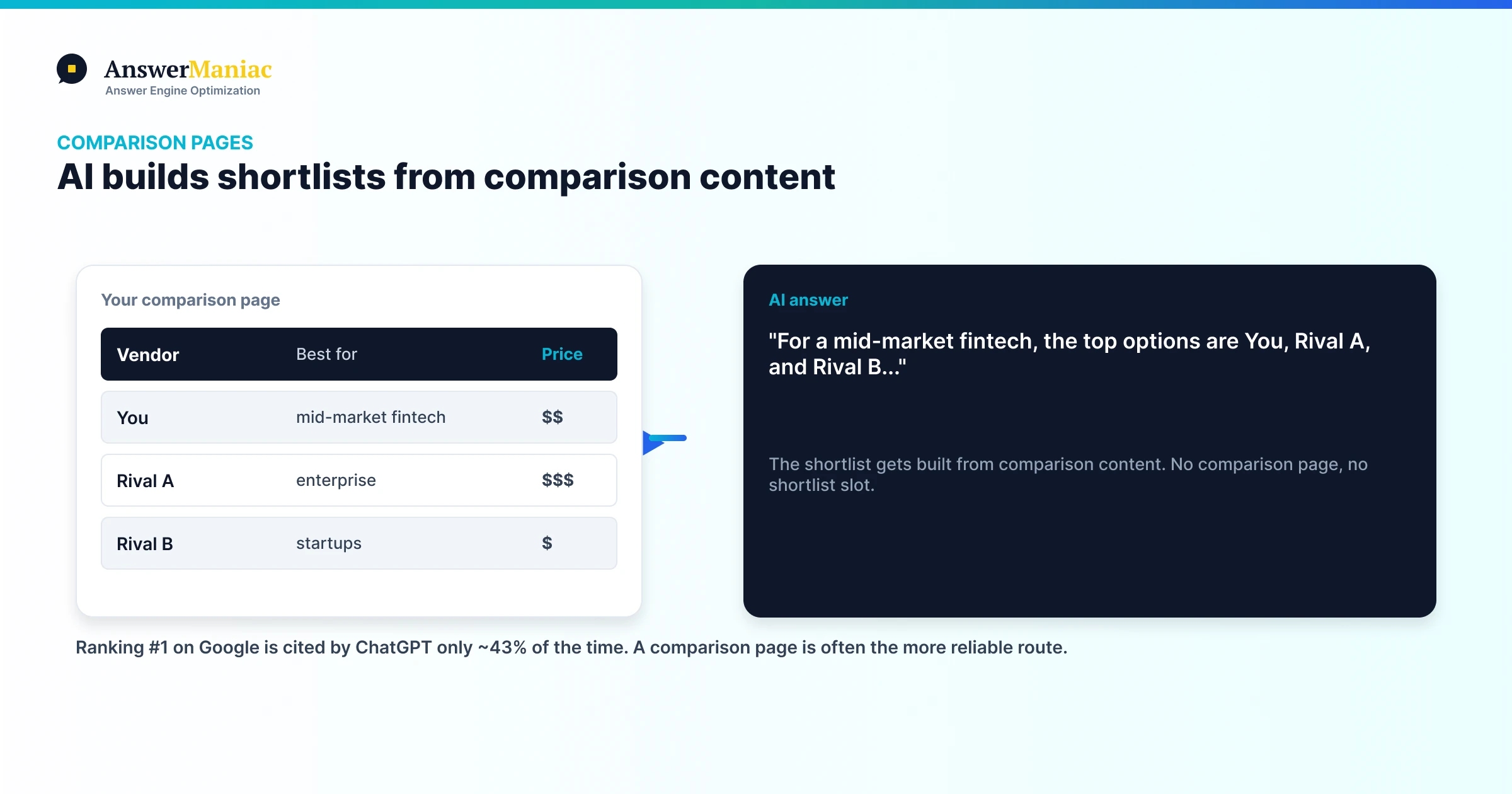
AI Overviews are triggered at especially high rates on comparison queries ("X vs Y," "best tools for Z," "alternatives to X"). Creating honest, thorough comparison pages that include your product alongside competitors gives Gemini a citable source for these high-intent queries.
The key is genuine objectivity. Pages that transparently acknowledge competitor strengths while clearly articulating your differentiators earn citations at far higher rates than pages that read as thinly disguised sales content.
Tactic 5: Publish Original Data and Research
Gemini prioritizes first-party data because it is unique, verifiable, and not available anywhere else on the web. Publishing original research -- customer surveys, industry benchmarks, usage statistics, trend analyses -- gives Gemini a reason to cite you that cannot be replicated by competitors summarizing the same secondary sources.
Even small-scale original data (a survey of 200 customers, an internal analysis of 1,000 support tickets) carries more citation weight than a beautifully written piece that synthesizes existing research.
Tactic 6: Maintain a Living Content Calendar
Gemini's freshness bias is measurable and consistent. Build a quarterly content refresh cycle for your highest-value pages. Update statistics, add new examples, revise outdated recommendations, and ensure the last-modified date in your Article Schema reflects the actual update date.
Pages that have not been updated in more than 12 months see a measurable decline in AI Overview citation rates, even when they retain strong organic rankings.
Schema Markup Google Gemini Prioritizes
Structured data is the technical bridge between your content and Gemini's retrieval system. While all valid schema types are parsed, five types have a direct and observable impact on Gemini citation rates. For a complete implementation guide with JSON-LD code for each type, see our schema markup for AI guide.
Organization Schema with sameAs
This is non-negotiable. Your Organization Schema must include sameAs links to your verified profiles across platforms Gemini cross-references.
{
  "@context": "https://schema.org",
  "@type": "Organization",
  "@id": "https://www.example.com/#organization",
  "name": "Your Company",
  "url": "https://www.example.com",
  "sameAs": [
    "https://www.linkedin.com/company/your-company",
    "https://twitter.com/yourcompany",
    "https://www.wikidata.org/wiki/Q12345678",
    "https://www.crunchbase.com/organization/your-company"
  ]
}
The sameAs property is what allows Gemini to resolve your brand as a Knowledge Graph entity. Without it, you are relying on inference alone.
FAQPage Schema
FAQPage Schema directly maps to the Q&A format that AI Overviews use to structure responses. Pages with FAQPage markup are cited at higher rates for question-format queries.
{
  "@context": "https://schema.org",
  "@type": "FAQPage",
  "mainEntity": [
    {
      "@type": "Question",
      "name": "How does Google Gemini select sources?",
      "acceptedAnswer": {
        "@type": "Answer",
        "text": "Gemini selects sources based on E-E-A-T signals, Knowledge Graph alignment, structured data quality, and content freshness."
      }
    }
  ]
}
Article Schema with author and dateModified
The dateModified property feeds directly into Gemini's freshness signal. The author property, when linked to a verifiable Person entity, strengthens the E-E-A-T signal chain.
{
  "@context": "https://schema.org",
  "@type": "Article",
  "headline": "Your Article Title",
  "datePublished": "2026-01-15",
  "dateModified": "2026-02-20",
  "author": {
    "@type": "Person",
    "name": "Author Name",
    "url": "https://www.example.com/team/author-name"
  }
}
SpeakableSpecification Schema
This schema type is under-used but increasingly relevant. SpeakableSpecification tells Google which sections of your page are most suitable for text-to-speech -- and by extension, for AI-generated voice answers via Gemini on mobile and Google Assistant. Marking your direct answer sections as speakable increases the likelihood that Gemini uses those specific passages.
{
  "@context": "https://schema.org",
  "@type": "WebPage",
  "speakable": {
    "@type": "SpeakableSpecification",
    "cssSelector": [".direct-answer", ".key-takeaway"]
  }
}
BreadcrumbList Schema
BreadcrumbList helps Gemini understand your site's topical hierarchy and the relationship between pages. Sites with clear breadcrumb structures are treated as more authoritative on topics where they have demonstrated depth through multiple related pages.
Measuring Your Gemini Visibility
Tracking your Gemini visibility requires a combination of Google's own tools and manual testing. There is no single dashboard that shows your AI citation performance, but the following methods give you a reliable measurement framework.
Google Search Console: AI Overview Performance
Google Search Console now reports impressions and clicks from AI Overviews as a separate segment. To access this data:
- Navigate to Search Console and select your property
- Go to Performance and click on Search Results
- Filter by "Search Appearance" and select "AI Overview"
- Analyze which queries trigger AI Overviews that include your pages and track the trend over time
This data tells you where you are already being cited and where you have opportunities to expand.
Manual Gemini App Testing
There is no automated tool that perfectly replicates Gemini's citation behavior, so manual testing remains essential. Build a list of 20 to 30 high-value queries that your buyers use, and test them in the Gemini app monthly. Record which brands are cited, which of your pages appear, and how the citation landscape changes over time.
Third-Party AI Monitoring Tools
Several platforms now offer automated AI visibility tracking across multiple engines, including Gemini. These tools can scale your monitoring beyond what manual testing allows and provide competitive benchmarking data that shows how your citation share compares to competitors.
For a complete audit methodology that covers all major AI engines including Gemini, see our AI visibility audit guide.
Key Metrics to Track
| Metric | What It Measures | Where to Find It |
|---|---|---|
| AI Overview Impressions | How often your pages appear in AI Overviews | Google Search Console |
| AI Overview CTR | Click-through rate from AI Overview citations | Google Search Console |
| Gemini App Citation Rate | Percentage of test queries where your brand is cited | Manual testing |
| Citation Position | Whether you are first-cited, listed, or absent | Manual testing |
| Competitor Citation Share | How often competitors are cited vs your brand | Manual and third-party tools |
Frequently Asked Questions
How is Google Gemini different from ChatGPT for brand visibility?
Gemini is deeply integrated with Google's existing search infrastructure, which means it draws on signals that no other AI engine has access to: your Search Console performance data, Knowledge Graph entity status, and Core Web Vitals. ChatGPT relies on Bing's index and its own crawler (GPTBot) for retrieval. In practice, this means that strong Google organic performance gives you a significant advantage in Gemini visibility that does not automatically transfer to ChatGPT, and vice versa. You need a strategy that addresses both ecosystems. Our AEO and GEO services cover optimization across all major AI engines.
Do Google Ads influence Gemini AI citations?
No. There is no evidence that running Google Ads directly influences whether your content is cited in AI Overviews or the Gemini app. Google has stated that AI Overview citations are based on organic signals, and practitioner testing supports this. However, the brand awareness and search volume that Google Ads campaigns generate can indirectly strengthen your Knowledge Graph presence and branded search signals, which do feed into Gemini's entity resolution system. The influence is indirect, not transactional.
How quickly can I improve my Gemini citation visibility?
Most companies see measurable changes within 60 to 90 days of implementing a structured optimization plan. The fastest wins come from technical optimizations -- implementing schema markup, fixing content structure, and ensuring your Organization Schema is properly configured. These changes can influence citation behavior within weeks as Google re-crawls and re-indexes your pages. Longer-term gains from building Knowledge Graph authority, earning third-party mentions, and publishing original research typically take three to six months to compound.
Should I block Gemini from crawling my content?
Almost never. Some publishers have chosen to block Google-Extended (the user agent associated with Gemini's training data collection) out of concern about content being used without attribution. However, blocking Google-Extended does not prevent your content from appearing in AI Overviews, which are powered by Google's standard search index. It only prevents your content from being used to train future Gemini models. For most businesses, being included in both the search index and the training data is the optimal strategy, because it maximizes the surface area where your brand can appear in AI-generated responses.
Ready to get your brand cited in Google's AI answers? See how AnswerManiac's optimization plans are structured to drive Gemini and AI Overview visibility. View pricing and plans.
Get AEO Insights Weekly
Join 500+ B2B marketers getting AI visibility tactics every Tuesday.
Ready to Get Your Brand Cited by AI?
See how your competitors show up in ChatGPT, Perplexity, and Gemini — and what it would take to get recommended.