How to Rank in Perplexity: Step-by-Step SEO Guide for AI Search
Learn how to rank in Perplexity with this step-by-step SEO guide for AI search, focused on structure, freshness, and authority.
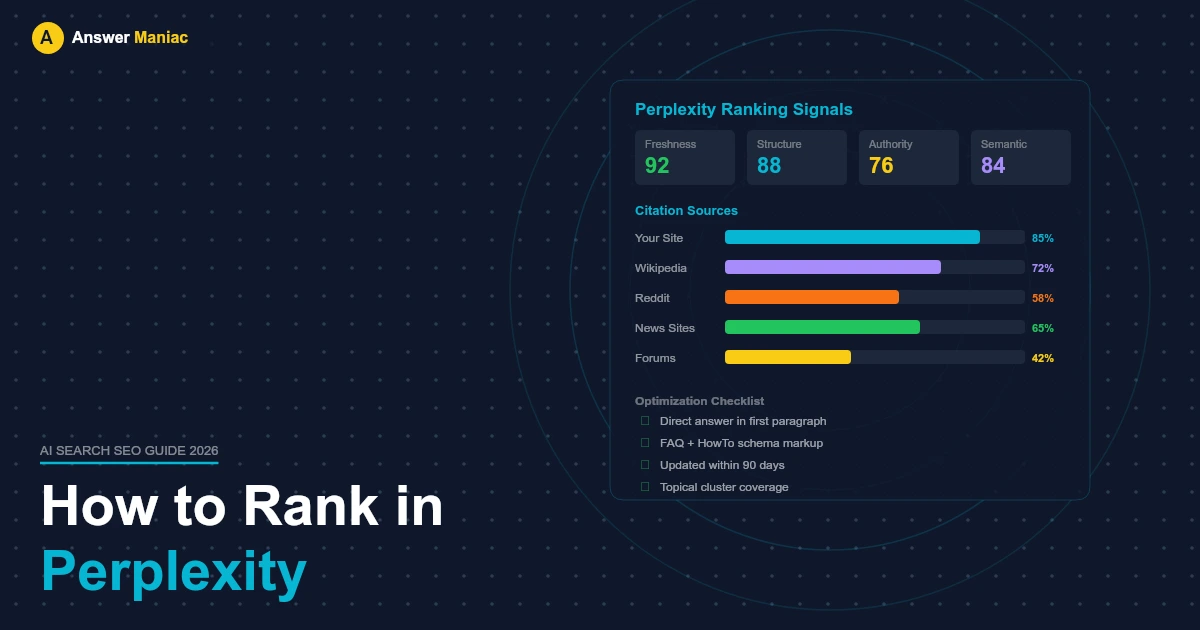
Direct Answer: Rank in Perplexity by putting direct answers first, using clear headings and structured data (FAQ, HowTo, Article schema), keeping content fresh with 30-90 day updates, and building topical authority across clusters. Perplexity prioritizes freshness, semantic relevance, factual accuracy, and machine-readable structure over traditional backlink signals.
Get a free AI visibility audit to see where you rank in Perplexity
Getting ranked in Perplexity means giving clear answers fast. The system scans the web for direct, factual responses it can cite right away. Our process is built around that. We write the answer first, then back it up with clean structure and fresh data, making it easy for AI to understand and trust. This guide walks through how we do it, step by step.
If you want your content cited, keep reading.
Key Takeaways
- We rank by putting the direct answer up front, then building out structured, factual sections.
- We get seen by mixing fresh updates, semantic keyword connections, and machine-friendly formatting.
- We stay cited by regularly updating pages and building topical authority across our site.
What ranking signals does Perplexity AI prioritize?
Perplexity AI works differently. It's trying to build a trustworthy answer on the fly, not find the page with the most backlinks. It prioritizes a few clear things.
Freshness is a big one — information updated in the last few months gets a close look. Semantic relevance matters more than matching exact keywords; it wants content that truly fits the question's meaning. Authority still counts, but it's measured by how often you're cited on a topic and how accurate your facts are.
Finally, structure is non-negotiable. Clear headings, simple tables, and direct explanations make it easy for the AI to pull a precise quote. It's a shift in thinking: from chasing page-one rankings to becoming a source the answer engine can't ignore. For a deeper look at how this differs from traditional optimization, see our AI visibility vs SEO breakdown.
How is Perplexity different from traditional search engines?
The core difference is the result. Google gives you ten blue links and hopes you find your answer. Perplexity reads those sources for you and gives you a summarized answer right at the top, with citations.
Your goal changes completely. In traditional SEO, you want the click. With Perplexity, you want the citation. You optimize to be quoted inside the generated answer, whether the user visits you or not.
Machine readability becomes the top priority. Can an AI easily scan your page, understand the key points, and pull a clean quote? That's what matters.
| Factor | Traditional Search Engines | Perplexity AI |
|---|---|---|
| Output | A list of links to click. | A written answer that cites sources. |
| Primary Goal | Get the user to visit your website. | Get your content quoted in the answer. |
| Ranking Focus | Backlinks and keyword authority. | Freshness, clarity, and factual structure. |
| Content Style | Longer, comprehensive pages. | Direct answers and scannable facts. |
We're constructing clear, factual assets designed to be used as building blocks for an AI's response. For more on this approach, see our complete Perplexity guide.
How do we research topics and keywords for AI answer engines?

Our research starts in the answer engines. We type real, conversational questions into Perplexity and ChatGPT. We collect these long-tail questions. Then we see who's already winning — we analyze the sources these AIs cite. Which websites show up over and over? That tells us who the AI already trusts.
From there, we map the landscape. We group related questions into clusters. For example, "how to start composting" leads to "what can you compost" and "how to fix a smelly compost bin." By covering an entire cluster, we show the AI we have deep knowledge.
Our process
- Gather Real Queries: Pull questions from AI chat logs and answer snippets.
- Identify Trusted Sources: Note the domains cited repeatedly for authority.
- Build Topic Clusters: Group questions by the core subject.
- Validate with Coverage: Check if our planned content matches what the AI cites.
This ensures we create what the answer engine is actually looking for. Our guide on content strategy for AI visibility covers this research process in detail.
How should technical SEO be configured for Perplexity visibility?
https://www.youtube.com/watch?v=9B3OqtH2wok Credits: Goldie SEO
Think of technical SEO as the foundation. If the AI can't find or read your page, nothing else matters. Perplexity pulls from search indexes, primarily Bing's. So our first job is making sure our site is fully accessible to those crawlers.
That means a clean robots.txt file, a submitted sitemap in Bing Webmaster Tools, and pages that load fast. We aim for under 2.5 seconds. A slow page might get crawled, but it can miss its chance when Perplexity is looking for the freshest, quickest answer.
We also focus on mobile-friendliness and stable rendering. The goal is zero friction for the bots that feed data into answer engines. It's not glamorous work, but it's essential.
According to Google's own guidance, a solid technical foundation is what allows content to be properly indexed and reused by AI systems. We check these boxes first, so our well-written content actually has a chance to be seen.
Which structured data schemas improve AI citation likelihood?
Structured data acts like a translator for AI. It tells the machine exactly what each part of our page means, removing the guesswork. This makes it much easier for a system like Perplexity to extract a clean, accurate quote. Structured data does not guarantee citations, but it increases eligibility.
- Use FAQ Schema for clear question and answer pairs.
- Apply the HowTo Schema for step-by-step processes.
- Implement Article Schema to define the main content and updates.
- Test all markup with the Google Rich Results Test.
Using these doesn't guarantee a citation, but it significantly increases the odds. It's like putting a clear label on a file in a cabinet; the AI can find the right information faster and with more confidence. For a deep dive into implementation and ROI, see our schema markup guide and schema markup ROI calculator.
How should content be structured for citation-worthy AI responses?

Forget writing for people. Write for the scanner. Tools like Perplexity don't read a page like you do — they break it into pieces and judge each piece alone. That means every single heading and paragraph has to be a complete, standalone answer.
As SEO Sherpa explains, Perplexity evaluates pages in modular chunks rather than linear flow:
"Perplexity processes content in chunks, not like a human reading top to bottom, so every heading, subheading, and paragraph must stand alone as a complete, answer-ready unit. Use headings that mirror common natural language queries, like 'What is...' or 'How does...', then follow up with a clear, factual response." - SEO Sherpa[1]
So we use the inverted pyramid. The direct answer comes first, then a short explanation. Headings act as clear labels. Tables and bullet lists isolate facts so the AI can lift them directly.
| Element | Purpose | AI Benefit |
|---|---|---|
| Direct Answer First | Immediate clarity | Faster extraction |
| Clear Headings | Defines intent | Higher relevance |
| Tables & Lists | Isolates key facts | Clean reuse in answers |
You're building a set of trustworthy, modular pieces that the system can use. For the full list of content formats that get cited most, see The AI Citation Playbook: 23 Content Types.
What role do freshness and content updates play in Perplexity rankings?
Freshness acts like a temporary spotlight. When you publish a new page or make significant updates, Perplexity often gives it a closer look. This creates an early visibility window to earn your first citations. If it performs well, that visibility can last. If not, its prominence fades. That's why we treat content as a living document, not a one-time publication.
Freshness supports authority — it doesn't replace it.
We aim to review and update key pages every 30 to 90 days. An update doesn't always mean a full rewrite. It can be refreshing a statistic, adding a new question, or changing the published date.
Update actions
- Review performance data monthly.
- Update statistics, dates, and references.
- Add new questions based on emerging queries.
- Republish with clear update signals.
Regular updates tell Perplexity the information is being maintained, supporting the page's authority. The speed at which your citations grow after updates is what we call citation velocity.
How do authority signals and brand mentions influence citations?
Authority in Perplexity is not about ranking position. It is about selection. The system does not reward pages for volume or storytelling; it rewards sources that consistently provide clear, verifiable answers.
This is why using a ChatGPT citation tracker mindset matters. When the same brand is repeatedly mentioned and quoted across AI answers, those signals compound into recognizable authority.
Power Digital Marketing frames this shift clearly:
"Success here is not about ranking position. It is about being selected and cited. Authority, structure, and factual clarity matter more than keyword volume alone... Long introductions, heavy storytelling, and marketing filler reduce citation potential." - Power Digital Marketing[2]
You build authority through consistency. When Perplexity sees the same brand giving accurate answers on a topic, it starts to trust it by default. Citations build on each other.
We create topical clusters — tight groups of pages answering related questions with the same facts. We back it up with mentions on other reputable sites. Understanding entity optimization and knowledge graphs is key to building this kind of compounding authority.
How can external platforms increase Perplexity Share of Voice?

Your presence on other trusted websites directly increases your chances of being cited. Perplexity often pulls from multiple sources to build a single answer.
When those mentions are consistent and intentional, simple AI citation monitoring makes it easier to see which platforms reinforce your visibility and which ones actually drive reuse inside AI-generated answers. If your insights are referenced on a well-regarded industry forum, a Q&A site, or a news outlet, that's another entry point.
Some formats — like a clear summary with a supporting chart — can see citation rates nearly 70% higher because they're so easy for the AI to extract and use.
Our strategy isn't about promotional comments. It's about factual contribution. We might provide a detailed, helpful answer on a relevant Reddit thread or a professional community like Stack Exchange. We ensure the information aligns perfectly with what's on our own site, using consistent brand references and terminology.
The aim is to become a visible part of the factual conversation happening across the web. This doesn't replace on-site content; it surrounds it with validation, giving Perplexity more reasons to see us as a credible source. For advanced tactics, see our guide on competitor displacement.
How do we measure and iterate AI visibility in Perplexity?
You can't improve what you don't measure. For Perplexity, we track a few key things manually, including how often our pages appear as cited sources. Having a consistent way to track AI citations helps us spot which answers are being reused and which ones need clarification.
Measurement checklist
- Track citation appearances manually.
- Monitor referral traffic sources.
- Review engagement metrics monthly.
- Update and expand underperforming sections.
This loop sustains long-term AI visibility.
We do this review on a monthly basis. The data tells a story. If a page gets traffic from Perplexity but has a high bounce rate, maybe the intro isn't clear enough. If a page isn't being cited at all, perhaps its structure is confusing, or it's not fresh.
Our iteration is straightforward: we clarify answers, update information, and expand sections that seem to be missing the mark. It's a continuous loop of checking, adjusting, and improving to make our content as useful and citable as possible over the long term.
FAQ
How do answer engines choose which pages appear in AI-generated responses?
Answer engines evaluate pages by looking at clarity, relevance, and usefulness. They analyze structured content to understand topic meaning and user intent. Ranking signals include content helpfulness, semantic alignment, and machine readability. Pages that give direct, complete answers to real questions are more likely to appear in AI-generated responses and earn consistent citations.
What makes content truly citation-worthy for AI search systems?
Content becomes citation-worthy when it is specific, accurate, and easy to confirm. Clear structure, logical flow, and strong topical coverage help answer engines assess trust. Pages that explain concepts plainly, support claims with context, and stay focused on one topic are more likely to be cited across AI-driven search results.
How does structured data improve visibility in AI-driven search results?
Structured data helps AI systems understand what each section of a page is about. Using clear markup such as FAQ Schema or Article Schema defines intent, context, and relationships. This improves retrieval accuracy, supports reliable citation patterns, and increases the likelihood that answer engines select the content for AI-generated responses.
Why are user intent and conversational questions critical for AI search ranking?
AI search favors content that matches how people naturally ask questions. Pages written around real user intent and conversational questions are easier for answer engines to interpret. When answers are written clearly and directly, AI systems can confidently reuse them in conversational responses and surface them across organic and AI-driven results.
How do content freshness and page experience influence AI visibility?
Answer engines prefer content that reflects current information and reliable updates. Content freshness signals accuracy, while good page speed and usability support trust. Pages that load quickly, stay updated, and remain easy to read help improve content selection, strengthen visibility, and drive steady referral traffic from AI-based search systems.
Step-by-Step Framework to Rank in Perplexity AI
To rank in Perplexity, you have to think as it does. It wants a clear answer first, then proof. We start by finding the exact questions people are asking AI, then we create content that answers them in plain language that the system can scan and trust.
Our framework at AnswerManiac follows The ANSWER Framework: Audit, Navigate, Structure, Write, Earn, Refine. Map how AI sees your brand now. Build content designed to be cited, not just clicked — clean structure, factual clarity. Then reinforce it with external signals that show you're reliable across the web.
It's not a shortcut. It's about building a dependable presence Perplexity recognizes as the good answer. Get started with a free AI Visibility Audit to see where you stand today.
References
Get AEO Insights Weekly
Join 500+ B2B marketers getting AI visibility tactics every Tuesday.
Ready to Get Your Brand Cited by AI?
See how your competitors show up in ChatGPT, Perplexity, and Gemini — and what it would take to get recommended.