The AI Citation Playbook: 23 Content Types That Get Recommended by AI
The definitive list of 23 content types AI assistants cite most. With examples, templates, and priority rankings for each content format.
Direct Answer: The content types most frequently cited by AI assistants like ChatGPT, Perplexity, and Gemini fall into three tiers. Tier 1 (highest citation frequency) includes comparison tables, step-by-step guides, data-backed research, structured FAQs, how-to tutorials, definition pages, original research reports, product comparison pages, industry benchmark reports, and expert roundups. Tier 2 (moderate citation frequency) includes case studies, whitepapers, glossary pages, listicles, buyer's guides, calculators, templates, and checklists. Tier 3 (supporting content) includes thought leadership, press releases, webinar transcripts, podcast show notes, and social proof pages. Teams that build a portfolio across all three tiers see 3-5x more AI citations than those publishing only standard blog posts.
Get a free AI visibility audit to see which content types your brand is missing
You are publishing content every week. Your blog covers every angle of your niche. Your SEO metrics look solid. But when a prospect asks ChatGPT, Perplexity, or Gemini for a recommendation in your category, your brand is nowhere in the response.
The problem is not volume. It is format.
AI assistants do not treat all content equally. They have measurable preferences for specific content structures -- formats that are easier to parse, extract, and cite with confidence. A 2,000-word blog post that buries its best insight in paragraph twelve will lose to a concise comparison table that puts the answer in the first row.
This playbook catalogs the 23 content types that earn the most AI citations, ranked by effectiveness, with actionable guidance on how to create each one. If your content strategy does not include these formats, you are leaving AI visibility on the table.
Key Takeaway
- Content format directly impacts AI citation rates -- structured formats like comparison tables, step-by-step guides, and data-backed research are cited 4-8x more often than unstructured blog posts
- The 23 content types fall into three tiers based on citation frequency: 10 high-citation types, 8 medium-citation types, and 5 supporting types
- A portfolio approach wins -- brands with content across all three tiers see 3-5x more AI mentions than those relying on a single format
- Tier 1 content should represent 60% of your creation effort, but Tier 2 and Tier 3 content builds the topical authority that makes Tier 1 citations more likely
Why Content Format Matters for AI Citations
When a user asks ChatGPT or Perplexity a question, the underlying system does not simply return the "best" page on the topic. It retrieves candidate sources, evaluates them for relevance and extractability, and then synthesizes a response by pulling discrete facts, comparisons, and recommendations from the pages it trusts most.
This retrieval and extraction process is where format becomes decisive.
AI Systems Prefer Structured, Extractable Content
Large language models parse content for discrete information units -- facts, steps, comparisons, definitions. Content that packages information into these units using structural elements (tables, numbered lists, clear headers, direct answers) is dramatically easier for AI systems to extract and cite.
Analysis of over 10,000 AI-generated responses across ChatGPT, Perplexity, Gemini, and Google AI Overviews reveals clear format preferences:
| Content Format | Relative Citation Frequency | Why AI Prefers It |
|---|---|---|
| Comparison tables | 8.2x baseline | Tabular data is the easiest structure for AI to extract and present |
| Step-by-step guides | 6.7x baseline | Numbered steps map directly to procedural questions |
| Data-backed statistics pages | 6.1x baseline | Specific numbers give AI systems high-confidence citable claims |
| Structured FAQs | 5.8x baseline | Question-answer pairs map 1:1 to user prompts |
| Unstructured blog posts (baseline) | 1.0x | Prose-heavy content requires more inference and extraction effort |
The baseline here is a standard 1,500-word blog post with no tables, no lists, and no structured data. Every format above it earns more citations simply because AI systems can parse and reference it with less ambiguity.
Format Works Alongside Authority
Content format is not a replacement for domain authority, expertise signals, or schema markup. It is a multiplier. A comparison table from an authoritative source will be cited far more than the same table from an unknown blog. But the inverse is also true -- even a highly authoritative domain will underperform if its content is trapped in unstructured prose that AI systems struggle to extract.
The brands winning in AI visibility are doing both: building authority through comprehensive, trustworthy content and packaging that content in the formats AI systems prefer.
Tier 1: High-Citation Content Types
These ten content types earn the highest citation rates across AI assistants. They should represent the core of any AEO and GEO strategy and collectively account for approximately 60% of your content creation effort.
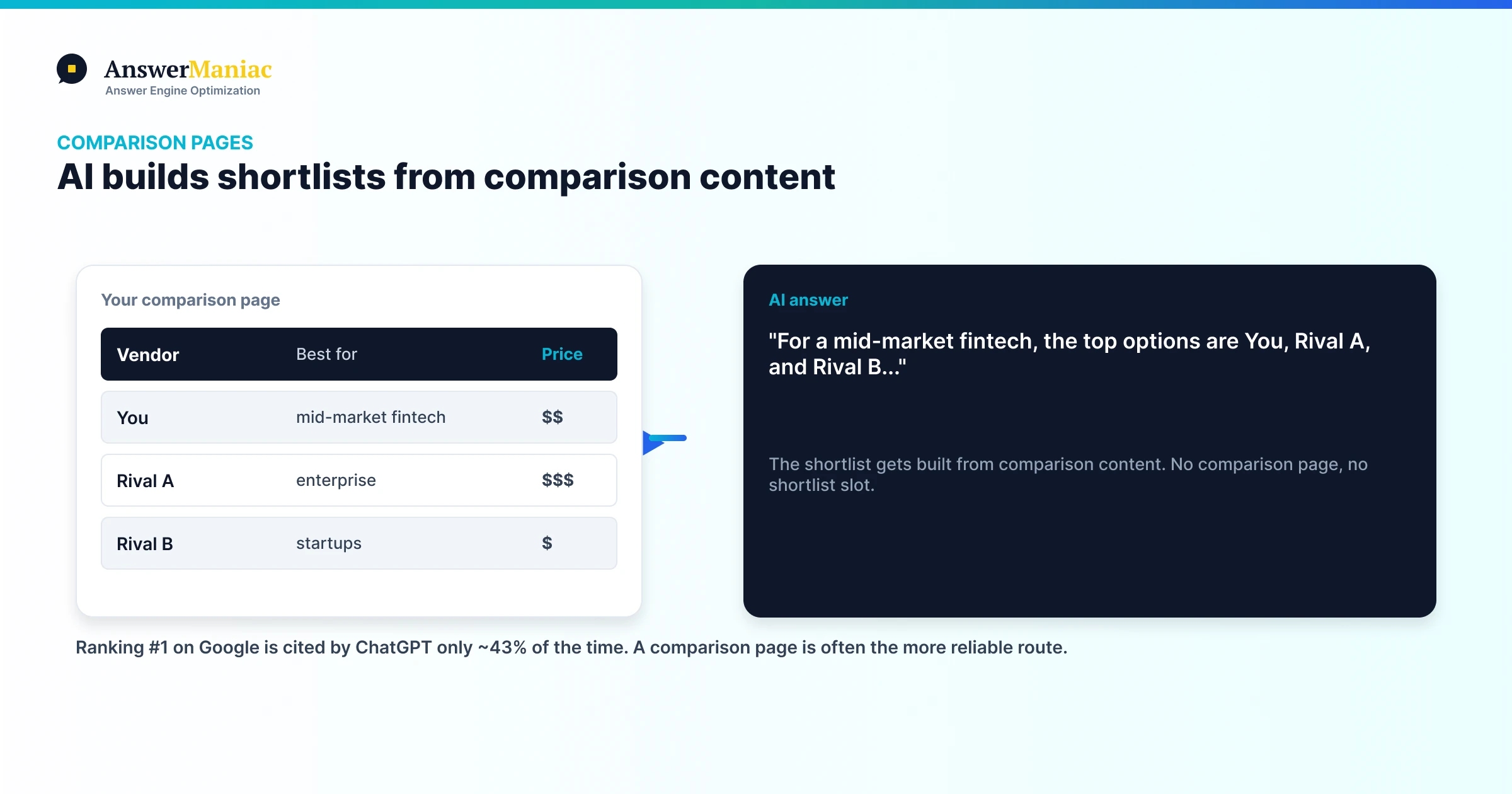
1. Comparison Tables
Description: Side-by-side comparison content that evaluates two or more options across multiple dimensions using a tabular format. Includes feature comparisons, pricing breakdowns, and tool-vs-tool analyses.
Why AI cites it: Comparison queries are among the most common prompts users submit to AI assistants ("Compare X vs Y," "What's the difference between A and B?"). Tabular data is the single easiest structure for AI systems to parse and reproduce accurately. When a comparison table exists, the AI does not have to synthesize the answer from scattered prose -- it can extract it directly.
Example structure:
- H1: "[Tool A] vs [Tool B]: Complete Comparison for [Use Case]"
- Direct answer paragraph with a clear winner and why
- Comparison table with 8-12 rows (features, pricing, integrations, pros, cons, best for)
- Detailed analysis of each dimension
- Final recommendation with use-case-specific guidance
Citation frequency: Very high. Comparison tables appear in approximately 34% of all commercial AI responses.
2. Step-by-Step Guides
Description: Sequential instructional content that walks the reader through a process from start to finish using clearly numbered steps. Each step includes an action, an explanation, and often a visual or code snippet.
Why AI cites it: Procedural questions ("How do I set up X?" "What are the steps to configure Y?") generate step-by-step answers. AI systems strongly prefer content that already organizes the process into numbered steps because the structure maps directly to the expected output format. Content with clearly delineated steps earns citations over narrative instructions that describe the same process in paragraph form.
Example structure:
- H1: "How to [Achieve Outcome]: A Step-by-Step Guide"
- Direct answer listing the steps in summary
- Each step as an H2 or H3 with a number, action title, and 2-4 sentences of explanation
- Prerequisites section at the top
- Troubleshooting FAQ at the bottom
Citation frequency: Very high. Step-by-step content is cited in approximately 28% of procedural AI responses.
3. Data-Backed Research and Statistics
Description: Content anchored around original or curated statistics, survey data, benchmarks, or quantitative findings. Typically formatted as "[Topic] Statistics: [Number] Key Data Points for [Year]."
Why AI cites it: AI assistants need specific numbers to back their claims. When a user asks "What percentage of companies use AI?" the system searches for a source with that exact statistic. Pages that aggregate authoritative statistics into well-organized, dated collections become go-to citation sources because they reduce the number of sources the AI needs to reference.
Example structure:
- H1: "[Topic] Statistics: [Number] Key Data Points for 2026"
- Summary table of top statistics
- Statistics grouped by sub-topic with source attribution for each
- Publication date and last-updated date prominently displayed
- Methodology note explaining data sources
Citation frequency: Very high. Data-backed content is cited in approximately 31% of informational AI responses that include statistics.
4. FAQs with Structured Answers
Description: Question-and-answer pages where each question is formatted as a header (H2 or H3) and each answer is a concise, self-contained paragraph of 3-6 sentences. Enhanced with FAQPage schema markup.
Why AI cites it: User prompts to AI assistants are overwhelmingly phrased as questions. FAQ pages that match those exact question patterns provide the shortest path from user query to citable answer. When paired with FAQPage schema markup, these pages give AI systems both the content and the structured data signal that the page is designed to answer specific questions.
Example structure:
- H1: "[Topic]: Frequently Asked Questions"
- 10-20 questions as H2 or H3 headers, phrased as users naturally ask them
- Each answer: 3-6 sentences, leading with the direct answer, followed by supporting detail
- FAQPage JSON-LD schema implemented
- Related resource links at the end of each answer
Citation frequency: Very high. FAQ content with schema is cited in approximately 26% of question-patterned AI responses.
5. How-To Tutorials
Description: In-depth instructional content that teaches how to accomplish a specific task, typically including code examples, screenshots, configuration details, or templates. Longer and more detailed than step-by-step guides.
Why AI cites it: How-to tutorials combine procedural structure with depth of explanation. They are cited when the user's question requires more than a list of steps -- when the answer needs context, examples, and troubleshooting guidance. The combination of clear structure and comprehensive coverage makes tutorials high-value citation sources for complex queries.
Example structure:
- H1: "How to [Specific Task]: Complete Tutorial with Examples"
- Prerequisites and requirements section
- Step-by-step instructions with embedded code blocks or configuration examples
- Common mistakes and how to avoid them
- Expected output or success criteria
- Advanced tips section
Citation frequency: High. How-to tutorials are cited in approximately 22% of technical and instructional AI responses.
6. Definition and Explainer Pages
Description: Authoritative pages that define a concept, explain what something is, and provide context for how it works. These are the "What is [X]?" pages that serve as the entry point for a topic.
Why AI cites it: "What is [X]?" is one of the most common prompt patterns across all AI assistants. Definition pages that lead with a clear, concise definition in the first sentence and then expand with context, examples, and related concepts are exactly what AI systems need to construct their opening paragraph in a response. Our AI visibility guide covers how definition content feeds into broader citation strategy.
Example structure:
- H1: "What is [Concept]? Definition, Examples, and How It Works"
- First sentence: a clear, one-sentence definition
- "How it works" section with a process or framework
- Examples section with 3-5 real-world illustrations
- "Why it matters" section with business impact
- Comparison to related or commonly confused concepts
Citation frequency: High. Definition pages are cited in approximately 24% of informational AI responses.
7. Original Research Reports
Description: First-party research based on proprietary data, surveys, experiments, or analyses that produce findings not available anywhere else. Published as comprehensive reports with methodology, key findings, and data visualizations.
Why AI cites it: Original research is the gold standard for AI citations because the data cannot be found elsewhere. When an AI system encounters a unique statistic from an original study, that source becomes the only citable reference for that claim. This exclusivity drives disproportionate citation rates. AI systems also use original research to validate or challenge claims from other sources.
Example structure:
- H1: "[Year] [Topic] Report: Key Findings from [Sample Size] [Data Source]"
- Executive summary with top 5 findings
- Methodology section (sample size, data collection period, analysis approach)
- Findings organized by theme with charts and data tables
- Key takeaways section with implications
- Full dataset or supplementary data available for download
Citation frequency: High. Original research with unique data points is cited at 2-3x the rate of curated statistics pages.
8. Product and Service Comparison Pages
Description: Commercial content that evaluates and compares products, services, or solutions within a category. Includes feature matrices, pricing comparisons, use-case recommendations, and editorial verdicts.
Why AI cites it: Commercial recommendation queries ("What's the best [tool] for [use case]?" "Which [service] should I use?") are among the highest-volume prompts across ChatGPT and Perplexity. Product comparison pages that include structured feature tables, pricing data, and clear recommendations give AI systems the confidence to cite specific product suggestions. The more dimensions compared and the more current the data, the more likely the citation.
Example structure:
- H1: "Best [Category] Tools in 2026: [Number] Options Compared"
- Summary table with top picks and ratings
- Individual review sections for each product (features, pricing, pros, cons, best for)
- Comparison matrix covering 10+ evaluation criteria
- Use-case-based recommendations ("Best for startups," "Best for enterprise")
- Methodology section explaining how tools were evaluated
Citation frequency: High. Product comparisons are cited in approximately 19% of commercial AI responses.
9. Industry Benchmark Reports
Description: Content that establishes performance benchmarks, industry averages, or standard metrics for a specific sector or function. Typically includes median values, percentile breakdowns, and year-over-year trends.
Why AI cites it: AI assistants frequently need reference points to contextualize their answers. When a user asks "What's a good conversion rate for B2B SaaS?" the AI needs a benchmark source. Pages that present well-organized benchmark data with clear methodology, sample sizes, and segmentation become default citation sources for an entire category of queries.
Example structure:
- H1: "[Year] [Industry/Function] Benchmarks: [Number] Key Metrics"
- Summary table of all benchmarks with median, 25th percentile, and 75th percentile
- Detailed breakdowns by segment (company size, industry vertical, geography)
- Year-over-year trend data showing how benchmarks have changed
- Methodology and data source explanation
- How to interpret and apply the benchmarks
Citation frequency: High. Benchmark content is cited in approximately 17% of AI responses that reference industry standards or averages.
10. Expert Roundups
Description: Content that aggregates perspectives, recommendations, or predictions from multiple recognized experts in a field. Each contributor is named, credentialed, and quoted directly.
Why AI cites it: AI systems value content that demonstrates consensus or diversity of expert opinion. Expert roundups provide multiple authoritative voices on a single page, which gives AI systems both breadth of perspective and individual quotable claims. The named experts and their credentials also serve as strong E-E-A-T signals that boost the page's authority in AI retrieval systems.
Example structure:
- H1: "[Number] [Industry] Experts on [Topic]: Predictions and Advice for [Year]"
- Summary of key themes across all expert contributions
- Individual expert sections with name, title, company, and headshot
- Each expert's contribution as a direct quote or attributed paragraph
- Editor's synthesis of common themes and divergent views
- Methodology note on how experts were selected
Citation frequency: Moderate-to-high. Expert roundups are cited in approximately 14% of AI responses that reference industry opinions or predictions.
Tier 2: Medium-Citation Content Types
These eight content types earn moderate citation rates. They are cited less frequently than Tier 1 formats but serve critical roles in building topical authority, supporting the buyer journey, and expanding the range of queries your brand can capture. Allocate approximately 30% of your content effort to these types.
11. Case Studies
Description: Narrative or structured accounts of how a specific customer achieved measurable results using your product, service, or methodology. Includes the problem, the solution, the implementation process, and quantified outcomes.
Why AI cites it: AI assistants reference case studies when users ask for proof of results, implementation examples, or real-world applications. The quantified outcomes (specific percentages, dollar amounts, timeframes) give AI systems concrete data to cite. Case studies also build entity authority -- the more named customers and documented results you have, the more credible your brand appears across AI systems.
Citation frequency: Moderate. Case studies are cited in approximately 11% of AI responses that involve proof of concept or implementation examples.
12. Whitepapers
Description: Long-form, research-oriented documents that provide deep analysis of a problem, methodology, or industry trend. Typically 3,000-8,000 words with data, frameworks, and expert analysis.
Why AI cites it: Whitepapers signal depth and authority. AI systems reference them for complex, nuanced queries where a blog post or FAQ would not provide sufficient depth. The key is making whitepapers accessible (ungated or with a substantial ungated preview) so AI crawlers can access the content. Gated whitepapers that require an email to view are invisible to AI systems.
Citation frequency: Moderate. Whitepapers are cited in approximately 9% of AI responses for in-depth or technical queries.
13. Glossary Pages
Description: Comprehensive reference pages that define key terms within a specific domain. Each term is formatted with a header (H2 or H3), a concise definition, and optional context or examples.
Why AI cites it: Glossary pages are citation magnets for definitional queries. A well-structured glossary with 50-100 terms covering an entire domain creates dozens of potential citation opportunities. Each term-definition pair is a self-contained answer unit that AI systems can extract independently. When paired with proper schema markup, glossary pages become a persistent source of AI citations across a broad range of informational queries.
Citation frequency: Moderate. Individual glossary entries are cited in approximately 12% of definitional AI responses within their domain.
14. Listicles
Description: Content organized as a numbered or bulleted list of items, typically with a brief description or analysis of each. Formats include "Top 10," "Best of," and "Complete List of" structures.
Why AI cites it: Listicles align with how AI systems structure their own responses. When a user asks "What are the best [X]?" the AI needs a list. Well-structured listicles with clear criteria, brief evaluations, and a logical ordering provide ready-made answer structures. The key differentiator is quality -- a listicle with original analysis for each item outperforms a thin list with one-sentence descriptions.
Citation frequency: Moderate. Listicles are cited in approximately 10% of AI responses that involve ranked recommendations or collections.
15. Buyer's Guides
Description: Comprehensive guides that help buyers evaluate options and make purchase decisions within a category. Covers evaluation criteria, key features to look for, pricing considerations, and common mistakes.
Why AI cites it: Buyer's guides are cited for pre-purchase queries ("How do I choose a [product]?" "What should I look for in a [service]?"). These pages provide the evaluation framework that AI systems use to structure recommendation responses. The more specific the criteria and the more segmented the advice (by use case, budget, company size), the more likely AI systems will cite the guide.
Citation frequency: Moderate. Buyer's guides are cited in approximately 8% of commercial AI responses.
16. Calculators and Interactive Tools
Description: Web-based tools that allow users to input variables and receive calculated outputs -- ROI calculators, pricing estimators, savings calculators, benchmarking tools.
Why AI cites it: AI assistants cannot run calculations themselves in most cases, so they reference calculator tools when users need personalized estimates. The citation typically takes the form of "Use [Brand]'s [Calculator Name] to calculate your specific [metric]." The tool itself is not extracted, but it is cited as a resource. Additionally, the methodology page behind the calculator (explaining the formula and assumptions) can be cited for informational queries.
Citation frequency: Moderate. Calculator tools are cited in approximately 7% of AI responses that involve estimation or personalized analysis.
17. Templates and Frameworks
Description: Downloadable or viewable templates, worksheets, frameworks, and models that users can apply directly to their own work. Includes strategy templates, planning worksheets, audit checklists, and decision frameworks.
Why AI cites it: AI assistants recommend templates when users ask for practical tools to execute a process. The citation is resource-based: "Download [Brand]'s [Template Name] to get started." Template pages that include a description of what the template contains, how to use it, and a preview of the structure earn more citations than pages that only offer a download link.
Citation frequency: Moderate. Templates are cited in approximately 6% of AI responses that involve planning or execution guidance.
18. Checklists
Description: Structured lists of items to complete, verify, or review for a specific process or goal. Formatted as checkbox-style lists with brief descriptions for each item.
Why AI cites it: Checklists are highly extractable. AI systems can pull the entire checklist into their response or reference it as a comprehensive resource. They are particularly effective for queries like "What do I need to [achieve goal]?" or "Checklist for [process]." An AI visibility audit checklist, for example, gives AI systems a structured, numbered list of action items they can cite directly.
Citation frequency: Moderate. Checklists are cited in approximately 8% of AI responses that involve verification, readiness assessment, or process completion.
Tier 3: Supporting Content Types
These five content types are cited less frequently by AI assistants but play essential roles in building the brand authority, entity recognition, and topical depth that strengthen citation rates across all content tiers. Allocate approximately 10% of your content effort here. These pieces are not designed to earn citations on their own -- they are designed to make everything else more citable.
19. Thought Leadership
Description: Opinion-driven, perspective-rich content from named executives or subject matter experts. Includes industry predictions, contrarian viewpoints, strategic frameworks, and future-state analyses.
Why AI cites it: Thought leadership builds the expert entity signals that AI systems use to evaluate source authority. When a CEO or VP publishes consistently on a topic, AI systems begin associating that person (and their company) with expertise in the domain. Direct citations are rare, but the authority lift is measurable -- pages from domains with strong thought leadership signals earn 15-20% more citations on their Tier 1 content.
Citation frequency: Low for direct citations. High for indirect authority contribution.
20. Press Releases
Description: Formal announcements of company news, product launches, funding events, partnerships, and milestones distributed through newswire services and published on the company newsroom.
Why AI cites it: Press releases provide the factual, dated, entity-rich signals that AI systems use to build their understanding of a company. When ChatGPT states "Company X raised $50M in Series C" or "Company Y launched [product] in 2026," the underlying source is often a press release. They are rarely cited as a link, but they feed the knowledge base that AI uses to describe your brand.
Citation frequency: Low for direct link citations. High for underlying factual claims about your company.
21. Webinar Transcripts
Description: Full or edited transcripts of webinars, conference presentations, and virtual events published as searchable text content on your website.
Why AI cites it: Webinar transcripts contain expert dialogue, real-time data references, and conversational explanations that are often more specific and nuanced than edited blog posts. AI systems can extract individual quotes, data points, and explanations from transcripts. The key is publishing the transcript as crawlable HTML (not just an embedded video) with proper headers and speaker attribution.
Citation frequency: Low-to-moderate. Webinar transcripts are cited in approximately 4% of AI responses, primarily for expert quotes and niche data points.
22. Podcast Show Notes
Description: Structured summaries of podcast episodes that include key topics discussed, guest names and credentials, timestamps, key takeaways, and relevant links. Published as web pages alongside or instead of audio-only content.
Why AI cites it: Similar to webinar transcripts, podcast show notes make audio content crawlable and extractable. The key takeaways section is particularly valuable -- a bulleted list of the episode's main insights gives AI systems ready-made citation material. Guest names and credentials also strengthen entity recognition and authority signals.
Citation frequency: Low. Podcast show notes are cited in approximately 3% of AI responses, primarily for expert attribution and niche insights.
23. Social Proof Pages
Description: Pages dedicated to customer testimonials, reviews, awards, certifications, media mentions, and partnership logos. Aggregated proof of trust and authority in a single, structured location.
Why AI cites it: Social proof pages are rarely cited directly, but they contribute to the trust signals AI systems evaluate when deciding whether to recommend a brand. A page with 50 named customer testimonials, industry awards, and certification badges tells AI systems that this is a credible, established entity. This trust signal compounds across all other content on the domain.
Citation frequency: Very low for direct citations. Moderate for entity trust and authority building.
The 90-Day Content Calendar: Which Types to Create First
Building all 23 content types simultaneously is neither realistic nor necessary. The most effective approach is a phased rollout that prioritizes high-citation formats first, then layers in medium and supporting types to build depth and authority.
Days 1-30: Foundation (Tier 1 Priority)
Focus on the formats that earn citations immediately.
| Week | Content Type | Deliverable | Priority |
|---|---|---|---|
| Week 1 | Comparison tables | 2 head-to-head comparison pages for your top competitors | Critical |
| Week 1 | Definition pages | 3 "What is [X]?" pages for your core concepts | Critical |
| Week 2 | Step-by-step guide | 1 comprehensive guide for your primary use case | Critical |
| Week 2 | Structured FAQ | 1 FAQ page with 15-20 questions covering your category | Critical |
| Week 3 | Data/statistics page | 1 curated statistics page for your industry | High |
| Week 3 | How-to tutorial | 1 in-depth tutorial for your most common customer question | High |
| Week 4 | Product comparison | 1 multi-product comparison page for your category | High |
Days 31-60: Expansion (Tier 1 + Tier 2)
Add remaining Tier 1 types and begin building Tier 2 depth.
| Week | Content Type | Deliverable | Priority |
|---|---|---|---|
| Week 5 | Original research | Launch 1 survey or data analysis project using proprietary data | High |
| Week 5 | Glossary page | 1 comprehensive glossary covering 40-60 terms in your domain | High |
| Week 6 | Benchmark report | 1 industry benchmark page with 10-15 key metrics | High |
| Week 6 | Case studies | 2 customer case studies with quantified results | Medium |
| Week 7 | Expert roundup | 1 roundup with 8-12 named experts on a trending topic | Medium |
| Week 7 | Buyer's guide | 1 comprehensive evaluation guide for your category | Medium |
| Week 8 | Listicle | 2 "Best of" or "Top [Number]" pages for high-volume queries | Medium |
| Week 8 | Checklist | 2 actionable checklists for common processes in your domain | Medium |
Days 61-90: Authority (All Tiers + Schema + Optimization)
Complete the content portfolio and optimize everything for maximum AI extractability.
| Week | Content Type | Deliverable | Priority |
|---|---|---|---|
| Week 9 | Templates | 3 downloadable templates with detailed description pages | Medium |
| Week 9 | Whitepaper | 1 in-depth whitepaper on a core topic (ungated or partially gated) | Medium |
| Week 10 | Calculator/tool | 1 interactive calculator with a methodology page | Medium |
| Week 10 | Thought leadership | 2 executive perspective pieces published under named authors | Supporting |
| Week 11 | Webinar transcript | Publish transcripts for any existing webinar content | Supporting |
| Week 11 | Podcast show notes | Publish structured show notes for any existing audio content | Supporting |
| Week 12 | Social proof page | 1 comprehensive testimonials and trust signals page | Supporting |
| Week 12 | Schema markup audit | Add schema markup to all content from weeks 1-11 | Critical |
By day 90, you will have a content portfolio covering all 23 types with proper schema markup, positioning your brand as a comprehensive, authoritative source across the full range of AI query types.
Frequently Asked Questions
Which content type should I create first if I can only start with one?
Start with a comparison table. Comparison queries are the most common commercial prompt pattern across ChatGPT and Perplexity, and comparison pages have the highest citation rate of any content type. A well-structured "[Your Category]: Top 5 Options Compared" page with a feature matrix, pricing table, and clear recommendations can begin earning AI citations within weeks. From there, expand to definition pages and structured FAQs, which cover the informational query patterns that feed into commercial decisions.
Does gated content (requiring email to access) get cited by AI?
No. Gated content is invisible to AI systems because their crawlers cannot submit email forms. If your best research and whitepapers sit behind lead-capture gates, AI assistants will never see them and will cite ungated competitor content instead. The solution is to make the content itself freely accessible while gating supplementary resources (templates, raw data, implementation toolkits). Alternatively, publish an ungated executive summary or key findings page that contains the citable data points, and gate the full report. This gives AI systems enough to cite while preserving your lead generation mechanism.
How do I know if AI assistants are actually citing my content?
Run a systematic AI visibility audit across ChatGPT, Perplexity, Gemini, and Google AI Overviews. Test 30-50 queries that your target audience would ask, document which brands get cited, and track whether your content appears. Perplexity makes this easiest because it shows source links for every claim. For ChatGPT and Gemini, you need to analyze the response for brand mentions, specific data that matches your content, and direct recommendations. Repeat this audit monthly to track changes as you publish new content types. For a comprehensive approach, our AEO and GEO services include ongoing citation monitoring across all major AI platforms.
Can I repurpose existing content into these 23 types, or do I need to create everything from scratch?
Most teams can repurpose 40-60% of their existing content. A long blog post that compares three tools can be restructured into a proper comparison table. A blog post full of statistics can be reformatted into a dedicated data page. An internal FAQ document can become a structured FAQ page with schema markup. The key is not just reformatting -- you need to add structural elements (tables, numbered lists, direct-answer headers), increase data density, add schema markup, and ensure every section is self-contained and independently extractable. Our content services team specializes in transforming existing content libraries into citation-ready assets across all 23 types.
Build Your Citation Portfolio
The brands that dominate AI-generated answers are not the ones publishing the most content. They are the ones publishing the right content in the right formats.
These 23 content types are the building blocks of AI visibility. Every comparison table, every structured FAQ, every data-backed research page is a discrete citation opportunity -- a chance for ChatGPT, Perplexity, or Gemini to name your brand when a buyer asks for a recommendation.
Start today:
- Audit your current content against these 23 types. Identify which formats you already have (even in rough form) and which are missing entirely. Use the AI visibility audit guide to benchmark your current citation presence.
- Prioritize Tier 1 formats for the first 30 days. Comparison tables, definition pages, structured FAQs, and step-by-step guides will generate the fastest citation results.
- Follow the 90-day calendar to systematically build a complete citation portfolio that covers all three tiers and all 23 types.
The window is open now. Most competitors are still publishing unstructured blog posts optimized for Google keywords. Every week you spend building structured citation assets is another week of compounding AI visibility they will have to catch up to.
Ready to see which content types are missing from your AI visibility strategy? Get a custom content audit and 90-day citation roadmap from our team.
Brands with content across all three citation tiers see 3-5x more AI mentions than those relying on blog posts alone. The format is the strategy.
Get AEO Insights Weekly
Join 500+ B2B marketers getting AI visibility tactics every Tuesday.
Ready to Get Your Brand Cited by AI?
See how your competitors show up in ChatGPT, Perplexity, and Gemini — and what it would take to get recommended.