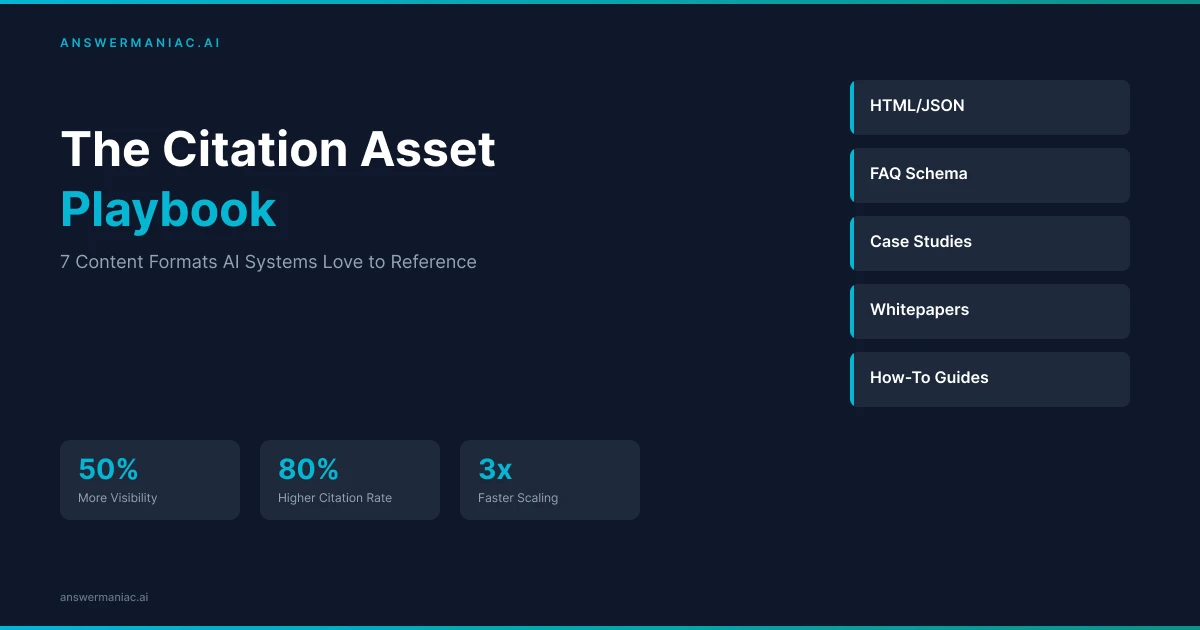
The Citation Asset Playbook: 7 Content Formats That AI Systems Love to Reference
Learn citation asset content formats that boost AI visibility, improve structure, and help your content get referenced more often.
Quick Answer
A citation asset is any piece of content structured so AI systems can extract, verify, and reference it in generated answers. The most effective formats share three traits: they answer one specific question per section, they include verifiable data with named sources, and they use clear headings that match how people actually search. Comparison tables, FAQ sections with schema markup, original research with methodology, step-by-step guides, glossary definitions, case studies with measurable outcomes, and data visualizations with source attribution consistently outperform unstructured long-form content in AI citation rates. Building these assets works best as part of an AI-first content strategy where each section is designed to stand alone, supported by knowledge graph signals that help AI confirm your brand's authority on the topic.
Citation asset formats decide how digital content is set up so AI can read it and cite it. If the structure is clear and the metadata is complete, the content is easier to find and reuse. Many platforms, like Salesforce B2C Commerce, handle over 100 file types, which makes things harder to keep consistent.
When files are messy or missing key details, they often get ignored. Simple, clean formatting gives content a better shot at being picked up. If you want your work to be cited, pay attention to how it is built. Keep reading to see what matters.
What Actually Drives Citation Visibility
Here are the key ideas to focus on:
- Structured formats with full metadata can raise citation visibility by up to 50%
- Educational, high-intent content sees about 80% higher citation rates
- Standard citation formats reduce errors and make scaling easier
What Are Citation Asset Content Formats?
Citation asset content formats are the way content is organized so systems can find and use it. If the setup is unclear, files may be ignored or hard to reference.
Platforms often handle many file types, sometimes more than 100. Some, like HTML or database entries, are easy for systems to read. Others, like PDFs, images, or videos, usually need extra details to make sense.
Metadata adds that context. It tells the system the Source Title, publication date, author, and usage rights. Without it, content can easily be overlooked. As highlighted by Box Blog:
"That demands an AI-first content strategy, one that transforms unstructured data into insight, automates workflows at scale, and enables the real-time transparency and speed that Gen Z expects from financial services."
Key elements for citation-ready content:
- Content structure: HTML, JSON, text blocks
- Metadata: author, date, licensing
- File types: PDF, MP4, PNG
- Identifiers: Digital Object Identifier (DOI)
Leaving any of these out makes content harder to locate, reference, and reuse.
What Are the Core Types of Content Assets?
Content assets generally fall into two categories: structured content and file-based assets. Both appear in systems like Salesforce B2C Commerce.
Structured content includes product descriptions, FAQs, and help pages. These live inside systems and can be updated without changing code.
File assets are fixed files such as PDFs, images, or videos. They are accessed via links or storage paths.
Structured content is easier for systems to read. File assets often need extra metadata to be as useful. Teams deciding between an AI SEO agency and handling it in-house often see this gap clearly, since structured systems make scaling content far more consistent.
Overview:
- Content assets: HTML blocks, structured text, database entries
- File assets: PDFs, images, videos, downloads
- Dynamic assets: updated without code changes
- Static assets: require manual updates
Keeping these categories clear makes content easier to manage and reuse.
Which File Formats Are Commonly Used for Citation Assets?
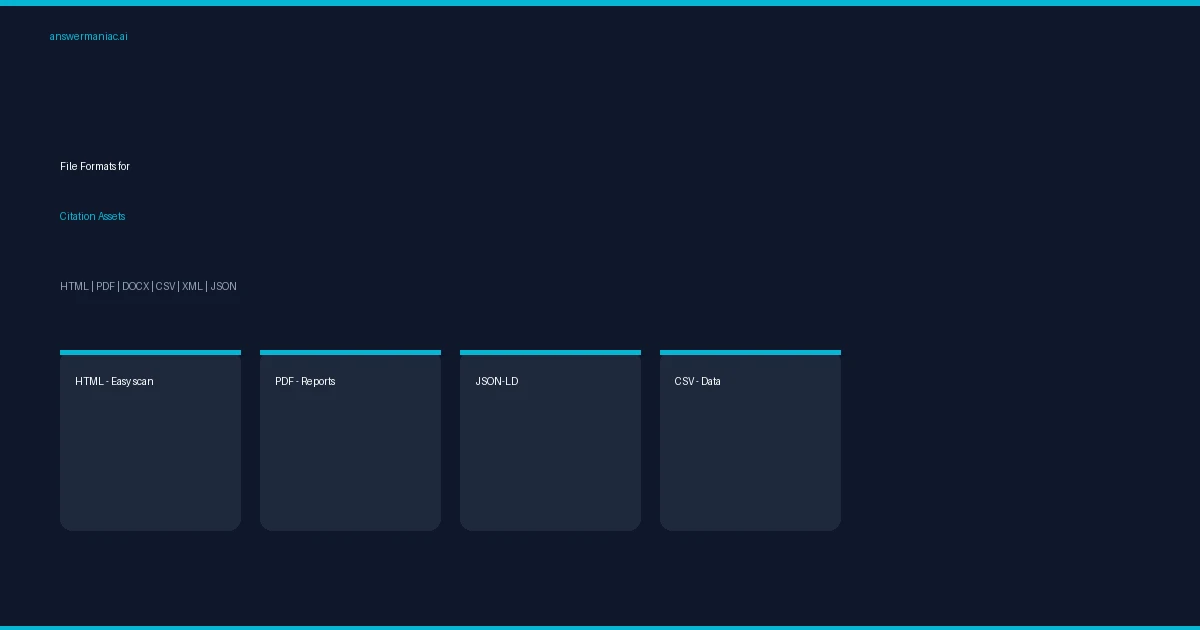
Citation assets come in a few common format groups. Each one handles content in its own way.
| Category | Formats | Use Case |
|---|---|---|
| Images | JPG, PNG, SVG | Visual content |
| Documents | PDF, DOCX | Written material |
| Media | MP4, MP3 | Video and audio |
| Web | HTML, JS | Page content |
The format affects how content gets picked up.
- PDFs show up often in reports and research
- HTML is easier for systems to scan and pull from
- MP4 allows specific time references
- PNG and SVG are used for charts and visuals
Some formats carry structure. Others need help. That gap decides whether content gets used or ignored. When teams track AI search ROI, format differences often explain why some assets perform better than others in visibility and reuse.
How Do Marketing Content Formats Influence Citation Value?
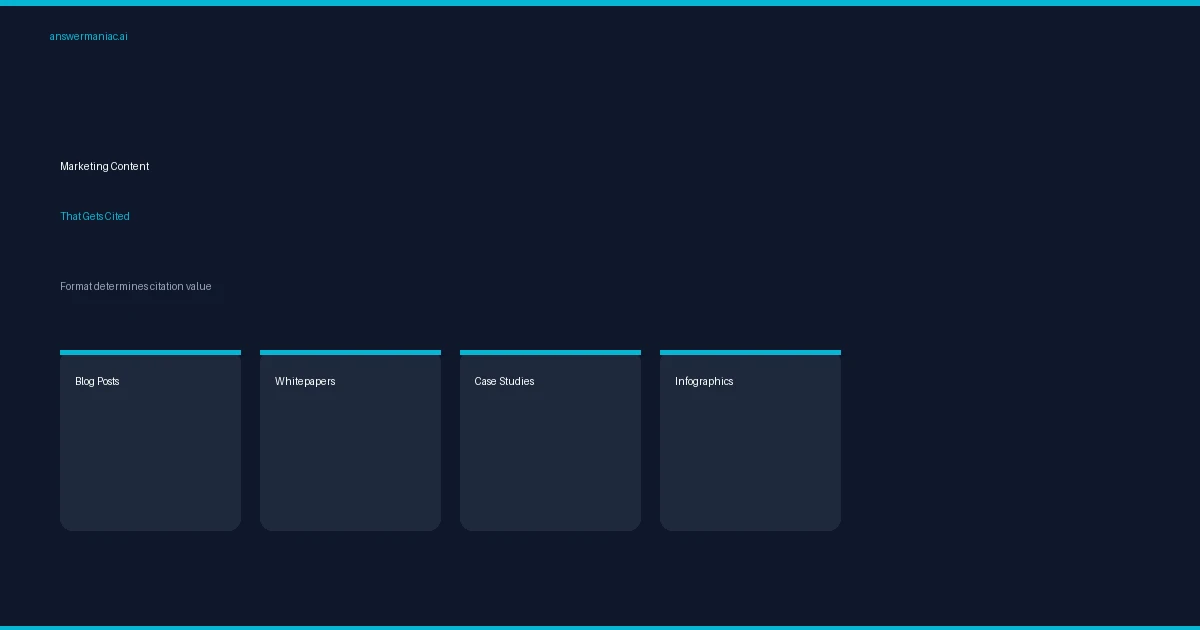
Marketing content gets cited when it is easy to use. Clear answers matter more than length.
Data from Semrush shows a simple pattern. Content that explains a topic gets picked more often than content that only promotes.
Format plays a part. Long content, like whitepapers and case studies, gives full detail. Short content, like blog posts and FAQs, answers quick questions. Both show up in different situations. As noted by Ronn Torossian:
"Frame pitches around definitional or instructional content. Stories answering 'What is [Your Industry Term]?' or 'How to [Solve Problem]?' match the FAQ schema and how-to schema that AI systems prioritize for extraction. AI systems extract quotes more reliably when they're formatted with clear attribution and focused on a single insight."
What tends to get reused:
- Blog posts with clear headings and direct answers
- Whitepapers with data and sources
- Case studies with real results
- Infographics with visible sources
If someone can scan it and use it fast, it is more likely to be cited.
Why Citation Chaos Kills Technical Documentation
Citation problems usually start small. A missing date here, a different format there. Over time, it adds up.
Writers in Reddit (r/technicalwriting) often mention the same issue. Teams use different styles without a shared rule. One file follows APA, another uses Chicago.
This creates friction. Names are written in different ways. Dates go missing. Formatting shifts between documents.
It also leads to repeat work. When sources are unclear, people rewrite instead of reuse. Some reports put duplication close to 50%.
Common issues:
- Mixed citation styles in one project
- Author names that do not match
- Missing or wrong dates
- Manual formatting errors
These gaps make documents harder to trust and harder to manage.
What Are Standard Citation Practices for Digital Assets?
Citations show where information comes from and help others track it down. APA Style is widely used for digital files.
In APA 7th Edition, entries follow a simple order: author, year, title, and source. This keeps references consistent across files.
There are three main citation styles: author-date, numerical, and note-based.
Digital files often need extra details, like a link or the file type, so they can be found easily.
The basics to include are:
- Author or organization
- Publication date
- Title
- URL or Digital Object Identifier (DOI)
How Does Metadata Improve Citation Accuracy and Retrieval?
Metadata is the information attached to a file that explains what it contains. Without it, files can sit unnoticed or be hard to find.
Platforms like SharePoint use metadata to record who created a file, when it was updated, and other key details. A PDF or image alone rarely tells the full story. Metadata adds context, making it clear what a file is and how it should be used.
Version history is important. Without it, old files may be mistaken for current ones.
The most useful metadata usually includes:
- Author and contributor names
- Version history and timestamps
- Licensing and usage rights
- Tags and keywords
When these details are complete, files stay organized and easy to locate. Missing metadata can lead to duplicates or lost content. This becomes critical in regulated fields like AI search optimization in healthcare, where metadata consistency directly affects trust and discoverability.
Quora's AI Citation Blueprint: What Works?
On Quora, the posts that get picked are the ones that answer the question right away.
Long setups do not help much. A clear answer at the start does.
Posts that explain something step by step show up more often. This matches what Semrush has observed in search data.
Most of the time, it comes down to focus. One question, one answer.
What tends to work:
- A direct answer at the top
- Short, clear explanations
- Examples when needed
- Clean formatting with no clutter
If a reader does not have to search for the answer, neither does a system.
X (Twitter) Content Formats: What Drives Citations?
On X, people trust what they can see. That is why image-based posts do better.
A short post with a few images often carries more weight than a long thread with none.
Screenshots show where the information came from. That alone makes them useful.
Text still matters, but it stays short. The image does most of the work.
Formats that show up more:
- Screenshot posts
- Threads with a few images
- Short text with visual proof
- Real-time data captured in images
These posts are easy to check, and that makes them easier to reuse.
YouTube and DAM Failures: What Metadata Mistakes Cost You
A lot of content fails quietly. It gets uploaded, then sits with little reach. On platforms like YouTube, this often comes down to weak metadata.
The file is there, but the details are thin. Titles are vague. Tags do not match what people search for. Descriptions feel rushed or empty.
Systems depend on those signals. When they are missing or messy, the content is harder to place and easier to skip.
You see it in small ways:
- Fields left blank
- Tags that change from one upload to another
- No record of updates
- File names like "final_v2_new" that mean nothing later
These are not big mistakes, but they stack up. Over time, they make content harder to find and harder to trust.
Citation Asset Content Formats: Key Takeaways for Optimization
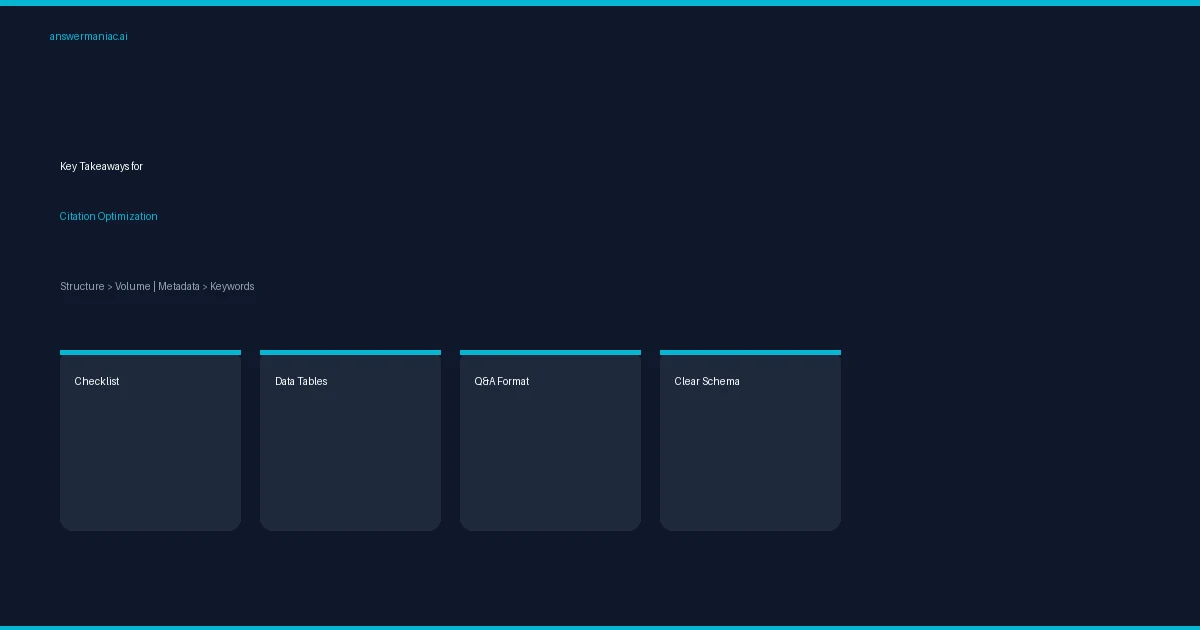
Most teams do not struggle with content. They struggle with how it is organized.
Standards like NISO Z39.29-2005 exist to keep things steady, especially when content grows. Without a shared approach, small inconsistencies spread.
Fixing things later takes more time than setting rules early.
What tends to hold up:
- One clear citation format across all content
- Metadata filled in every time, not just sometimes
- Structure that stays the same from file to file
- Content that answers a specific need
Clean structure does not stand out, but it keeps everything working in the background.
FAQ
What citation style should beginners use for different academic disciplines?
Beginners often start with APA Style because it provides clear rules and simple structure. The American Psychological Association designed it for subjects like psychological outcomes and behavior genetics. However, some fields prefer Modern Language Association or Chicago style formats. Each academic discipline follows specific citation needs, so students must check their assignment guidelines or a trusted citation manual before choosing the correct citation format.
How do in-text citations work in APA 7th Edition writing?
In APA 7th Edition, in-text citations include the author's name and publication date within the sentence. This format allows readers to connect ideas with full reference citations in the reference list. Writers must follow rules from official style manuals to keep citation elements consistent. When available, adding a Digital Object Identifier improves accuracy and helps readers locate the exact source quickly.
Where can students find reliable online citation manuals and style guides?
Students can find helpful guidance in online citation manuals and official Citation Style Guides. These citation resources explain rules for APA Style, Chicago Manual of Style, and other citation styles in clear steps. Many reference sources also include quick links at the bottom of this page to help users navigate sections easily. Using trusted style manuals ensures accurate and consistent reference citations.
What citation elements are required for digital and media sources?
Digital and media sources require complete citation elements to ensure clarity and credibility. Writers must include the source title, publication title, and publication date. This rule applies to social media posts, internet ads, TV or radio commercials, comic books, and print ads. Proper citation format helps readers understand the origin of information, especially when discussing data and statistics or topics like supportive care.
Why do citation formats matter for technical and security-related content?
Citation formats are important in technical writing because they support accuracy and traceability. Topics like security solutions, online attacks, SQL command issues, and malformed data require precise reference citations. Including details such as a Cloudflare Ray ID can help identify specific cases. Government documents and building plans also demand correct citation styles to ensure information remains reliable and verifiable.
How to Start Improving Citation Visibility
Most content gets ignored for simple reasons. It is hard to scan, missing details, or not clear about what it answers. Fixing that starts with structure. Keep formats consistent, add simple metadata, and make sure each piece answers one clear question. Small changes like better titles and tags can help people find your content faster.
Build from there. Use the same format every time so nothing feels off. Add details while you write, not after. If you want a simple way to stay consistent, try AnswerManiac and see how structured answers turn into content people can find and reuse.
References:
- Box Blog - Gen Z Effect: Rethinking Financial Services
- Ronn Torossian - Earned Media Is Your AI Citation Strategy
Related Articles:
Get AEO Insights Weekly
Join 500+ B2B marketers getting AI visibility tactics every Tuesday.
Ready to Get Your Brand Cited by AI?
See how your competitors show up in ChatGPT, Perplexity, and Gemini — and what it would take to get recommended.