Knowledge Graph Optimization: How to Get Your Brand Into Google's Entity Database
Learn knowledge graph optimization for your brand and help Google recognize you clearly in AI-driven search results.
Quick Answer
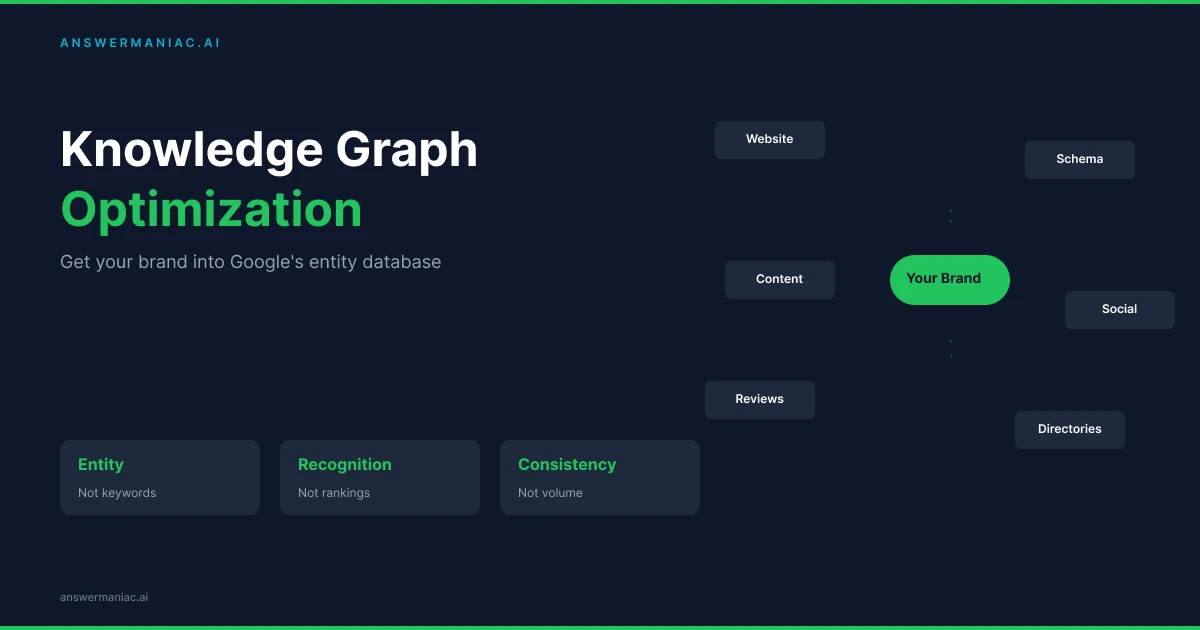
Knowledge graph optimization for a brand works in four steps. First, define your core entities — company, products, people, locations — using Schema.org structured data in JSON-LD format. Second, standardize your brand name, description, and details so they match exactly across your website, directories, social profiles, and any third-party listings. Third, build off-site authority through consistent citations on platforms like Crunchbase, LinkedIn, and industry directories. Fourth, connect all profiles using sameAs schema to create one unified identity. Google confirms a brand entity when the same verified facts appear across multiple independent sources, a process that typically takes three to six months. This entity foundation strengthens every other channel — from AI-first content to citation assets — because AI systems reference brands they can verify. Companies weighing agency versus in-house strategies for this work should note that knowledge graph optimization requires sustained, consistent execution across platforms.
Knowledge graph optimization helps search engines understand your brand as one clear identity. Instead of reading your site as scattered pages, it tries to match your business name, details, and connections across different places. When those details align, your brand is easier to recognize and group.
Google uses this to show features like Knowledge Panels and AI Overviews, which often appear before standard results. If your information stays consistent, your brand is more likely to show up correctly. The work is mostly about fixing and aligning what already exists. Keep reading to see what matters most.
What Matters Most for Knowledge Graph Optimization
Here are the key ideas to focus on:
- Knowledge graph optimization shifts focus from keywords to entities and relationships, improving how your brand appears in Google search results and AI answers
- Strong, structured data, consistent branding, and external citations increase the chance of appearing in Knowledge Panels and SERP features
- Entity-first strategies support long-term brand visibility across AI systems, including large language models and Google AI Overviews
What is Knowledge Graph Optimization for A Brand?
Knowledge graph optimization means making your brand clear and consistent so Google can recognize it as one thing.
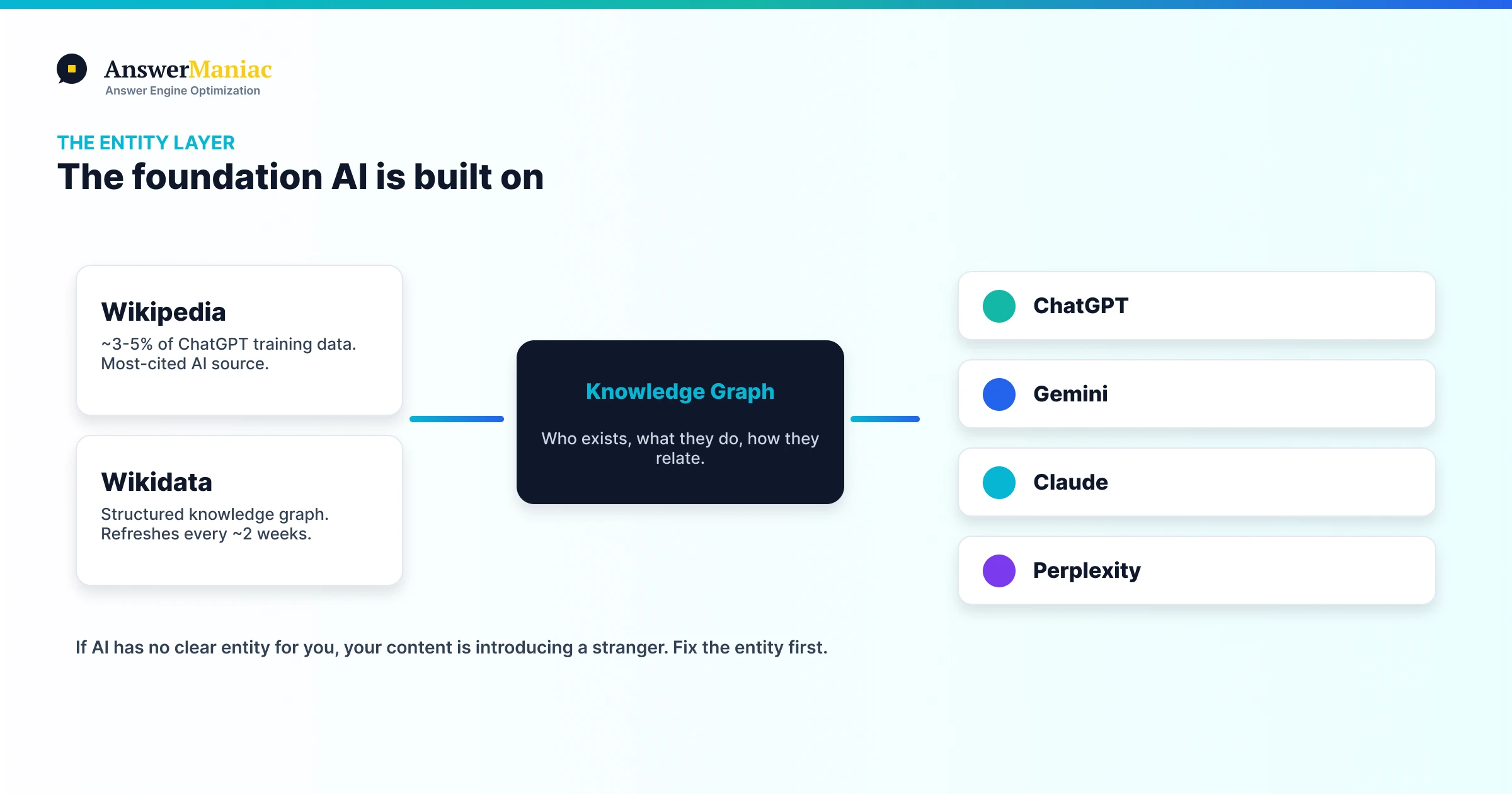
Google does not rely only on keywords anymore. It connects entities, like businesses, people, and products, and maps how they relate. That is how it understands what something is, especially as systems move toward AI-first content strategy models that depend on structured, connected data.
Your brand sits inside that system as a single point. It links to your products, your team, and your location. If those links are clean and consistent, it is easier for search engines to confirm your identity.
Google Search Central notes that structured data helps systems read business details and relationships more clearly. Many searches now depend on this type of understanding.
What this looks like in practice:
- List your main entities, such as brand and products
- Show clear connections between them
- Use the same name everywhere
- Add structured data to support it
This helps your brand show up correctly in search and AI results.
Why Are Brands Shifting to Entity-First SEO?
Search has changed. Ranking pages is no longer the only goal.
Many users now get answers without clicking a result. That means visibility comes from being included in the answer itself.
Systems like AI Overviews pull from structured and connected data. They look for entities they can identify with confidence.
Consistency matters more than before. If your brand appears the same across directories, websites, and listings, it is easier to verify.
What brands gain from this shift:
- More chances to appear in knowledge panels
- Better placement in AI-generated answers
- Stronger trust signals from consistent data
- Better match with how people search using full questions
Entity-first SEO follows how search systems now process information.
As highlighted by Search Engine Land:
"From SEO to algorithmic education: The roadmap for long-term brand authority. Learn the multi-speed approach that strengthens entity identity, builds algorithmic confidence, and boosts visibility in AI-powered results."
Why Are Brands Asking "Where Is My Knowledge Panel?"
Because there is no direct way to create one.
A knowledge panel appears after Google has enough signals to confirm your brand. It depends on how consistent and well-supported your data is across the web.
Many think adding schema markup will trigger it. It will not. External sources often play a role in confirming an entity.
It also takes time. For many brands, this can take several months. Smaller brands often need more signals to reach that point.
Common reasons it does not appear:
- No quick method to force it
- Limited authority or recognition
- A few mentions on trusted sites
- Mismatched brand details across platforms
A knowledge panel shows up once your brand is clear, consistent, and supported across multiple sources.
What Are The Core Components of Brand Knowledge Graph Optimization?
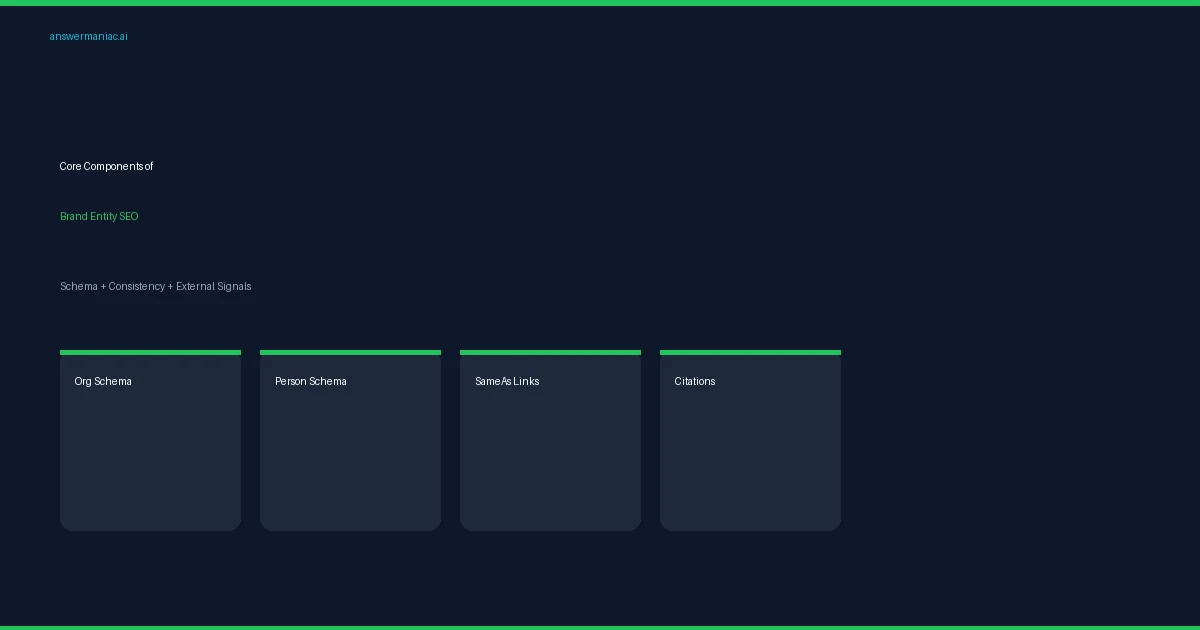
This comes down to getting your brand details clear, keeping them the same everywhere, and backing them up outside your site. If those three line up, search engines have less guesswork.
Defining Core Brand Entities
List what matters: your company, products, team, and locations. Then define each one using Schema.org.
Keep the details steady. Same name, same short description, same role. Small changes, even spacing or wording, can break the match.
Structured Data Implementation
Structured data labels your content so machines can read it correctly. JSON-LD is the usual format.
Focus on a few types:
- Organization schema for your business
- Person schema for team members
- Product schema for what you offer
- FAQPage schema for common questions
Clear structure also supports citation asset formats, which help search systems reuse and verify your information across different surfaces.
Test it with Google's Structured Data Testing Tool. Accuracy matters more than coverage.
Entity-Consistent Content
Write about your brand the same way on every page.
Do not switch names or terms. Keep roles and descriptions aligned. Internal links help connect related pages and show how things fit together.
Off-Site Entity Signals
Search engines check other sites to confirm your details.
Look at:
- Matching name, address, and phone number
- Active social profiles
- Mentions on other websites
- Listings in open data sources
If these match your site, trust builds. If they do not, it creates doubt.
Entity SEO Vs Traditional SEO: What's The Difference?
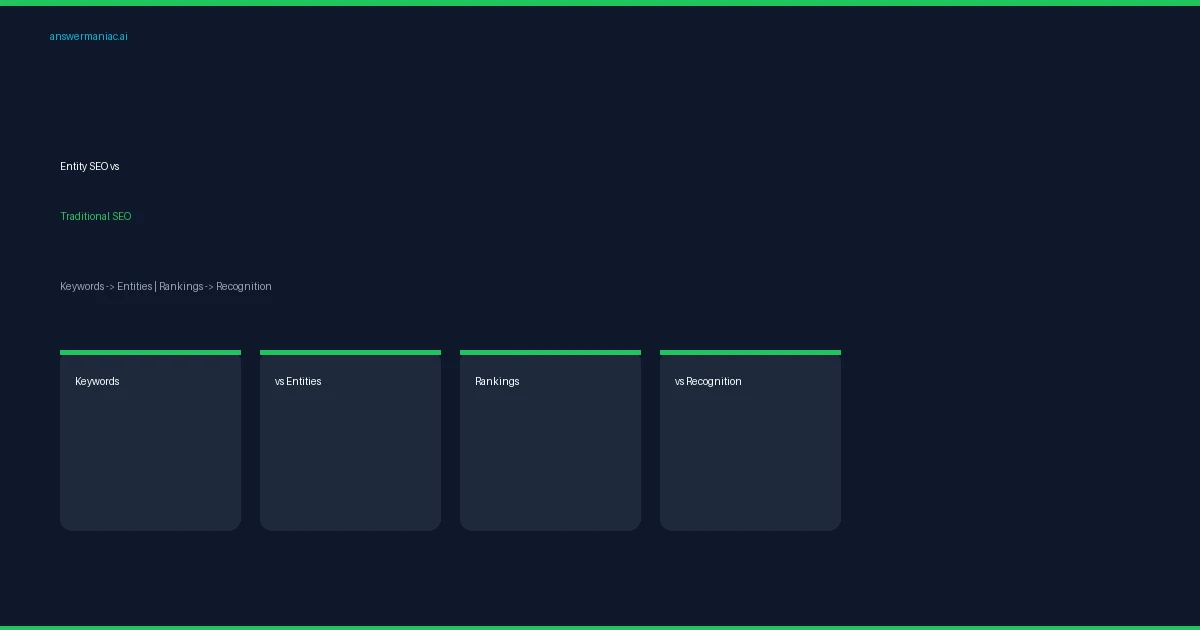
Traditional SEO tries to rank a page. Entity SEO tries to make your brand clear.
With traditional SEO, you pick keywords and build content around them. The goal is position. Higher rank, more clicks.
Entity SEO looks at identity. It helps search engines figure out what your brand is, how it connects to other things, and whether the details match across sources.
| Aspect | Traditional SEO | Entity SEO |
|---|---|---|
| Focus | Keywords | Entities |
| Goal | Rankings | Recognition |
| Data Type | Text-based | Structured + relational |
| Example | Blog ranking | Knowledge Panel |
| System | Search engine | Google Knowledge Graph |
Search results now show more panels, snippets, and direct answers. These rely on entity data. Pages still matter, but identity carries more weight than before.
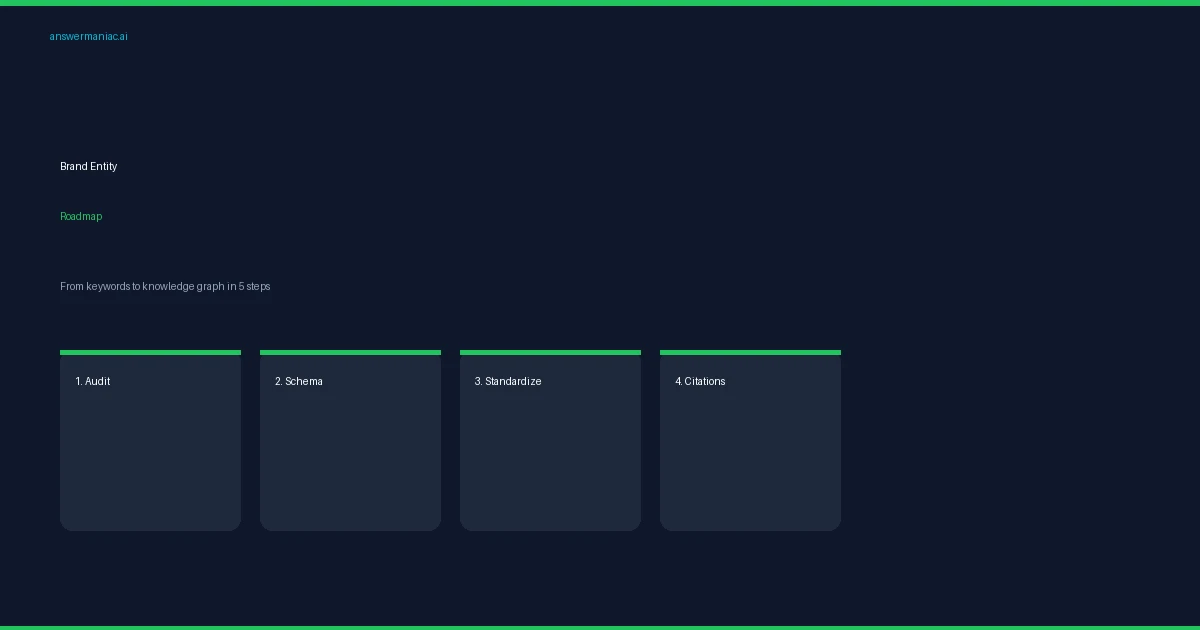
How Do You Build A Brand Entity In The Knowledge Graph?
You build it by keeping your brand details aligned across every place they appear.
There is no shortcut. It is a set of small actions done the same way, every time.
Steps to follow:
- Search your brand name and review what shows up
- Add schema markup to key pages
- Use one version of your brand name everywhere
- Get listed on directories and mentioned on other sites
- Link profiles using SameAs schema
| Step | Action | Expected Outcome |
|---|---|---|
| Audit presence | Review search results | Find gaps or errors |
| Add structured data | Apply schema markup | Clearer signals |
| Standardize branding | Keep details the same | Easier to match |
| Build citations | List on directories and media | More supporting signals |
| Connect profiles | Link accounts with SameAs | One connected identity |
Small inconsistencies, even minor ones, can break the connection.
Why Reddit and Forums Influence AI Brand Visibility
AI systems pull from places where people talk, not just official pages.
Forums like Reddit show how a brand comes up in real use. That includes questions, complaints, and recommendations. This kind of data gives context.
Recent findings show Reddit often appears in AI answers, especially for questions that need explanation or experience.
Why it matters:
- Mentions confirm your brand exists outside your site
- Discussions add context to your name
- Everyday language matches how people search
- Repeated mentions make your brand easier to pick up
If your brand only exists on your own site, it is harder for AI systems to connect it to real-world use.
What Are The Biggest Failures In Knowledge Graph Optimization?
Most failures are basic. The data does not line up.
Many brands add structured data and expect results. Nothing happens because the same details do not show up anywhere else.
Another common issue is inconsistency. One version of the name on the website, another on directories, a third on social profiles. That breaks the link.
A lot of small brands stay invisible for this reason. The signals exist, but they do not match.
Where it falls apart:
- Schema added, but no outside mentions
- Different brand names across platforms
- Missing or unclear business details
- Little recognition from other sites
- No clear links between brand, product, and team
The fix is not complicated. Keep the same details everywhere and make sure your brand shows up beyond your own site.
When Does Entity-Based SEO Fail for Brands?
It fails when there is not enough to confirm your brand.
New brands run into this often. If your name does not appear on sites like Crunchbase or trusted directories, there is not much to check against, which becomes even more critical in areas like AI search optimization in healthcare, where accuracy and entity validation are stricter.
Another issue is thin coverage. A few pages with no clear structure do not say much about what your brand does.
Common gaps:
- Very few mentions online
- No listings on known platforms
- Limited or missing structured data
- No clear connections between pages
This builds slowly. As your brand shows up in more places, with the same details, recognition starts to follow.
How to Align Your Content Strategy With Knowledge Graph Optimization
Keep your content simple and consistent.
Each page should stick to one role. Your About page explains the company. Product pages describe what you sell. Team pages list people. Mixing these makes things harder to follow.
Link related pages so the structure is clear. If a product belongs to your brand, connect it. If a team member works on that product, link that too.
HubSpot reports topic clusters can lift traffic by around 30%. The gain usually comes from clearer structure, not more pages.
What to focus on:
- Group related pages into content clusters
- Link pages that belong together
- Add FAQs using the FAQ schema
- Keep names and descriptions the same
The goal is not more content. It is content that lines up.
Knowledge Graph Optimization for Brand: What Actually Works
What works is repeating the same, correct details across every place your brand appears.
Schema helps, but it does not do much on its own. It needs support from content and mentions on other sites.
Brands that improve visibility usually fix small issues first, then keep things consistent.
What to focus on:
- Add schema markup to key pages
- Use one version of your brand name everywhere
- Check how your brand appears in search
- Get listed and mentioned on other sites
Results take time. As your details match across more sources, your brand becomes easier to confirm and display.
Insights from Yext indicate:
"AI engines don't decide visibility based on how your pages look; they decide it based on whether they can clearly understand the facts about your brand. A knowledge graph organizes those facts (like hours, services, providers, products) in a way AI can easily use."
FAQ
What is Knowledge Graph Optimization and why does it help search visibility?
Knowledge Graph Optimization means organizing your brand data so search engines clearly understand it. You use structured data and schema markup to describe your business, products, and services. This process helps your content appear in search results, the Knowledge Panel, and other SERP features. It improves search visibility by creating strong entity signals and clear connections between your business information and core entities.
How does schema markup improve search results and AI Overviews?
Schema markup, also known as structured data markup, helps search engines interpret your content correctly. It gives clear meaning to your pages for AI systems and large language models. This improves how your content appears in search results, AI Overviews, and AI-generated search features. When your data is structured well, search engines trust it more and show it in helpful and visible formats.
What data sources help build a strong Knowledge Graph presence?
Reliable data sources include social media platforms, open data sources, and trusted public records that contain business information. These sources help create a strong entity presence and accurate entity relationships. When your information stays consistent across platforms, search engines build more trust in your data. This consistency supports knowledge graph optimization and improves your chances of appearing in knowledge graph box results.
How do entity relationships and internal linking support SEO?
Entity relationships explain how different topics and pages connect to each other. Internal linking guides search engines through these connections across your website. Together, they create a clear semantic map that supports entity-based search. This structure strengthens content clusters, improves understanding for AI systems, and helps increase your search visibility over time.
Which schema types help improve brand visibility and AI citations?
Organization schema, person schema, and local business schema clearly describe your brand and its details. Product schema provides accurate product details, while FAQ schema and FAQPage schema help present helpful answers. SameAs schema connects your profiles across different platforms. These structured data types improve brand visibility, support AI citations, and help your content appear in AI platforms and advanced search engine features.
Bringing Your Brand Into Google's Knowledge Graph
Look at your brand the way Google does: not as pieces, but as proof. Every page, every mention, every detail either agrees with or breaks the story. Imagine a friend who changes their name every day. You would pause. So does Google. So ask yourself: are you clear enough to trust, or too scattered to follow?
Small gaps cost you more than you think. They hide you. But when everything lines up, you get seen. You get chosen. If you want help turning answers into clear signals, start with AnswerManiac. Build it, repeat it, and keep it strong.
References:
Related Articles:
Get AEO Insights Weekly
Join 500+ B2B marketers getting AI visibility tactics every Tuesday.
Ready to Get Your Brand Cited by AI?
See how your competitors show up in ChatGPT, Perplexity, and Gemini — and what it would take to get recommended.