EU AI Act Takes Effect August 2: What B2B Content Teams Need to Do This Week
The EU AI Act's transparency rules take effect August 2, 2026. Here's exactly what B2B content marketing teams need to change, with a compliance checklist.
Quick Answer
Key Dates and Requirements
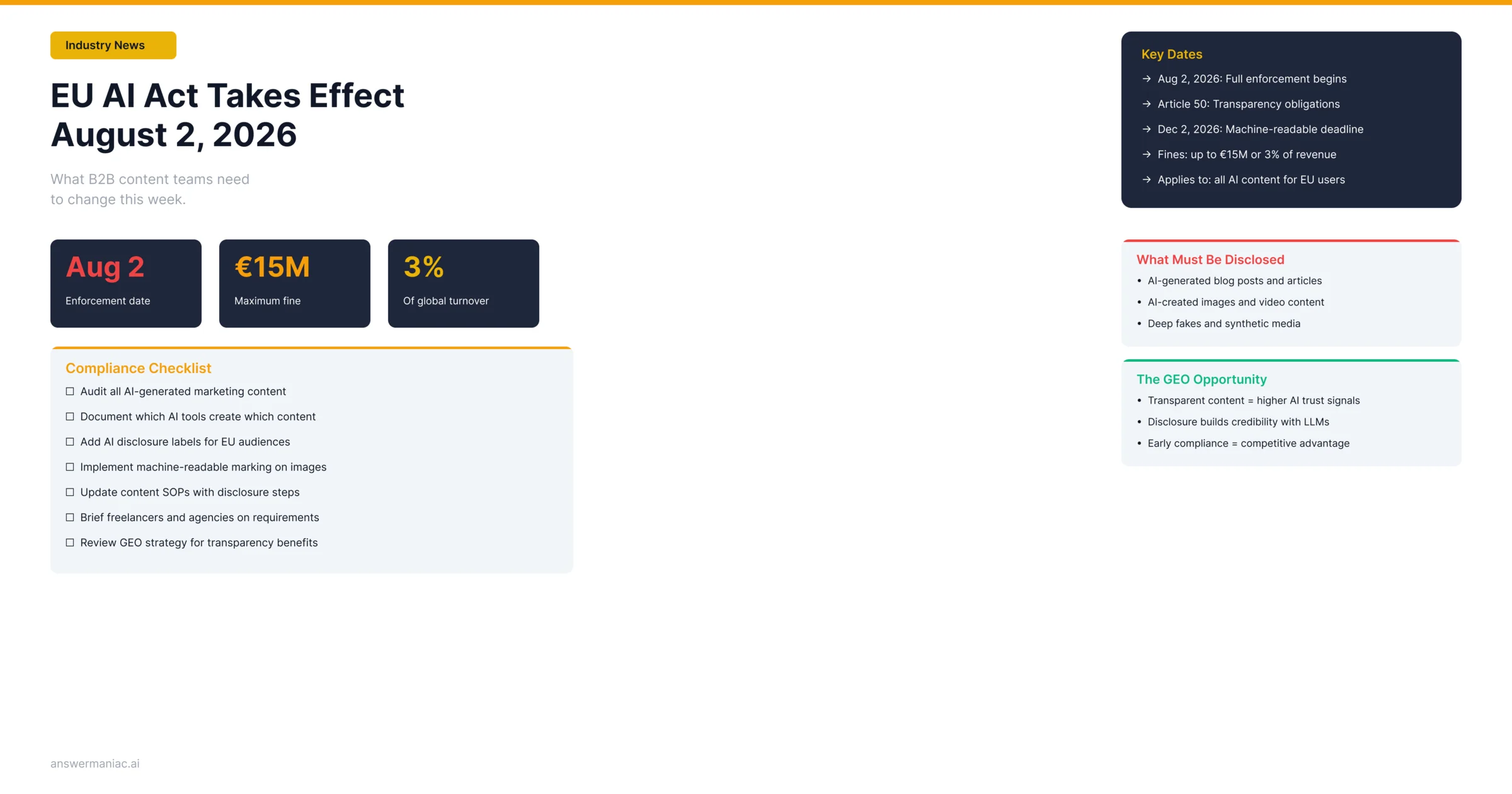
- August 2, 2026: EU AI Act becomes fully applicable, including Article 50 transparency obligations for generative AI systems.
- What's required: AI-generated content published to inform the public must be clearly labeled. Machine-readable marking is mandatory for AI-generated text, images, audio, and video. Disclosure buried in terms and conditions or metadata-only watermarks does NOT satisfy the obligation.
- Who it applies to: Any organization deploying or using generative AI systems that produce content reaching EU audiences — regardless of where you're headquartered.
- Fines: Up to 15 million euros or 3% of global annual turnover, whichever is higher, for transparency violations.
- Grace period: The AI Omnibus provisional agreement (May 2026) gives AI systems already on the market until December 2, 2026 to implement machine-readable marking under Article 50(2). But disclosure obligations for publishers? Those are live on August 2.
Your B2B blog post written by Claude last Tuesday? The Midjourney hero image on your landing page? The ChatGPT-drafted email sequence going out to your European prospect list? All of these now carry specific legal obligations.
Not theoretical ones. Not "best practice" ones. Enforceable ones.
What's Happening on August 2
The EU AI Act — Regulation (EU) 2024/1689 — hits full applicability on August 2, 2026. We've known this was coming since the regulation entered into force in August 2024, with a phased rollout that started banning prohibited AI practices in February 2025 and gradually expanded from there.
August 2 is the big one. This is when the remaining provisions kick in, including the transparency requirements under Article 50 that directly affect anyone using generative AI to create content.
I'll be honest: most B2B marketing teams I've talked to over the past few months have been treating this as a "we'll figure it out later" problem. Later is now tomorrow.
The enforcement structure isn't theoretical either. National authorities across EU member states have been standing up their AI oversight bodies throughout 2025 and early 2026. The EU AI Office in Brussels coordinates cross-border enforcement. Complaints can be filed by competitors, consumers, or NGOs.
What Article 50 Actually Requires
Article 50 is the section that matters for content teams. Here's what it says in practical terms, stripped of the legal formatting:
For providers of generative AI systems (OpenAI, Anthropic, Midjourney, etc.):
They must ensure that AI-generated outputs — text, images, audio, video — are marked in a machine-readable format and are detectable as artificially generated. This means technical measures like watermarking, metadata tagging, cryptographic provenance signals, or machine-readable audit logs embedded in the output.
For deployers (that's you, the company using these tools):
If you publish AI-generated content that informs the public on matters of public interest, you must clearly disclose that the content was generated or manipulated by AI. This disclosure must be given at the point of first interaction. It must meet accessibility requirements. And it must be prominent — not buried in a footer link to your terms of service.
For deep fakes and synthetic media:
AI-generated or manipulated images, audio, or video depicting existing persons, places, or events must be disclosed. This includes AI-generated ad creative that uses synthetic voices, faces, or scenarios.
One critical detail that trips people up: disclosure in terms and conditions or metadata-only watermarks does NOT satisfy the transparency duty. The regulation explicitly requires that disclosure be accessible and understandable to the person encountering the content. A machine-readable watermark is necessary for the technical compliance layer, but it's not sufficient as your disclosure to humans.
How This Affects B2B Content Marketing Specifically
If you're a B2B company publishing content for audiences that include EU-based readers — and if you're marketing software or services internationally, they almost certainly do — here's where Article 50 intersects with your daily operations:
Blog Posts and Articles
Content written substantially by AI tools needs disclosure. "Substantially" isn't precisely defined in the regulation, which means enforcement will be guided by the AI Office's interpretive guidance and, eventually, case law. But the safe reading is: if an AI system generated the core content and a human edited it, that's AI-generated content. If a human wrote the piece and used AI for grammar checking or spell check, it probably isn't.
The grey area is where most B2B teams live — AI drafts, human edits, published under a human byline. Until enforcement patterns clarify that grey area, disclosure is the safer path.
AI-Generated Images and Graphics
Midjourney headers, DALL-E social graphics, AI-generated infographics — all require both machine-readable marking (from the provider side) and visible disclosure (from your side as the publisher). This one's less ambiguous than text. If the image was generated by AI, label it.
Email Marketing
Content that reaches inboxes of EU residents and was generated by AI falls under the transparency requirements. The "informing the public" criterion is broader than you might think — B2B thought leadership emails that discuss industry trends, market conditions, or regulatory topics can qualify.
Paid Advertising
AI-generated ad copy and creative running in EU markets must include disclosure. This applies to programmatic display, LinkedIn sponsored content, and any paid distribution where synthetic content is involved.
Sales Enablement Content
Whitepapers, case studies, and one-pagers generated with AI that are distributed to EU prospects? Yes, these count too if they're informing the public about your product or market.
The Compliance Checklist: What to Audit This Week
Stop reading here and do this. Come back to the rest of the article after.
- Audit all AI-generated content in your marketing pipeline. Go through every active blog post, landing page, email sequence, and social post published in the last 12 months. Flag anything where AI did the heavy lifting on drafting.
- Document which tools are used for which content types. Create a simple matrix: ChatGPT for blog drafts, Claude for email sequences, Midjourney for hero images — whatever your stack looks like. You need a record of this for compliance documentation.
- Add AI disclosure labels to content published for EU audiences. A clear, visible label near the content. Something like: "This article was created with AI assistance" or "AI-generated image." It needs to be visible before or at the point the reader encounters the content — not behind a click.
- Implement machine-readable marking on AI-generated images and video. Work with your design team or tools to ensure AI-generated visual assets carry C2PA metadata, watermarks, or equivalent machine-readable provenance signals. Most major AI image generators already embed this, but verify it survives your publishing pipeline (some CMS platforms strip metadata on upload).
- Update content creation SOPs with disclosure requirements. Every content workflow document — from your editorial calendar process to your freelancer briefs — needs a step that addresses: "Was AI used? If yes, apply disclosure protocol."
- Brief your freelancers and agencies on the new requirements. If you're outsourcing content creation, your contractors need to know. Send a clear, one-page brief: what the requirement is, what disclosure looks like, and how to flag AI-assisted content in their deliverables to you.
- Review your GEO content strategy — AI transparency can actually boost credibility. More on this below, but the short version: labeling AI-assisted content honestly is aligned with what AI engines reward. Don't treat disclosure as a burden. Treat it as a trust signal.
What This Means for Your GEO Strategy
Here's where it gets interesting for anyone working on generative engine optimization.
The reflex reaction to EU AI Act disclosure requirements is defensive: "We have to admit we used AI, and that'll hurt our credibility." I've seen this concern from at least a dozen B2B marketing leaders in the past month.
The data suggests the opposite.
AI engines — ChatGPT, Perplexity, Gemini, Claude — are increasingly sophisticated at evaluating source credibility. And one of the signals they weight is transparency. A piece of content that honestly discloses its creation method, provides clear attribution, and backs claims with verifiable sources is more trustworthy to a citation algorithm than an undisclosed AI-generated article pretending to be entirely human-written.
We ran some informal tests across client accounts in Q2 2026. Content with clear AI-assistance disclosures and strong sourcing didn't see citation drops in any of the major AI engines. In several cases, citation rates held steady or improved slightly after adding disclosures — though I want to be careful about causal claims with a small sample.
Here's the practical GEO angle:
-
Transparency feeds E-E-A-T signals. Google's quality rater guidelines and AI engine citation algorithms both reward content that's upfront about its creation process and backs claims with evidence. Disclosure of AI assistance, paired with human editorial oversight and expert review, is a stronger trust signal than pretending AI wasn't involved.
-
Machine-readable metadata helps AI engines parse your content. The same C2PA metadata and provenance signals required by Article 50 give AI engines more context about your content. More context means better understanding. Better understanding means more accurate citations.
-
Compliance is a differentiator right now. Most B2B companies haven't done this yet. Being early and thorough with your AI transparency framework makes your content stand out — both to human readers and to the AI engines deciding which sources to cite.
If you're working on GEO, check out our breakdown of the best generative engine optimization tools for 2026 to see which platforms help you track how AI transparency affects your citation performance.
Grace Periods and Exceptions to Know
Not everything hits at once. A few nuances worth tracking:
The AI Omnibus transition (Article 50(2) machine-readable marking): The provisional agreement reached in May 2026 grants AI systems that were already on the market before August 2, 2026 an extended deadline of December 2, 2026 to implement machine-readable output marking. This applies to providers — OpenAI, Anthropic, Midjourney, and similar — not to you as a deployer. Your disclosure obligations as a content publisher start August 2, regardless of whether your AI tool provider has fully implemented their machine-readable marking yet.
Artistic and creative exceptions: Article 50 includes a narrow exception for content that is "part of an obviously creative, satirical, artistic, or fictional work." A B2B blog post about fleet management software compliance doesn't qualify. Neither does a LinkedIn thought leadership post. This exception exists for film, art, and literature — not for marketing content.
Small-scale research and development: If you're using AI internally for brainstorming, internal memos, or R&D that never reaches the public, the transparency disclosure requirements don't apply to those internal uses. The trigger is publication to inform the public.
Non-EU companies without EU presence: The regulation applies to AI systems placed on the market or put into service in the EU, and to deployers located within the EU. But it also applies when the output of the AI system is used within the EU. If your English-language blog post is read by someone in Berlin — and you know or reasonably should know your content reaches EU audiences — the obligation likely applies. For B2B companies marketing internationally, assume it applies.
FAQ
Does the EU AI Act apply to companies outside the EU?
Yes. If you deploy AI systems whose outputs are used within the EU, or if your AI-generated content reaches EU audiences, the regulation applies regardless of where your company is incorporated. This is similar to how GDPR applies extraterritorially.
What counts as "AI-generated content" under Article 50?
Content where an AI system generated the substantive output — text, images, audio, or video. Light use of AI tools for grammar checking or formatting likely doesn't trigger disclosure obligations. Substantial drafting, image generation, or content synthesis does. The line isn't precisely drawn yet, so err on the side of disclosure.
Is adding "Written with AI assistance" to my blog posts enough?
For the human-facing disclosure, a clear and visible label like that is a reasonable starting point. But you also need machine-readable marking on the content (particularly images and video). And the disclosure needs to be present at the point of first interaction — not hidden behind a navigation link.
What are the fines for non-compliance?
Up to 15 million euros or 3% of your global annual turnover, whichever is higher. These are the penalties specifically for transparency violations under the AI Act. Actual enforcement will likely focus first on egregious or repeat violations, but the maximum penalties are substantial.
Does this affect my SEO or GEO strategy?
It shouldn't hurt it — and it might help. AI engines reward transparent, well-sourced content. Adding honest disclosure about AI assistance, combined with strong human editorial oversight and verifiable sourcing, aligns with what both traditional SEO and GEO strategies reward.
My AI tools already add watermarks. Am I covered?
Partially. Machine-readable watermarks from your AI provider (OpenAI, Midjourney, etc.) cover the technical marking requirement on the provider side. But as a deployer and publisher, you still need visible, human-readable disclosure at the point of content delivery. Both layers are required.
What about the December 2, 2026 deadline I keep seeing?
That's the extended deadline from the AI Omnibus provisional agreement for AI providers to implement machine-readable output marking on systems already on the market. It doesn't extend your disclosure deadline as a content publisher. Your obligation to clearly label AI-generated content for EU audiences starts August 2, 2026.
The Bottom Line
You don't need to panic about this. You need to act on it.
The EU AI Act's transparency requirements aren't unreasonable — they're asking you to be honest about how your content is made. Most B2B companies should've been doing this already as a trust-building practice. Now there's a legal requirement with real enforcement teeth behind it.
Spend two hours this week running through the checklist above. Brief your team. Update your SOPs. Add disclosure labels to your published AI-assisted content. It's not a massive overhaul — it's a process update.
And if you're building a GEO strategy alongside your traditional SEO work, recognize that AI transparency isn't working against you. It's working for you. The AI engines deciding which sources to cite are built to value exactly the kind of honest, well-attributed, transparently produced content that the EU AI Act now requires.
That's not a coincidence. That's the direction the entire information ecosystem is moving.
Get AEO Insights Weekly
Join 500+ B2B marketers getting AI visibility tactics every Tuesday.
Ready to Get Your Brand Cited by AI?
See how your competitors show up in ChatGPT, Perplexity, and Gemini — and what it would take to get recommended.