Google AI Mode Goes Default: What It Means for B2B Pipeline
Google rebuilt the search box around AI Mode at I/O 2026. Here's the citation overlap data, the real CTR numbers, and what B2B teams should change now.
Quick Answer
Key facts
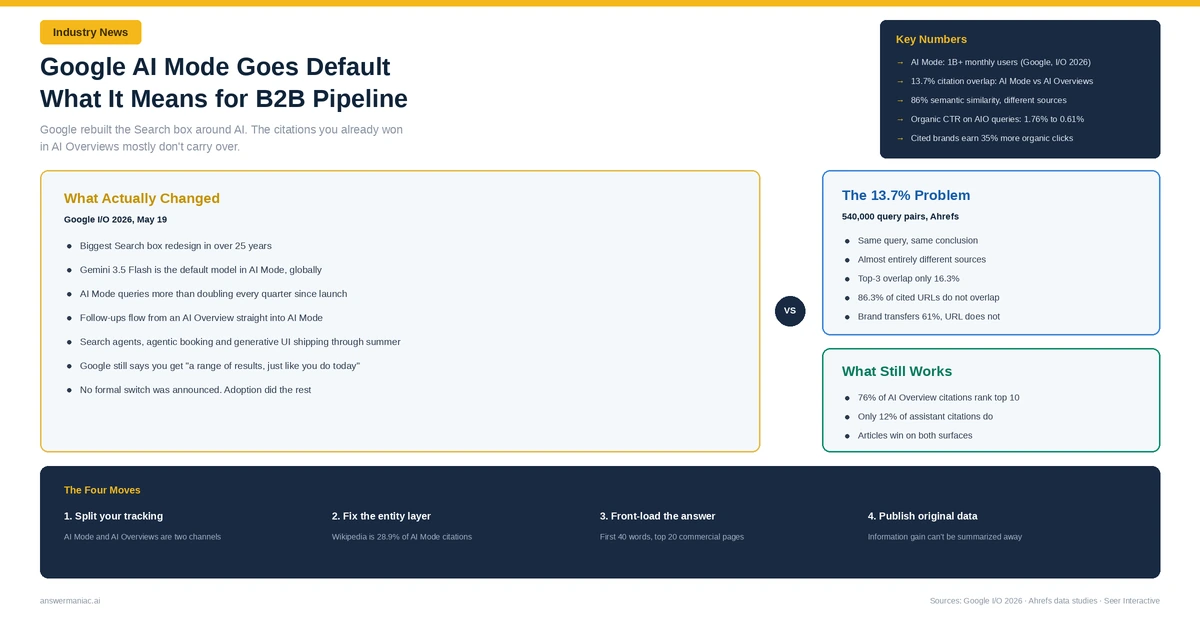
- Google I/O 2026 (May 19, 2026): Elizabeth Reid, VP of Search, announced "the biggest upgrade to our Search box in over 25 years," now rebuilt around AI (Google, The Keyword)
- AI Mode surpassed one billion monthly users within a year of debut, with queries "more than doubling every quarter" since launch (Google, The Keyword)
- Gemini 3.5 Flash is the new default model in AI Mode for everyone globally, as of May 19, 2026 (Google)
- AI Mode and AI Overviews cite the same URLs only 13.7% of the time across 540,000 query pairs; top-3 citation overlap is 16.3% (Ahrefs, December 2025)
- The two systems reach 86% semantic similarity while citing different sources. They agree on what to say, not on who gets credit (Ahrefs)
- Organic CTR on queries with AI Overviews fell from 1.76% to 0.61%, a 61% decline, across 3,119 informational queries and 25.1M impressions from June 2024 to September 2025 (Seer Interactive)
- Brands cited inside an AI Overview earn 35% more organic clicks and 91% more paid clicks than brands that aren't (Seer Interactive)
- 76% of AI Overview citations come from pages ranking in Google's top 10. Only 12% of citations from ChatGPT, Gemini, Copilot and Perplexity do (Ahrefs)
- AI Mode responses run roughly 4x longer and carry 3.3 brand or person entities on average versus 1.3 in AI Overviews (Ahrefs)
- 59.4% of AI Overview responses contain no brand or entity at all, versus 34.7% of AI Mode responses (Ahrefs)
What Google Actually Announced, and What It Didn't
The headlines from May got ahead of the source material. Plenty of coverage declared that AI Mode became the default Google experience. Google's own I/O post is more careful than that, and the gap matters if you're planning a budget around it.
Here's what Elizabeth Reid, Google's VP of Search, actually wrote on May 19:
"Because your curiosity doesn't always fit into keywords, we're also introducing the biggest upgrade to our Search box in over 25 years — now completely reimagined with AI."
And a few lines later, in the same section:
"You'll continue to get a range of results from Search, just like you do today."
So blue links didn't die on stage. What changed is the entry point. The box now expands as you type, accepts images, files, videos and Chrome tabs as inputs, and offers AI-powered suggestions that go past autocomplete. You can ask a follow-up straight from an AI Overview and flow into a conversation with AI Mode, carrying context with you.
That's not a toggle. That's a funnel redesign.
The adoption numbers explain why everyone read it as a default switch. AI Mode passed one billion monthly users inside a year, and Google says its queries have more than doubled every quarter since launch. When a surface grows like that and the front door is rebuilt to feed it, the distinction between "default" and "where everyone ends up" stops being useful.
Google also shipped Gemini 3.5 Flash as the default model inside AI Mode for everyone globally, plus a set of agentic features arriving through summer 2026: information agents that monitor the web in the background, expanded agentic booking, and generative UI that builds custom layouts and trackers on the fly.
I ran a handful of our own client category queries in AI Mode the week after I/O. The thing that stood out wasn't the answer quality. It was how many vendors got named in a single response compared to what the AI Overview showed for the same query. More on why that happens below.
The 13.7% Problem
This is the number B2B teams should be building around, and almost nobody is.
Ahrefs analyzed 540,000 query pairs, capturing both an AI Mode response and an AI Overview response for the same query. Citation overlap between the two came in at 13.7%. Restricting the comparison to just the top three citations in each response only lifted it to 16.3%.
On a separate slice of 730,000 query pairs, Ahrefs measured how similar the answers themselves were. Semantic similarity came in at 86%, with 89.7% of response pairs scoring above 0.8 on cosine similarity. Word-level overlap was 16%. They started with the same first sentence 2.51% of the time.
Read that combination again. Two Google systems, same query, same conclusion, almost entirely different sources.
The mechanism is query fan-out. Google's own developer documentation confirms both AI Overviews and AI Mode use it, running multiple related searches behind a single user query and merging what comes back. Different models, different fan-out patterns, different sources selected from a broader pool. Same destination, different route.
For a B2B marketing team this breaks a very common reporting habit. You get cited in an AI Overview for "best compliance management software," you screenshot it, you put it in the board deck as AI visibility. That citation has roughly a 13.7% chance of also being the citation AI Mode picks for the same query.
There's a softer number that cuts the other way, and it's worth being honest about: at the entity level, 61% of the time AI Mode includes every brand that AI Overview mentioned and then adds more. So brand mention transfers better than URL citation does. But "adds more" means you're now sharing the answer with competitors who didn't make the AI Overview cut. Getting mentioned and getting chosen are different outcomes.
If you want the mechanics of how these systems pick, we broke it down in how AI search engines choose sources.
What the CTR Data Actually Shows
The most rigorous public dataset on this is still Seer Interactive's, which tracked 3,119 informational queries across 42 organizations, covering 25.1 million organic impressions and 1.1 million paid impressions from June 2024 through September 2025.
| Metric | Before | After | Change |
|---|---|---|---|
| Organic CTR, queries with AI Overviews | 1.76% | 0.61% | −61% |
| Paid CTR, queries with AI Overviews | 19.7% | 6.34% | −68% |
| Organic CTR, queries without AI Overviews | 2.72% | 1.62% | −41% |
The third row is the one people skip. CTR fell 41% even on queries where no AI Overview appeared. Users changed how they read a results page, not just what they clicked on pages that had an AI answer.
Two caveats I'd rather state than bury. This is informational-query data, which skews toward the top of a B2B funnel rather than the bottom. And it predates the I/O 2026 changes, so it measures the AI Overviews era, not the rebuilt-search-box era. Nobody has published a clean post-I/O B2B dataset yet. Anyone quoting you one right now is extrapolating.
Now the number that pays for the work. Brands cited inside an AI Overview earn 35% more organic clicks and 91% more paid clicks than brands that aren't cited. The click didn't disappear. It consolidated onto whoever got named.
That's the whole thesis of zero-click SEO in 2026 reduced to one statistic. Visibility inside the answer is now the click strategy.
What Gets Cited: AI Mode vs AI Overviews
The two surfaces have measurably different taste. From the same Ahrefs dataset:
| Signal | AI Overviews | AI Mode |
|---|---|---|
| Response length | Baseline | ~4x longer |
| Brand/person entities per response | 1.3 average | 3.3 average |
| Responses with no brand mentioned | 59.4% | 34.7% |
| Responses with no citation at all | 11% | 3% |
| Wikipedia share of citations | 18.1% | 28.9% |
| Quora presence | Baseline | 3.5x higher |
| Video and homepage/category citations | ~2x AI Mode | Lower |
| Preferred content format | Articles | Articles |
Both systems overwhelmingly prefer article-format pages. That's the one thing they agree on. Everything else diverges.
The pattern that matters for B2B: AI Mode mentions brands more than twice as often as AI Overviews do, cites sources on 97% of responses, and leans harder on encyclopedic and reference sources. A longer answer needs more grounding, and more grounding means more slots. That's more room for you and more room for the four competitors you'd rather not appear beside.
Content length is not the lever people assume. Ahrefs found 53.4% of pages cited by AI Overviews are under 1,000 words, and only 16% are over 2,000. Nobody is winning citations by padding.
One more asymmetry that reframes how you should spend. 76% of AI Overview citations pull from pages ranking in Google's top 10, based on 1.9 million citations across one million AI Overviews. But across 15,000 prompts run through ChatGPT, Gemini, Copilot and Perplexity, only 12% of cited URLs ranked in Google's top 10 at all. Worth flagging the outlier: Perplexity sits at 28.6%, while ChatGPT, Gemini and Copilot hover around 8%. The 12% is an average that Perplexity pulls upward.
Translation: your existing SEO program still buys AI Overviews. It buys much less in AI Mode, and close to nothing in ChatGPT. That's the practical boundary between GEO and SEO, and it's why treating them as one budget line produces confusing results.
Why This Hits B2B Harder Than B2C
Three structural reasons.
Your funnel is research-heavy. B2B buyers run comparison, evaluation and shortlist queries. Those are exactly the informational and commercial-investigation queries where AI answers trigger most reliably. A consumer buying sneakers still hits a product page. A VP of Ops evaluating fleet management software asks a question, reads a synthesized shortlist, and forms an opinion about six vendors before touching a single site.
Your category is small enough for one answer to decide it. In a niche vertical, an AI Mode response naming five vendors is functionally the entire consideration set. There is no page two. If you're not in those 3.3 entity slots, you were never evaluated. That's the invisibility problem we covered in AI search engine optimization.
Your attribution is already fragile. Long sales cycles, multiple stakeholders, dark social. Add a channel where the influence happens inside an answer box that leaves no referrer, and last-touch reporting quietly stops describing reality. Pipeline sourced by an AI Mode session shows up in your CRM as direct or branded search, weeks later.
The 59.4% figure has a flip side worth planning against: most AI Overview responses mention no brand at all. Those are informational queries where no vendor is expected. Don't chase them. Chase the queries where a vendor list is the natural answer, because that's where the entity slots exist.
What to Do in the Next 90 Days
This maps to The ANSWER Framework, which is how we sequence this work: Audit, Navigate, Structure, Write, Earn, Refine.
| Priority | Action | Why now |
|---|---|---|
| P0 | Split your tracking. Measure AI Mode and AI Overviews as separate surfaces, never as one "Google AI" number | 13.7% citation overlap means a blended metric hides which surface you're actually losing |
| P0 | Confirm Google-Extended and Googlebot access is clean, and check your WAF and bot-fight rules | Crawl access is a plumbing problem before it's a content problem, and it silently caps everything downstream |
| P0 | Build a frozen prompt set of 30 to 50 real buyer questions in your category. Run it monthly, unchanged | Rotating prompts turns your trend line into noise. This is the measurement baseline everything else reports against |
| P1 | Fix your entity footprint: consistent Organization schema, sameAs links, accurate third-party profiles on G2, Crunchbase, LinkedIn | AI Mode leans 28.9% on Wikipedia-class encyclopedic sources. Entity clarity is what gets you into that layer |
| P1 | Restructure your top 20 commercial pages so the first 40 words answer the query directly, then support it | Both surfaces prefer article-format content and extract from the top. Length isn't the lever; extractability is |
| P1 | Earn coverage in the sources these systems already trust: category roundups, analyst mentions, comparison content on third-party domains | Only 12% of assistant citations rank in Google's top 10. Off-domain corroboration reaches where your own pages can't |
| P2 | Publish original benchmark or survey data in your vertical | Information gain is the one asset a synthesized answer can't summarize away from you. It has to name the source |
| P2 | Refresh commercial pages on a 90-day cycle with genuinely new material, not date bumps | Retrieval-based surfaces reward real recency. Editing a timestamp is not recency |
Ranking still matters. 76% of AI Overview citations come from top-10 pages, so a page that doesn't rank isn't getting into that surface. What's changed is that ranking is now the entry fee, not the outcome. The playbook for the AI Overview side specifically is in how to show up in AI Overviews, and the cross-engine version is how to rank in AI search engines.
How to Measure Whether It Worked
Four numbers. Not a dashboard with forty.
- Citation rate by surface. Across your frozen prompt set, how often does AI Mode cite you? How often does AI Overviews? Report them separately, always.
- Entity mention rate. Track brand-name appearances without a link as a distinct metric. AI Mode averages 3.3 entities per response and mentions brands far more than it links them. A mention with no citation still shapes a shortlist.
- Share of the answer. When a response names five vendors, are you one of them, and where in the list? Position inside an answer behaves like ranking inside a SERP.
- Branded and direct pipeline lag. Watch branded search volume and direct traffic on a 60 to 90 day lag against citation-rate movement. This is the closest proxy to attribution you're going to get, and it's imperfect. Say so out loud in the board deck rather than presenting a clean number you can't defend.
A word on tools. Every AI visibility platform samples prompts differently and refreshes on its own schedule, so a score from one tool and a score from another aren't comparable. Pick one, freeze the prompt set, measure your own trend. Setup is covered in AI visibility tracking, and we compared the platforms in the best generative engine optimization tools for 2026.
Frequently Asked Questions
Did Google actually make AI Mode the default?
Not by explicit announcement. At I/O on May 19, 2026, Google announced the biggest Search box redesign in over 25 years, made Gemini 3.5 Flash the default model inside AI Mode globally, and reported that AI Mode had crossed one billion monthly users. Google's own post still states that users "will continue to get a range of results from Search, just like you do today." The accurate framing is that the entry point was rebuilt to feed AI Mode and adoption did the rest, not that classic results were switched off.
If I'm already cited in AI Overviews, will I show up in AI Mode?
Sometimes, and less often than you'd expect at the URL level. Ahrefs measured 13.7% citation overlap between the two surfaces across 540,000 query pairs. Brand-level transfer is better: 61% of the time AI Mode includes every entity AI Overviews mentioned, then adds more. So your name has a decent chance of carrying over while your specific page does not, and you'll be sharing the response with additional competitors.
How much organic traffic should a B2B site expect to lose?
Seer Interactive's dataset showed organic CTR on AI Overview queries falling from 1.76% to 0.61%, a 61% decline, with a 41% decline even on queries without an AI Overview. That's informational-query data through September 2025, so treat it as directional for the top of a B2B funnel rather than a forecast for your bottom-funnel pages. No credible post-I/O 2026 B2B dataset has been published yet.
Does ranking in Google's top 10 still matter for AI visibility?
For AI Overviews, yes, substantially: 76% of AI Overview citations come from top-10 pages. For AI assistants, much less: only 12% of URLs cited by ChatGPT, Gemini, Copilot and Perplexity ranked in Google's top 10 for the original prompt. Rankings are close to a prerequisite on one surface and close to irrelevant on another, which is why a single "AI visibility" budget line tends to produce results nobody can explain.
What content format gets cited most in AI Mode?
Article-format pages, by a wide margin, on both surfaces. Length is not the differentiator: 53.4% of pages cited by AI Overviews are under 1,000 words and only 16% exceed 2,000. AI Mode leans harder on encyclopedic and reference sources than AI Overviews does, with Wikipedia appearing in 28.9% of its citations versus 18.1%. Structure and extractability beat word count.
Should we still invest in traditional SEO?
Yes, but stop expecting it to cover the whole surface area. Technical health, crawlability and top-10 rankings are what get you into AI Overviews, and that's 76% of those citations. They do far less for AI Mode and for third-party assistants, where entity strength, off-domain corroboration and original data matter more. Treat them as two connected programs with different levers, not one program with a new name.
Sources
- Google, "A new era for AI Search," Elizabeth Reid, VP Search (May 19, 2026)
- Ahrefs, "Are AI Mode and AI Overviews Just Different Versions of the Same Answer? (730K Responses Studied)" (December 2025)
- Ahrefs, "Only 12% of AI Cited URLs Rank in Google's Top 10 for the Original Prompt"
- Ahrefs, "76% of AI Overview Citations Pull From the Top 10"
- Ahrefs, "Short vs. Long Content in AI Overviews: The Data Says Both Work"
- Seer Interactive, "AIO Impact on Google CTR: September 2025 Update"
- Search Engine Land, "Google AI Overviews drive 61% drop in organic CTR, 68% in paid"
- Google Search Central, "AI features and your website" (query fan-out documentation)
Get AEO Insights Weekly
Join 500+ B2B marketers getting AI visibility tactics every Tuesday.
Ready to Get Your Brand Cited by AI?
See how your competitors show up in ChatGPT, Perplexity, and Gemini — and what it would take to get recommended.