How Growth-Stage B2B Companies Out-Cite Incumbents in AI Answers
You can't outspend the incumbent, but you can out-cite it. Here's the challenger playbook for winning ChatGPT and Perplexity recommendations, built on data from 332 growth-stage B2B companies.
Quick Answer
How challengers out-cite incumbents in AI answers: AI engines rank companies by how findable and legible they are, not by how much they spend. That levels a field where you could never win on ad budget. In our Q3 study of 332 growth-stage B2B companies, specialist challengers out-scored much larger brands by owning narrow categories, building third-party presence, and keeping a clean entity. The playbook: pick a specific category you can own, earn citations on Perplexity first, build entity clarity for ChatGPT over time, and measure a real visibility rate so you know it's working.
Here's a thing that's true in AI search and almost nowhere else in marketing: the incumbent's budget doesn't help it much.
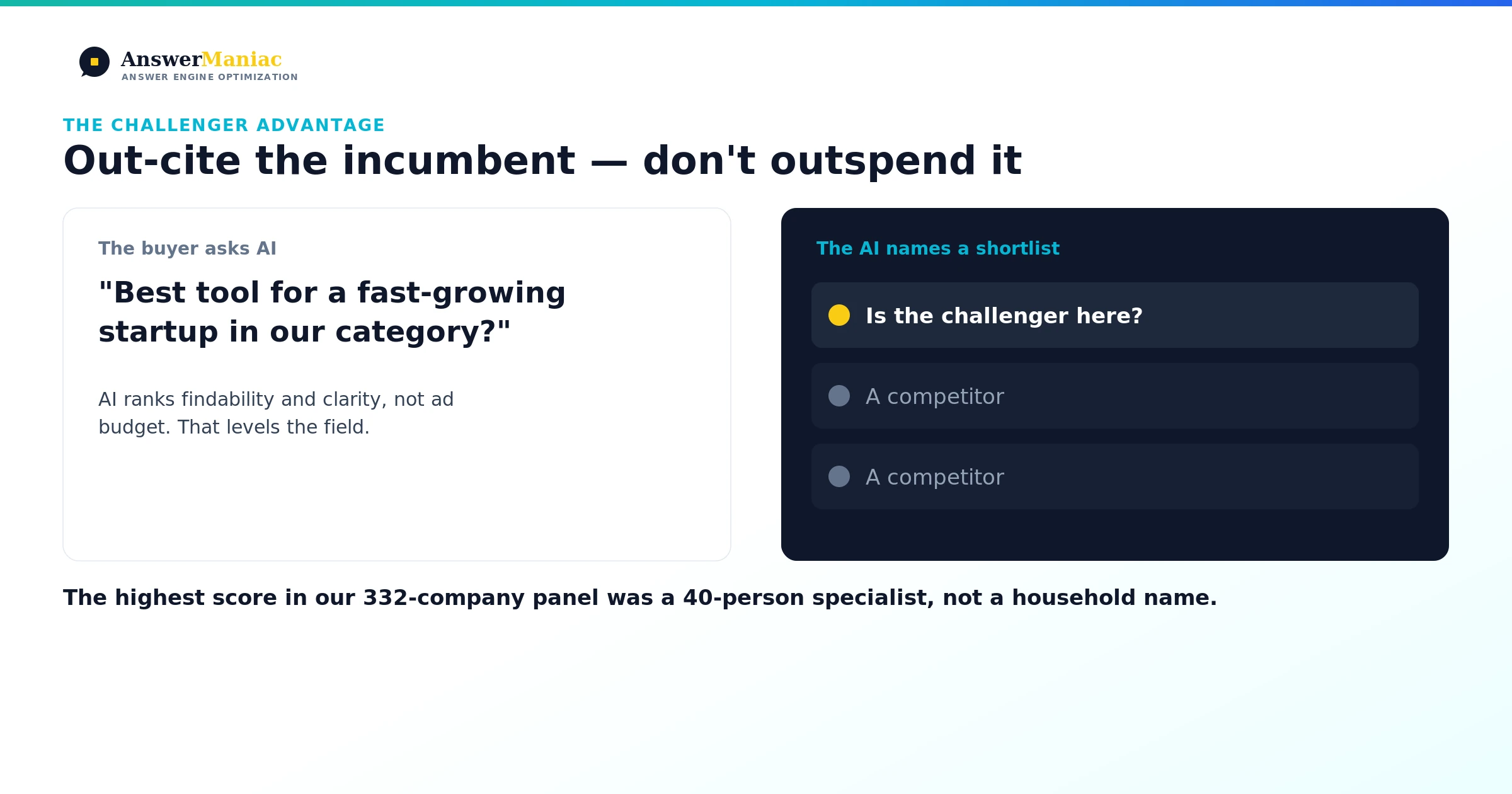
In traditional search, money compounds. More budget means more content, more links, more PR, and the big brand pulls away. In AI answers, the engine isn't counting your spend. It's answering a buyer's question with the companies it can find and confidently describe. A 40-person NetSuite specialist that nails that can beat a global SaaS brand that doesn't. We watched it happen across 332 companies in our Q3 2026 State of AI Search study, where the highest-scoring company in the entire panel was a focused implementation firm, not a household name.
This post is the challenger's playbook. It's built for the company that can't outspend the incumbent and shouldn't try.
Why the field is level (for now)
Three facts from our data make the case.
No one is dominating. The highest overall AI visibility rate in our 332-company panel was 30%. In most verticals the "leader" sat between 9% and 18%. There is no incumbent occupying the AI answer the way one occupies the top organic result. The territory is mostly unclaimed.
Specialists beat generalists. The top performers were narrow. SuiteCentric in NetSuite, Western Computer in Microsoft Dynamics, Auvik in MSP software, Nudge Security in cybersecurity. Each owns a specific slice, and AI engines reward that specificity because it matches specific buyer queries.
The winning engine responds to effort, not spend. Perplexity cited 158 of our 332 companies; ChatGPT cited 52. Perplexity surfaces companies with a findable third-party footprint, which is something you build, not something you buy. That's the challenger's opening.
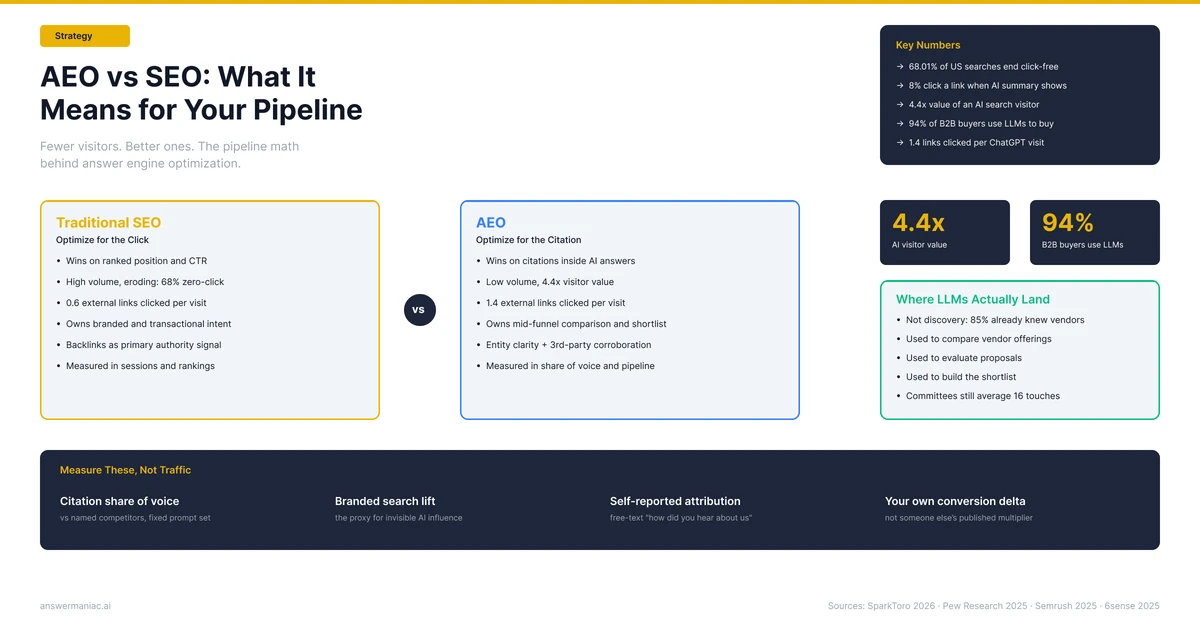
Buyers are already there. G2's March 2026 survey found 51% of B2B software buyers now start research with an AI chatbot more often than Google, and 54% say the chatbot is the biggest influence on their shortlist. The field is level and the buyers have arrived. The only question is whether you claim the space before the incumbent notices it exists.
The challenger playbook
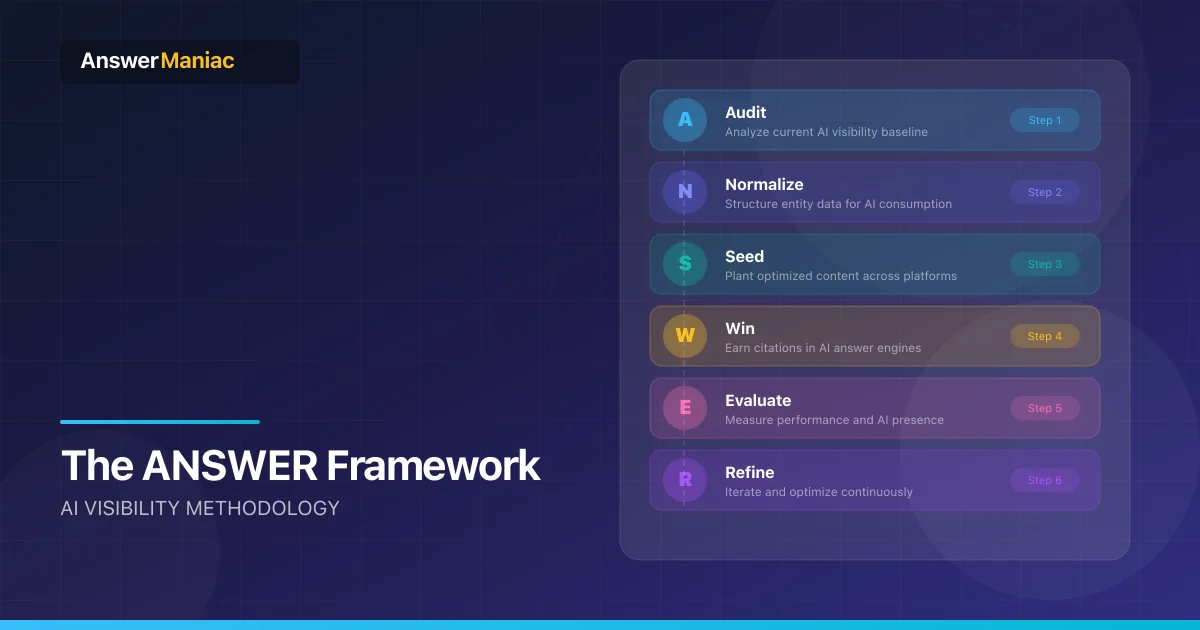
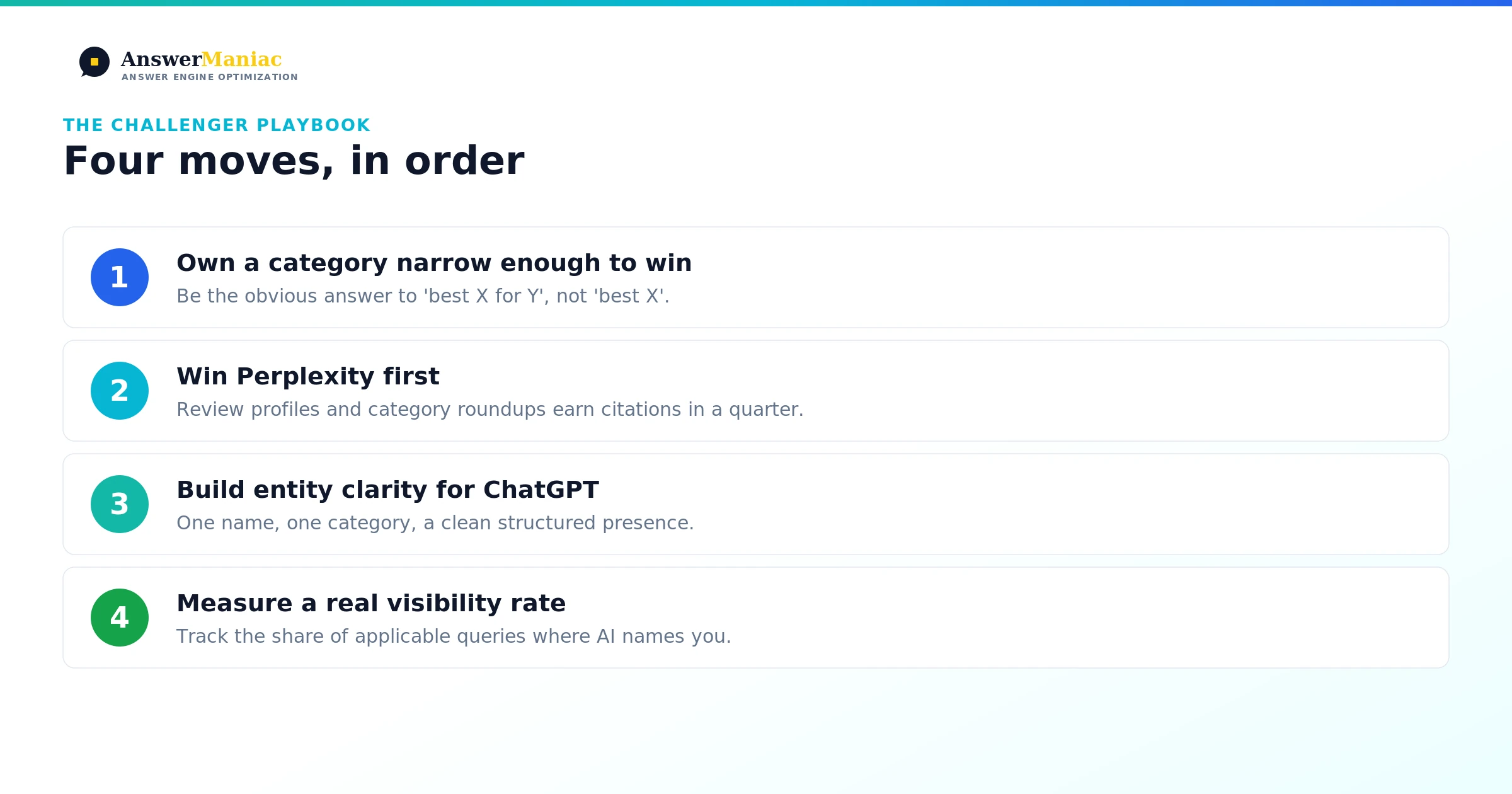
Four moves, in order. This is the compressed version of what we run for clients inside the ANSWER Framework.
1. Pick a category narrow enough to own
The incumbent is broad. Your advantage is being the obvious answer to a specific question. Don't fight for "best CRM." Win "best CRM for field service contractors." The narrower query has less competition, a clearer buyer, and an AI engine that's looking for exactly the specific match you can be.
In our data, every top performer owned a narrow lane and said so plainly. The invisible companies tended to chase broad categories where incumbents already sit, or hid their specialty behind vague positioning. Pick the lane you can actually be the answer in, then make sure your category language matches how buyers phrase it, which we covered in how B2B buyers prompt AI.
2. Win Perplexity first
Perplexity is the challenger's engine. It retrieves and summarizes third-party sources live, so a company that earns coverage shows up fast, without needing years of entrenched authority. In our study it cited three times as many companies as ChatGPT.
The work that moves Perplexity:
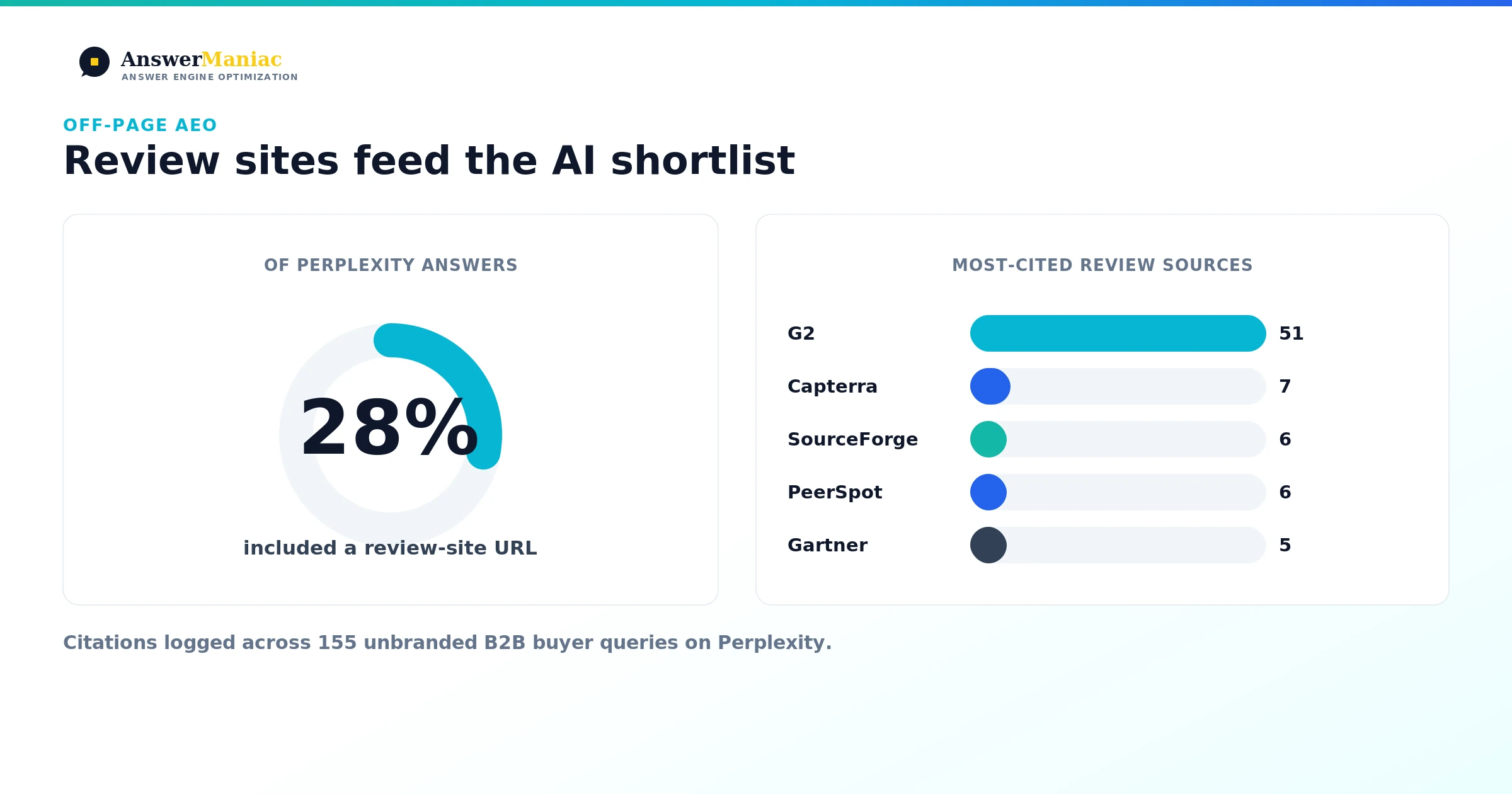
- Accurate, specific profiles on the review sites your category uses.
- Placement in independent category roundups and "best X for Y" lists.
- Third-party coverage that describes you in plain category terms.
We go deep on the retrieval engines in optimizing for Perplexity and on the review-site angle in do G2 and Capterra reviews get you cited by AI. This is where a challenger sees movement within a quarter or two.
3. Build entity clarity for the long ChatGPT game
ChatGPT is harder and slower, but it's where durable authority lives. It names companies it can resolve as clear, consistent entities. So while Perplexity delivers early wins, you build the entity foundation that eventually opens ChatGPT:
- One canonical company name, used identically everywhere.
- A stable, specific category description across your site and every profile.
- Structured entity presence, including Wikidata and, where warranted, Wikipedia. We cover this in Wikipedia and Wikidata for AI visibility and entity optimization for AI knowledge graphs.
The incumbent often has messy, inconsistent entity signals because it grew through acquisitions and rebrands. A disciplined challenger can actually be clearer than the giant, and ChatGPT rewards clarity.
4. Measure a real rate, not a vanity count
You can't improve what you're measuring wrong. Track your AI visibility rate: the percentage of applicable buyer queries where an engine names you, per engine, averaged. Run it monthly against a stable query set. A rate tells you whether the work is landing. A raw "mentions" count tells you almost nothing, because it hides how many chances you had.
Start by finding out where you stand. Our free AI citation audit measures it with the exact method behind our research.
What not to do
A few challenger traps we see constantly.
Don't fight the incumbent on its broad term. You'll lose and you'll waste the quarter. Win the specific query it ignores.
Don't pour everything into your own website. A beautiful homepage with no third-party footprint is invisible to Perplexity. The highest-impact work happens off your domain.
Don't buy "AI visibility guarantees." Nobody can guarantee a specific citation count; the engines are non-deterministic and change. Anyone promising guaranteed citations is selling you something that isn't real. Guarantee the work and the measurement, not the algorithm's output.
Don't grade yourself on ChatGPT alone. It's the hardest engine for a challenger. You'll conclude AI search is hopeless while missing the Perplexity citations you're already within reach of.
The window closes
The reason to do this now is simple: the 30% ceiling and the empty categories won't last. Every quarter more challengers take AI visibility seriously, and the companies that claimed the space early become the defaults the engine reaches for. First-mover advantage in AI answers is real, because once an engine consistently associates a category with your brand, dislodging you is the next company's problem, not yours.
You can't outspend the incumbent. You can out-cite it. The companies that understand the difference are the ones that'll own their categories in AI answers by the time the giants wake up.
Frequently asked questions
Can a small company really beat a big one in AI answers? Yes. In our Q3 study, the highest-scoring company across all 332 was a specialist implementation firm, not a major brand. AI engines reward findability and entity clarity, which don't require incumbent budgets.
Where should a challenger start? Perplexity. It responds fastest to the third-party presence and category-language work a challenger can do now. Build ChatGPT entity authority in parallel for the longer term.
How long before a challenger sees results? Perplexity visibility can move within a quarter or two. ChatGPT moves more slowly. We never guarantee a specific result, but the sequence is consistent across companies.
Isn't this just SEO? It overlaps, but the target is different. SEO aims at a ranking position; this aims at being named in an AI answer. The work (third-party presence, entity clarity, category language) is weighted differently, and the measurement is a citation rate, not a rank.
AnswerManiac helps growth-stage B2B companies earn AI citations in overlooked categories. See the data behind this playbook on our Q3 2026 research hub, or get a free AI citation audit to find your starting line.
Get AEO Insights Weekly
Join 500+ B2B marketers getting AI visibility tactics every Tuesday.
Ready to Get Your Brand Cited by AI?
See how your competitors show up in ChatGPT, Perplexity, and Gemini — and what it would take to get recommended.