How to Optimize for Perplexity: The B2B Marketer's Guide
Perplexity runs a search on every query, unlike ChatGPT. Here's how its citation engine works, what its two crawlers do, and how B2B brands earn citations.
Quick Answer
Key facts
- Perplexity operates two declared user agents:
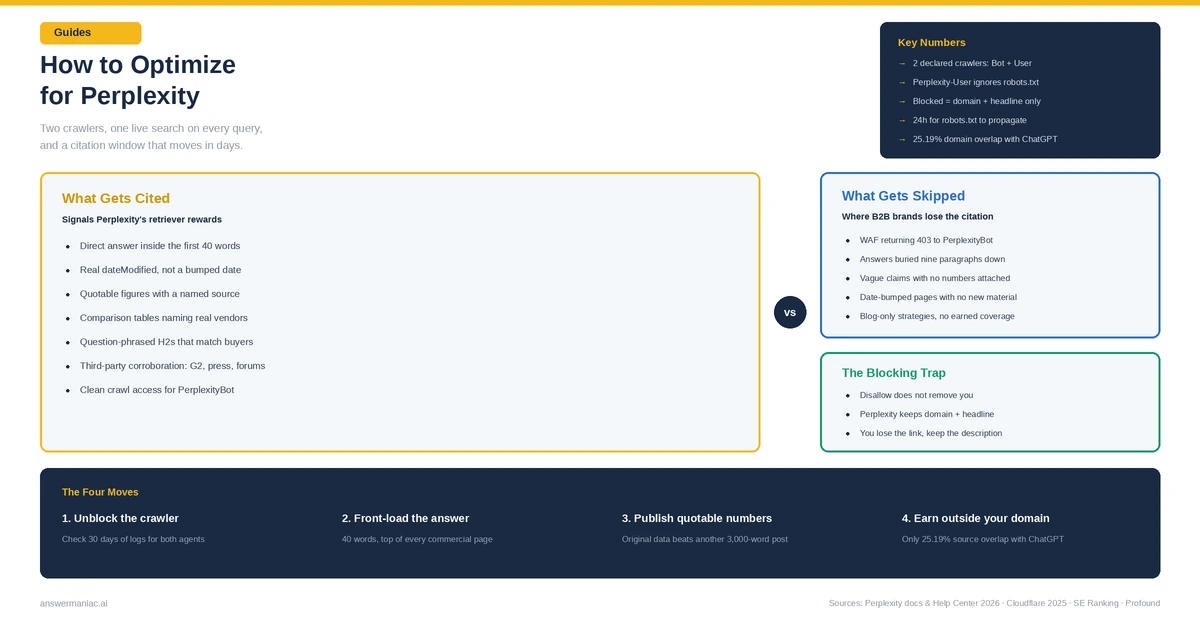
PerplexityBot(surfaces and links sites in Perplexity search results) andPerplexity-User(user-initiated page fetches, which per Perplexity's own docs "generally ignores robots.txt rules")- Blocking PerplexityBot in robots.txt does not remove you. Perplexity states it "may still index the domain, headline, and a brief factual summary" (Perplexity Help Center, updated July 16, 2026)
- Perplexity says it does not build foundation models, so allowed content is not used for AI model pre-training (Perplexity Help Center)
- robots.txt changes take up to 24 hours to reflect in Perplexity's systems (Perplexity docs)
- Cloudflare de-listed Perplexity as a verified bot in August 2025 after observing undeclared crawlers rotating user agents and ASNs across tens of thousands of domains and millions of requests per day
- The Perplexity Publishers' Program launched July 30, 2024 with TIME, Der Spiegel, Fortune, Entrepreneur, The Texas Tribune, and WordPress.com, and expanded in December 2024 to include the Los Angeles Times, The Independent, Adweek, Blavity, Prisa Media, and Lee Enterprises
- CEO Aravind Srinivas said at Bloomberg Tech 2025 that Perplexity processed 780 million queries in May 2025, growing more than 20% month over month. By mid-2026, Perplexity processes over 1 billion monthly queries (60–70 million daily) and surpassed 230 million monthly active users in Q1 2026
- Perplexity crossed $450 million ARR in March 2026, targeting $656 million by end of year (company disclosures)
- Perplexity and ChatGPT share only 25.19% of their cited domains (SE Ranking AI search comparison study)
Perplexity Is a Retrieval Engine Wearing a Chatbot's Clothes
This is the part most B2B teams get wrong, and it costs them months.
ChatGPT and Perplexity look similar. A box, a question, an answer with links. Underneath they behave nothing alike.
Profound analyzed roughly 700,000 US English-language ChatGPT conversations from October to December 2025 and found about 18% triggered at least one web search. The other 82% were answered from the model's existing parameters. So when you publish a new page and hope ChatGPT picks it up, you're playing for a minority of sessions.
Perplexity doesn't work that way. It was built as an answer engine on top of live retrieval. It searches, ranks, and cites on essentially every query. That's the whole product. And as of mid-2026, it's doing that across more than 1 billion monthly queries from 230 million-plus active users. This isn't a niche tool anymore.
Two practical consequences follow.
First, your feedback loop is short. A page you publish today can appear in a Perplexity citation this week, because there's no waiting for a model retrain. If you've ever wondered why AI visibility work feels like shouting into a void, it's usually because you were measuring it on ChatGPT. Perplexity is where you'll see movement first.
Second, the crawler matters more than the model. If PerplexityBot can't reach your page, no amount of content quality saves you. This is a plumbing problem before it's a content problem, and we've now found blocked or WAF-throttled Perplexity crawlers in a meaningful share of the technical audits we run. Nobody blocked it on purpose. It came bundled in a Cloudflare bot-fight setting or an AWS WAF managed rule that somebody enabled two years ago and never revisited.
For a broader comparison of how the major engines differ, see how to rank in Perplexity.
The Two Crawlers, and Why the Difference Matters
Perplexity publishes documentation for exactly two user agents. Most robots.txt files treat them as one thing. They aren't.
| User agent | What it does | Respects robots.txt |
|---|---|---|
PerplexityBot | Crawls and indexes pages so they can be surfaced and linked in Perplexity search results. Not used to collect content for foundation model training. | Yes |
Perplexity-User | Visits a page in response to a specific user question, then links to it in the answer. | Per Perplexity's docs, generally ignores robots.txt because a user requested the fetch |
The full user-agent strings are:
Mozilla/5.0 AppleWebKit/537.36 (KHTML, like Gecko; compatible; PerplexityBot/1.0; +https://perplexity.ai/perplexitybot)
Mozilla/5.0 AppleWebKit/537.36 (KHTML, like Gecko; compatible; Perplexity-User/1.0; +https://perplexity.ai/perplexity-user)
If you want to be citable, your robots.txt should say so explicitly:
User-agent: PerplexityBot
Allow: /

User-agent: Perplexity-User
Allow: /
Perplexity notes that changes can take up to 24 hours to propagate through its systems, so don't panic-check the next morning.
The WAF layer is where this actually breaks
robots.txt is a request. Your firewall is a wall. Plenty of sites "allow" PerplexityBot in robots.txt while Cloudflare or AWS WAF quietly returns a 403 to every request.
Perplexity publishes live IP ranges for both agents:
https://www.perplexity.com/perplexitybot.jsonhttps://www.perplexity.com/perplexity-user.json
Perplexity's own guidance is to match on user agent and source IP together, then set the action to Allow with higher priority than your blocking rules. Automate the IP refresh. Those endpoints change, and a hardcoded list from last quarter is a slow leak.
Check your server logs for both user agents before you write another word of content. If you see zero PerplexityBot hits in 30 days, you have a crawl problem, not a content problem. The technical side of this is covered in more depth in how to get traffic from Perplexity.
What Blocking Actually Costs You
Here's the detail almost nobody knows, and it changes the calculus for legal and comms teams who want to block AI crawlers by default.
Perplexity's Help Center states that PerplexityBot will not index the full or partial text of a site that disallows it. But it adds that "if a page is blocked, we may still index the domain, headline, and a brief factual summary."
Read that again. Blocking doesn't make you invisible in Perplexity. It makes you a nameplate. Perplexity can still describe your company, potentially from third-party sources and stale summaries, while removing your ability to shape that description with your own words or earn a link back.
That's the worst of both worlds for a B2B brand. You lose the citation and keep the misrepresentation.
Perplexity also states it does not build foundation models, so allowing PerplexityBot doesn't feed your content into pre-training the way some other crawlers do. That's a genuinely different risk profile from the AI-training crawlers, and it's worth putting in front of whoever owns your robots.txt policy.
The Cloudflare problem
Now the uncomfortable part, because pretending it doesn't exist would be dishonest.
In August 2025, Cloudflare published research alleging that Perplexity used stealth, undeclared crawlers to get around no-crawl directives. According to Cloudflare, when Perplexity's declared crawler was blocked, requests continued from rotating user agents and different ASNs, across tens of thousands of domains and millions of requests per day. Cloudflare de-listed Perplexity as a verified bot and added heuristics to block the behavior.
Perplexity's Help Center now addresses the history directly, saying the URL-summarization feature that let users pull blocked content has been disabled, that PerplexityBot only crawls in compliance with robots.txt, and that its third-party crawler partners have updated agreements to respect robots.txt, particularly for news publisher sites.
Both things can be true: the current documented behavior is compliant, and the enforcement history is contested. What it means for you practically is that "we blocked it" and "it isn't crawling us" are different claims. Verify with logs.
What Makes Content Citation-Worthy in Perplexity
Perplexity retrieves a set of candidate pages per query, then decides which ones survive into the answer with a citation number next to them. Most retrieved pages get dropped. Your job is to be the page that isn't.
Under the hood, Perplexity uses a three-layer source selection pipeline: keyword and semantic retrieval to build a candidate set, cross-encoder reranking to score relevance, and a final ML reranker that weighs entity signals alongside content quality. You don't need to understand the internals to act on them, but it explains why some of the following tactics work.
Four things move the needle, roughly in order of impact.
1. Answer the question in the first 40 words. Perplexity is extracting a claim, not reading your intro. If the answer to "what is the best fleet maintenance software for mid-market operators" appears in paragraph nine, you're not going to be the source. Put a direct answer block at the top of every commercial page. This is the same discipline that wins featured snippets, applied to a system with no second page.
2. Show the date, and make it real. Freshness signals matter more on Perplexity than on any other engine, because it runs live retrieval. Perplexity cites content published within the last 30 days at an 82% rate, and including visible year signals like "2026" in titles and body copy improves citation rates by roughly 30%. Publish dates, dateModified in your Article schema, and inline references to the current year all help. What doesn't help is bumping the date without changing the content. That's cosmetic, and it's the single most common thing we tell clients to stop doing.
3. Give it numbers it can quote. Perplexity's answers are dense with figures because figures are extractable and verifiable. A page that says "adoption is growing fast" loses to a page that says "adoption grew from 12% to 31% between Q1 2025 and Q1 2026, per our survey of 412 fleet operators." Original data is the strongest citation asset you can build, and it's the core of what we mean by Information Gain in The ANSWER Framework.
4. Get corroborated somewhere else. Perplexity's source set skews toward third-party and community domains. SE Ranking's comparison study found Perplexity and ChatGPT overlap on only 25.19% of cited domains, which means a source strategy tuned for ChatGPT is roughly three-quarters wrong for Perplexity. Reviews on G2, genuine participation in relevant subreddits, industry publication coverage, and analyst mentions all feed a different retrieval pool than your own blog does.
That last one is the part most B2B teams underinvest in, and it's the hardest to fake. We go deeper on the mechanics in Perplexity citations for B2B and on the earning side in how to get cited by Perplexity AI. For the broader argument about why this kind of visibility work compounds into pipeline, see AEO vs. SEO: the pipeline impact.
Format matters more than length
Perplexity favors content it can slice. In practice that means:
- Question-phrased H2s that mirror how buyers actually ask
- Comparison tables with real vendor names and real numbers
- Short paragraphs, two to four sentences
- FAQ blocks with FAQPage schema
- Lists where a list is genuinely the right structure, not as filler
A 1,200-word page structured this way will out-cite a 4,000-word essay on the same topic. Length is not a ranking factor here. Extractability is.
The Publishers' Program: What It Is, and Whether It Applies to You
Perplexity launched the Publishers' Program on July 30, 2024. The launch partners were TIME, Der Spiegel, Fortune, Entrepreneur, The Texas Tribune, and WordPress.com. In December 2024 it expanded to include the Los Angeles Times, The Independent, Adweek, Blavity, Prisa Media, Lee Enterprises, and others.
Per Perplexity's announcement, the program has three components: a revenue share when Perplexity earns advertising revenue from an interaction referencing a partner's content, free access to Perplexity's APIs so partners can build their own on-site answer engines, and free Enterprise Pro for all partner employees for one year.
Now the honest read for a B2B software company: this is a media program, and you are almost certainly not the target.
That doesn't make it irrelevant. It tells you something useful about where Perplexity sources from. Perplexity is paying to keep publishers in its index, which means publisher domains carry structural weight in its retrieval pool. If TIME, Fortune, and the LA Times are inside a formal partnership, coverage on domains like those is worth more in Perplexity than a comparable link is worth in Google.
The tactical translation for a B2B marketer isn't "apply to the Publishers' Program." It's "your digital PR budget has a higher return on Perplexity than your blog budget does." Which is an uncomfortable thing to tell a content team, but the data points that way.
A Prioritized Perplexity Checklist
| Priority | Action | Why it matters |
|---|---|---|
| P0 | Audit server logs for PerplexityBot and Perplexity-User hits over 30 days | Zero hits means every downstream tactic is wasted effort |
| P0 | Explicitly Allow both agents in robots.txt | Removes ambiguity from wildcard disallow rules |
| P0 | Add WAF allow rules matching user agent AND published IP ranges | robots.txt compliance is meaningless if the firewall returns 403 |
| P1 | Add a 40-word direct answer block to the top of every commercial page | Direct extraction target for the citation |
| P1 | Implement Article, FAQPage, and Organization schema with accurate dateModified | Machine-readable freshness and entity signals |
| P1 | Build a fixed prompt set of 30 to 50 real buyer questions and track citations weekly | You cannot optimize what you don't measure |
| P2 | Publish one original-data asset per quarter (survey, benchmark, teardown) | Quotable figures are the strongest citation asset you can build |
| P2 | Run a third-party corroboration campaign: G2, industry press, analyst briefings | Perplexity's source pool skews away from brand-owned domains |
| P2 | Refresh top commercial pages on a 90-day cycle with genuinely new material | Live retrieval rewards real recency, not date-bumping |
How to Measure Whether Any of This Worked
Perplexity gives you two things ChatGPT mostly doesn't: visible citation links and referral traffic with a real referrer.
Track four numbers.
- Citation rate. Across your fixed prompt set, how often does a Perplexity answer include one of your URLs? Keep the prompt set frozen or your trend line is noise.
- Referral sessions from perplexity.ai. These show up in GA4 as a normal referral. Segment them. AI-referred visitors behave differently from organic ones, and Semrush's 2025 analysis put the average AI search visitor's value at roughly 4.4 times a traditional organic search visitor. One framing note: ChatGPT still leads AI referral traffic at 74.78%, with Perplexity at 7.23% as of 2026. The volume gap is real, but Perplexity's referral traffic is growing faster and converts differently. For the ChatGPT side of this equation, see the B2B ChatGPT citation playbook.
- Citation position. Being source three in an answer is worth more than being source eleven, and most users never expand the full source list.
- Mention without citation. Perplexity sometimes describes a vendor in the answer text without linking it. Track brand-name appearances separately from URL citations, because they move on different timelines.
One caution on tooling. Every AI visibility platform samples prompts differently and refreshes on different schedules, so comparing your score across two tools tells you nothing. Pick one, freeze the prompt set, and measure your own trend. We walk through the setup in AI visibility tracking and compare the platforms in the best generative engine optimization tools for 2026.
If you want the click side of this rather than the citation side, how to get clicks from Perplexity and the Perplexity click-through strategy cover the conversion layer. For background on the platform itself, there's the complete guide to Perplexity AI search in 2026.
Frequently Asked Questions
Does blocking PerplexityBot remove my site from Perplexity?
No. Perplexity's Help Center states that PerplexityBot will not index the full or partial text content of a site that disallows it, but that Perplexity "may still index the domain, headline, and a brief factual summary." You lose the citation link and the ability to shape how you're described, and you keep the risk of being described inaccurately from other sources. For most B2B companies that trade is a bad one.
What's the difference between PerplexityBot and Perplexity-User?
PerplexityBot is the indexing crawler that builds Perplexity's search index and respects robots.txt. Perplexity-User is the fetcher that visits a page when a specific user's question requires it, and Perplexity's documentation states it generally ignores robots.txt because the fetch was user-initiated. Neither is used to collect content for foundation model training, since Perplexity says it does not build foundation models.
How is optimizing for Perplexity different from optimizing for ChatGPT?
Perplexity runs a live web search on essentially every query. Profound found that only about 18% of ChatGPT conversations trigger a web search at all. That means Perplexity rewards freshness, crawl access, and extractable structure, and it rewards them quickly. ChatGPT rewards entity strength and third-party corroboration accumulated over a longer horizon. The source pools barely overlap either: SE Ranking measured 25.19% shared cited domains between the two.
Should my B2B company try to join the Perplexity Publishers' Program?
Probably not. The program is aimed at media organizations and content publishers, and its partner list is dominated by outlets like TIME, Fortune, the Los Angeles Times, and The Independent. The strategic takeaway for a B2B brand isn't to apply. It's that publisher domains carry structural weight inside Perplexity's index, so earned coverage on those properties is disproportionately valuable compared with what the same link does in Google.
How fast can a new page get cited by Perplexity?
Faster than on any other AI surface, because there's no model retrain in the loop. Once PerplexityBot has crawled a page and it's in the index, it's eligible for retrieval on the next matching query. There's no published benchmark, and anyone quoting you a fixed number of days is guessing. What we can say is that the constraint is usually crawl access and index freshness, not a waiting period.
Does schema markup help with Perplexity citations?
Schema makes your page cleanly parseable, which is a precondition for reliable extraction, not a ranking lever on its own. Perplexity has never published a weighting for structured data. Treat Article with an accurate dateModified, FAQPage, Organization, and Product markup as table stakes. The differentiating work is content structure, genuine freshness, and third-party corroboration.
How big is Perplexity compared to ChatGPT for B2B search?
Perplexity surpassed 230 million monthly active users in Q1 2026 and processes over 1 billion queries per month. It's smaller than ChatGPT by user count, and ChatGPT leads AI referral traffic at 74.78% versus Perplexity's 7.23%. But the gap is narrowing fast. Perplexity's revenue crossed $450 million ARR in March 2026, and its user base grew roughly 66% year over year. More importantly, Perplexity sends referral traffic with a clean referrer, so you can actually measure what it's doing in your pipeline. That alone makes it worth prioritizing.
How does Perplexity decide which sources to cite?
Perplexity uses a three-layer pipeline: keyword and semantic retrieval to build a candidate set, cross-encoder reranking to score relevance against the query, and a final ML reranker that factors in entity signals alongside content quality. The practical implication is that both your content relevance and your entity authority matter. A well-structured page that directly answers the query gets retrieved. A page from a recognized, corroborated entity gets promoted through reranking. You need both. We cover the entity side in The ANSWER Framework.
Sources
- Perplexity, "Perplexity Crawlers" (official API documentation)
- Perplexity Help Center, "How does Perplexity follow robots.txt?" (updated July 16, 2026)
- Perplexity, "Introducing the Perplexity Publishers' Program" (July 30, 2024)
- Cloudflare, "Perplexity is using stealth, undeclared crawlers to evade website no-crawl directives" (August 2025)
- TechCrunch, "Perplexity expands its publisher program" (December 5, 2024)
- Adweek, "Perplexity Adds The Independent, LA Times, Blavity, and Others to Its Publisher Revenue-Sharing Program"
- SE Ranking, "ChatGPT vs Perplexity vs Google vs Bing: AI Search Engine Comparison"
- Semrush, "26 AI SEO Statistics for 2026"
- Profound, "How ChatGPT sources the web" (February 2026)
Get AEO Insights Weekly
Join 500+ B2B marketers getting AI visibility tactics every Tuesday.
Ready to Get Your Brand Cited by AI?
See how your competitors show up in ChatGPT, Perplexity, and Gemini — and what it would take to get recommended.