How to Get Traffic from Perplexity: The Ultimate Guide
Turn Perplexity's citations into consistent referral traffic. This guide shows you the content formats and authority signals the AI engine actually trusts.
Direct Answer: You get traffic from Perplexity by creating content it views as authoritative, current, and contextually relevant. When a user asks a question, Perplexity scans the web, generates an answer, and cites sources with clickable links. To earn those citations: structure content with answer-first summaries, build trust through third-party mentions (G2, Reddit, industry publications), implement Article and FAQ schema markup, and keep content regularly updated. Track results by filtering GA4 for perplexity.ai referrals.
Get a free AI visibility audit to see where your brand stands
You get traffic from Perplexity by creating content it views as authoritative, current, and contextually relevant to the user's question. When a user asks a question, the AI scans the web for relevant answers. If your page is selected as a source, it may be cited with a direct link, which can send highly qualified visitors, especially for research-driven queries.
It's not about keyword density, it's about becoming the obvious, cited reference. This process rewards a unique blend of deep expertise and clear communication. If you want those referral clicks, you need to speak the language of the new search. Let's break down exactly how to do that.
Key Takeaways
- Structure for Scanners: Use answer-first summaries, bullet points, and tables so Perplexity's AI can easily parse and cite your content.
- Build a Trust Cluster: Secure mentions on high-authority sites like Reddit, G2, or industry publications to prove your credibility to the AI.
- Track the Right Signals: Monitor your progress with tools filtered for AI referrals, not just traditional organic traffic.
How Perplexity AI Drives High-Intent Referral Traffic
Perplexity AI drives traffic through citations, not search rankings. A user asks a question. The AI answers conversationally and then cites its sources right in the response. That citation is a clickable link back to your site.
This changes SEO. You're not fighting for a spot on a results page. You're competing to be the definitive source the AI chooses to cite. The traffic comes from users who are already deep in their research, making it highly qualified.
Perplexity appears to use its own crawling and retrieval systems, often referred to as PerplexityBot, alongside live web search to discover and reference content. It scans the web looking for pages to index. It favors content with clear authority, direct answers, and clean structure. Think of it like a librarian picking the best reference book for a patron's specific question.
To attract this traffic, focus on being useful. Create content that answers complex questions completely and clearly. If your page is the best resource on a topic, it becomes prime material for the AI to reference. The resulting click is a direct referral from an engaged user. For a broader view of how this fits into the Perplexity ecosystem, see our Perplexity citations B2B guide.
Observed Citation Factors in the Perplexity Index
Perplexity's ranking is based on a few key factors. You can think of them as layers of trust.
| Ranking Factor | What Perplexity Evaluates | How to Optimize for It |
|---|---|---|
| Authority & Trust | Domain reputation, backlink quality, and brand recognition across the web | Earn mentions from authoritative sites, industry blogs, and trusted communities like Reddit or G2 |
| Freshness & Relevance | How recent and contextually accurate the content is | Regularly update articles, refresh examples, and align content with current user questions |
| Content Quality & Structure | Clarity, depth, and E-E-A-T signals | Use answer-first summaries, clear headings, tables, and author credentials |
| Technical Foundation | Crawlability, speed, and structured data | Implement Article and FAQ schema, optimize load times, and ensure clean HTML structure |
Authority & Trust: A strong domain matters. Sites with established backlinks and a reputation signal reliability, which the AI needs for its citations.
Freshness & Relevance: Updated content ranks better. For time-sensitive or evolving topics, a recently updated article is often more valuable than content published several years ago. Track how fast your presence grows with citation velocity metrics.
Content Quality & Structure: The AI looks for E-E-A-T (Experience, Expertise, Authoritativeness, Trustworthiness). Author credentials and a site's reputation in its field are important signals. Third-party citations of your work are a strong plus.
Technical Foundation: Technical clarity that helps AI parse content, such as clean HTML structure, fast load times, and structured sections. Your site must be technically sound:
- Use FAQ and Article schema markup so the AI can parse your content's structure
- Ensure fast page load times
- Cover topics comprehensively, using related terms and concepts beyond a single keyword
Content Structures That Maximize AI Citations
Write for Two Readers: The Person and the Machine
Your goal is to make information effortless for an AI to find and use.
Adopt an Answer-First Approach
Begin each section with a direct, one-sentence answer to the implied question. Place this summary before the detailed explanation. This gives the AI a clear signal.
Format for Scannability
Use clear headings (H2, H3) to define sections. Break up text with bulleted lists, numbered steps, or simple tables. Pages organized this way are far more likely to be cited. Avoid large, unbroken paragraphs.
Optimize Your Page Structure
Consider this format for a key topic:
- A brief summary answering the core question
- Headings for each major subtopic
- A concise answer at the start of each section
- Supporting details in lists or data points
- Descriptive alt text for images
- Links to related articles on your site
This approach doesn't simplify your expertise. It clarifies it, making your content the most efficient source for the AI to reference. For the full list of content formats that perform best, see our AI citation playbook with 23 content types.
The Role of Third-Party Mentions in Perplexity SEO
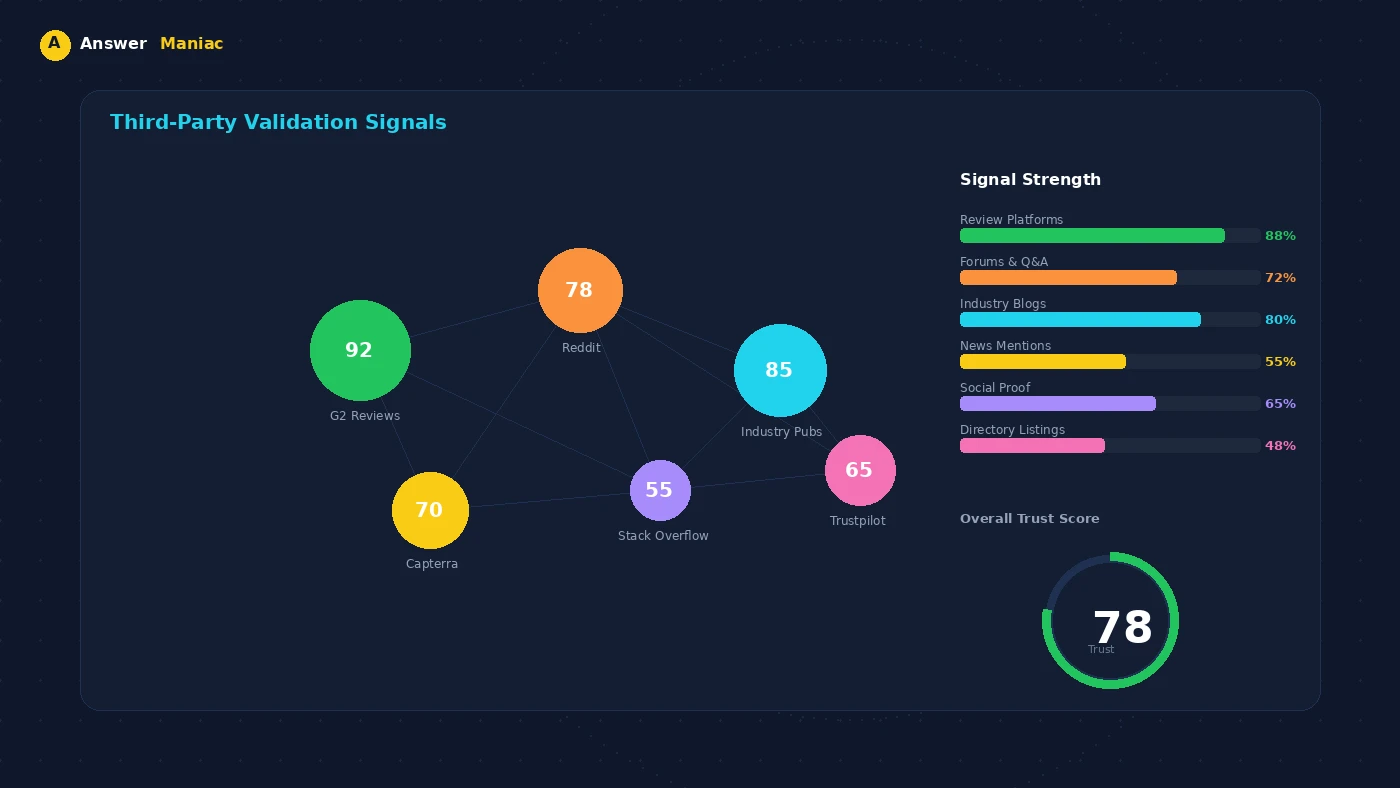
Perplexity cross-references information. It looks for consensus to confirm you're a trustworthy source. Think of it as building a "trust cluster." The AI scours the web for signals that validate your authority.
A mention on a reputable site (like ZDNet or a major industry blog) acts as a powerful vote of confidence. Beyond formal publications, the AI may reference user-generated platforms when they demonstrate clear consensus or expert discussion.
"Reddit threads where users actively discuss or recommend a solution are frequently cited by Perplexity and can reinforce topical relevance through consensus signals." - Emily Paxton[1]
Verified reviews on sites like G2 or Capterra serve as direct social proof.
These signals tell Perplexity you're a safe, recommended choice. Off-site signals become increasingly important alongside on-page clarity.
To evaluate how strong your trust signals are compared to competitors, an AI citation tracking dashboard allows you to monitor citation patterns, third-party mentions, and which domains Perplexity consistently prefers to reference.
Getting featured in "best of" lists is for AI citations, not just backlinks. Encouraging detailed customer reviews is an AI optimization tactic. You're building a moat of trust signals the AI will use to justify citing your domain over a competitor's.
Using Perplexity Pages as a Traffic Growth Channel
Some practitioners report referral traffic from Perplexity-hosted Pages, though outcomes vary and this behavior is not formally documented by Perplexity. Think of it as a tool for building a shareable, citable resource. The strategy for traffic growth involves both creation and inclusion.
First, you can create your own Pages. Focus on topics central to your business. Use the AI to gather the latest information and embed your own blog posts or tools as key sources.
To understand whether Perplexity Pages are actually driving visibility and clicks, a lightweight AI citation monitoring setup helps you quickly see when and where your content is being cited inside AI-generated answers.
Second, aim to be included in Pages that other users build. When someone researches a topic you cover, you want your website to be one of the sources the AI suggests. This requires having clear, authoritative content that the AI can easily reference.
Being cited in multiple Pages builds your visibility and trust within the platform's ecosystem, consistently sending qualified visitors your way.
Tracking and Measuring AI-Driven Referral Traffic
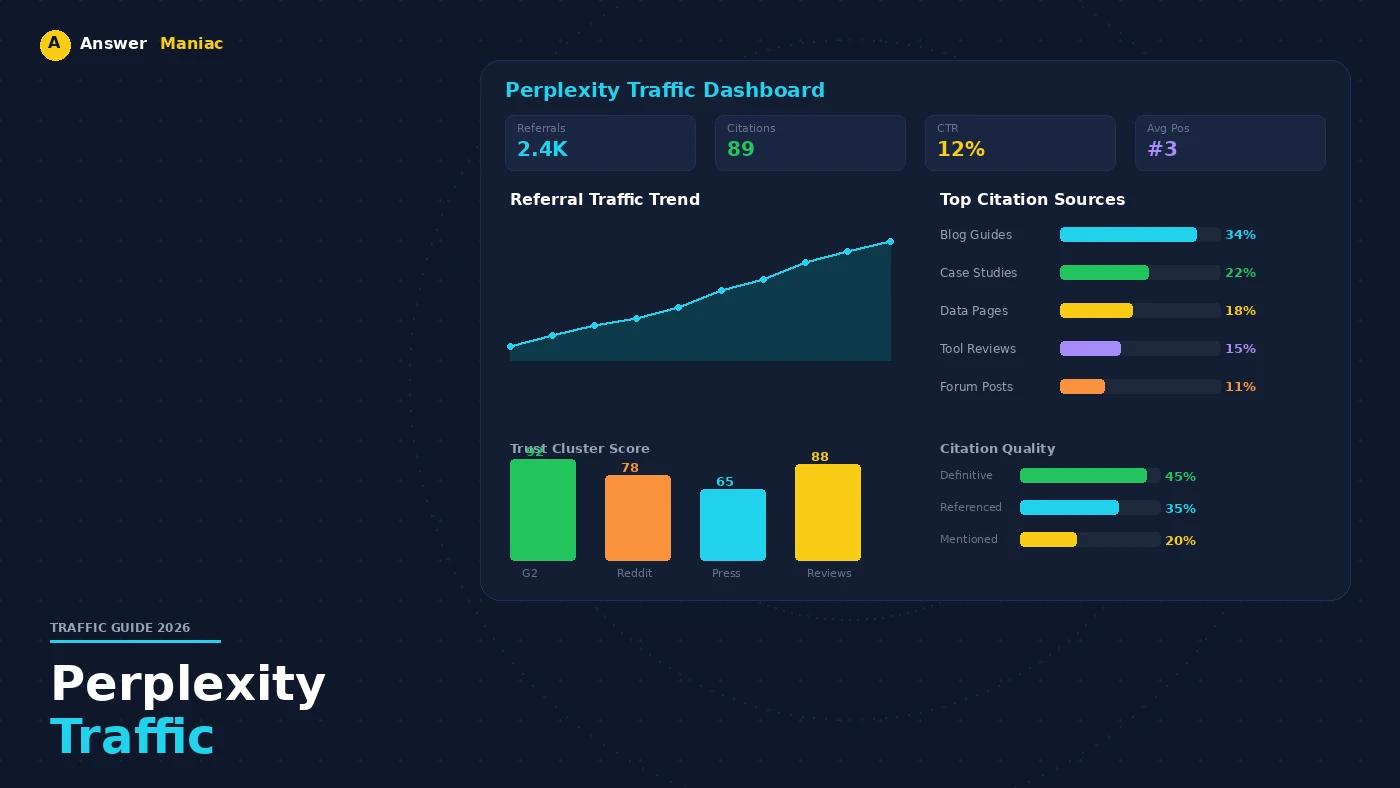
Tracking traffic from Perplexity requires specific setup, as it often gets lost in standard analytics. Visitors from AI platforms can sometimes be mislabeled as 'Direct' or 'Organic' traffic in GA4.[2]
To fix this, create a custom segment in GA4. Look for the Perplexity user-agent string, or filter your traffic by referral source domains that contain "perplexity.ai." This separates your AI referrals from other channels, giving you a true count.
But raw traffic is only part of the story. You also need to track citations, how often and for what queries your content is referenced by Perplexity. This is where specialized tools help.
- Platforms like Semrush are adding AI search tracking features
- Dedicated tools like Otterly.ai are built to monitor brand citations across various AI engines
These tools show you which questions your site answers, and more importantly, which competitors are being cited instead. This gap analysis tells you where to improve your content to capture more AI-driven visibility and traffic.
To understand how often your brand appears inside AI-generated answers, you need AI visibility tracking, which focuses on monitoring citations, prompts, and AI-driven brand exposure beyond traditional rankings.
FAQ
How can Perplexity AI SEO and generative engine optimization drive new AI search traffic?
Perplexity AI SEO uses generative engine optimization to attract AI search traffic. Focus on GEO strategies like answer-first content structure, plain language writing, and semantic relevance. Use conversational queries, long-tail Perplexity queries, and tables for AI parsing. These steps help you increase likelihood of citation and earn steady referral traffic from Perplexity.
What technical signals help pages rank higher in Perplexity results?
PerplexityBot crawling favors fast loading pages, structured data schema, and strong domain authority signals. Use FAQ schema markup and Article schema implementation for a visibility boost. Apply content freshness updates and regular refresh cycles. These improve entity recognition and support E-E-A-T for AI.
How does content structure improve visibility for Perplexity user agents?
Answer-first content structure, bullet point summaries, and plain language writing help Perplexity user agents parse content. Add semantic keyword variations, multimedia content optimization, and interlinked authority pages. Use topical content clusters and embed links naturally. This improves AI mentions tracking, hybrid organic metrics, and schema visibility over time.
How do citations, reviews, and authority sources affect AI ranking?
Trusted source citations and third-party references improve credibility. Best-of list mentions, DA 70+ site features, G2 user testimonials, and Reddit authority threads send strong user-generated content signals. These support E-E-A-T for AI and increase citation rates in AI answers.
How can tracking and testing improve referral traffic from Perplexity?
Use GA4 referral tracking, Perplexity user agent logs, and manual Perplexity testing. Monitor with Semrush, Ahrefs, and dedicated AI tracking tools. Run competitor gap analysis, content iteration cycles, and quarterly content refreshes. Measure traffic spikes, internal case studies, and relative uplift trends observed after content updates.
Your Next Step with Perplexity Traffic
Getting traffic from Perplexity isn't about gaming a new system, it's about mastering fundamentals. Focus on authoritative, question-driven content that's easy for humans and machines to trust. Shift from keywords to clarity, from links to citations, and from rankings to being the source AI confidently references.
That's a practical framework for Generative Engine Optimization as it exists today. If you want to turn GEO into a repeatable growth channel, start optimizing with AnswerManiac or get your free AI Visibility Audit.
References
- 85% of Brand Mentions in AI Search Come From... - Emily Paxton on LinkedIn
- About Traffic Sources in GA4 - Google Analytics Help
Related Articles
Get AEO Insights Weekly
Join 500+ B2B marketers getting AI visibility tactics every Tuesday.
Ready to Get Your Brand Cited by AI?
See how your competitors show up in ChatGPT, Perplexity, and Gemini — and what it would take to get recommended.