How to Rank in AI Search Engines: ChatGPT, Perplexity, Gemini & More
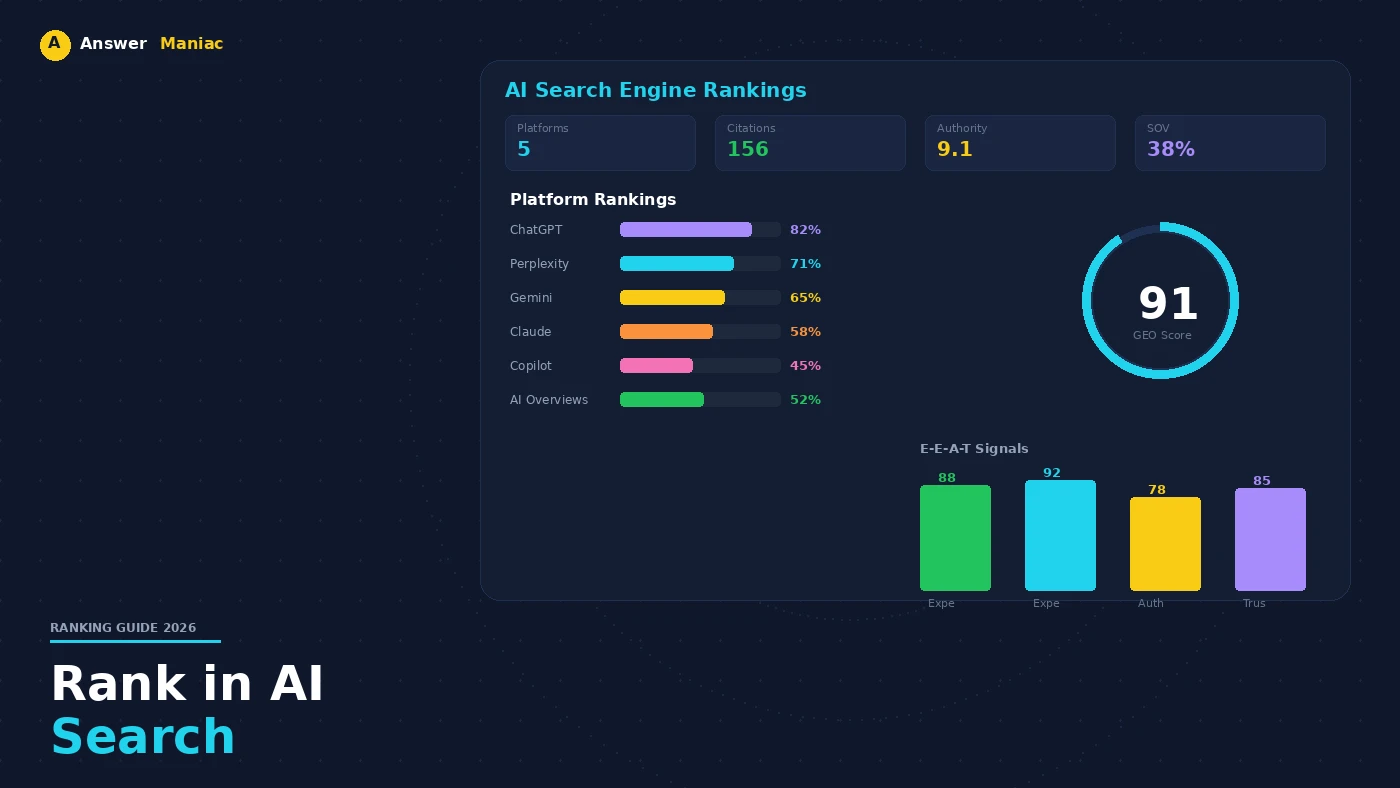
A practical guide on how to rank in AI search engines across ChatGPT, Perplexity, Gemini, and beyond, what actually works now.
Direct Answer: You rank in AI search engines by becoming the most trusted, structured, and validated source for your topic. Optimize content for machine extraction (answer-first intros, clear headers, schema markup), build topical authority through deep content clusters, earn external validation from reviews, forums, and publications, and ensure technical crawlability for AI bots. Each platform — ChatGPT (Bing-powered), Perplexity (citation-heavy), Gemini (E-E-A-T focused) — has unique signals, but authority and structure are universal.
Get a free AI visibility audit to see where your brand stands
You rank in AI search by becoming the go-to source that AI tools like ChatGPT, Perplexity, and Gemini trust enough to name and quote. This isn't about keyword tricks or chasing blue links anymore. It's about showing that your content is the safest, clearest, and most accurate answer an AI can share without second-guessing.
Traditional SEO helps your page get found, but AI search rewards something different: authority, clarity, and proof. If you want steady, high-quality traffic from AI answers, you need a new playbook, one designed for being quoted, not just ranked. Keep reading to learn the exact steps that actually make a difference.
Key Takeaways
- Structure content for extraction, not just consumption, using clear headers, lists, and schema markup so AI can easily pull precise answers.
- Build topical authority around specific commercial questions by creating dense, evidence-based content clusters that position your brand as the expert.
- Prove your trustworthiness with external validation signals, from expert collaborations to mentions on reputable platforms, showing AI you are a consensus choice.
What is Generative Engine Optimization (GEO)?
Think of traditional SEO as a popularity contest judged by algorithms. Generative Engine Optimization, or GEO, is more like an audition for a role as a trusted expert. Your goal is not just to be seen by Google's crawlers, but to be chosen and cited by an AI's reasoning process.
When someone asks ChatGPT for the best project management software for remote teams, it looks across the web to find information. Then it puts that information together to give one clear, helpful answer. GEO is the practice of structuring your content so it becomes the preferred source in that synthesis.
The core shift is from keywords to entities and from links to citations. AI models understand the world through entities, people, places, products, concepts. They build connections between them. Your job is to clean up how AI perceives your brand entity. Are you clearly connected to the right products, claims, and expertise? This is called your Knowledge Graph, and enriching it is step one. For a deep dive into this, see our guide on entity optimization and knowledge graphs.
In 2026, visibility in AI search is fundamentally a function of Topical Authority. You must own a specific slice of the conversation so thoroughly that AI has no choice but to point to you.
"Generative engine optimization (GEO) is the practice of optimizing digital content and online presence to enhance visibility in AI-driven search results and generative AI responses." - Wikipedia[1]
Optimizing Content for ChatGPT and Bing Search
ChatGPT's browsing capability, powered by Bing, acts as its window to the real-time web. To rank here, your content must be the clearest windowpane. Bing's index favors clean, fast-loading HTML and straightforward answers. The model isn't reading for pleasure, it's scanning for a definitive, concise summary it can relay.
- Front-load the core answer in the first 100 words. State the conclusion, then explain.
- Use simple, factual language. Avoid jargon and clever phrasing that might confuse parsing.
- Format with clear headers (H2, H3) and bulleted lists to create obvious entry points for information extraction.
- Incorporate relevant schema markup, like FAQ or HowTo, to give Bing extra context about your page's purpose.
OpenAI integrates Bing Search to verify and retrieve current data. If your page takes too long to load or is cluttered with intrusive scripts, it might be skipped. Speed and clarity win. Think of it as preparing a briefing document for a very busy executive, which in this case, is the AI.
How Perplexity Works as an Answer Engine
Perplexity is different from other AI search tools because it calls itself an answer engine, and it really means it. It's built for research. ChatGPT often gives friendly, easy-to-read summaries. Perplexity works differently. It focuses on clear answers with proof. It shows where its information comes from by linking to studies, trusted news sites, and even Reddit to include real user opinions.
Because of this, your content strategy has to do two things well: show strong authority and provide solid facts. Perplexity prefers content that goes deep. A detailed guide with sources, references, charts, or data will usually beat a short blog post. It looks for evidence, not guesses.
Mentions in industry newsletters or expert roundups are especially powerful because they show outside experts trust your content. To get cited, your page must explain not just what something is, but why it matters and how it works, clearly and with proof. For Perplexity, it's not about being the loudest answer. It's about being the best-supported one. Learn more in our guide on Perplexity citations for B2B.
The Role of E-E-A-T in Google Gemini Rankings
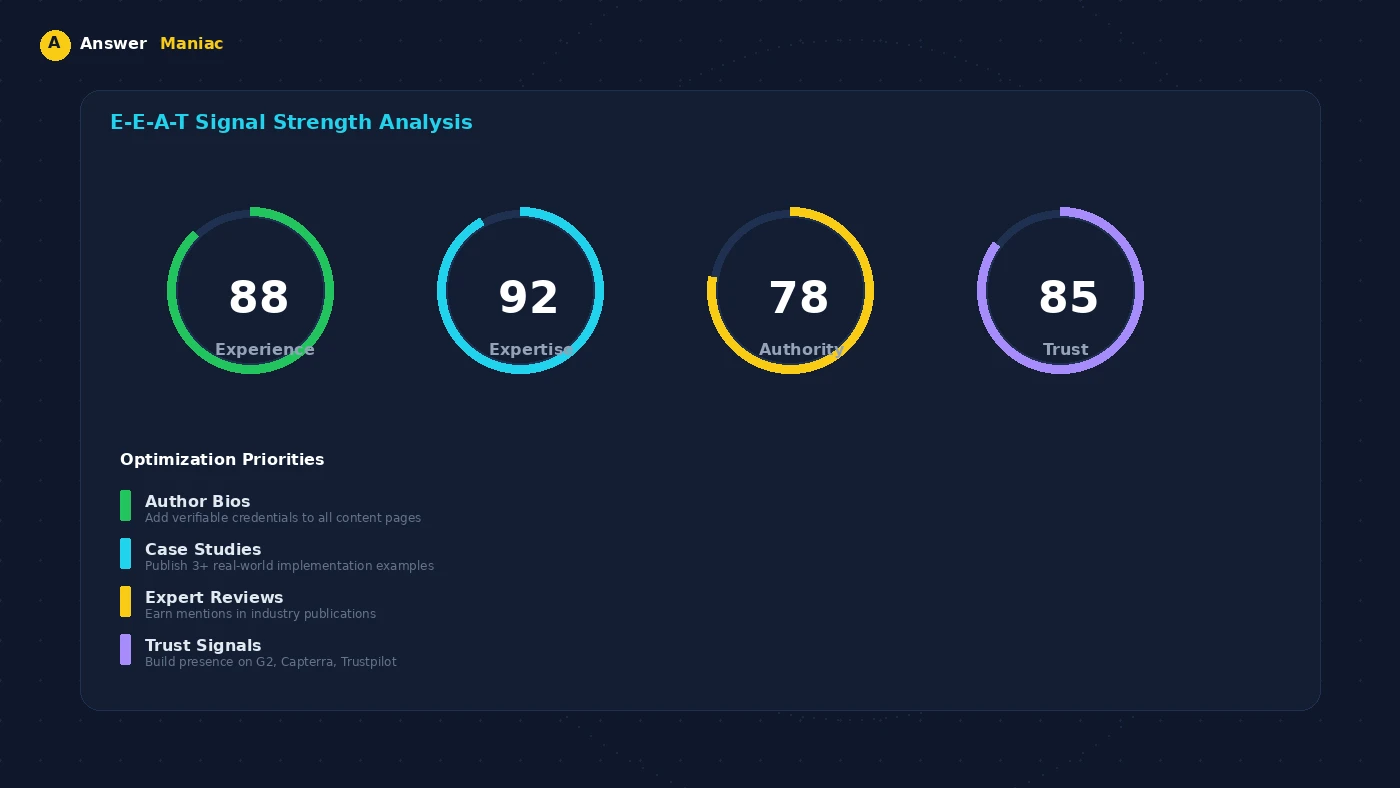
Gemini is not a separate universe, it's deeply integrated into the Google ecosystem you already know. This means the foundational pillars of Google's Search Quality Rater Guidelines, Experience, Expertise, Authoritativeness, and Trustworthiness (E-E-A-T), are absolutely critical.
Gemini is designed to leverage Google's knowledge graph and its understanding of entity relationships. If your site has strong E-E-A-T signals for Google Search, you're already ahead for Gemini.[2]
Gemini favors content that naturally answers the questions users have. Pages that already appear in "People Also Ask" boxes or as featured snippets are prime candidates for Gemini citations. To optimize, explicitly create content that targets these question-based queries. Use a clear, helpful tone. Showcase author bios with verifiable credentials. Publish case studies that demonstrate real-world experience.
Google's AI is looking for the same markers of reliability its human raters are trained to find. By solidifying your E-E-A-T, you're building a foundation that works across both traditional and AI-powered Google search experiences. For Gemini-specific tactics, see our Gemini AI visibility guide.
Content Structures That Perform Best in LLM Retrieval
AI models use a process called retrieval-augmented generation (RAG). They first retrieve relevant chunks of text from sources, then generate an answer.
When your content is organized into clean information blocks like tables, lists, and schemas, it becomes much easier to analyze performance using an AI citation tracking dashboard that shows which formats are most frequently retrieved and cited by AI models. Noisy, unstructured paragraphs are hard to use. Clean, scannable formats are easy.
The goal is to reduce cognitive load for the machine. Think in information blocks.
| Element | Benefit for AI Ranking | Example |
|---|---|---|
| Bullet or Numbered Lists | Allows for quick, clean snippet extraction without reformatting | "Top 5 features," "Three implementation steps" |
| Schema Markup | Provides machine-readable context about your content's type and structure | Implementing FAQPage or HowTo schema |
| Tables | Presents structured comparisons or data in a consistent format ideal for parsing | Pricing grids, product specification comparisons |
Using Schema.org markup significantly increases the likelihood of your content being understood and cited correctly. A simple table comparing tools isn't just helpful for a human reader, it's a perfectly packaged data point for an AI to grab and present. Our AI citation playbook covers the 23 content types that get cited most.
Implementing Technical GEO for AI Search Visibility
Technical optimization ensures AI crawlers can access, understand, and trust your site. Once your technical foundations are in place, you should set up AI citation monitoring to confirm whether AI systems like ChatGPT, Perplexity, and Gemini are actually pulling from your pages. It's the unglamorous, essential groundwork.
- Consider experimenting with llms.txt as the standard matures. Similar to robots.txt, this file can provide guidance to large language model agents about which parts of your site are suitable for crawling and training.
- Audit and enhance your structured data. Use Google's Rich Results Test to ensure your schema markup is error-free and deployed on key commercial pages. Consistency here is a major trust signal.
- Prioritize core web vitals and site speed. A slow site frustrates users and crawlers alike. AI tools with real-time browsing won't wait around.
- Ensure a clean, semantic HTML structure. Avoid over-reliance on JavaScript to render critical content. AI crawlers often see a site more like the text-based Lynx browser of the 90s.
- Create a logical internal linking structure. Use descriptive anchor text that reinforces entity relationships and helps distribute authority to your most important content clusters.
Measuring Performance and Visibility in AI Search
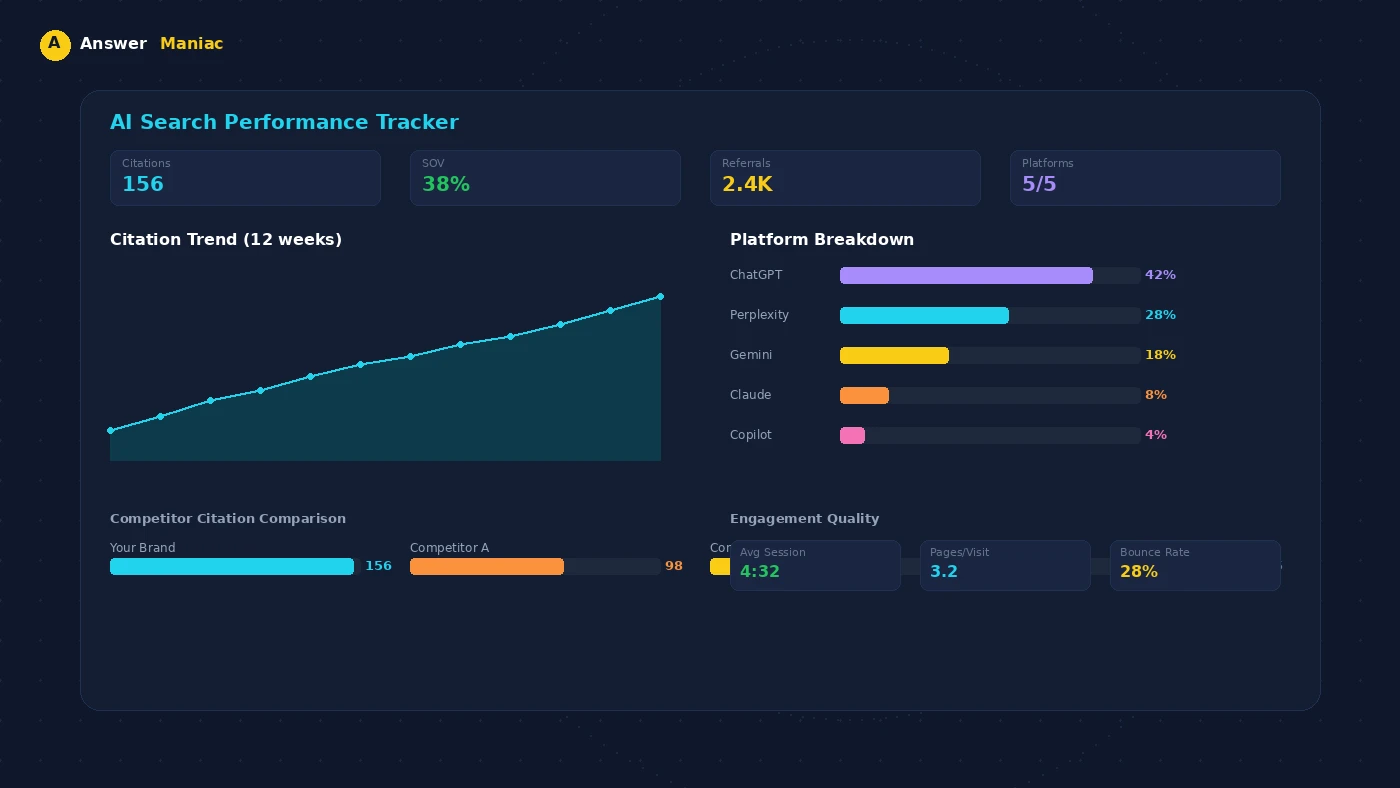
Traditional rank-tracking tools don't apply in AI search, which is why AI visibility tracking has become essential for understanding where and how your brand appears in generated answers.
- Manual Query Tracking: Each week, run your target commercial questions through ChatGPT, Perplexity, and Gemini. Document which brands and URLs are cited. Are you there? Is it a competitor? This is your primary performance metric.
- Analytics Segmentation: Watch your referral traffic. Look for direct referrals from domains like perplexity.ai or chatgpt.com. While not all AI traffic is tagged, an upward trend is a strong indicator.
- Monitor Engagement Metrics: When traffic comes from these sources, look at the session duration and pages per session. Is the AI sending you qualified visitors who engage? High engagement proves your cited content is relevant.
- Track Brand Mentions Without Links: Use a media monitoring tool to see where your brand is discussed on forums, in newsletters, or on sites like Reddit. AI picks up on these mentions as signals of real-world relevance.
The Click-Through Rate (CTR) from an AI citation is often hidden, but the referral and the subsequent user behavior tell the real story. Success is a growing number of citations for your core commercial answers. The rate at which those citations grow is your citation velocity.
FAQ
How does AI search optimization improve ChatGPT ranking and Gemini visibility?
AI search optimization improves ChatGPT ranking and Gemini visibility by aligning content with how AI systems evaluate answers. It uses conversational search optimization, semantic keywords, and user intent analysis. Clear headings, front-loaded answers, and short paragraphs help extraction. Following Google standards and keyword relevance supports stronger AI engine ranking and AI Overviews ranking.
What content formats work best for Perplexity SEO and answer engine SEO?
Perplexity SEO performs best with fact-based lists, bullet lists, numbered steps, and table comparisons. These formats support answer engine SEO because they are easy to scan and cite. Concise summaries, Q&A blocks, and precise facts improve featured snippets and zero-click answers for voice search users.
How do E-E-A-T signals and topical authority influence AI engine ranking?
E-E-A-T signals and topical authority help AI systems judge trust and depth. Expert collaborations, case studies, and authoritative backlinks strengthen credibility. External citations boost accuracy, while user-generated authority adds real-world context. Content freshness and update frequency signals show reliability. These factors improve AI engine ranking for long-tail queries.
Which technical elements help AI crawlers understand and rank content?
Structured data, FAQ schema, and HowTo schema help machines interpret pages. Site speed and clean internal linking improve access. Technical audits identify issues early. Bing index support and SGE optimization improve overall visibility. An llms.txt file guides AI crawlers to the right content.
How can publishers measure and improve AI search performance?
Publishers should use referral traffic monitoring, engagement metrics, and session duration analysis to measure value. Query testing and competitor benchmarking reveal gaps. Phrase query analysis and tools like AlsoAsked support question-based keywords. Tracking trending topics, low-competition queries, and high-volume terms improves conversational query performance and natural language SEO results.
Your Path to Being the Answer
Ranking in AI search engines isn't a mystery, it's a methodology. Success comes from shifting focus from outdated metrics to the new currency: citations. By structuring content for machine extraction, building undeniable topical authority, and earning external validation, you train AI systems to see your brand as the safest, most reliable answer.
The shift may feel daunting, but the path is clear. With AnswerManiac, you can audit your current AI visibility, uncover gaps, and start earning the citations that matter. Get your free AI Visibility Audit to see where you stand.
References
Related Articles
Get AEO Insights Weekly
Join 500+ B2B marketers getting AI visibility tactics every Tuesday.
Ready to Get Your Brand Cited by AI?
See how your competitors show up in ChatGPT, Perplexity, and Gemini — and what it would take to get recommended.