Perplexity Citations: How B2B Companies Get Featured in Answer Threads
Learn how to get your B2B brand cited in Perplexity AI answer threads. Step-by-step guide to Perplexity's citation algorithm and content requirements.
Direct Answer: Perplexity uses a retrieval-augmented generation (RAG) pipeline that searches the live web, selects the most relevant sources, and weaves them into answers with numbered inline citations. To get your B2B brand cited in Perplexity answer threads, you need content that is fresh (updated within the last 6 months), structurally clear (headings, lists, tables), topically specific (one focused question per page), and backed by original data or expert authority. Unlike ChatGPT, which draws primarily from training data, Perplexity fetches and cites sources in real time -- meaning your content's discoverability, structure, and authority determine whether it earns a numbered reference in the answer.
Run a free AI Visibility Audit at answermaniac.ai to see whether Perplexity is already citing your competitors instead of you.
Perplexity is not just another chatbot. It is an answer engine that behaves more like a research analyst than a search engine. Every answer it generates includes numbered inline citations that link directly to the sources it pulled from. For B2B marketers, this changes the game: if your content earns one of those citation slots, you get brand visibility, credibility, and referral traffic every time a buyer asks a question in your category. If you do not earn a citation, your brand does not exist in that conversation.
This guide breaks down exactly how Perplexity's citation system works, what it looks for in a source, and how B2B companies can systematically earn those inline references.
Key Takeaway
- Perplexity cites sources with numbered inline references linked directly to the original page, making each citation a high-value brand touchpoint that drives both visibility and click-through traffic
- Content freshness and structural clarity are the two strongest signals for earning Perplexity citations -- pages updated within the last 6 months with clear headings and extractable data blocks outperform older or narrative-heavy content
- Five content formats consistently earn Perplexity citations: comparison tables, data-backed claims, step-by-step guides, expert opinion pieces, and original research -- and B2B companies that publish in these formats see measurably higher citation rates
How Perplexity's Citation System Works
Understanding Perplexity's citation mechanics is essential before you try to optimize for it. Perplexity does not work the way ChatGPT or traditional search engines do. It combines three distinct processes into a single answer experience.
The RAG pipeline
Perplexity uses retrieval-augmented generation, or RAG. When a user enters a query, here is what happens in sequence:
- Query analysis -- Perplexity interprets the question, identifies the intent, and determines what type of information is needed (a definition, a comparison, a list of options, a how-to, etc.)
- Live web retrieval -- Instead of relying solely on pre-trained knowledge, Perplexity sends the query to its web index and retrieves a set of candidate sources from across the internet in real time
- Source evaluation and ranking -- The retrieved sources are scored on relevance, authority, freshness, and structural clarity. Only the top-scoring sources move forward
- Answer generation with inline citations -- The language model synthesizes information from the selected sources and generates a cohesive answer. Each factual claim or key point is tagged with a numbered citation that links to the specific source it was drawn from
This means Perplexity's citations are not decorative. They are a functional part of the answer architecture. Every numbered reference corresponds to a real page that Perplexity judged to be the best available source for that specific piece of information.
How Perplexity differs from ChatGPT
The distinction matters for B2B marketers because the optimization strategy is fundamentally different.
ChatGPT generates answers primarily from its training data -- the massive dataset it was trained on, which has a knowledge cutoff. When ChatGPT mentions a brand or cites a source, it is drawing from patterns learned during training, not from a live web search. This means earning ChatGPT citations requires building a strong entity presence across the training corpus over time.
Perplexity, by contrast, searches the web fresh for every query. Your content does not need to be in a training dataset. It needs to be live, indexable, and structured in a way that Perplexity's retrieval system can find it, evaluate it, and extract from it right now. This makes Perplexity more responsive to content changes -- and more accessible for B2B companies that are starting their AI visibility optimization efforts today.
Inline references vs. footnote citations
Perplexity places citation numbers directly next to the claims they support, inline within the answer text. A typical Perplexity answer might read: "B2B buyers now use AI search tools in 80% of vendor evaluations [1], and companies that appear in AI answers see up to 5x higher conversion rates [2]."
Each bracketed number links to a specific source. Users can click through to read the full page. This inline format means your brand name and page title appear in the citation list at the bottom of every answer where you are referenced -- creating repeated brand exposure even when the user does not click.
What Perplexity Looks For in a Source
Perplexity's source selection is not random. Through extensive testing and analysis, four factors consistently determine whether a page earns a citation slot.
Freshness
Perplexity heavily weights recency. Pages with recent publish dates or clearly updated timestamps outperform older content on the same topic. For B2B companies, this means your cornerstone content needs active maintenance. A comprehensive guide published in 2024 with no updates will lose citation positions to a less thorough but recently published 2026 article.
What to do: Update your top 20 content pages quarterly. Change the publish date, refresh statistics, add new sections, and remove outdated references. Perplexity notices.
Authority
Perplexity evaluates the credibility of a source using signals similar to E-E-A-T: who wrote the content, what domain it sits on, how many authoritative sites link to it, and whether the author or organization has recognized expertise in the topic. A page on cybersecurity best practices from a known security vendor with named expert authors will outrank a generic blog post on a low-authority domain.
What to do: Add named author bios with credentials. Build backlinks from industry publications. Publish on a domain with a consistent, established entity presence across platforms like LinkedIn, G2, and Crunchbase.
Structure
Perplexity's retrieval system needs to extract specific facts and claims from your page. Content that is structured with clear headings, bullet points, numbered lists, and tables is significantly easier for the system to parse and cite than long-form narrative paragraphs.
What to do: Format every key page with a clear H1 that matches a real query, a direct answer in the first 150 words, and supporting content organized in lists and tables. See our content strategy guide for AI visibility for detailed formatting frameworks.
Specificity
Perplexity prefers sources that answer a specific question thoroughly over pages that cover many topics superficially. A page titled "How to Choose an ERP System for Mid-Market SaaS Companies" will be cited over a page titled "Everything You Need to Know About ERP" when a user asks a specific ERP selection question.
What to do: Build topic-specific pages that target one buyer question per URL. Avoid mega-guides that try to cover an entire category on a single page. Depth on a narrow topic beats breadth on a wide one.
5 Content Formats Perplexity Loves to Cite
Not all content is equally citable. These five formats consistently earn the highest citation rates in Perplexity answer threads based on our analysis of B2B-related queries.
1. Comparison tables
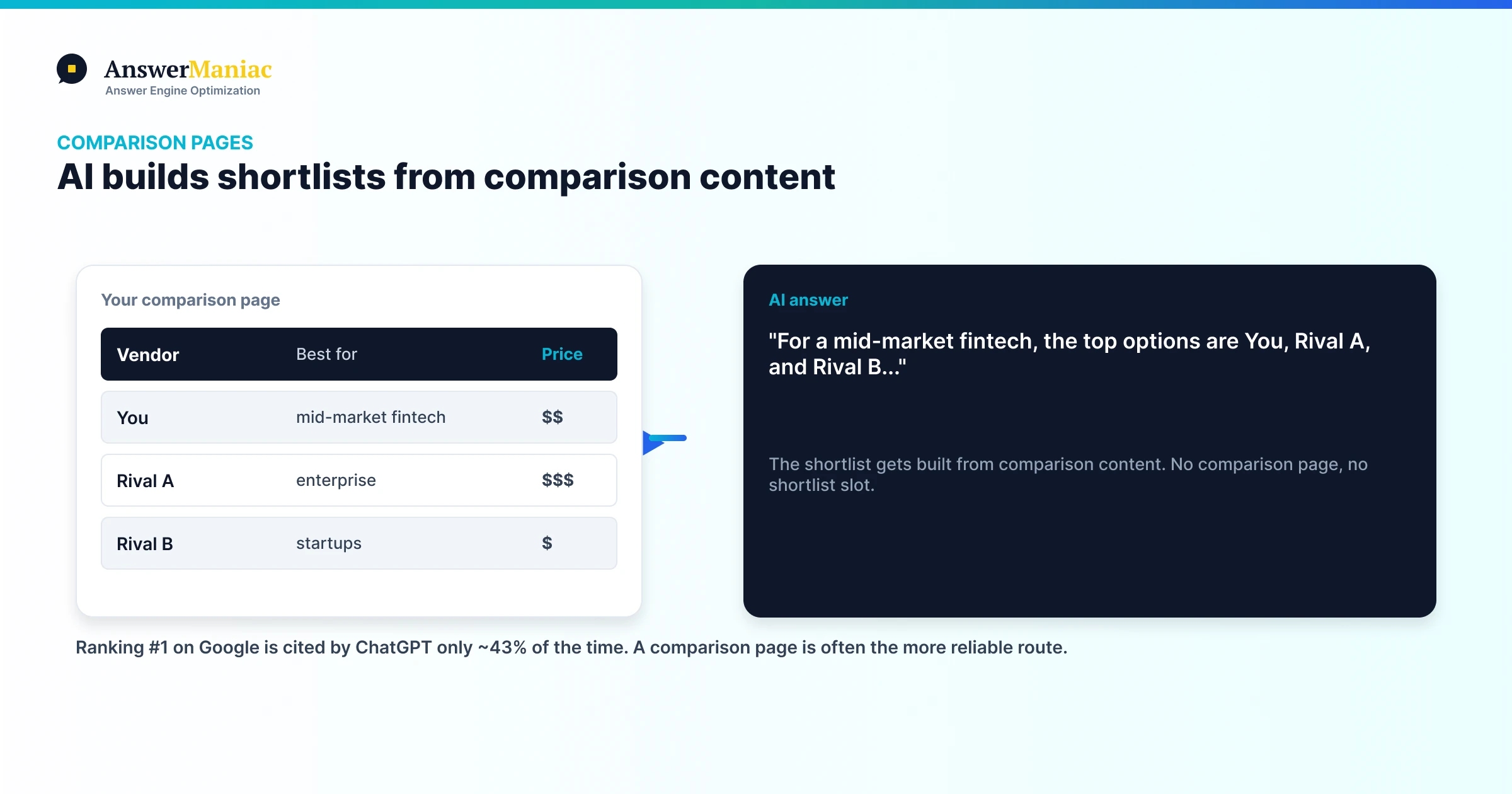
When a user asks Perplexity to compare two or more tools, platforms, or approaches, it actively seeks structured comparison data. Pages that present comparisons in a clean table format -- with rows for each feature and columns for each option -- are cited at disproportionately high rates.
Example: A page comparing "HubSpot vs. Salesforce for mid-market B2B companies" with a table covering pricing tiers, integration capabilities, reporting features, and implementation timelines.
2. Data-backed claims with specific numbers
Perplexity prioritizes sources that contain specific, verifiable data points. Statements like "B2B companies that implement schema markup see a 40% increase in AI citation rates" are more citable than "schema markup helps with AI visibility." The more specific and original the data, the more likely Perplexity will reference your page as the authoritative source.
Example: An industry benchmark report stating "In our analysis of 500 B2B SaaS websites, companies with FAQPage schema were cited by Perplexity 3.2x more often than those without structured data."
3. Step-by-step guides
Perplexity frequently generates how-to answers for procedural queries. When it does, it looks for pages that present steps in a clear, numbered sequence. Each step becomes a discrete, extractable unit of information that Perplexity can cite independently or as part of a synthesized answer.
Example: A guide titled "How to Implement a Vendor Evaluation Scorecard in 7 Steps" with each step as a separate H2 or H3 section.
4. Expert opinion pieces with named authors
When a query involves judgment or recommendations ("What is the best approach to..."), Perplexity weights content from named experts with verifiable credentials. Opinion content from an anonymous blog carries less citation weight than a bylined piece from a recognized industry practitioner.
Example: A VP of Product at a supply chain software company publishing "Why Most Mid-Market Companies Get Warehouse Automation Wrong" with the author's name, title, company, and a brief bio.
5. Original research and proprietary data
This is the highest-value content format for Perplexity citations. Original research -- surveys, benchmarks, case studies with real numbers -- cannot be replicated by competitors. When Perplexity encounters a unique data point that only exists on your page, your page becomes the only possible citation source for that claim.
Example: "Our 2026 State of B2B AI Adoption report, based on a survey of 1,200 B2B marketing leaders, found that 62% have no AI visibility strategy despite 80% acknowledging its importance."
The Perplexity Optimization Checklist
Use this 10-item checklist to audit and optimize your content for Perplexity citation eligibility. Work through it for every high-priority page on your site.
-
1. Page title matches a real buyer query -- Your H1 should closely mirror a question or search phrase your target buyer types into Perplexity. Use conversational, specific phrasing rather than keyword-stuffed titles.
-
2. Direct answer in the first 150 words -- Within the opening paragraph, provide a clear, self-contained answer to the question posed in your title. This is the block Perplexity is most likely to extract and cite.
-
3. Content updated within the last 6 months -- Check that your publish date or "last updated" timestamp is recent. Refresh statistics, add new examples, and remove outdated references to signal freshness.
-
4. Named author with credentials -- The page includes an author byline with the person's name, title, and a brief bio that establishes their expertise on the topic. Anonymous or "admin" authorship weakens your citation candidacy.
-
5. At least one structured data block -- Include at least one comparison table, numbered list, or bullet-point summary that Perplexity can extract as a discrete, citable unit of information.
-
6. Schema markup implemented -- Add relevant schema markup (FAQPage, HowTo, Article, or Product) to give Perplexity's crawler structured metadata about your content.
-
7. One focused topic per page -- The page answers one specific question or covers one narrow subtopic in depth. Avoid combining multiple unrelated subjects on a single URL.
-
8. External authority signals present -- The page (or the domain) has backlinks from reputable industry sites, and your brand is mentioned on third-party platforms that Perplexity trusts as authority indicators.
-
9. Original data or unique insight included -- The page contains at least one proprietary data point, original statistic, or unique expert perspective that cannot be found on competitor pages.
-
10. Mobile-friendly and fast-loading -- Perplexity's web crawler needs to access and render your page quickly. Pages that load slowly or are poorly optimized for mobile may be skipped during the retrieval phase.
Score yourself: 8-10 items checked means your page is strongly positioned for Perplexity citations. 5-7 means you have gaps to close. Below 5 means the page is unlikely to earn citations in its current form.
Perplexity vs ChatGPT vs Gemini: Citation Differences
Understanding how each major AI engine handles citations helps you prioritize your optimization efforts. The differences are significant.
| Feature | Perplexity | ChatGPT | Gemini |
|---|---|---|---|
| Source retrieval | Live web search for every query | Primarily training data; web browsing in Plus/Enterprise | Hybrid: training data + Google Search integration |
| Citation format | Numbered inline citations with clickable links | Occasional source mentions; links only with browsing mode | Inline links in AI Overviews; conversational mentions in chat |
| Citation frequency | Every factual claim is cited (5-15 citations per answer) | Sporadic; many answers have zero explicit citations | Moderate; AI Overviews typically cite 3-6 sources |
| Content freshness weight | Very high -- prefers recently published/updated content | Low -- limited by training data cutoff unless browsing | High -- leverages Google's real-time index |
| Optimization path | Publish well-structured, fresh, authoritative content now | Build long-term entity presence across the web | Traditional SEO + structured data + E-E-A-T |
| Click-through potential | High -- citations are prominent and clickable | Low -- users rarely leave the chat interface | Moderate -- AI Overviews compress traditional click-through |
| Best content format | Comparison tables, data-backed claims, step-by-step guides | Comprehensive definitions, entity-rich pages | FAQ-structured content, local data, product comparisons |
| Time to first citation | Days to weeks (if content is live and indexed) | Months to years (requires training data inclusion) | Weeks to months (depends on Google indexing and authority) |
The key takeaway from this comparison: Perplexity is the most accessible AI engine for B2B companies that want citation results quickly. Because it searches the web live and cites sources aggressively, well-optimized content can earn citations within days of being published or updated. ChatGPT requires a longer-term strategy focused on entity building, while Gemini sits between the two. For a comprehensive approach across all engines, see our complete AI visibility guide.
Real Examples: B2B Pages That Get Cited
These are realistic examples based on patterns we observe in B2B pages that consistently earn Perplexity citations. Each illustrates a different citation-earning strategy.
Example 1: The Comparison Page That Owns a Category Query
Company: A mid-market project management SaaS vendor Page: "Monday.com vs Asana vs [Our Platform]: Feature Comparison for Teams Over 100" Why Perplexity cites it: The page contains a detailed feature comparison table with 15+ rows covering pricing, integrations, reporting, permissions, and support tiers. Each cell contains specific data (not vague descriptions like "good" or "enterprise-grade"). The page is updated monthly with current pricing, and the author is the company's Head of Product with a full bio and LinkedIn link.
Result: When a user asks Perplexity "What is the best project management tool for large teams?", this page earns a citation because it is the most structurally clear, specific, and current comparison available. The company's brand appears in the citation list alongside the well-known competitors -- creating the perception of category parity.
Example 2: The Original Research Report That Becomes the Default Source
Company: A B2B marketing analytics platform Page: "2026 State of B2B Marketing Attribution: Survey of 800 Marketing Leaders" Why Perplexity cites it: The page contains proprietary survey data that no other source can replicate. Specific findings like "Only 23% of B2B marketing teams can attribute revenue to individual content pieces" and "Companies using multi-touch attribution models report 34% higher confidence in budget allocation" are unique to this report. The data is presented in clearly labeled charts with text summaries beneath each one, making extraction straightforward.
Result: Any time a user asks Perplexity about B2B marketing attribution, this report is cited because the data points are original and cannot be sourced elsewhere. The company earns citations not just for their own brand queries but for the entire topic area -- a powerful authority signal.
Example 3: The Step-by-Step Guide That Answers a Procedural Question
Company: A B2B cybersecurity compliance platform Page: "How to Prepare for a SOC 2 Audit: 9-Step Checklist for SaaS Companies" Why Perplexity cites it: The page is structured as a numbered checklist where each step is a separate H2 section with 2-3 paragraphs of explanation and a concrete action item. The page includes a downloadable template, estimated time per step, and common mistakes for each phase. The author is the company's CISO with 15 years of compliance experience, and the page links to three published case studies of companies that completed the process using the platform.
Result: When a user asks Perplexity "How do I prepare for a SOC 2 audit?", this page earns multiple inline citations across different steps of the answer. The company's brand appears several times in a single answer thread -- multiplying the visibility impact of a single piece of content.
FAQ
How long does it take to get cited by Perplexity?
Because Perplexity searches the live web in real time, new or updated content can earn citations within days of being published -- provided the page is indexed, structurally optimized, and on a domain with established authority. This is significantly faster than ChatGPT, which requires inclusion in training data, or Gemini, which depends on Google's indexing pipeline. That said, earning consistent citations across multiple queries typically takes 4-8 weeks of sustained optimization. Publishing a single optimized page may earn a citation quickly, but building a presence that covers your full range of buyer queries requires a systematic content strategy for AI visibility.
Does Perplexity prioritize certain domains or site types?
Perplexity does not maintain a public whitelist of preferred domains, but its source selection patterns show clear preferences. Established industry publications, vendor sites with strong E-E-A-T signals, recognized review platforms (G2, Capterra, TrustRadius), and government or academic sites (.gov, .edu) consistently earn citation positions. For B2B vendors, having your own site cited alongside these trusted sources requires demonstrable authority -- named experts, original data, external backlinks, and consistent entity information across the web. Generic content on low-authority domains rarely earns citations regardless of how well it is structured.
Can I track which of my pages Perplexity is citing?
There is no native Perplexity analytics dashboard for publishers, but there are several ways to monitor your citation presence. First, query Perplexity directly with your core buyer questions and check whether your pages appear in the citation list. Second, monitor your referral traffic from Perplexity in Google Analytics -- look for "perplexity.ai" as a referral source. Third, use an AI visibility audit framework to systematically track your citation presence across all major AI engines on a regular schedule. Automated monitoring tools are becoming available, and our AEO and GEO services include ongoing Perplexity citation tracking.
Should I optimize for Perplexity separately from other AI engines?
You should have a unified AI visibility strategy with Perplexity-specific adjustments. The fundamentals -- clear structure, schema markup, authority signals, and original data -- benefit you across all AI engines. However, Perplexity's emphasis on content freshness and its live web retrieval model mean that recently published or updated content has a larger impact on Perplexity than on ChatGPT. Similarly, Perplexity's inline citation format rewards content with discrete, extractable data blocks (tables, lists, statistics) more than some other engines. The best approach is to build a strong AI visibility foundation and then layer in Perplexity-specific tactics like aggressive update schedules and structured comparison content.
Get Your B2B Brand Into Perplexity Answer Threads
Perplexity is where an increasing number of B2B buyers go to research vendors, compare options, and make shortlist decisions. Every answer thread it generates includes numbered citations -- and every citation is a brand visibility opportunity your competitors are either capturing or ceding.
The path to earning those citations is concrete: publish fresh, specific, structurally clear content backed by original data and real expertise. Maintain it. Build authority signals outside your own domain. And monitor the results consistently.
If you want to know exactly where your brand stands today -- which Perplexity queries you appear in, which ones your competitors own, and what gaps you need to close -- start with a baseline score.
View our pricing and audit tools at answermaniac.ai to get a complete picture of your AI visibility across Perplexity, ChatGPT, Gemini, and Google AI Overviews.
Related Articles
Get AEO Insights Weekly
Join 500+ B2B marketers getting AI visibility tactics every Tuesday.
Ready to Get Your Brand Cited by AI?
See how your competitors show up in ChatGPT, Perplexity, and Gemini — and what it would take to get recommended.