How to Appear in ChatGPT Results: 7 Tactics That Actually Work
A tactical guide to how to appear in ChatGPT results, what gets cited, what gets ignored, and the 7 moves that work now.
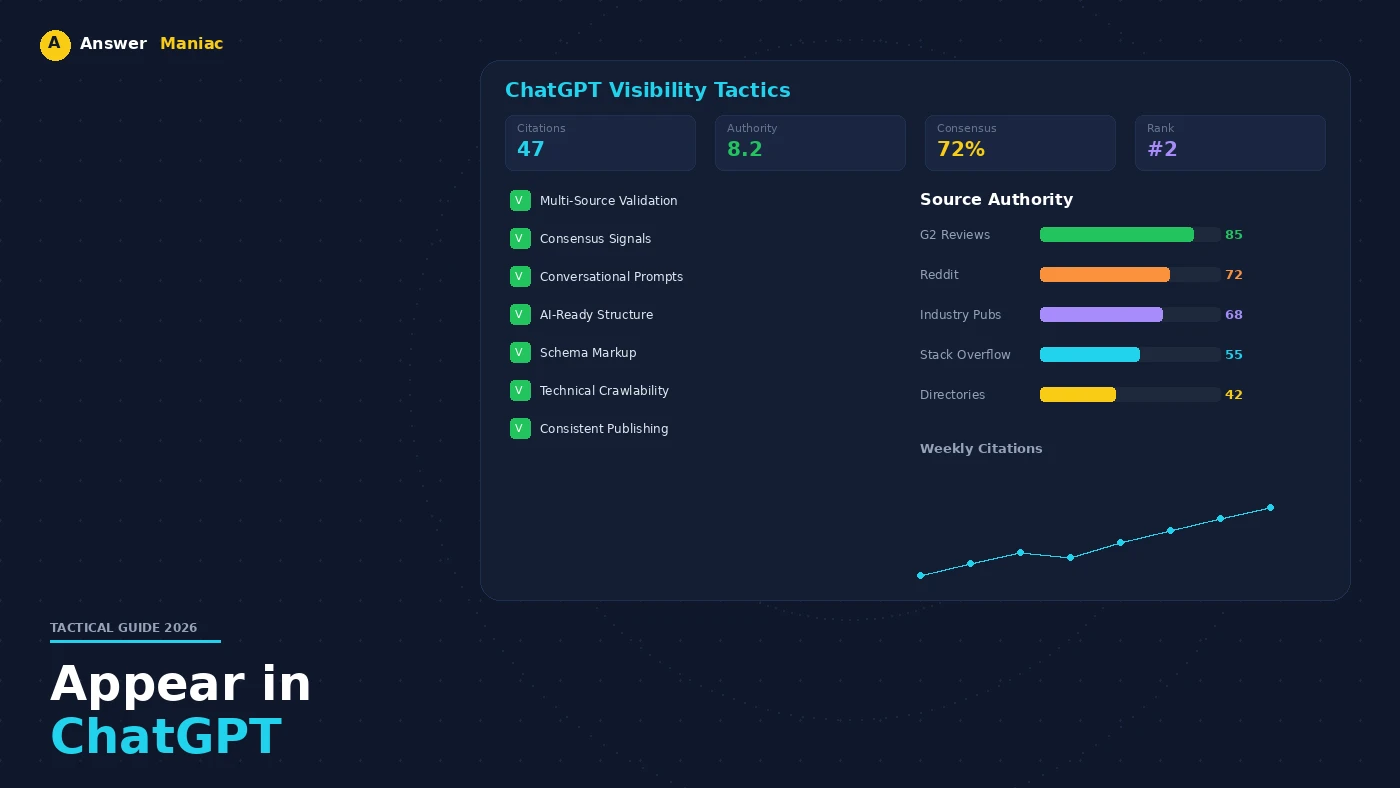
Direct Answer: You appear in ChatGPT results by becoming a trusted, citable source — not by chasing keywords. Build authority through multi-source validation (G2, Reddit, industry publications), structure content for easy AI extraction (answer-first intros, clear H2/H3 hierarchy, schema markup), research real conversational prompts from GSC, ensure technical crawlability for GPTBot, and maintain consistent publishing. ChatGPT favors consensus across independent sources over self-promotion.
Get a free AI visibility audit to see where your brand stands
You appear in ChatGPT results by becoming a trusted, citable source, not by chasing keywords. AI models like ChatGPT surface brands they recognize as authoritative, well-structured, and consistently validated across the web. That means your content must be easy for machines to extract, confident enough to quote, and credible enough to trust.
Traditional SEO signals still matter as foundational inputs, but they are no longer sufficient on their own. What matters now is whether your brand sounds like the safest, clearest answer to a real question. This guide breaks down the practical steps to earn citations, build authority, and show up where decisions are being made. Keep reading to learn how to make your brand the answer AI chooses.
Key Takeaways
- Build authority through multi-source validation on forums and review sites.
- Structure content for easy AI extraction with clear hierarchies and data.
- Maintain visibility with consistent updates and technical bot access.
Build Authority Through Multi-Source Validation
ChatGPT isn't browsing live. Its core knowledge comes from a vast, frozen snapshot of the internet, books, articles, websites, all processed during training. It generates answers based on learned patterns from training data. For current info, it can search. When it does, it acts like a verification engine.
As OpenAI explains:
"We train our models on a mixture of licensed data, data created by human trainers, and publicly available data." - OpenAI[1]
AI systems favor consensus over claims. A single mention on your own website is weak. Repeated mentions across independent, reputable platforms create authority.
Strong validation signals include:
- Review platforms: G2, Capterra, Trustpilot
- Forums and Q&A: Reddit, Quora, Stack Overflow
- Industry publications: Roundups, guest features, expert quotes
- Directories: Local or niche-specific listings
When your brand appears consistently across these sources, AI systems interpret it as a trusted entity rather than self-promotion. Authority is earned through repetition across independent domains. This is exactly what entity optimization and knowledge graph presence is designed to strengthen.
Understand How ChatGPT Selects Sources (Consensus-Based)
Forget traditional keyword hunts. With AI, you're researching how people talk. Start with your own data, Google Search Console is perfect. Look for those long, winding questions and conversational phrases. That's your raw material.
Tools can help track these conversational prompts and surface where answers are actually being pulled from. This comparison of AI citation tracking tools worth using in 2026 shows which platforms reveal real AI visibility instead of vanity metrics. Once you have a list, group them. Cluster related questions into themes, this builds topical authority.
ChatGPT does not browse the web in real time by default. Its core knowledge comes from a fixed training dataset that includes licensed data, human-created data, and publicly available sources.
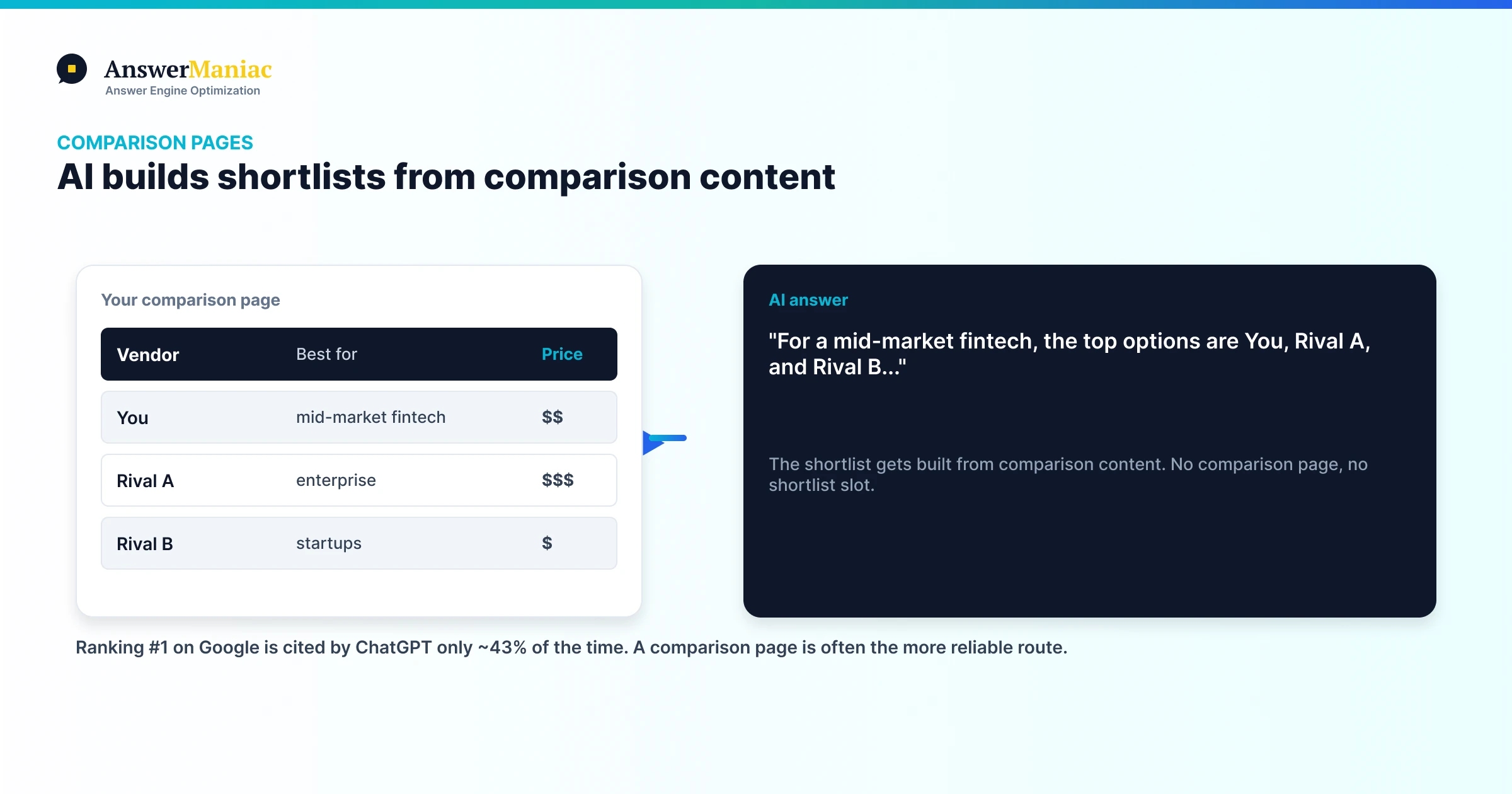
When search is enabled, ChatGPT behaves like a verification engine. It does not select the top-ranking link. Instead, it looks for alignment across multiple credible sources.
A fact gains strength when it appears consistently across:
- News sites
- Educational domains (.edu)
- Established forums
- Authoritative blogs with clear authorship
Clean structure, transparent authorship, recent updates, and reputable domains increase trust. Every citation reflects a calculated attempt to assemble the most defensible answer possible.
Research Real Conversational Prompts
https://www.youtube.com/watch?v=pDOF2ctSzUA Credits: Irene CalcaNeo
You can't win a race if you don't know where the starting line is. That's why analyzing current AI results is a requirement, not a suggestion. Benchmarking is non-negotiable.
Skip the assumptions and go straight to the source. Take your target prompts, the exact questions your customers are asking, and run them through ChatGPT, Perplexity, Gemini, and whatever else is relevant. Then, look closely.
AI optimization starts with how people actually ask questions, not with traditional keyword lists.
Your best starting point is Google Search Console. Look for:
- Long, conversational queries
- Natural language questions
- Problem-focused phrasing
Group these prompts into clusters to build topical authority. Focus on high-intent formats such as:
- Comparisons: "X vs Y for specific use case"
- Recommendations: "Best [tool] for [scenario]"
- Problem-solving: "How to fix [specific error]"
- Brand queries: Direct questions about your product
This approach aligns content with real user intent and AI retrieval patterns.
If you want a repeatable system for benchmarking visibility, this guide on how to track AI citations across ChatGPT and other AI tools walks through how to monitor brand mentions and source citations over time.
How to Structure AI-Ready Content for Better Extraction
AI systems favor clarity and structure.
Best practices include:
- Place the direct answer within the first 40 words of each section
- Use clear H2 and H3 hierarchies
- Prefer tables and bulleted lists for data
- Build comprehensive coverage where depth is required
Schema markup is critical. FAQPage and HowTo schema explicitly tell machines how to interpret your content, improving extraction accuracy.
Incorporate data in scannable formats. Bulleted lists and tables are excellent because they present information in clean, discrete chunks. For in-depth topics, aim for comprehensive guides (2,900+ words) that demonstrate deep topical authority.
| Element | AI Optimization Requirement |
|---|---|
| Intro | Direct answer within 1-2 sentences |
| Data | Use tables and bulleted lists |
| Length | Use long-form guides where depth is required, but prioritize completeness over word count |
| Schema | Implement FAQ and HowTo structured data |
Can Multi-Source Validation Increase Your Citation Rate?
Absolutely. One of the strongest signals of authority for an AI is cross-referencing. If ChatGPT sees your brand mentioned on Capterra, discussed in a Quora thread, and listed in an industry "best of" article, it creates a "digital consensus."
To validate whether that consensus is actually forming inside AI answers, you need visibility at the model level. Learning how to monitor your brand mentions inside ChatGPT helps confirm whether those third-party mentions are translating into real citations.
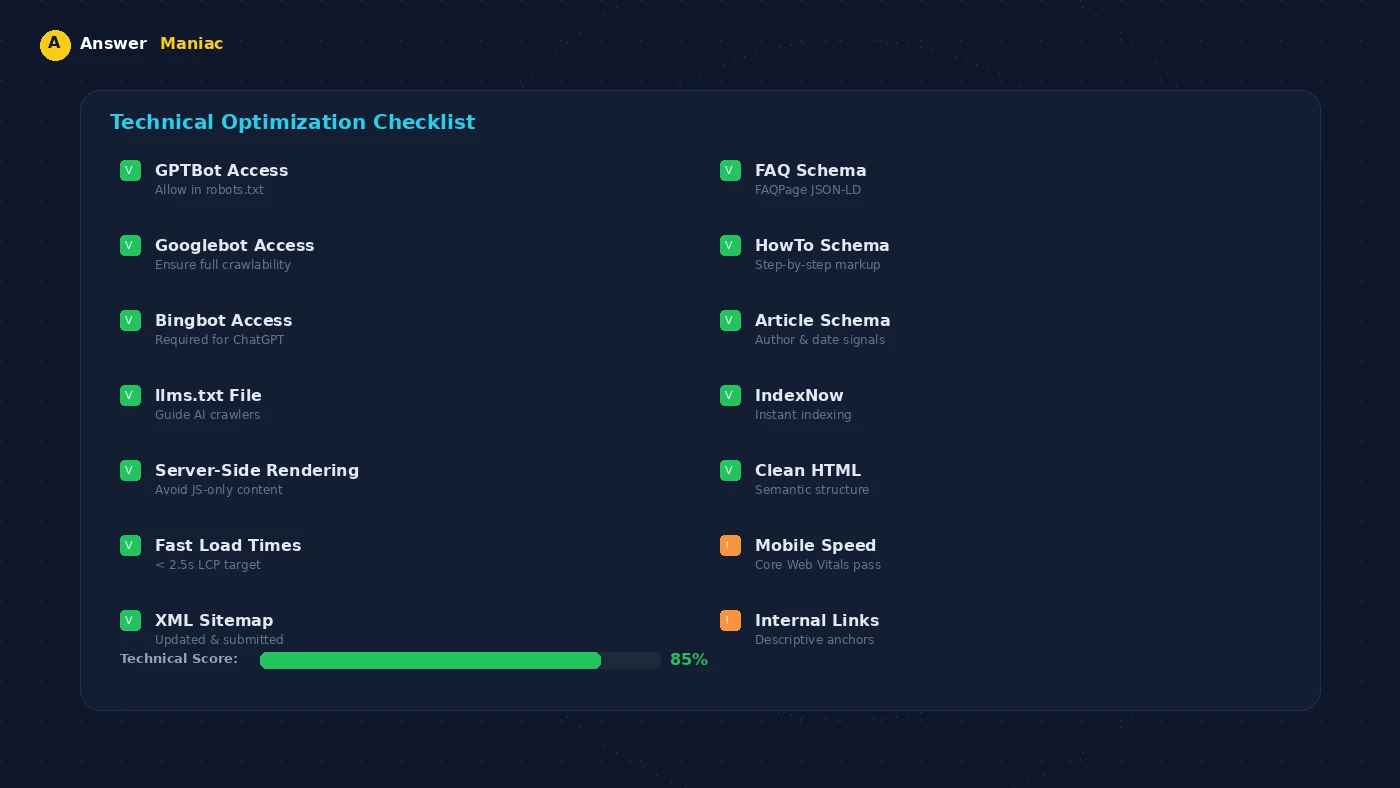
Even the best content fails if crawlers cannot access it.
Foundational requirements:
- Ensure GPTBot, Googlebot, and Bingbot are not blocked in robots.txt
- Implement llms.txt to guide AI crawlers
- Avoid JavaScript-heavy rendering that hides content
- Use server-side rendering (SSR) when possible
- Maintain fast load times, especially on mobile
Additional visibility steps:
- Submit important URLs via IndexNow
- Keep an updated XML sitemap
- Use schema markup for local and geo-specific queries
Technical accessibility is non-negotiable.
What Technical Optimizations Ensure Bots Can Crawl Your Site?
AI visibility is not permanent. It must be maintained through consistent publishing and regular updates.
There is no fixed publishing frequency that guarantees success. The right cadence depends on your audience, industry, and resources. News-driven sites may publish daily. Authority-focused brands often succeed with weekly or bi-weekly updates. Niche sites can perform well with fewer, higher-quality posts.
Content freshness also plays a role. Updating existing pages with new data, clearer explanations, or improved structure signals ongoing accuracy. AI systems reassess relevance over time. Tracking how fast your mentions grow compared to competitors is what citation velocity measures.
Iteration is part of the process. Monitor AI results, adjust content, and refine structure based on observed behavior. Visibility grows through steady alignment, not one-time optimization.
Consistency turns authority into a lasting signal rather than a temporary spike.
Google explains the importance of performance clearly:
"Speed is a ranking factor for Google Search." - Google Search Central[2]
Proactive steps for visibility:
- Submit key pages via IndexNow for faster indexing
- Maintain a clear, updated XML sitemap
- For local businesses, Schema Markup provides explicit semantic context that helps machines interpret your content
- Optimize for geo-specific queries
These aren't flashy tricks. They're the foundation. They ensure the door is actually open for AI to read your work.
Finding the Sweet Spot
There's no one magic number. The best publishing frequency depends on your goals, resources, and audience.
- For brand awareness and news: Daily or multiple times a day can work
- For building authority and thought leadership: Weekly or bi-weekly posts are often enough to show you're an expert
- For a smaller audience or niche topics: Quality matters more than quantity. Publishing once or twice a week might be perfect
Google loves fresh content. Posting regularly (e.g., weekly) can help search engines view your site as an active authority in your industry. This can lead to more traffic. It's about building trust and a relationship with your audience, not just hitting a daily quota.
Finding the "Just Right" Frequency
Think of your blog like a news channel. How often do you need to update your audience to keep them coming back for more? For some, that might be daily. For others, once a week may be enough. The key is consistency.
Pick a schedule you can realistically maintain long-term, whether that's every weekday, every Monday, or even once a month. The most important thing is to stick to your chosen schedule.
FAQ
How does ChatGPT optimization improve AI answer visibility and help rank in ChatGPT results?
ChatGPT optimization improves AI answer visibility by aligning content with how language models read and select answers. Using answer engine optimization and ChatGPT SEO tactics helps pages appear in AI responses. Clear structure, semantic relevance, and strong entity authority signals make content easier for models to trust, cite, and surface in ChatGPT search results.
What technical steps support AI crawler optimization and GPTBot indexing?
AI crawler optimization depends on clear technical access and fast delivery. Server-side rendering, sitemap optimization, and IndexNow submission help crawlers discover updates quickly. GPTBot indexing improves with an llms.txt file, descriptive URLs, strong mobile speed, and structured data for AI like FAQ schema and HowTo schema.
Which content structures improve LLM citation strategies and appear in AI responses?
LLM citation strategies work best when content is easy to extract. Answer-first intros, clear H2/H3 structure, bullet points, and tables help models reuse information accurately. In-depth guides, clear stats, citations, and content freshness updates with last updated timestamps increase trust and generative search ranking.
How do authority signals influence generative search ranking in ChatGPT?
Authority signals affect generative search ranking by showing broad trust across the web. Multi-source validation from review site mentions, best-of listicles, and forum backlinks strengthens credibility. Signals like Reddit citations, Quora authority, Trustpilot reviews, Capterra listings, and expert quotes support brand entity recognition.
How should teams research, track, and iterate to rank in ChatGPT over time?
Teams should start with conversational queries research and prompt analysis tools to understand real user questions. Competitor AI benchmarking shows gaps and opportunities. Visibility trackers, rank trackers, and biweekly tracking measure progress. User intent mapping, high-intent prompts, and an iterate optimization loop support a 3-6 month strategy.
Tying It All Together for ChatGPT Visibility
Appearing in ChatGPT results isn't accidental, it's the outcome of aligning your content with how AI models discover, evaluate, and trust information. That means combining prompt research, results analysis, AI-ready content structure, multi-source validation, solid technical foundations, and consistent publishing.
Together, these elements move your brand from invisible to citable. Your content stops being just something humans read and becomes material AI uses to build answers. Start by auditing your current AI visibility, then map a strategy that compounds over time.
Ready to see where you stand? Get your free AI Visibility Report from AnswerManiac.
References
Related Articles
Get AEO Insights Weekly
Join 500+ B2B marketers getting AI visibility tactics every Tuesday.
Ready to Get Your Brand Cited by AI?
See how your competitors show up in ChatGPT, Perplexity, and Gemini — and what it would take to get recommended.