Internal Linking for AI Visibility: Architecture That Gets You Retrieved
Internal linking and site architecture help AI crawlers and retrieval systems find, understand, and cite your pages. Here's the B2B playbook for 2026.
Direct Answer: AI systems cite passages they can retrieve, and they retrieve passages they can find and understand. Internal links do both jobs. They give crawlers like GPTBot and PerplexityBot a clean path to every page, and they signal to retrieval systems how your pages relate, which topic a page belongs to, and which entity you're an authority on. Orphaned pages and vague anchors starve both the crawl and the semantics. Descriptive anchors, a hub-and-spoke cluster structure, and shallow click depth get you pulled into answers.
Check how AI sees your business to see which of your pages models already recognize, and which ones they've never found.
Here's a thing most B2B marketers miss. When ChatGPT or Perplexity answers a buyer's question, it isn't reading your whole site. It's pulling a few hundred words from a retrieval index, and that index was built from pages a crawler actually reached and a system actually understood. If your best page sits three redirects deep with one link pointing at it from a 2023 blog post, it may as well not exist.
In our Q3 2026 study of 332 B2B companies, roughly half were never cited by ChatGPT or Perplexity for the questions their own buyers ask. The content existed. The problem was structural more often than editorial. Pages that nobody linked to, clusters with no center, anchors that said "learn more" and taught the machine nothing.
Internal linking is the cheapest, most-ignored lever in AI visibility. You already own the pages. You just have to connect them in a way that both a crawler and a retrieval model can read.
Key Takeaways
- Retrieval starts with discovery. AI crawlers find pages by following links. A page with no internal links pointing to it is usually never crawled, never indexed, and never citable.
- Links carry meaning, not just equity. Descriptive anchor text and tight topical clusters tell retrieval systems what a page is about and which entity it belongs to, which improves the odds your passage gets pulled for the right query.
- Shallow beats deep. Keep money pages within a few clicks of a hub. Click depth is a proxy for how important and how reachable a page is.
- Audit the structure, not just the words. Screaming Frog, Ahrefs Site Audit, and Google Search Console will show you orphan pages and crawl dead-ends faster than any content review.
Why internal links decide whether you get retrieved
Start with how the answer actually gets made. Tools like ChatGPT search, Perplexity, and Google's AI surfaces don't reason over your full page in real time. They work from a corpus of pre-processed text, and that retrieval corpus only contains pages a crawler fetched.
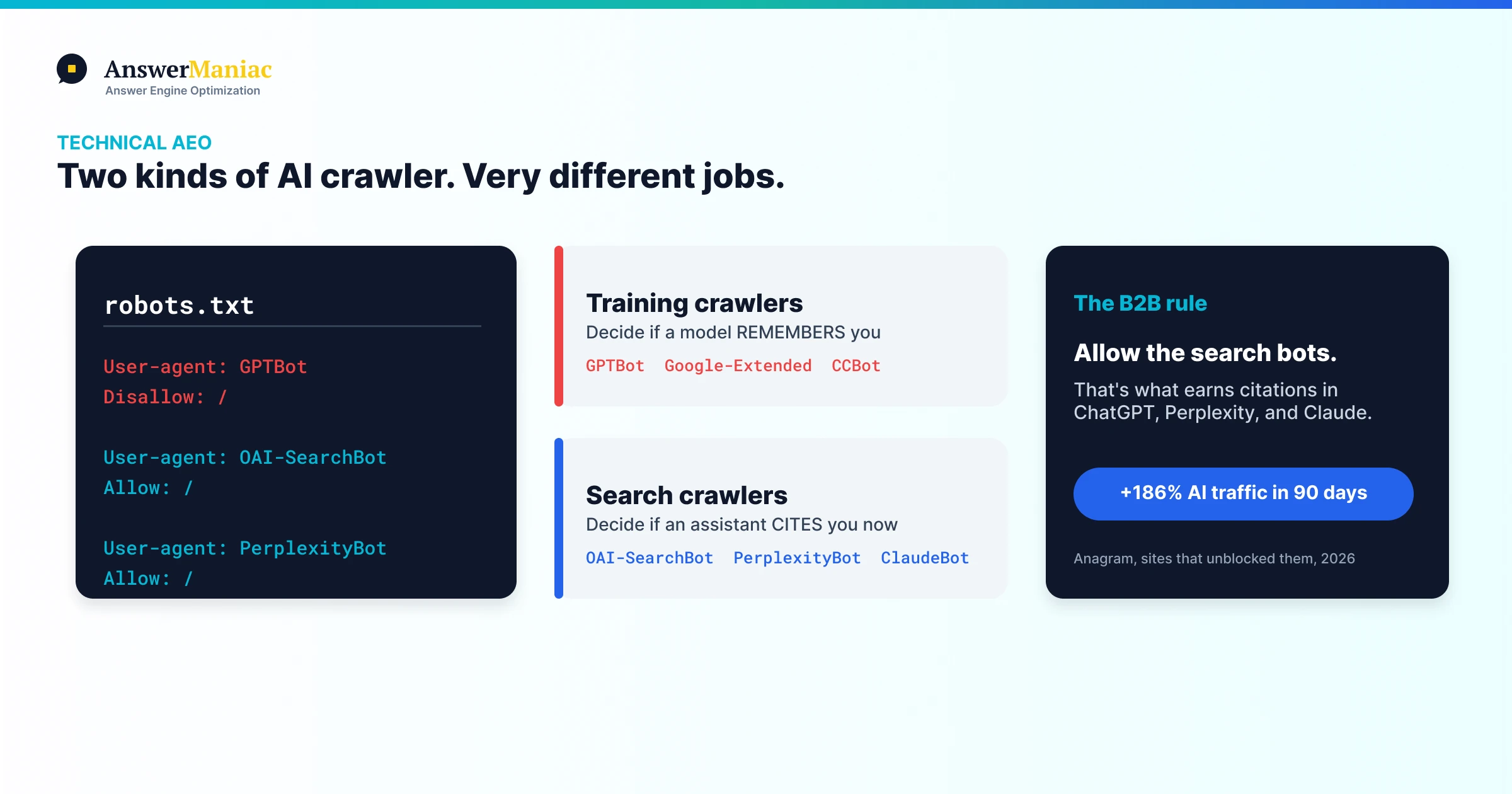
Those crawlers find pages the same way Googlebot always has: by following links. OpenAI documents two separate agents here. GPTBot gathers content, and OAI-SearchBot is the crawler that puts you into ChatGPT's search results. Perplexity runs PerplexityBot for its index. All of them traverse the web link by link, which is spelled out plainly in OpenAI's bot documentation and Perplexity's bot docs. Google's own guidance is blunt about the mechanism: it generally only follows links that are HTML anchor elements with an href attribute, and a page with no links pointing to it is hard to discover at all (Link best practices for Google).
No inbound internal link means no reliable crawl path. No crawl means no entry in the corpus. No corpus entry means zero chance of citation, no matter how good the writing is.
Orphan pages are invisible pages
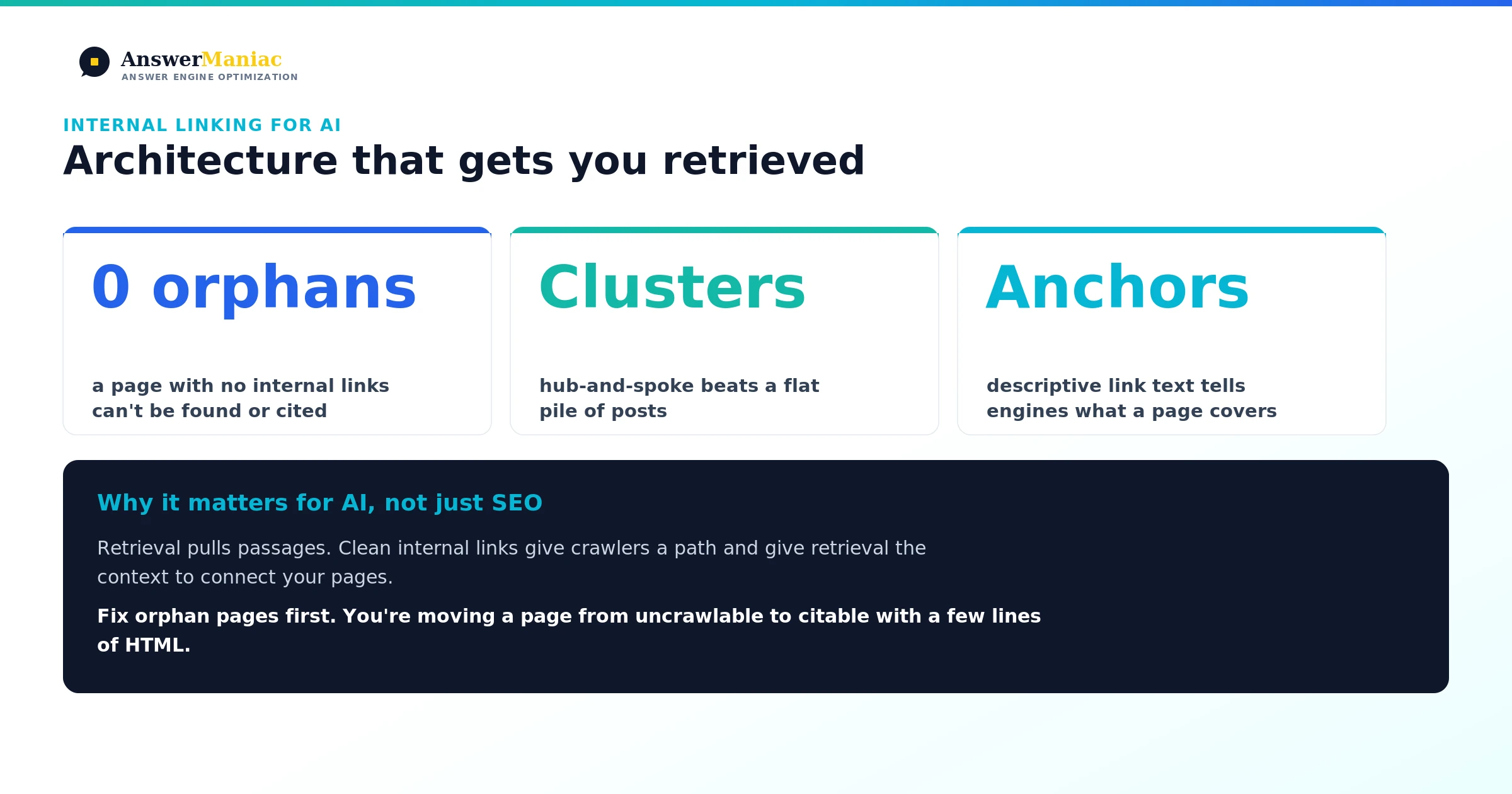
An orphan page has no internal links pointing to it. You reach it only if you already know the URL. I ran a crawl for a RegTech client last quarter and found their single best comparison page, the one answering the exact question their buyers type into ChatGPT, had no internal links at all. It was published, indexed in Google through an old sitemap entry, and completely absent from AI answers. We added nine contextual links from related pages and a hub. Six weeks later it started showing up as a cited source in Perplexity.
Screaming Frog flags orphans when you connect it to your sitemap and Search Console data. Ahrefs Site Audit reports them under internal link issues. Fix these first. They're the highest-impact change you can make, because you're moving a page from "uncrawlable" to "citable" with a few lines of HTML.
How retrieval systems chunk and read your pages
Discovery gets you into the index. Understanding gets you pulled from it. This is where internal linking does quieter, more interesting work.
Retrieval systems don't store pages whole. They split them into smaller passages, embed each one as a vector, and match those vectors against a user's query. The industry term is chunk retrieval, and the problem it creates is context loss. A chunk ripped out of a long page can lose the thread of what it was about.
Anthropic's own research on this is worth knowing. In testing its Contextual Retrieval method, adding document-level context to each chunk before embedding cut retrieval failures by about 35 percent (Anthropic, Introducing Contextual Retrieval). The lesson for you isn't to replicate their pipeline. It's to understand what these systems are fighting: isolated passages that don't carry enough context to be matched and trusted.
Internal links and clear structure are your version of adding context. When your page on, say, SOC 2 automation links out to a pillar page on compliance software and pulls links from related posts on audit readiness, you're establishing that this page belongs to a topic. Retrieval systems that weight relationships between pages read that cluster as a coherent body of work on one subject. That's the practical core of semantic SEO: you're mapping meaning, not just stacking keywords.
Descriptive anchors are machine-readable labels
Anchor text is the single most undervalued signal in a B2B site. Google states it directly: anchor text should be descriptive, concise, and relevant to the destination, and you should avoid generic text like "click here" (Link best practices for Google).
The reason this matters more for AI than for classic SEO is that the anchor is a tiny, human-written label describing the target page. "Read more" describes nothing. "Perplexity citation strategy for B2B SaaS" describes exactly what the reader and the model will find. When a retrieval system builds its understanding of a destination page, the anchors pointing at it are part of the evidence. Vague anchors waste that evidence.
Two rules keep you clean. Write anchors that make sense read out of context. And vary them naturally across sources rather than linking to one page with the identical phrase every time, which muddies which page owns which concept.
The cluster structure that AI models reward
Hub-and-spoke, pillar-cluster, topic clusters. Different names, one idea. You build a central hub page on a broad topic, then surround it with specific pages that each cover one subtopic in depth. Every spoke links up to the hub and sideways to its closest siblings. The hub links down to every spoke.
This structure does three things at once for AI visibility.
It creates clean crawl paths. A crawler landing on the hub can reach every spoke in one hop. Nothing orphans.
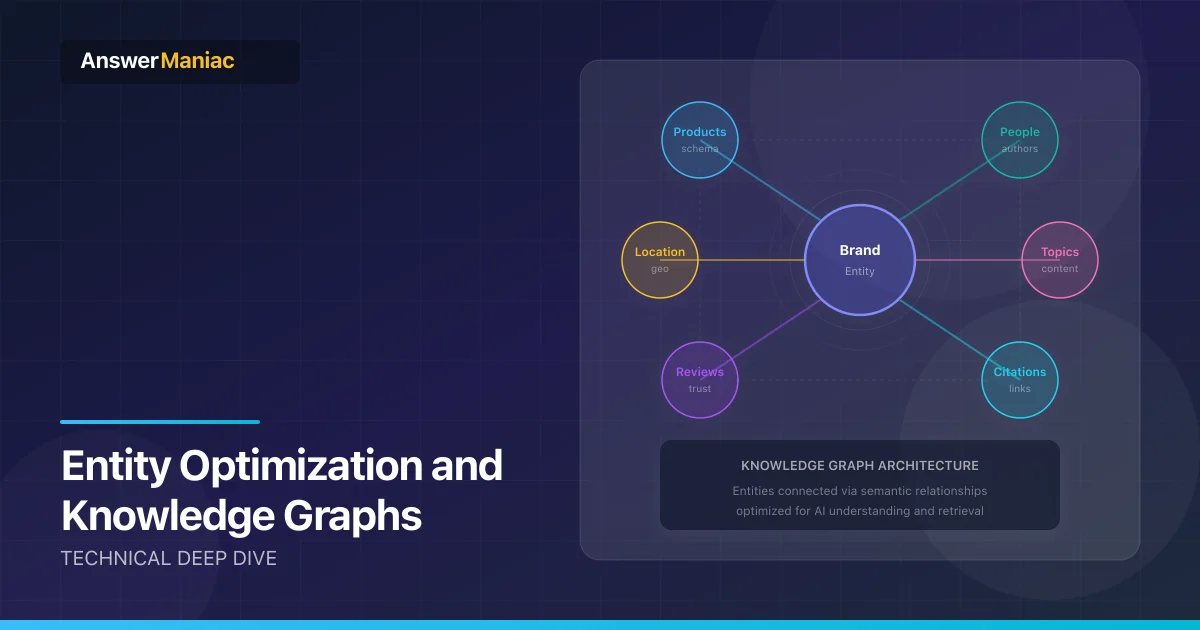
It concentrates topical authority. When a dozen tightly related pages interlink around one subject, you stop looking like a site with a stray blog post and start looking like the source on that subject. That's how entity optimization compounds. You become the recognized authority on a defined thing, and models reaching for a source on that thing find you densely connected to it.
It keeps click depth shallow. Google has long advised keeping important pages within a few clicks of a main entry point, because depth signals importance and reachability. A spoke buried five clicks down gets crawled less and is treated as less central. Aim to keep your revenue pages and best answer content within three clicks of the homepage or a major hub.
Map clusters to how buyers actually prompt
Don't build clusters around keyword volume alone. Build them around the questions your buyers type into AI. Our ANSWER Framework starts with an audit of exactly these prompts, because the cluster is only useful if its hub answers a real question and its spokes answer the obvious follow-ups.
A fleet management company might build a hub on "fleet management software," with spokes on telematics integration, fuel-cost reporting, DOT compliance, and route optimization. Each spoke answers one buyer question completely, links to the hub, and links to the two or three sibling spokes a buyer would logically ask about next. That mirrors the way a conversation with ChatGPT unfolds, and it gives the retrieval system a connected map of your expertise instead of scattered pages.
A practical internal linking audit you can run this week
You don't need a new tool. You need to look at structure with intent.
Pull a full crawl. Run Screaming Frog or Ahrefs Site Audit across the whole site. Export the internal link report and sort pages by number of inbound internal links. Anything with zero or one is a problem.
Find and fix orphans. Cross-reference the crawl with your XML sitemap and Google Search Console's page list. Pages indexed by Google but absent from the crawl graph are your orphans. Link to each from at least one relevant hub and two contextual sources.
Audit anchor text. Search your exports for "click here," "read more," "learn more," and "this page." Rewrite each to describe the destination. This is tedious and it works.
Check click depth. Screaming Frog reports crawl depth as a column. Any page you care about that sits at depth four or deeper needs a link from something shallower.
Validate the crawl in Search Console. Use the URL Inspection Tool to confirm your important links render in the HTML, especially if your site injects navigation or related-post links with JavaScript. If a link only appears after a script runs and the tool doesn't see it in the rendered HTML, a crawler might miss it too.
Understanding how AI search engines choose sources makes the payoff clear. Retrieval favors content that's reachable, well-labeled, and densely connected to its topic. Internal linking is how you deliver all three. Pair it with schema markup and you've covered both the human-readable and machine-readable layers that get pages retrieved and cited.
FAQ
Do internal links actually affect whether AI tools cite me? Yes, indirectly but decisively. AI crawlers discover pages by following links, and retrieval systems weight how pages relate to each other. A page with no internal links usually never enters the corpus these tools draw from, so it can't be cited regardless of quality. Links also label and contextualize pages, which improves the odds the right passage gets matched to a query.
What's the difference between an orphan page and a low-authority page? An orphan page has no internal links pointing to it, so crawlers struggle to find it at all. A low-authority page is found but has few links and little topical connection, so it's crawled and weighted as unimportant. Orphans are a discovery problem you fix first. Low authority is a density problem you fix with clustering.
How many internal links should a page have? There's no fixed number. The useful rule is that every important page should receive links from its topic hub and at least two related pages, and should link out to its closest siblings and its hub. Focus on relevance and coverage rather than hitting a count.
Does anchor text matter more for AI than for traditional SEO? It matters for both, but AI retrieval leans on it as a short, human-written description of the destination. Descriptive anchors give retrieval systems clearer evidence of what a page covers. Generic anchors like "click here" waste that signal. Google's own guidance recommends descriptive, concise, relevant anchors.
How do I know if AI crawlers are reaching my pages? Check your server logs or a log analyzer for user agents like GPTBot, OAI-SearchBot, and PerplexityBot to confirm they're fetching your pages. Then run a crawl in Screaming Frog or Ahrefs Site Audit to confirm those pages are reachable through internal links, and use Google Search Console's URL Inspection Tool to verify links render in the HTML.
Get a clear read on what AI can and can't find
Most B2B sites lose citations to structure, not writing. Pages that nobody links to, clusters with no center, anchors that teach a machine nothing. The fix is mechanical, and you can start this week with a crawl and an afternoon of relinking.
If you want to see which of your pages AI models already recognize and which ones they've never found, check how AI sees your business. Then book a discovery call and we'll map the architecture that gets your best pages retrieved.
Get AEO Insights Weekly
Join 500+ B2B marketers getting AI visibility tactics every Tuesday.
Ready to Get Your Brand Cited by AI?
See how your competitors show up in ChatGPT, Perplexity, and Gemini — and what it would take to get recommended.