llms.txt for B2B: What It Is, Whether It Actually Works, and How to Ship One
A survey of 300,000 domains found 10% now publish llms.txt, but no major AI engine has confirmed it reads the file. Here's the honest B2B guide to llms.txt in 2026.
Quick Answer
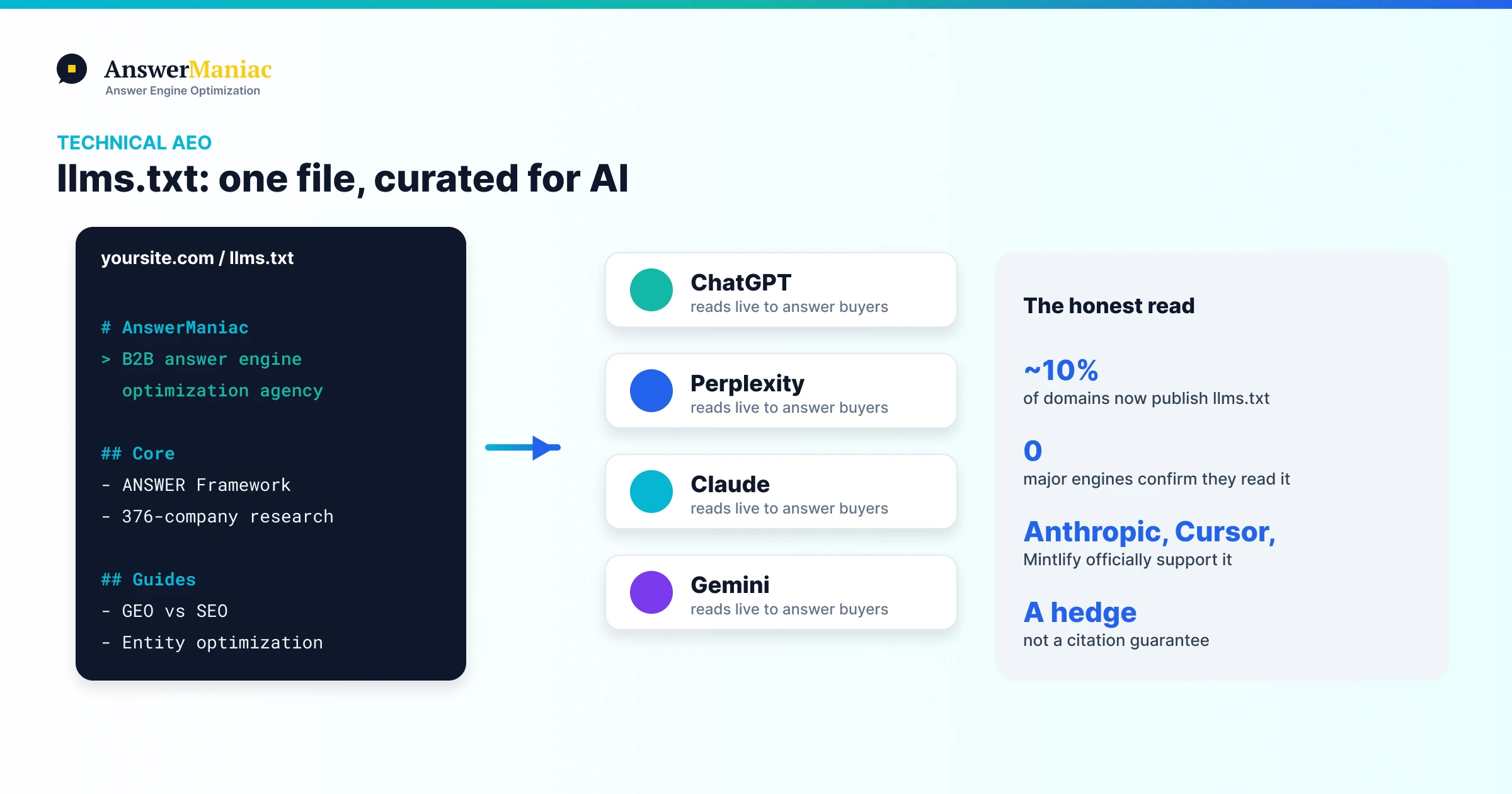
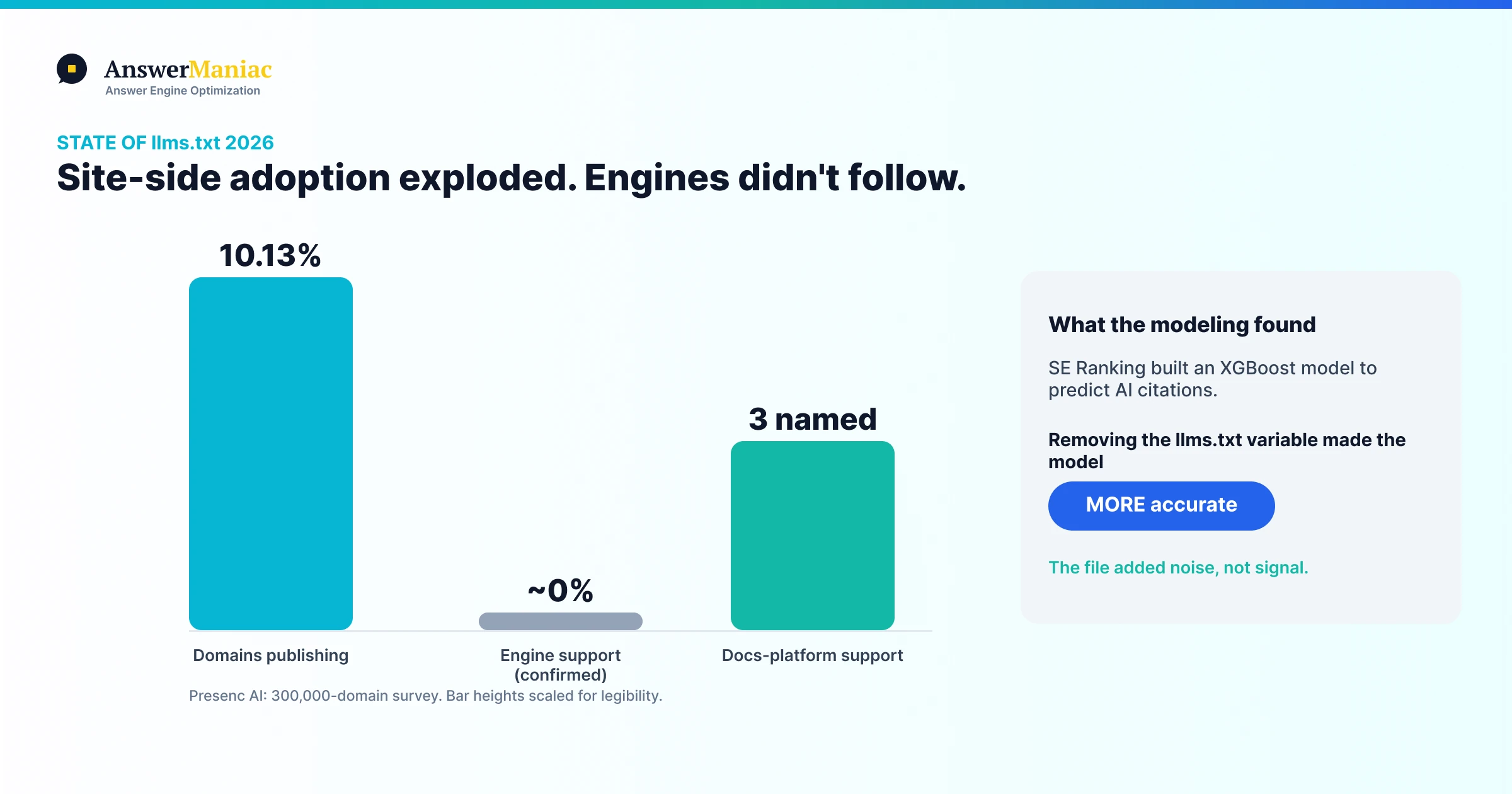
llms.txt (2026 definition): A plain markdown file served at your domain root (yoursite.com/llms.txt) that gives AI systems a curated map of your most important pages, usually with a short authoritative summary of what your company does. As of 2026, site-side adoption has climbed to roughly 10% of surveyed domains (Presenc AI, 300,000-domain study), but no major AI engine (OpenAI, Google, Anthropic, Meta) has publicly committed to reading it in production. Anthropic, Cursor, and Mintlify officially support it for developer docs. For B2B companies, llms.txt is worth shipping as a low-cost hedge, not a citation guarantee.
Here's the uncomfortable part nobody selling you an "llms.txt service" wants to lead with: the engines you actually care about have not confirmed they read the file.
I ran into this last month. A prospect forwarded me a competitor's llms.txt, convinced it was the reason that competitor kept showing up in ChatGPT. So I pulled the SE Ranking analysis on it. They built an XGBoost model to predict AI citation frequency, and when they removed the llms.txt variable, the model got more accurate. The file was adding noise, not signal.
That does not mean you should ignore llms.txt. It means you should understand exactly what it does and does not do before you spend an afternoon on it. This guide gives you the honest version: what the standard is, what the 2026 adoption data shows, which engines actually parse it, and how to write one that helps your AI visibility even in the likely case that the big engines skip it.
What llms.txt Actually Is
llms.txt was proposed in September 2024 by Jeremy Howard at Answer.AI. The idea is simple. Robots.txt tells crawlers what they cannot access. A sitemap lists every URL. Neither one tells an AI model which pages matter or what your company is.
llms.txt fills that gap. It is a markdown file at your root that does three things:
- States who you are in one authoritative paragraph.
- Lists your most important pages as curated markdown links with short descriptions.
- Optionally points to clean, token-friendly versions of those pages (often a matching llms-full.txt or per-page .md files).
The pitch is that when an AI system wants to understand your site, it reads one clean file instead of crawling and guessing. For a documentation-heavy product, that is genuinely useful. Anthropic, Cursor, and Mintlify adopted it precisely because developer docs are where curated context pays off.
The 2026 Adoption Reality
This is where you need real numbers, not vibes.
| Metric | Figure | Source |
|---|---|---|
| Domains publishing llms.txt | ~10.13% of 300,000 surveyed | Presenc AI, State of llms.txt 2026 |
| Major engines with confirmed production support | 0 (OpenAI, Google, Anthropic, Meta, Mistral) | Presenc AI / Codersera, 2026 |
| Confirmed support for dev-doc use | Anthropic, Cursor, Mintlify | Reported Jan 2026 |
| llms.txt as a predictor of citation frequency | Removing it improved model accuracy | SE Ranking XGBoost study |
Read those rows together and the picture is clear. Publishing a file at your root is easy, so lots of sites did it. Getting the engines that answer buyer questions to actually use it is a different thing, and that has barely moved.
The nuance worth holding onto: OpenAI and Perplexity have been observed fetching the file in some retrieval patterns without announcing support, and a few teams report modest citation upticks after publishing a well-built one, concentrated on Anthropic and Perplexity. That is a weak signal, not a promise. Treat any agency that guarantees ChatGPT citations from an llms.txt as selling you certainty they do not have.
Should Your B2B Company Add One?
Yes, with the right expectations. Here is the decision I give clients.
Add llms.txt if:
- You have documentation, an API reference, a glossary, or a knowledge base. This is the strongest case, and it is the one Anthropic and Mintlify actually built for.
- You want a canonical, machine-readable statement of what your company is and who it serves. That summary paragraph is reusable across your whole entity optimization effort.
- Your engineering cost is an hour. It is. There is no reason to skip a cheap hedge on an evolving standard.
Do not add llms.txt if:
- You are treating it as a replacement for the real work. It is not. Schema markup, entity consistency, and citation-worthy content do the heavy lifting. The file is a bookmark, not an engine.
- You expect it to move ChatGPT citations next week. The data does not support that.
The honest framing: llms.txt is a low-cost, low-risk bet on where retrieval is heading. If the major engines standardize on it in 2027, you are ready. If they never do, you spent an hour and got a cleaner brand summary out of it. That asymmetry is why we ship it for most clients and tell them plainly it is a hedge.
How to Write an llms.txt That Actually Helps
Even if an engine never parses your file, the discipline of writing it forces clarity that helps everywhere else. Here is the structure we use.
1. Open with an authoritative summary
Start with an H1 (your company name) and a blockquote or short paragraph that states, in plain language, what you do and who you serve. No adjectives, no marketing. This is the exact sentence you want an AI model to repeat about you.
# AnswerManiac

> AnswerManiac is a B2B answer engine optimization agency that helps
> software companies get cited by ChatGPT, Perplexity, Gemini, and Copilot
> using the ANSWER Framework: a 6-stage AI visibility methodology.
2. Group your best links by intent
Under H2 headers, list the pages that answer real buyer questions. Use descriptive link text and a one-line note on each. Prioritize your research, your framework, and your highest-signal guides over generic pages.
## Core Methodology
- [The ANSWER Framework](/answer-framework): 6-stage AI visibility methodology
- [B2B SaaS AI visibility research](/research): 376-company benchmark across 5 verticals

## Guides
- [GEO vs SEO](/blog/geo-vs-seo-complete-comparison): how the two disciplines differ
3. Keep it curated, not complete
The mistake most teams make is dumping their sitemap into llms.txt. The entire value is curation. Twenty to forty of your best pages beats every URL you own. If it reads like a table of contents a smart human would hand to a new hire, it is right.
4. Serve clean page versions where you can
If your stack allows it, publish token-friendly markdown versions of your key pages and link them. This is optional and higher effort, but it is the part the dev-doc platforms lean on hardest.
5. Validate and keep it current
Run it through a validator, confirm it returns a 200, and put it on the same update cadence as your sitemap. A stale llms.txt pointing at dead URLs is worse than none.
Where llms.txt Fits in a Real AI Visibility Program
Think of the layers in order of proven impact.
- Entity and schema foundation. Consistent NAP, Organization schema, and knowledge graph presence. This is the real technical work.
- Citation-worthy content. Original data, clear answers, formats the engines actually pull from.
- Off-site presence. Reviews, earned media, and community consensus on Reddit, G2, and Quora.
- llms.txt. The cheap hedge that sits on top, useful mostly for docs and as a canonical summary.
That ordering matches the ANSWER Framework stages: Audit, Navigate, Structure, Write, Earn, Refine. llms.txt lives inside Structure, and it is one of the smaller line items there. If a vendor is pitching llms.txt as the headline of your AI strategy, that is the tell that they are selling the easy part.
Frequently Asked Questions
Does ChatGPT read llms.txt? OpenAI has not confirmed production support. There is observational evidence that its systems sometimes fetch the file, but no guarantee it influences citations. Do not build your strategy on it.
Does Google use llms.txt for AI Overviews or Gemini? No confirmation from Google. Google-Extended and Gemini behavior has not been shown to change based on the file. Google has publicly leaned toward standard crawling and structured data instead.
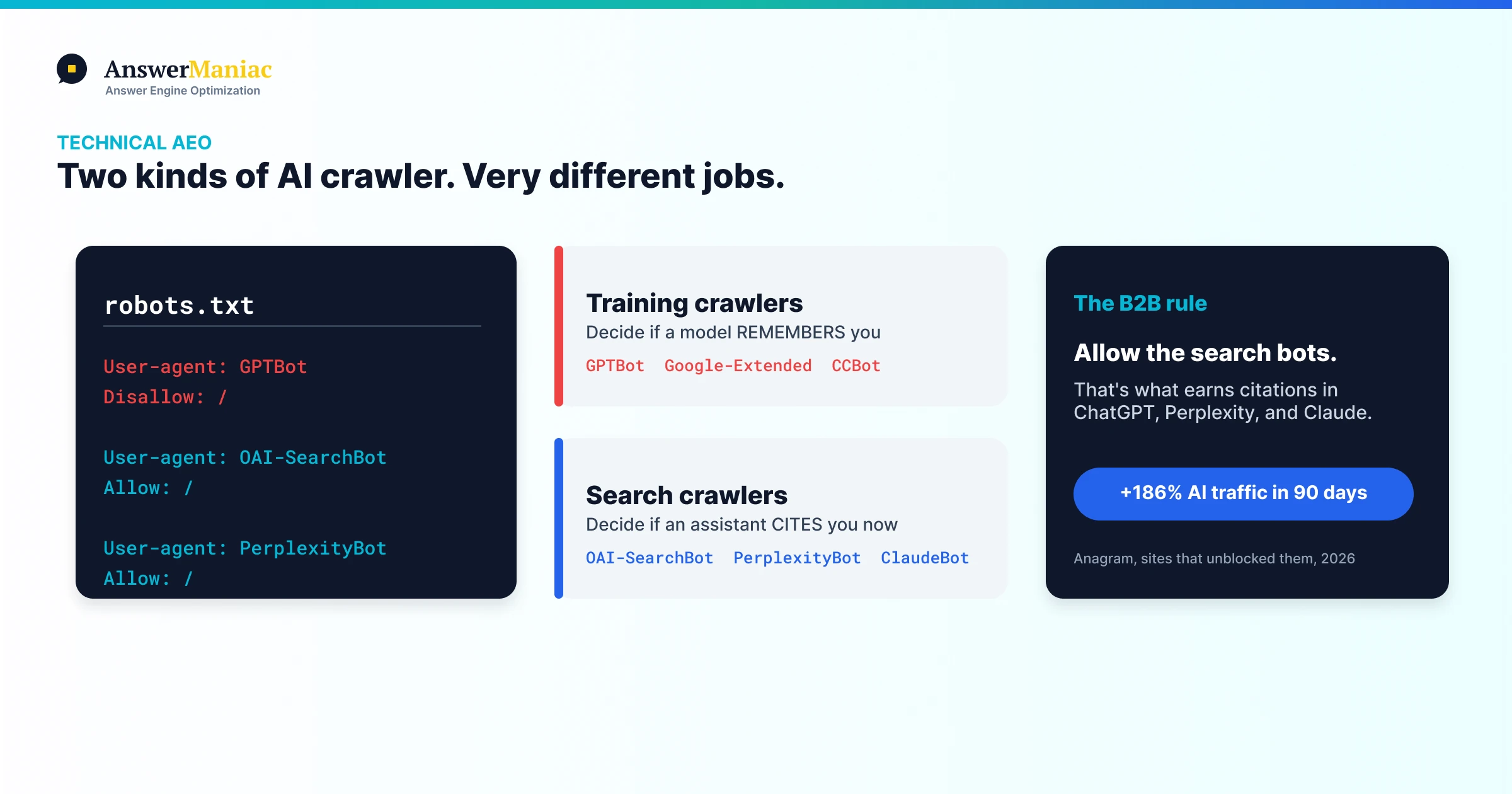
Is llms.txt the same as robots.txt? No. Robots.txt controls crawler access (what bots can and cannot fetch). llms.txt is a curated content map for AI systems. They solve different problems and you can use both. For crawler access decisions, see our guide on blocking or allowing AI crawlers.
Will llms.txt get my company cited? On its own, no. The evidence for a direct citation lift is weak, and one model study found it added noise rather than signal. It supports a broader program; it does not replace one.
How long does it take to build? About an hour for a curated file of 20 to 40 links plus a summary. Serving clean markdown page versions takes longer and is optional.
The Takeaway
llms.txt is real, cheap, and worth shipping for most B2B companies, especially those with documentation. It is also oversold. Site-side adoption hit roughly 10% in 2026 while confirmed engine support stayed near zero, and the best available modeling found it did not predict citations. Publish one because it is a smart, low-cost hedge and it forces you to write a clean summary of your business. Do not publish one expecting it to be the reason ChatGPT starts recommending you. That work happens elsewhere.
Want to know whether AI engines currently mention your company at all, with or without an llms.txt? Run a free AI visibility audit and see your baseline across ChatGPT, Perplexity, and Gemini.
Sources
- Presenc AI, "State of llms.txt 2026: Adoption, Standards, and Practice" (300,000-domain adoption survey)
- Codersera, "llms.txt Explained (May 2026): Spec, Adoption, and How to Ship One"
- SE Ranking, XGBoost citation-frequency modeling on llms.txt presence
- Answer.AI / Jeremy Howard, original llms.txt proposal (September 2024)
- Reported platform support: Anthropic, Cursor, Mintlify (January 2026)
Related Reading
Get AEO Insights Weekly
Join 500+ B2B marketers getting AI visibility tactics every Tuesday.
Ready to Get Your Brand Cited by AI?
See how your competitors show up in ChatGPT, Perplexity, and Gemini — and what it would take to get recommended.
Related Articles
Should You Block or Allow AI Crawlers? A B2B Guide to GPTBot, ClaudeBot, PerplexityBot and Google-Extended
Entity Optimization for AEO: How to Get Your Brand Into AI Knowledge Graphs