How AI Search Engines Decide Which Brands to Recommend: The Query Fan-Out Mechanism
Learn how AI search engines choose sources and position your content to earn citations in AI-generated answers.
Direct Answer: AI search engines choose which brands to recommend using Retrieval-Augmented Generation (RAG). This system scans the live web for the most relevant, authoritative, and up-to-date information. It doesn't just look for keywords — it looks for factual density and clear answers. To get recommended, your content must be structured for easy extraction by AI.
Check your AI visibility now — our free audit shows whether AI models recognize your brand as a citable entity.
AI search engines choose which brands to recommend by using a process called Retrieval-Augmented Generation (RAG). This system scans the live web for the most relevant, authoritative, and up-to-date information. It doesn't just look for keywords — it looks for factual density and clear answers.
To get recommended, your content must be structured for easy extraction by AI. Here are the specific signals and platform quirks that determine if AI will talk about your brand.
Three Most Important Things To Remember
- The RAG Process is King. AI uses Retrieval-Augmented Generation to pull live web data, making traditional SEO tactics like keyword density less critical than clear, factual content.
- Signals have shifted. Authority (E-E-A-T), content structure for easy "chunking," and factual density with stats and citations are now the primary selection signals.
- Every platform is different. ChatGPT, Gemini, and Perplexity each use different search backends and prioritize different signals. You need a tailored approach for each.
How Does the RAG Process Determine Which Content is Cited?
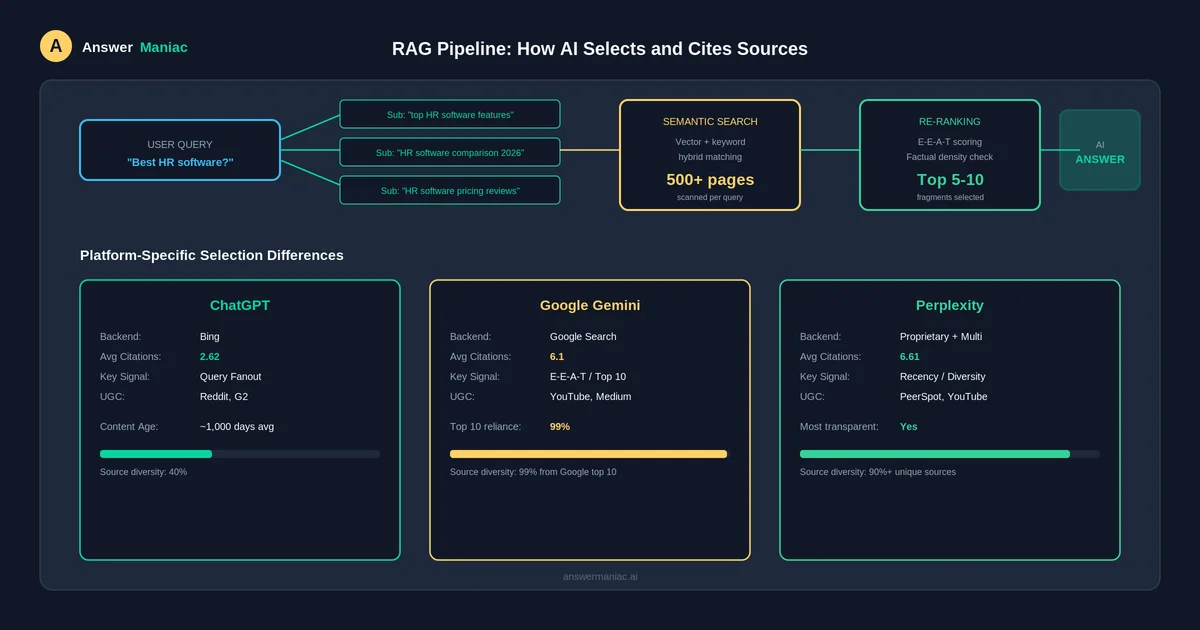
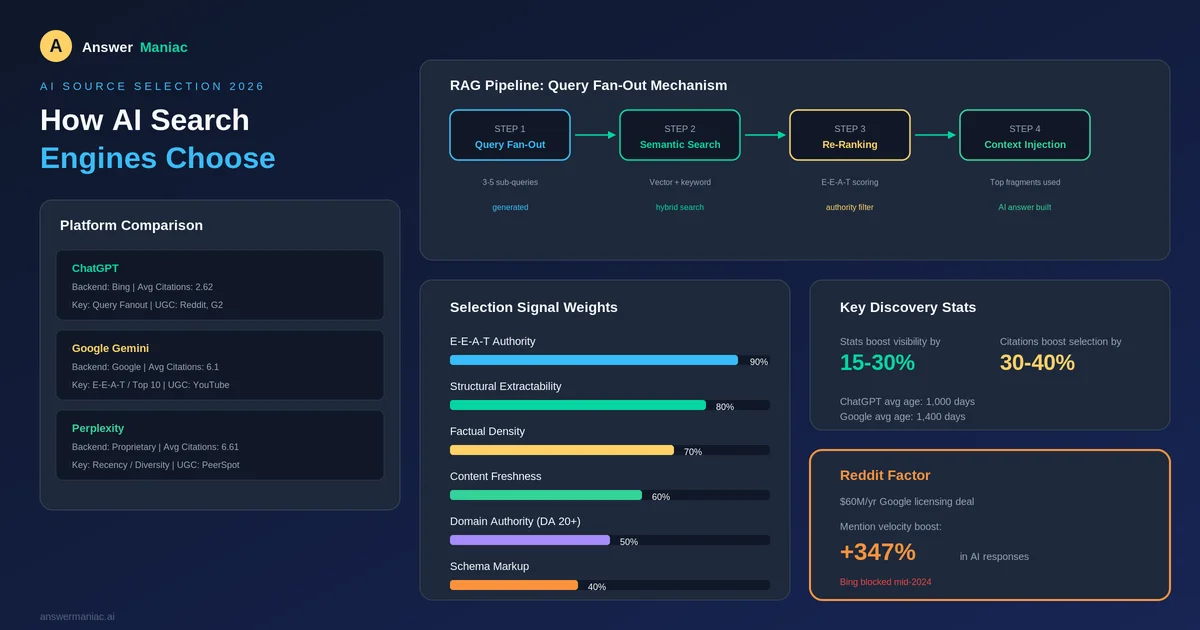
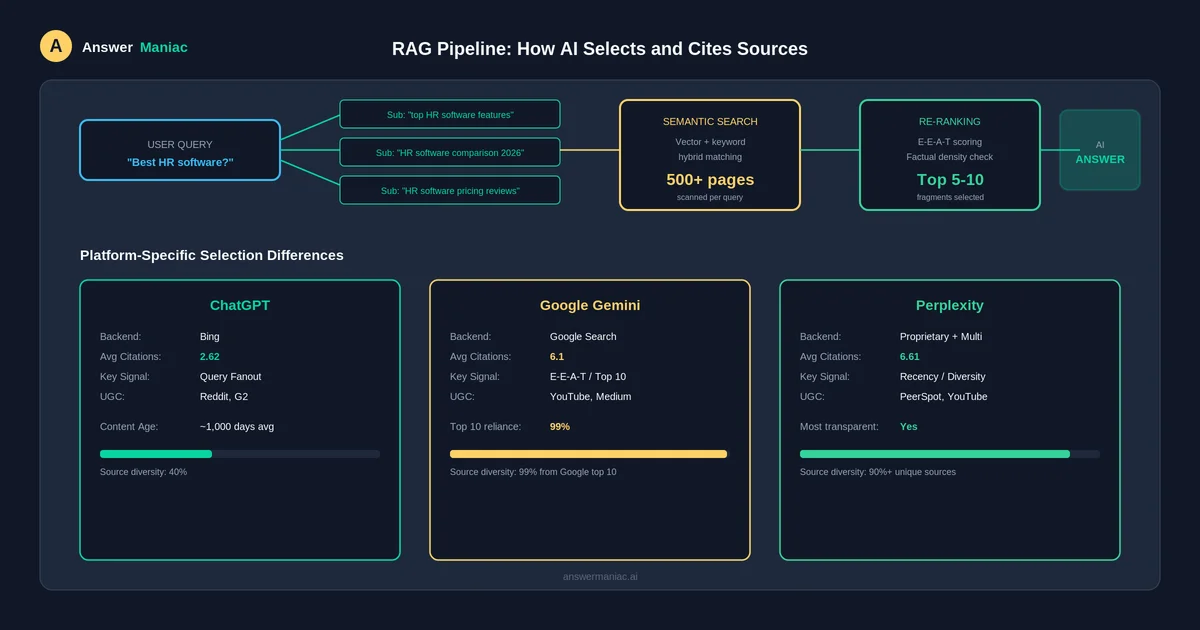
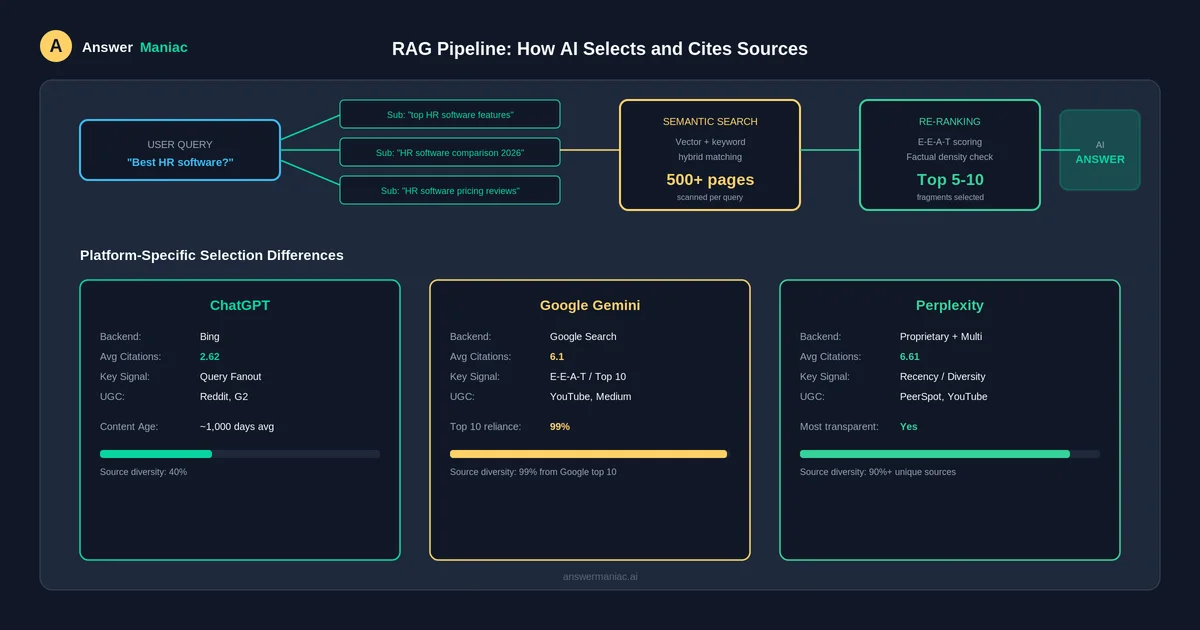
AI search engines use Retrieval-Augmented Generation (RAG) to find answers. This bridges the gap between an AI's static training data and the live web. The process starts with the AI breaking a user's question into smaller, focused sub-queries. This is called query fan-out.
Next, a semantic search finds content that matches the intent of each sub-query, not just the keywords. The top content fragments are then re-ranked. This final scoring is based on signals like E-E-A-T and how fact-dense the information is. The highest-ranked fragments are injected into the AI's prompt as the source material for its final answer.
The core steps work like this:
- Query Understanding & Fan-Out — a complex question is broken into 3-5 simpler sub-queries to gather comprehensive data points
- Semantic Retrieval — systems use hybrid search, combining keyword matching with vector-based search to find conceptual matches
- Re-Ranking — retrieved fragments are scored on authority, freshness, and factual correctness
- Context Injection — the top-ranked text is placed into the AI's prompt, becoming the primary source for the generated answer
What Are the Primary Selection Signals for AI Search Engines?
Selection is driven by a combination of Domain Authority, Content Structure, and Factual Density. AI models favor "extractable" content that provides a direct answer quickly.
They are looking for reliable, well-organized information they can easily understand and cite, which is why entity SEO for AI search is becoming critical for brands that want to control how they are interpreted and cited in AI-generated answers.
Research indicates that including specific statistics can increase visibility by 15-30%. Adding credible citations within your own content improves the probability of being selected by 30-40%. AI doesn't just want you to say something is true — it wants to see you proving it.
The main evaluation criteria:
- E-E-A-T — Experience, Expertise, Authoritativeness, and Trustworthiness are fundamental weights
- Structural Extractability — use of H2/H3 headers and short paragraphs allows bots to "chunk" data easily
- Factual Density — high-signal content includes bolded key entities, specific dates, and percentage values
- Freshness — updated content is favored. ChatGPT citations average 1,000 days old, while traditional Google results average 1,400 days
- Domain Authority — sites with a Moz Domain Authority of 20+ show significantly higher citation rates
How Do Selection Criteria Differ Across AI Platforms?
Each major AI platform uses different technical backends and ranking priorities. This leads to a high degree of source diversity in their answers. You can't optimize for one and expect the same results everywhere.
Perplexity is the most transparent, often citing 6.61 sources per answer. ChatGPT averages about 2.62 citations. Google Gemini heavily weights its parent's index, with about 99% of its citations coming from Google Search's top 10 organic results.
| Feature | ChatGPT | Google Gemini | Perplexity |
|---|---|---|---|
| Search Backend | Bing | Google Search | Proprietary + Multi-backend |
| Avg. Citations | 2.62 | 6.1 | 6.61 |
| Key Signal | Query Fanout | E-E-A-T / Top 10 | Recency / Source Diversity |
| UGC Focus | Reddit, G2 | YouTube, Medium | PeerSpot, YouTube |
Understanding these differences is key. Schema markup for LLM citations needs to account for the fact that each platform parses and prioritizes structured data differently.
Why is Reddit Becoming a Dominant Source for AI Citations?
Reddit has become a "privileged" data source, especially for Google AI Overviews. This followed a high-profile 2024 licensing deal valued at around $60 million per year. AI engines value the "lived experience" and "consensus" found in active subreddits.
For subjective queries like product recommendations or troubleshooting, AI often cites Reddit to provide human-verified perspectives. However, a platform asymmetry exists — Reddit blocked Bing's crawler in mid-2024, making its content less likely to appear in ChatGPT and other Microsoft-backed AI tools.
The dynamics of Reddit's AI citation power are specific. Human Consensus drives AI to cite Reddit for crowd-sourced, experiential answers. Google has direct API access while Bing faces crawling restrictions. Strategic engagement on Reddit can drive a 347% higher mention velocity in AI responses.
This reinforces why digital PR for LLM citations increasingly focuses on earning authoritative third-party mentions rather than just publishing on owned media.
How Can Content Be Optimized for Maximum AI Visibility?
Optimization requires a shift from "writing for keywords" to "writing for extraction." Your goal is to make your content as easy as possible for an AI to grab, understand, and cite. This involves both how you write and how your site is built technically.
Start with question-based headings (H2, H3) and provide the direct answer in the first 50 words under that header. Ensure your site is accessible to AI crawlers like GPTBot and PerplexityBot in your robots.txt file. Technical hygiene, like Server-Side Rendering and Schema Markup, is critical because many AI crawlers struggle with JavaScript-heavy sites.
Practical steps for AI-focused content optimization:
- Modular Writing — craft each section as a standalone "citable chunk" of 50-75 words that answers one clear question
- Schema Markup — implement Schema.org structured data for a 15-30% visibility boost, improving schema markup for LLM citations so models can associate entities and factual claims correctly
- The 9:1 Rule — maintain a high ratio of genuine value-to-promotion. Overly promotional content risks being flagged as low-quality
- Technical Crawlability — verify that security services like Cloudflare are not accidentally blocking AI crawler user-agents
Building semantic SEO for AI visibility into your content strategy ensures these optimization steps work together as a system, not isolated tactics.
FAQ
How do AI search engines evaluate content quality?
AI search engines review content quality using natural language processing and Large Language Models trained on large text corpora. They assess clarity, helpful information, original news reporting, and strong author bylines. E-E-A-T principles also guide evaluation. AI search algorithms analyze citation patterns, source citations, and user interactions to decide which pages deserve visibility in AI search and AI Overviews.
Do traditional SEO metrics still matter in AI search?
Traditional SEO metrics like Domain Authority and search rankings still play a role, but they are not the only signals. AI-powered search looks beyond keyword research and backlinks. It evaluates structured data, schema markups, and content optimization aligned with user intent. AI search platforms focus more on content quality, technical crawlability, and how well pages answer natural language queries.
What role does structured data play in AI search results?
Structured data helps AI search engines interpret content more accurately. Schema markups clarify entities, relationships, and page purpose. This supports retrieval-augmented generation and improves source share in AI-generated results. Clear meta tags, clean site structure, and strong technical crawlability make it easier for AI-powered search systems to surface your content in featured snippets and AI Overviews.
How do Large Language Models choose which sources to cite?
Large Language Models use retrieval-augmented generation, RAG layers, and web search capabilities to gather relevant pages. They compare citation rules, training data patterns, and E-E-A-T principles. AI search algorithms prioritize helpful content that aligns with search queries. Pages with clear structure, consistent source citations, and alignment with the Knowledge Graph are more likely to appear in AI search results.
Your Path to Becoming the Source AI Chooses
Knowing how AI chooses sources is just the start. You have to act. The old SEO rules don't work as well now. You have to structure your content for AI, prove your authority, and follow each platform's specific rules.
At AnswerManiac, we help you become the source AI trusts and recommends using The ANSWER Framework. We make your brand the obvious answer.
Check your free visibility report — it shows where you stand and what to fix.
References:
- Data Studios — How Does Perplexity Choose and Rank Its Information Sources
- Google Cloud — What Is Semantic Search
Related Articles:
Get AEO Insights Weekly
Join 500+ B2B marketers getting AI visibility tactics every Tuesday.
Ready to Get Your Brand Cited by AI?
See how your competitors show up in ChatGPT, Perplexity, and Gemini — and what it would take to get recommended.