Content Refresh for AI Search: How to Stay Cited as Models Change
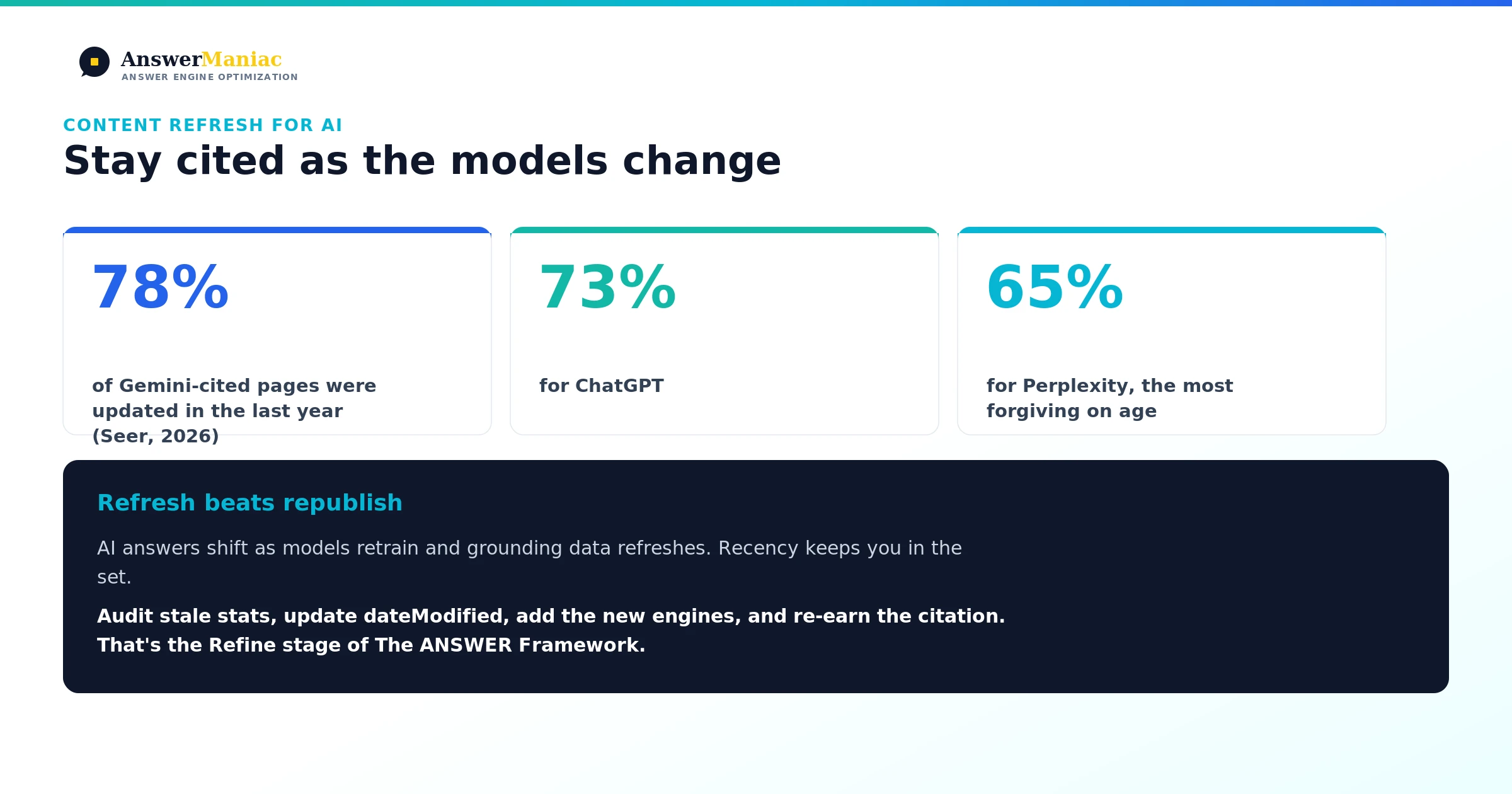
AI answers shift as models retrain and grounding data refreshes. Here's how to refresh existing content so it keeps earning citations in ChatGPT and Perplexity.
Direct Answer: Content refresh for AI search means updating existing pages with current facts, new data, and accurate
dateModifiedtimestamps so they keep getting cited as AI models retrain and grounding data changes. AI answers aren't fixed. The same prompt returns different sources week to week because engines recompute responses from signals that shift. A page that earned a citation in March can lose it by September without you touching it. The teams that hold their position treat their best pages as living assets: they audit for stale stats and dead facts on a schedule, re-earn citations with substantive updates, and measure a frozen prompt set over time instead of checking once and assuming nothing moved.
A client pinged me in March with a screenshot of ChatGPT recommending them for a buyer query they'd chased for a year. We'd earned it with one well-structured comparison page. By September, same prompt, they were gone. Nothing on the page had changed. That was the problem.
The page was frozen. The engine wasn't.
Most B2B teams think of content as something you publish and move on from. That model breaks in AI search. Citations decay. The fix is a refresh habit, not a bigger publishing calendar.
Check how AI sees your business before you read further. If you don't know which pages currently earn you citations, you can't protect them.
Key Takeaways
- AI answers are non-deterministic and shift as models retrain and grounding data refreshes, so a citation you earned months ago can disappear with no change on your end.
- Freshness that matters comes from maintaining content, not from publishing new pages. A Seer Interactive study of 7,683 cited pages found well-maintained older content keeps earning citations.
- Timestamp-only edits are a trap. Bump
dateModifiedwithout changing the substance and you risk nothing, or worse. Real updates mean new data, corrected facts, and fresh examples. - Refresh is a measurement loop, not a one-time fix. Track a frozen prompt set so you can tell a real decline from normal citation volatility.
Why AI Citations Decay When You Do Nothing
Here's the mechanic most people miss. A large language model doesn't look your page up and read it fresh each time. It generates an answer token by token from probabilities, and the retrieval layer that feeds it current sources changes constantly. OpenAI's own documentation notes that outputs can differ from request to request, even at low temperature settings. That's not a bug. It's how these systems work.
Three forces move your citations without any action from you.
Models retrain. Platforms ship new model versions on their own schedule, often silently. A refresh can reshuffle which sources get named for a query overnight. You can't control this one. You can only build a position strong enough to survive it.
Grounding data refreshes. Engines like Perplexity and Google AI Mode pull live sources at answer time. When a competitor publishes something newer or an index recrawls, the candidate pool shifts under you.
Recency weighting kicks in on fast-moving queries. For anything time-sensitive, "best X 2026," pricing, feature comparisons, regulatory changes, engines lean hard on current content. A page dated two years ago reads as a risk, even if the information inside is still correct.
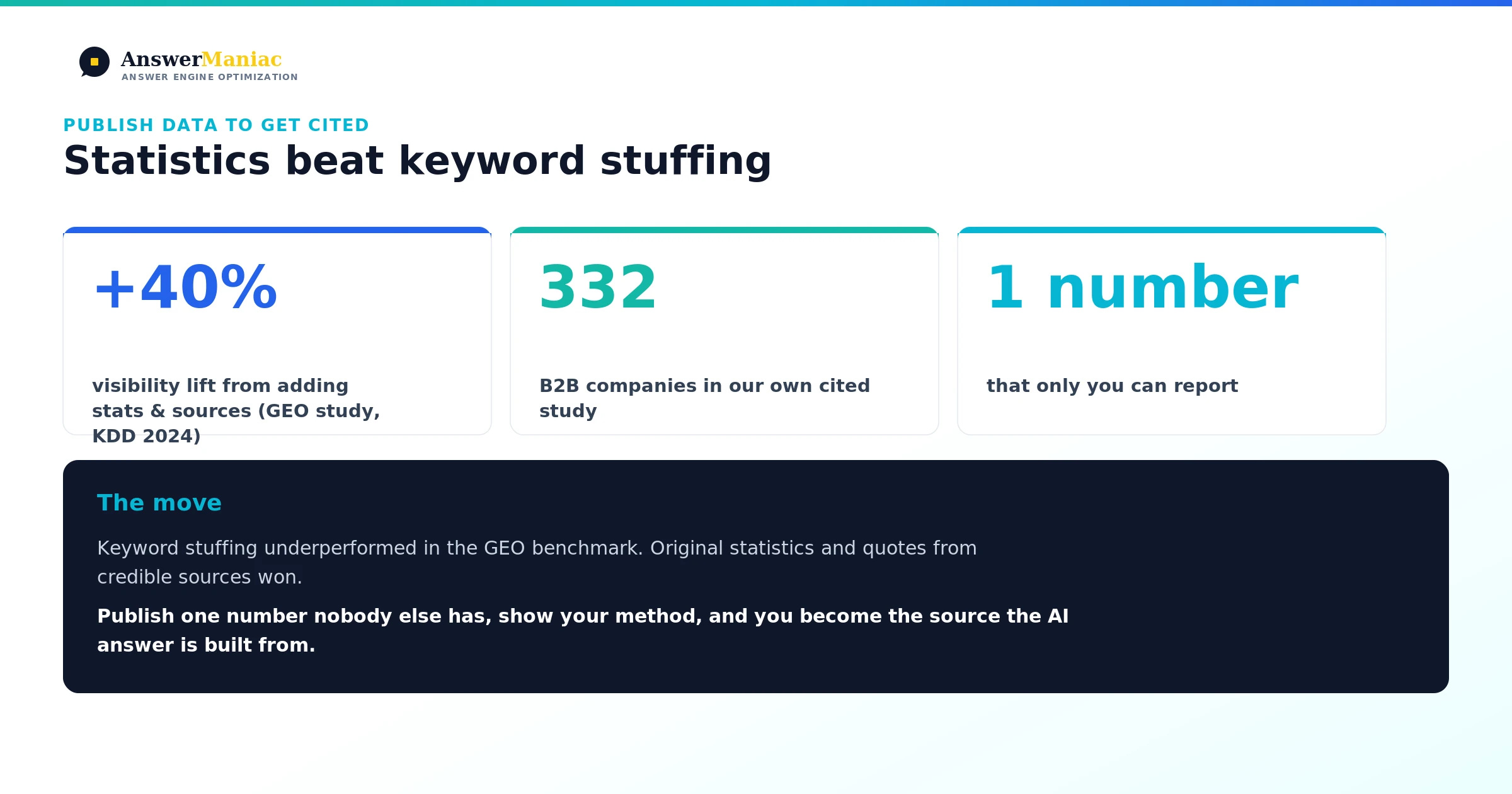
Our Q3 2026 study of 332 B2B companies found roughly half were never cited at all across the major engines, and among those that were, the answers shifted week to week. Presence in AI search is a probability, not a rank you lock in. Refresh is how you keep nudging that probability back up.
What "Stale" Actually Looks Like
Before you refresh anything, you need to find what's rotting. Stale isn't just an old date. It's content the engine no longer trusts to answer a current question. Run your top-cited and top-trafficked pages against this list.
Dead facts and expired stats
Any stat without a year, any "recent study" from 2023, any price or plan that's changed. AI engines cross-reference. When your number contradicts three newer sources, you become the outlier they drop, not the one they cite.
Missing engines and surfaces
Content written in early 2025 almost never mentions Google AI Mode, because it wasn't a default surface yet. If your page explains "how AI search works" and skips the engine a huge share of your buyers now use, it reads as dated to both humans and models.
Outdated framing and terminology
The field moves fast. If your page still frames everything around "mentions" when the field now says "citations," or ignores retrieval-augmented generation entirely, it signals you stopped paying attention. Specificity and current vocabulary are trust signals. For a deeper look at how source selection works now, see how AI search engines choose sources.
Thin coverage a competitor has since beaten
Sometimes the page didn't get worse. The bar got higher. A competitor published a more complete, better-structured answer and took your spot. That's not decay, that's displacement, and the refresh job is to out-specify them.
The Content Refresh Audit: A Repeatable Process
This is where The ANSWER Framework's Refine stage lives. Audit, Navigate, Structure, Write, Earn, then Refine, the loop that keeps the first five from going stale. Here's how to run it on existing content.
Step 1: Pull your citation inventory
Start with the pages AI engines actually reference. Use a prompt visibility tracking setup to see which URLs get cited for which queries, and pair it with Google Search Console to catch pages pulling AI Overview impressions. Ahrefs can surface which of your pages earn the most organic authority, a decent proxy for what engines trust. Rank pages by citation value, not by publish date.
Step 2: Score each page for decay risk
For every page in the inventory, flag four things: oldest stat on the page, last meaningful update, whether it covers every current engine, and whether a competitor now out-answers it. A page with 2023 stats, no update in 18 months, no mention of AI Mode, and a newer competitor ranking above it is a P0. Fix those first.
Step 3: Rewrite for information gain, not a date bump
This is the part teams get wrong. Changing dateModified without changing the content does nothing durable, and some larger AI systems reportedly compare content against the prior crawl, so a timestamp-only edit can be worse than leaving it alone. Add something new every time: a fresh data point from your own dashboard, an updated example, a corrected number, a new section answering a question buyers now ask. Lead with information gain. If the refresh doesn't add information that wasn't there before, it isn't a refresh.
Step 4: Fix the technical freshness signals
Update both the visible date on the page and the dateModified field in your Article schema (JSON-LD), and make them match. A mismatch between what a reader sees and what your structured data claims undermines trust. Keep datePublished honest and let dateModified reflect the real edit. These are table stakes, not a differentiator. The substance carries the weight.
Step 5: Re-earn the citation, don't assume it
Publishing the update isn't the finish line. The engine has to recrawl, re-evaluate, and decide you're the better answer again. Watch your frozen prompt set over the following weeks. If citations return, the refresh worked. If they don't, your update wasn't substantive enough or a competitor still out-answers you, and you go again.
How Often Should You Refresh?
Not everything needs the same cadence. Match the schedule to how fast the underlying topic moves.
| Content type | Refresh cadence | Why |
|---|---|---|
| "Best X 2026" lists, pricing, comparisons | Quarterly, minimum | Recency-weighted queries punish old dates hard |
| Statistics and data roundups | Every time a core stat updates | A single dead number can drop the whole page |
| How-to and framework explainers | Every 6 months | New engines and terminology age these quietly |
| Evergreen pillars and definitions | Annually, or when the field shifts | Depth and authority age slower, but still age |
One caveat worth stating plainly: evergreen isn't dead. The Seer Interactive study found Perplexity in particular still rewards strong, older content that gets maintained, favoring depth and authority over raw recency. So don't gut a deep pillar page to chase a date. Maintain it.
Measuring Whether the Refresh Worked
You can't manage citation retention from a single screenshot. The whole point of a frozen prompt set is to separate a real decline from the normal week-to-week swing every brand sees.
Pick 20 to 50 buyer queries, run them against ChatGPT, Perplexity, Gemini, and Google AI Mode on a fixed schedule, and log who gets cited. Track your AI Visibility Rate over time, not on any given day. When you refresh a page, you're looking for the trend line to recover, not for an instant result. For the full measurement approach and how to tie it to pipeline, work through how to measure AI search ROI.
The teams that win at this aren't publishing more. They're defending what already works, on a schedule, with real updates, and watching the data instead of the anecdote.
FAQ
How is content refresh for AI search different from traditional SEO content updates? Traditional SEO updates chase ranking signals for a relatively stable algorithm. AI search updates defend against a moving target: models that retrain silently and retrieval layers that pull live sources. The audit looks similar, but the stakes are higher because the system recomputes answers constantly, and the measurement has to account for non-determinism rather than a fixed rank.
Does just updating the dateModified timestamp help me get cited again?
On its own, no, and it can backfire. Larger AI systems reportedly compare new crawls against prior versions, so a timestamp change with no substantive edit signals manipulation rather than freshness. Update the date only as part of a real refresh that adds new data, corrected facts, or new sections.
How often should I refresh my best-performing pages? It depends on the topic's velocity. Pricing pages, comparison lists, and "best of 2026" content need quarterly attention at minimum. Evergreen pillars and definitions can run six months to a year. The rule: the faster the underlying facts change, the more often recency-weighted queries will punish an old date.
Will refreshing content hurt my existing rankings or citations? Not if you preserve what works and add to it. The risk comes from gutting a page that already earns citations. Keep the structure and depth that got you cited, correct what's stale, and extend coverage. Then watch your frozen prompt set to confirm the position held or recovered.
Which tools do I need to run a refresh program? At minimum: a prompt visibility tracker to see which pages get cited, Google Search Console for AI Overview impressions and query data, and Ahrefs or similar for authority signals. The tracker tells you what to protect, GSC tells you what's slipping, and your own analytics tell you what new data you can add that nobody else has.
Your best pages earned their citations once. Models change, grounding data refreshes, and competitors publish, so those citations won't defend themselves. If you want a refresh program that holds your AI visibility instead of watching it decay, book a discovery call and we'll audit which of your pages are at risk first.
Get AEO Insights Weekly
Join 500+ B2B marketers getting AI visibility tactics every Tuesday.
Ready to Get Your Brand Cited by AI?
See how your competitors show up in ChatGPT, Perplexity, and Gemini — and what it would take to get recommended.