AI Citation Volatility: Why You're Cited One Week and Gone the Next
40 to 60% of AI-cited sources rotate month to month. Here's why your ChatGPT and Perplexity citations swing week to week, and how B2B teams build a stable position.
Quick Answer
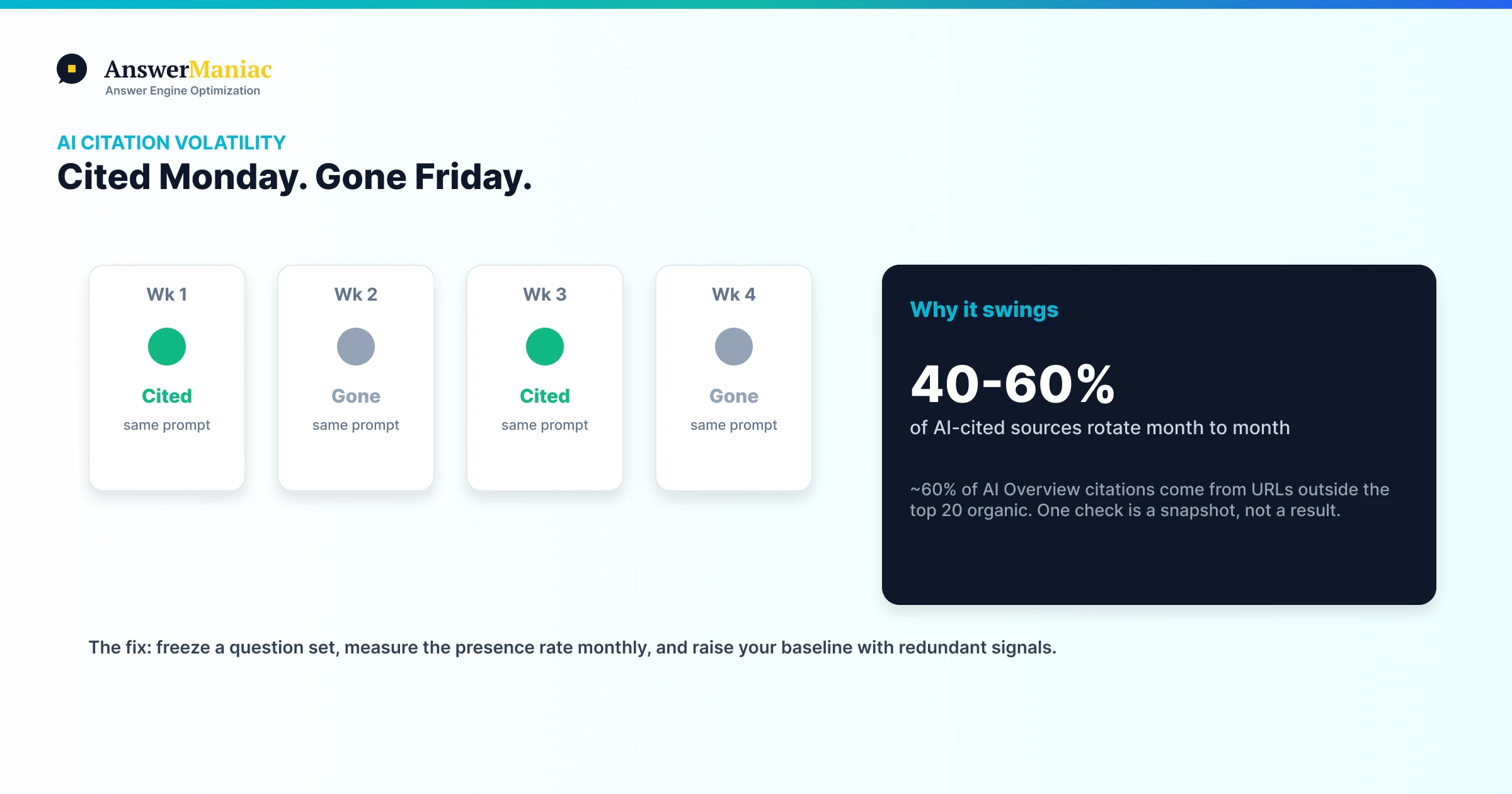
AI citation volatility is the week-to-week swing in whether an AI engine names or cites your brand. It is normal: roughly 40% to 60% of AI-cited sources rotate month to month (industry analysis, 2026), and around 60% of AI Overview citations come from URLs that do not rank in the top 20 organic results. A single check on a single day tells you almost nothing. The fix is not chasing every swing but building durable inputs (entity authority, citation-worthy content, off-site signals) and measuring a frozen question set over time so you can see the trend instead of the noise.
A client emailed me a screenshot on a Monday: ChatGPT recommending them for a key buyer query. Big win. By Thursday they sent another screenshot, same prompt, and they were gone. Replaced by a competitor. Nothing on their site had changed.
Welcome to AI citation volatility. It is real, it is measurable, and it quietly wrecks how most teams evaluate their AI visibility.
Here is the trap. People check ChatGPT once, see themselves cited, and declare victory. Or they check once, see nothing, and declare the whole channel broken. Both are wrong, because a single snapshot of a system that rotates 40% to 60% of its sources monthly is noise, not signal.
This piece explains what actually drives the swings, which ones to ignore, and how B2B teams build a citation position that holds instead of flickering.
The Data: Citations Rotate More Than You Think
The churn is not your imagination.
| Signal | Figure | What it means |
|---|---|---|
| AI-cited sources that rotate month to month | ~40% to 60% | Any single check is a snapshot of a moving system |
| AI Overview citations from URLs outside the top 20 organic | ~60% | Rank does not lock your citation in place |
| Perplexity answers that include citations | Nearly every answer | High visibility, but also high turnover of who gets cited |
| B2B SaaS companies with zero AI citations in our research | 44% of 100 | Most start from invisible, then swing near the threshold |
The takeaway from these numbers is not "AI is random." It is that AI answers are recomputed constantly from signals that shift, so your presence is a probability, not a fixed rank. Your job is to raise that probability until you are named most of the time, then keep it there.
What Actually Drives the Swings
Not all volatility is the same. Some you cause, some the platform causes, and some is your competitors moving. Knowing which is which stops you from overreacting.
Model and index updates. The platforms retrain and re-rank without notice. A model refresh can reshuffle who gets named for a query overnight, and there is nothing on your site to blame. This is the volatility you cannot control, only outlast.
Freshness and recency. Retrieval-based engines like Perplexity lean on recent, well-structured content. A newer competitor page can bump you until your content is updated. Stale pages slowly lose their spot.
Thin or borderline authority. If you are cited sometimes and not others, you are usually sitting near the threshold. The engine considers you a candidate but not a lock. That is a signal to strengthen your inputs, not to panic at any single miss.
Competitor movement. Citation slots are finite. When a competitor improves their share of voice, they can take the slot you held. Their gain shows up as your loss even though you did nothing wrong.
Prompt sensitivity. Small wording changes in the prompt can surface different vendors. If you test with a slightly different question each time, you will see "volatility" that is really just you moving the target.
How to Tell Signal From Noise
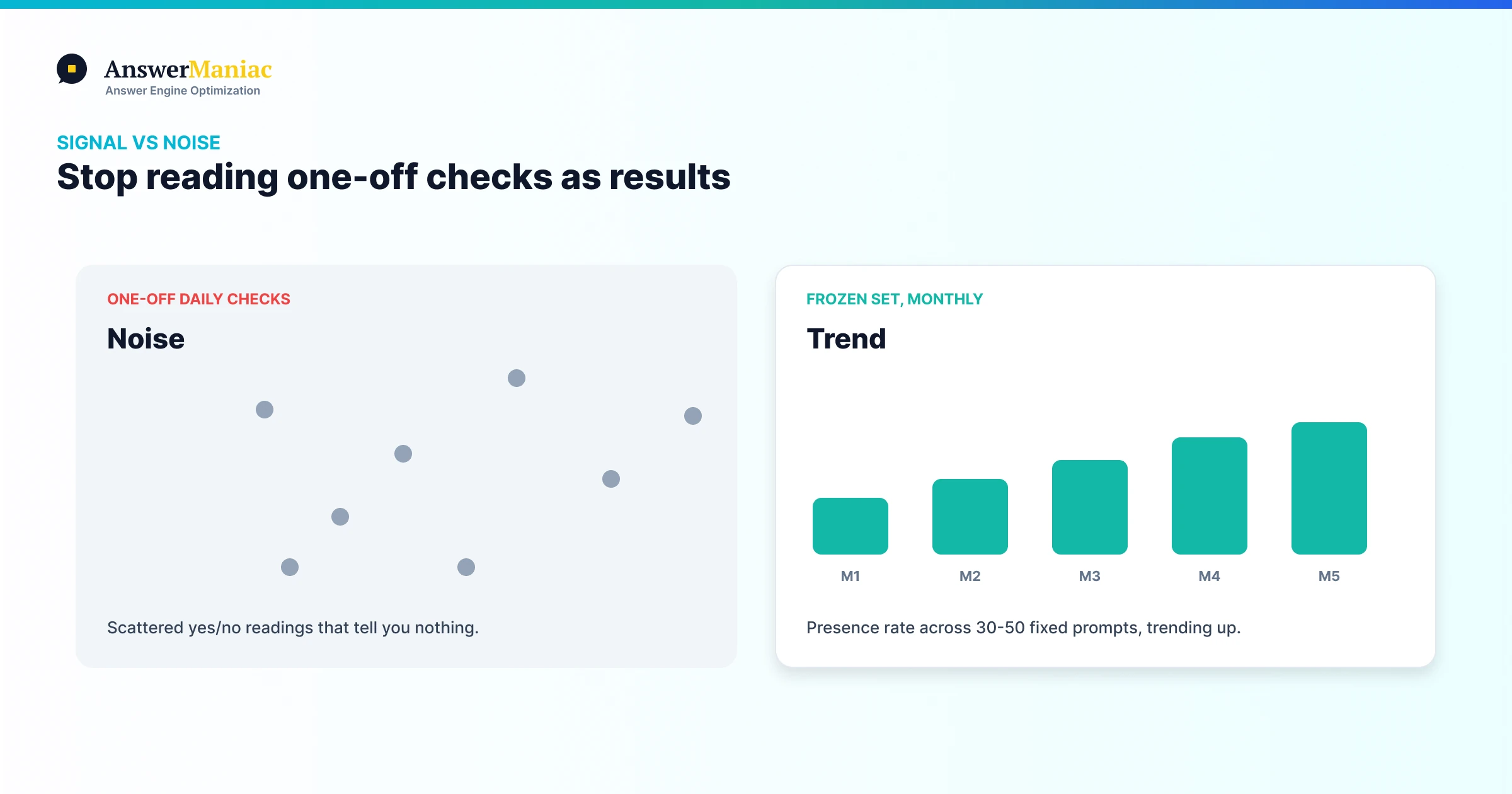
The single most important discipline is to stop reading individual checks as results.
Freeze your prompt set. Pick 30 to 50 real buyer questions and do not change them. A number you can move by rewording the question is a vanity metric. A frozen set is the only way to compare month to month honestly.
Measure on a fixed cadence. Monthly is the practical rhythm. It smooths the daily flicker while still catching real movement. Daily checking will drive you crazy and teach you nothing.
Track presence rate, not a single yes or no. The useful number is "cited in 34 of 50 prompts," not "cited today." Watch that rate trend up or down over months. That is your real position.
Separate the causes. When the rate drops, ask which driver moved: did a platform update land, did a competitor gain ground, or did your content go stale. The response is different for each.
This is exactly why the Refine stage of the ANSWER Framework uses a frozen protocol and classifies every outcome as positive, negative, inconclusive, or invalid. It is built to see through the noise that fools single-snapshot checks.
How to Build a Position That Holds
You cannot eliminate volatility, but you can raise your baseline so the swings happen above the citation threshold instead of across it.
- Entity authority. Consistent brand information across your site, Wikipedia and Wikidata, LinkedIn, Crunchbase, and structured data. The more overlapping signals confirm who you are, the less any single change moves you.
- Depth of citation-worthy content. One good page is a coin flip. A cluster of pages that answer the buyer questions in your category makes you the obvious source across many prompts, so a single competitor page cannot displace you everywhere.
- Freshness cadence. Update your key pages on a schedule. Recency is a live ranking factor for retrieval engines, and stale content is the most common reason a solid page slips.
- Off-site presence. Reviews, earned media, and genuine community discussion give the model repeated, independent confirmation that you belong in the answer. That redundancy is what stabilizes a citation.
The pattern is redundancy. A brand cited because of one page is fragile. A brand cited because of a web of reinforcing signals is stable.
Frequently Asked Questions
Why does ChatGPT cite me one day and not the next? Because AI answers are recomputed from signals that shift, and roughly 40% to 60% of cited sources rotate month to month. If you are cited sometimes, you are near the threshold. Strengthen your inputs to move from candidate to lock.
Is AI citation volatility a sign something is wrong with my site? Not necessarily. Much of the swing comes from model updates and competitor movement you did not cause. Look at the trend across a frozen question set over months before concluding anything about your site.
How often should I check my AI citations? Monthly, against a fixed set of prompts. Daily checking measures noise. Monthly measurement of a frozen set measures your real position.
Does ranking on Google protect my AI citation? No. Around 60% of AI Overview citations come from URLs outside the top 20 organic results, so rank alone does not lock your citation in place.
How do I make my AI citations more stable? Build redundancy: strong entity signals, a cluster of citation-worthy content, a freshness cadence, and off-site presence. The more independent signals confirm you belong in the answer, the less any single change knocks you out.
The Takeaway
AI citations swing because AI answers are recomputed, not ranked once. With 40% to 60% of sources rotating monthly, a single check tells you nothing. Stop reacting to snapshots. Freeze a question set, measure the presence rate monthly, and separate platform noise from real movement. Then raise your baseline with redundant, reinforcing signals so your swings happen above the citation line, not across it. Stability is not luck. It is built.
Want a real baseline instead of a lucky screenshot? Run a free AI visibility audit and see your presence rate across ChatGPT, Perplexity, and Gemini.
Sources
- Industry AI Overviews analysis, 2026: 40% to 60% of cited sources rotating month to month; ~60% of AI Overview citations from URLs outside the top 20 organic
- Reporting on Perplexity citing sources on nearly every answer
- AnswerManiac benchmark research: 100 B2B SaaS companies across 42 buyer-intent queries (44% received zero citations)
Related Reading
Get AEO Insights Weekly
Join 500+ B2B marketers getting AI visibility tactics every Tuesday.
Ready to Get Your Brand Cited by AI?
See how your competitors show up in ChatGPT, Perplexity, and Gemini — and what it would take to get recommended.