Wikipedia, Wikidata, and the Knowledge Graph: The Entity Layer B2B Underuses
Wikipedia is 3 to 5% of ChatGPT's training data and its most-cited source. Here's how Wikipedia, Wikidata, and the knowledge graph shape whether AI knows your B2B brand.
Quick Answer
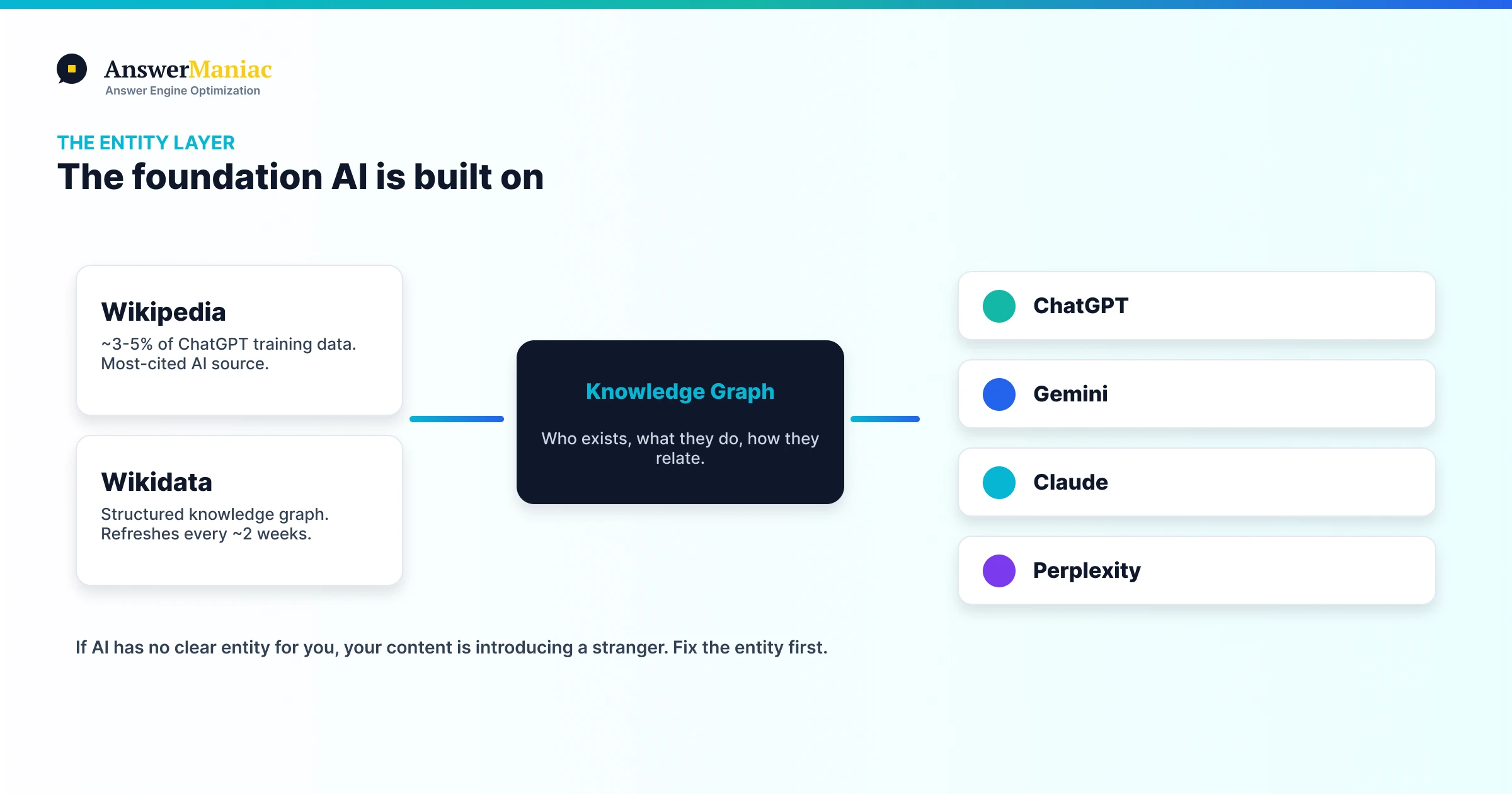
Why Wikipedia and Wikidata matter for AI visibility: Wikipedia is roughly 3% to 5% of ChatGPT's training data and remains the single most-cited source in AI answers, and it is in the core training set of nearly every major model, including ChatGPT, Claude, and Gemini (2026 analysis). Wikidata, the structured knowledge graph behind it, refreshes about every two weeks, faster than most model training cycles. Together they form the entity layer: the models' baseline understanding of who exists, what they do, and how they relate. If AI has no clear, consistent entity for your company, you are competing against the models' own foundation. Fixing your entity presence is often the highest-impact AI visibility work a B2B company can do.
Most B2B teams optimizing for AI start with content. Write more, structure it better, get cited. That is real work and it matters. But it skips the layer underneath, and that layer is often why the content is not landing.
The models do not learn about your company from a blank slate. They arrive with a map: an internal sense of which entities exist and how they connect, built largely from a small set of high-trust sources. Wikipedia is the biggest one. If your company is not a clear node on that map, every piece of content you publish is trying to introduce a stranger. If you are a clear node, your content confirms someone the model already knows.
That is the difference the entity layer makes. This piece explains how Wikipedia, Wikidata, and the knowledge graph shape AI's understanding of your brand, and how B2B companies actually build entity presence without gaming anything.
Why the Models Lean on Wikipedia So Heavily
The reliance is not a rumor. It is baked into how these systems were built.
| Signal | Figure | Why it matters |
|---|---|---|
| Wikipedia share of ChatGPT training data | ~3% to 5% | Small share, outsized influence on what the model "knows" reliably |
| Wikipedia's rank as an AI answer source | Most-cited source | It is the default fact anchor across engines |
| Models with Wikipedia in core training | ChatGPT, Claude, Gemini, and more | The reliance is industry-wide, not one vendor |
| Wikidata refresh cadence | ~every two weeks | Structured corrections propagate faster than retraining |
Here is the intuition. When a model learns language and facts, it reads Wikipedia at a scale it reads almost nothing else. Wikipedia is high-quality, heavily cross-referenced, and structured, so it becomes the reference point the model trusts when it is unsure. That is why an entity with strong Wikipedia and Wikidata presence gets described confidently and consistently, and an entity without one gets described vaguely, inconsistently, or not at all.
For a B2B company, the practical consequence is blunt. If the model does not have a clean entity for you, it will hedge, guess, or reach for a competitor it does understand.
The Three Layers of Entity Presence
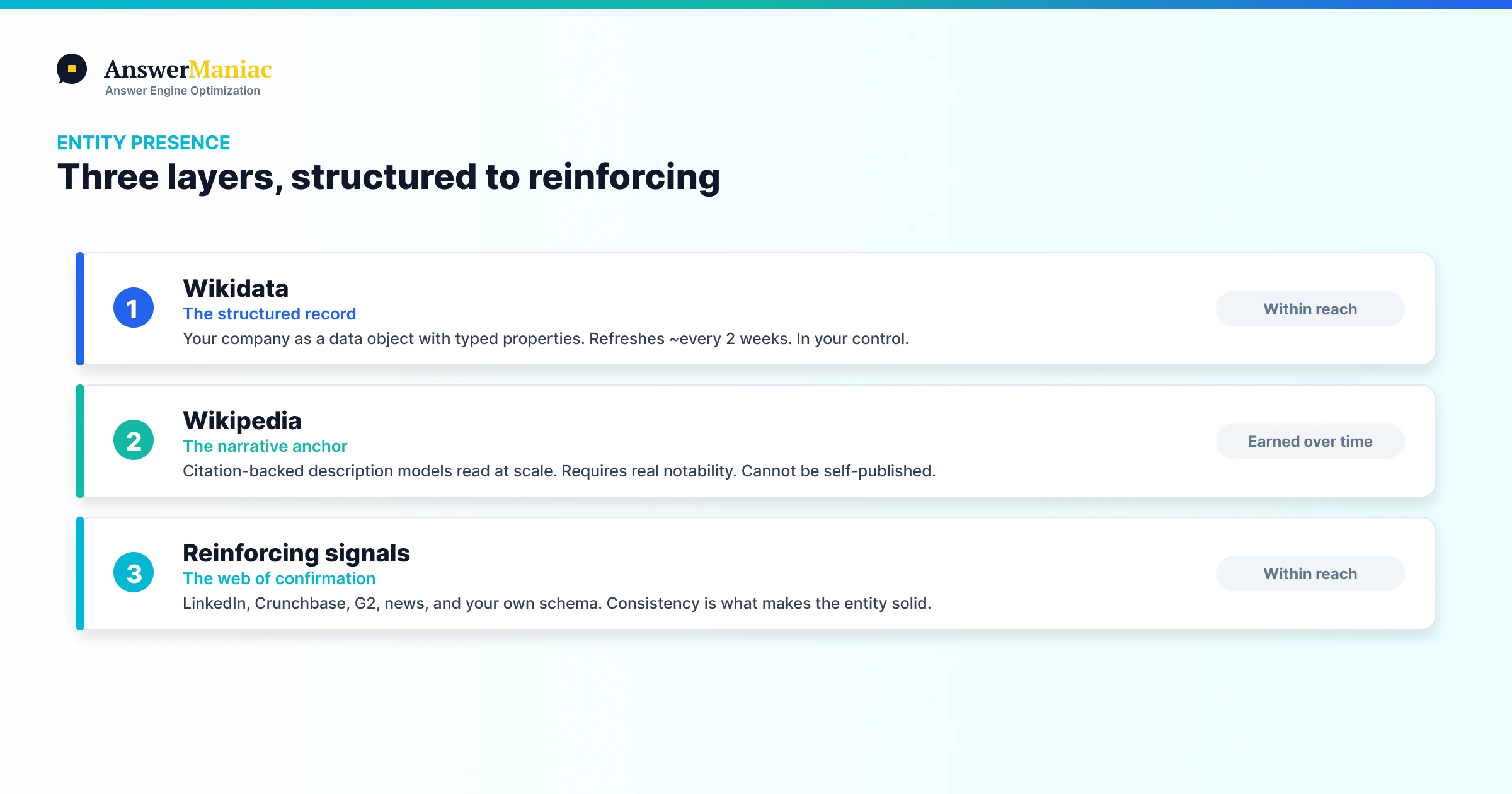
Think of your entity presence as three connected layers, from structured to narrative to reinforcing.
Wikidata (the structured record). Wikidata is the machine-readable knowledge graph: your company as a data object with typed properties (what you are, who founded you, your industry, your relationships). It refreshes roughly every two weeks, so a correct, complete Wikidata item is one of the faster ways to give models clean structured facts about you.
Wikipedia (the narrative anchor). A Wikipedia article is the human-readable, citation-backed description that models read at scale. It is also the hardest layer to earn, because Wikipedia requires genuine notability and independent coverage. You cannot buy or self-publish your way in, and trying gets you removed.
Reinforcing signals (the web of confirmation). Beyond Wikipedia and Wikidata sit the sources that echo and confirm your entity: LinkedIn, Crunchbase, industry directories, news coverage, G2, and structured data on your own site. Models rely on overlapping credibility signals, so consistency across all of these is what makes your entity solid.
The order matters. Reinforcing signals and Wikidata are within reach for almost any company. Wikipedia is earned over time through real notability, not manufactured.
What B2B Companies Should Actually Do
You do not need to be famous. You need to be consistent and machine-legible. Here is the practical sequence.
Fix your own structured data first. Organization schema, consistent NAP, sameAs links to your official profiles, and a clear description of what you do and who you serve. This is the foundation the entity optimization work builds on, and it is fully in your control.
Claim and complete your Wikidata item. Make sure your company exists as a Wikidata object with accurate, complete properties and links to authoritative sources. If it does not exist, a well-sourced item can be created. This is the structured layer, and it moves faster than any retraining cycle.
Make your entity consistent everywhere. The same company name, description, founding details, and category across LinkedIn, Crunchbase, G2, your site, and any press. Inconsistency dilutes the entity and makes the model less certain about you. Certainty is what earns a confident citation.
Earn coverage that could support Wikipedia later. You do not start with Wikipedia. You earn independent, notable coverage over time, and Wikipedia becomes possible once that coverage exists. Treat it as an outcome of real authority building, not a task to force.
Do not fake it. Self-created promotional Wikipedia articles get deleted, and manipulated entities damage trust. The models reward genuine, consistent, independently-confirmed presence, which is exactly what the ANSWER Framework Structure and Earn stages are built to produce.
Where This Fits in the Bigger Picture
Entity work is not a replacement for content. It is the foundation that makes content land. A citation-worthy page about your category performs far better when the model already has a clear entity for the company publishing it, because the model can connect the claim to a known, trusted node instead of an unknown one.
That is why we treat the entity layer as early-stage foundation work in every engagement. Get the structured facts clean and consistent, build the reinforcing signals, and your content stops introducing a stranger and starts confirming an authority.
Frequently Asked Questions
Does my company need a Wikipedia page to be cited by AI? No, but it helps significantly. Wikipedia is one of the most-cited AI sources and part of nearly every model's core training. If you cannot earn a Wikipedia article yet, a complete Wikidata item and consistent entity signals across the web still give models a clean understanding of you.
What is the difference between Wikipedia and Wikidata? Wikipedia is the human-readable, narrative article. Wikidata is the structured, machine-readable knowledge graph behind it, storing your company as a data object with typed properties. Models use both; Wikidata refreshes faster, about every two weeks.
Can I just create my own Wikipedia page? You should not create a promotional article about your own company. Wikipedia requires genuine notability and independent coverage, and self-created or manipulated articles get removed. Earn the coverage first; the article becomes possible after.
How much of ChatGPT's training data is Wikipedia? Reported figures put Wikipedia at roughly 3% to 5% of ChatGPT's training data. The share is small but its influence is outsized because Wikipedia is high-quality, structured, and heavily cross-referenced.
What is the fastest entity fix for a B2B company? Clean, consistent structured data on your own site plus a complete, accurate Wikidata item and matching profiles across LinkedIn, Crunchbase, and G2. Those are in your control and give models the clean facts they rely on.
The Takeaway
AI models do not meet your company cold. They arrive with a map built largely from Wikipedia and its knowledge graph, and if you are not a clear node on that map, your content is introducing a stranger. Fix the structured layer first, make your entity consistent everywhere, earn the coverage that supports notability over time, and never fake it. The entity layer is quiet, unglamorous, and often the single highest-impact AI visibility work a B2B company can do.
Not sure how AI describes your company today? Run a free AI visibility audit and see whether the models have a clear entity for you or a vague guess.
Sources
- 2026 analysis of Wikipedia in LLM training and citations (Wikipedia ~3% to 5% of ChatGPT training data; most-cited AI source; core training set of ChatGPT, Claude, and Gemini)
- Reporting on Wikidata's roughly two-week refresh cadence and overlapping entity credibility signals
- AnswerManiac benchmark research: 376 B2B companies across five verticals
Related Reading
Get AEO Insights Weekly
Join 500+ B2B marketers getting AI visibility tactics every Tuesday.
Ready to Get Your Brand Cited by AI?
See how your competitors show up in ChatGPT, Perplexity, and Gemini — and what it would take to get recommended.