Publish Original Data to Get Cited: Why Statistics Win AI Citations
Original data and statistics make B2B content a citation magnet. A KDD 2024 study found adding stats lifts AI visibility up to 40%. Here's how to produce it.
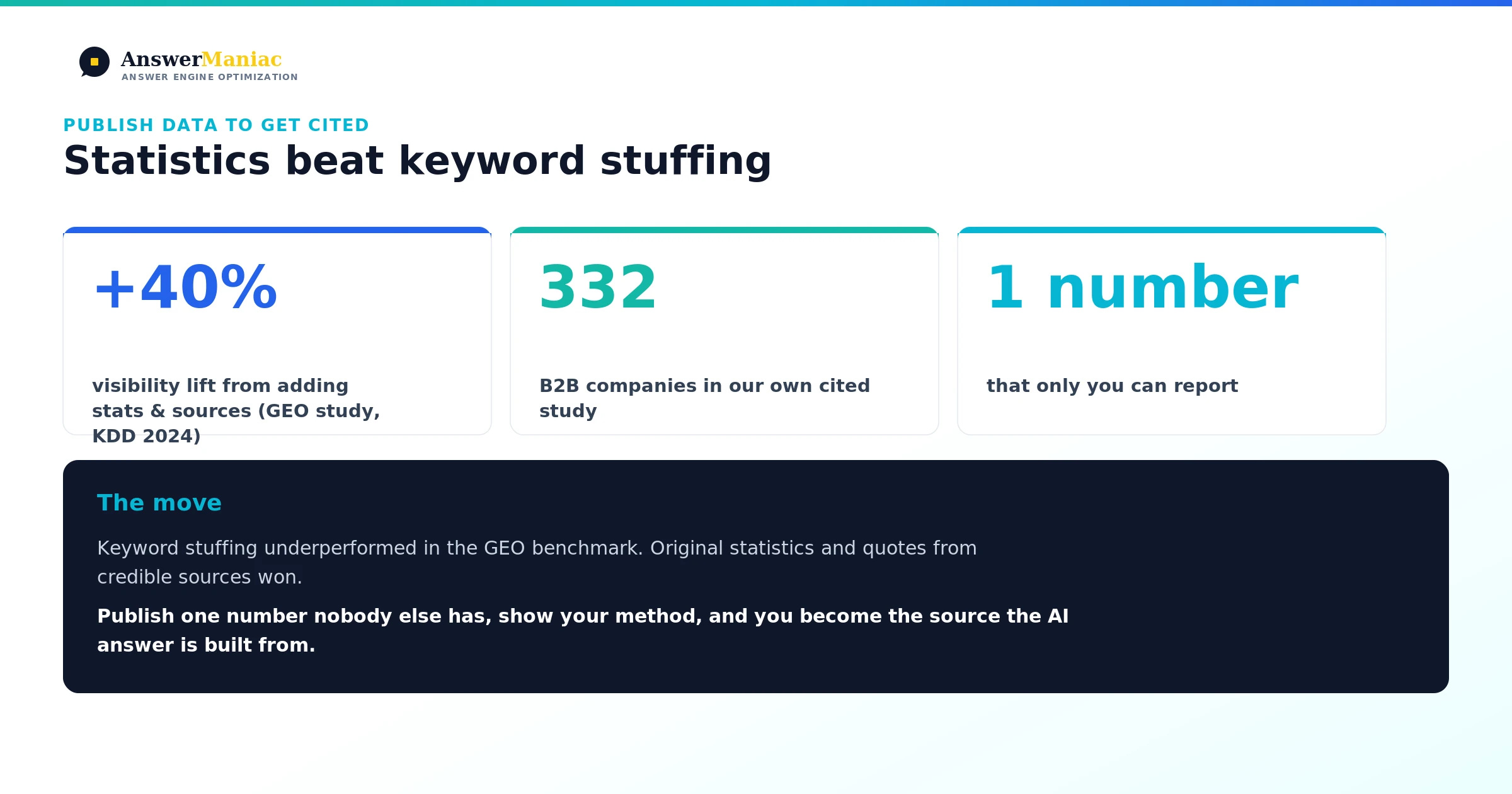
Direct Answer: Original data earns AI citations because language models prefer specific, verifiable, quotable facts over vague claims. A 2024 study from Princeton and partners (Aggarwal et al., "GEO: Generative Engine Optimization," accepted at KDD 2024) tested content tactics against generative engines and found that adding statistics, adding quotations from credible sources, and citing authoritative sources each raised a source's visibility in AI answers by up to roughly 40%, while keyword stuffing did not help. If you want ChatGPT and Perplexity to name you, publish a number no one else has.
Most B2B blogs are summaries. They repackage what's already ranking, add a few adjectives, and hope for the best. An AI model reading that content has no reason to cite it, because every claim in it already exists somewhere more authoritative. You're giving the model a worse copy of a source it already trusts.
Original data flips that. When you publish a survey result, a benchmark, or a number pulled from your own dashboard, you become the source. There's no upstream version to cite instead of you. That's the whole game.
Check how AI sees your business before you read further. If you're already invisible, this is the fastest route back in.
Key Takeaways
- A peer-reviewed study (Aggarwal et al., KDD 2024) found that adding statistics and quotes from credible sources lifted a page's visibility in AI answers by up to ~40%, outperforming keyword-based tactics.
- AI models cite what they can extract and verify. A specific stat with a named source is extractable. "Many companies struggle with X" is not.
- Original data removes the competition problem: if the number only exists on your page, the model has to cite you to use it.
- Producing citable data is cheaper than you think. A 200-response survey in SurveyMonkey or a benchmark built in Google Sheets can anchor a dozen pieces of content.
Why models reach for numbers
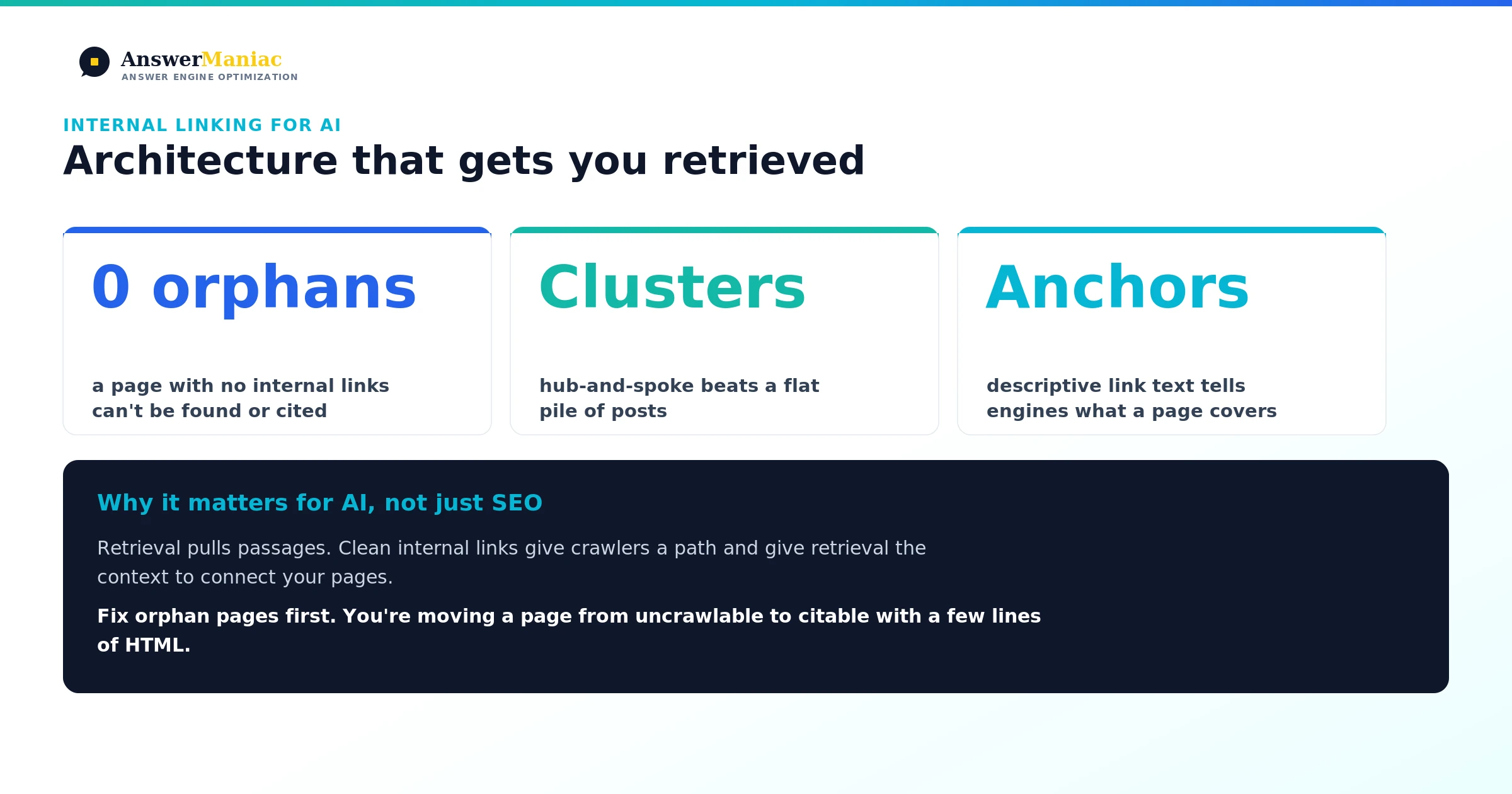
Language models assembling an answer are doing retrieval and synthesis. They pull candidate passages, weigh which ones support a claim, and stitch together a response with attributions. The passages that survive that process share a trait: they're concrete.
A sentence like "churn dropped 18% after the onboarding change" is a gift to a model. It's self-contained, it's specific, and it maps cleanly onto a user's question. Compare it to "improving onboarding can meaningfully reduce churn." The second sentence says almost nothing a model can hang an attribution on. This is what we mean by fact density: the number of verifiable, standalone claims packed into a passage. High fact density is what makes content extractable, and extractability is what gets you cited.
The GEO paper put numbers behind this intuition. The researchers built GEO-bench, a set of real user queries across multiple domains, then tested nine content optimization methods against generative engines. The methods that moved the needle most were adding relevant statistics, quoting credible sources, and citing authoritative references. The method that underperformed was the one every spammy SEO still reaches for: stuffing the target keyword. The authors report an overall visibility lift of up to 40% on their position-adjusted metric from the winning tactics (Aggarwal et al., arXiv:2311.09735, KDD 2024).
Read that again. The single most reliable way to improve how often an AI engine cites your content, according to the first rigorous study on the subject, is to add statistics. Not more words. Not more keywords. Numbers.
Summaries don't get cited. Sources do.
Here's the uncomfortable part for most content teams. If your article is a competent summary of a topic, you've built something a model will read and ignore. It'll absorb your framing, maybe, but it'll cite the original source you summarized, because that source carries more authority and more specificity.
This is the Information Gain problem. Google's own patents describe scoring documents on how much new information they add to what's already known about a topic. AI engines operate on the same logic, even if the mechanism differs. A page that adds nothing new gives an engine no reason to cite it.
Original data is the cleanest form of Information Gain available to a B2B team. You can't out-authority Gartner on market sizing. But you can run a survey Gartner didn't run, benchmark a workflow nobody's benchmarked, or pull an anonymized pattern from your own customer base that literally does not exist anywhere else. When you do that, you're no longer competing for the citation. You are the citation.
We put this through its paces on our own content. Our Q3 2026 study scored 332 growth-stage B2B companies for AI visibility by running unbranded buyer-intent queries through ChatGPT and Perplexity. The finding was blunt: exactly half of those companies, 166 of 332, never earned a single citation from either engine. Perplexity cited 158 of the 332; ChatGPT cited just 52. And review-site URLs showed up in 28% of Perplexity answers, with G2 the most-cited domain of all. You can read the full breakdown in our State of AI Search report.
That study is the example, not just the evidence. It's a dataset that didn't exist until we built it. Every time another site discusses challenger-brand AI visibility, there's now a specific, quotable number to reach for, and it points back to us. One survey, one weekend of query runs, and we manufactured a citation asset with a shelf life measured in quarters. That's the trade you're making when you publish data instead of opinion.
What "original data" actually means for a B2B team
You don't need a research department. You need one of these:
- A survey. Poll your audience, your customers, or your industry. 150 to 300 responses is enough to report a defensible percentage. SurveyMonkey or a Typeform embed plus your email list gets you there in a week.
- A benchmark. Measure something in your category that nobody's measured. Response times, pricing spreads, feature adoption, error rates. Pull it into Google Sheets, clean it, report it.
- A proprietary pattern. Aggregate and anonymize what you already see. "Across 400 onboarding sessions, the drop-off happens at step 3" is original data you're sitting on right now.
- An index or a teardown. Score a set of tools, sites, or companies on a consistent rubric and publish the ranking with the methodology.
Each of these produces numbers that can't be found elsewhere. That's the point. For a fuller menu of formats that attract citations, see our citation asset playbook.
How to structure data so it actually gets pulled
Producing the number is half the work. The other half is formatting it so a model can lift it cleanly. A buried stat in paragraph nine of a 3,000-word essay is worth less than the same stat written as a quotable sentence near the top.
Here's how to make your data extractable:
Lead with the number. Start the sentence with the stat, not with throat-clearing. "Half of the 332 B2B companies we studied were never cited by ChatGPT or Perplexity" beats "In our research, we discovered that a significant portion of companies had limited visibility..."
Make every stat standalone. The sentence should carry its own context: the number, what it measures, and the population. A model that pulls that one sentence should be able to use it without needing the paragraph around it.
Name your source and date inside the content. "According to our October 2026 survey of 332 companies" tells the model this is primary, attributable, and current. Specificity reads as credibility to both humans and machines.
Put a methodology section at the bottom. Sample size, dates, how you collected it. This is what separates a citable study from a made-up stat, and it's a signal engines increasingly weigh.
Use a table or a clear list for multi-point data. Structured data is easier to parse than prose. A comparison table gives a model discrete rows it can quote.
This is the Structure and Write work inside The ANSWER Framework (Audit, Navigate, Structure, Write, Earn, Refine). You can produce brilliant data and still get ignored if it's formatted like a diary entry. The formatting is what turns a number into a citation.
The compounding effect of one dataset
One genuine dataset doesn't give you one piece of content. It gives you a cluster.
A single survey becomes the headline report, a methodology post, three or four angle pieces pulling one finding each, a set of social posts, and a reference you link to from every related article on your site. Each of those surfaces the same proprietary number from a different entry point. The result is that when a buyer asks an AI engine a question your data touches, there are multiple paths back to you.
It also earns links the ordinary way. Journalists and other writers cite statistics constantly, and they need a source to point to. Publish the number first and you become that source. Those citations and links feed right back into the authority signals that make engines trust you in the first place. For the strategic layer that ties this together, see our guide to content strategy for AI visibility.
We track every dataset we've published and where it gets cited across AI engines. You can see the running record on our research page. The pattern holds: data gets quoted, opinions get skimmed.
FAQ
Does publishing statistics really improve AI citations, or is that just an SEO claim? It's a tested finding, not a marketing line. The GEO study (Aggarwal et al., accepted at KDD 2024) measured it directly: adding statistics and quotes from credible sources raised source visibility in generative-engine answers by up to roughly 40%, while keyword stuffing didn't help. The full paper is at arXiv:2311.09735.
How much data do I need to publish something citable? Less than you'd guess. A survey of 150 to 300 respondents supports a defensible percentage. A benchmark of 20 to 50 items is enough to report a pattern. What matters is that the number is specific, the methodology is transparent, and the data doesn't already exist elsewhere.
What's the difference between original data and just citing someone else's stats? Citing someone else's stat makes you a decent summary; the engine can still go cite the original. Publishing your own stat makes you the original. There's no upstream source to cite instead of you, which is exactly why original data converts to citations at a higher rate.
Where should I put the statistics in my content? Near the top, in standalone sentences that lead with the number, with the source and date named inline. Add a methodology section at the bottom. Avoid burying your best number deep in a long article where neither a reader nor a model will reach it easily.
How do I know if my data is actually getting cited by AI engines? Run buyer-intent queries through ChatGPT, Perplexity, Gemini, and Claude and check whether your pages and numbers appear. A structured check tells you which engines surface you and which don't, so you know where to push. You can check how AI sees your business to get that baseline.
Stop summarizing. Start sourcing.
The teams winning AI citations right now aren't the ones with the biggest content budgets. They're the ones publishing numbers nobody else has. One survey, one benchmark, one proprietary pattern, formatted so a model can lift it, and you've built an asset that earns citations for quarters.
See where you stand first. Check how AI sees your business to find out which engines cite you today and which ignore you. Then book a discovery call and we'll map the data you're already sitting on into citation assets worth publishing.
Get AEO Insights Weekly
Join 500+ B2B marketers getting AI visibility tactics every Tuesday.
Ready to Get Your Brand Cited by AI?
See how your competitors show up in ChatGPT, Perplexity, and Gemini — and what it would take to get recommended.