State of AI Search Q3 2026: Half of 332 B2B Challengers Are Invisible to ChatGPT and Perplexity
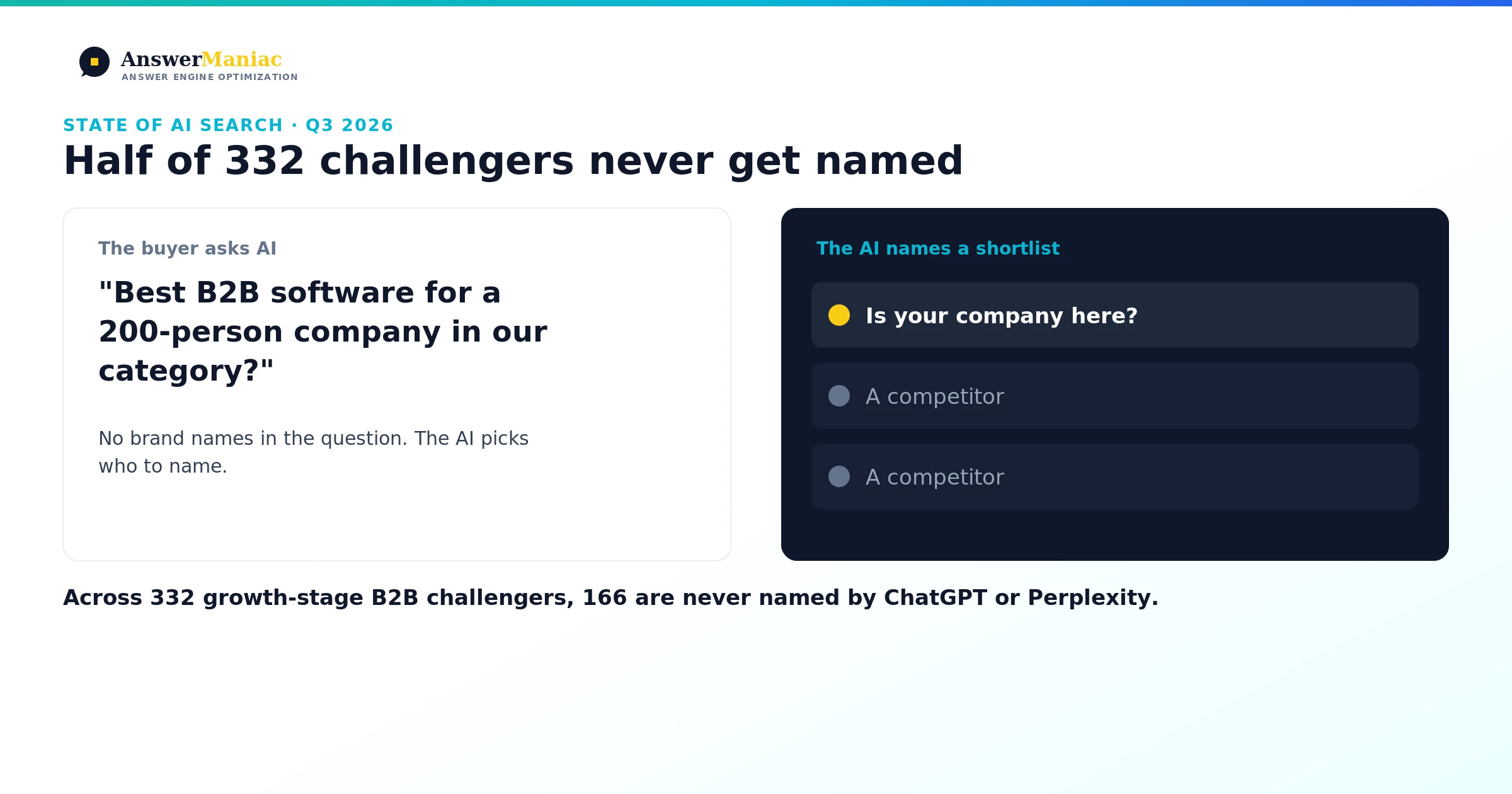
We scored 332 growth-stage B2B companies across 7 verticals for AI visibility. 166 got cited by ChatGPT or Perplexity. 166 were completely invisible. Here's the full breakdown.
Quick Answer
State of AI Search Q3 2026 (B2B challengers): We scored 332 growth-stage B2B companies across 7 verticals by running 155 unbranded, buyer-intent category queries through ChatGPT (gpt-4o) and Perplexity (sonar-pro). Exactly 166 companies earned at least one citation; 166 earned zero. Perplexity cited 158 of the 332, ChatGPT cited just 52. No company was cited in more than 30% of the queries that applied to it. The takeaway: for growth-stage B2B vendors, AI visibility is still wide open, and the companies winning it are not the ones with the biggest budgets.
Every quarter we run the same experiment. We take a defined set of B2B companies, ask the AI engines the questions their buyers actually ask, and record who gets named. No branded prompts, no "tell me about [company]" softballs. Just the category questions a real buyer types when they're starting a shortlist.
This quarter we went wider than we ever have. 332 companies. Seven verticals. 155 queries. Two engines. And we deliberately left out the incumbents. You already know ChatGPT names Salesforce and CrowdStrike. The interesting question is what happens to the challenger below them, the one fighting for the shortlist spot that AI now controls.
Here's what we found.
The headline: it's a coin flip
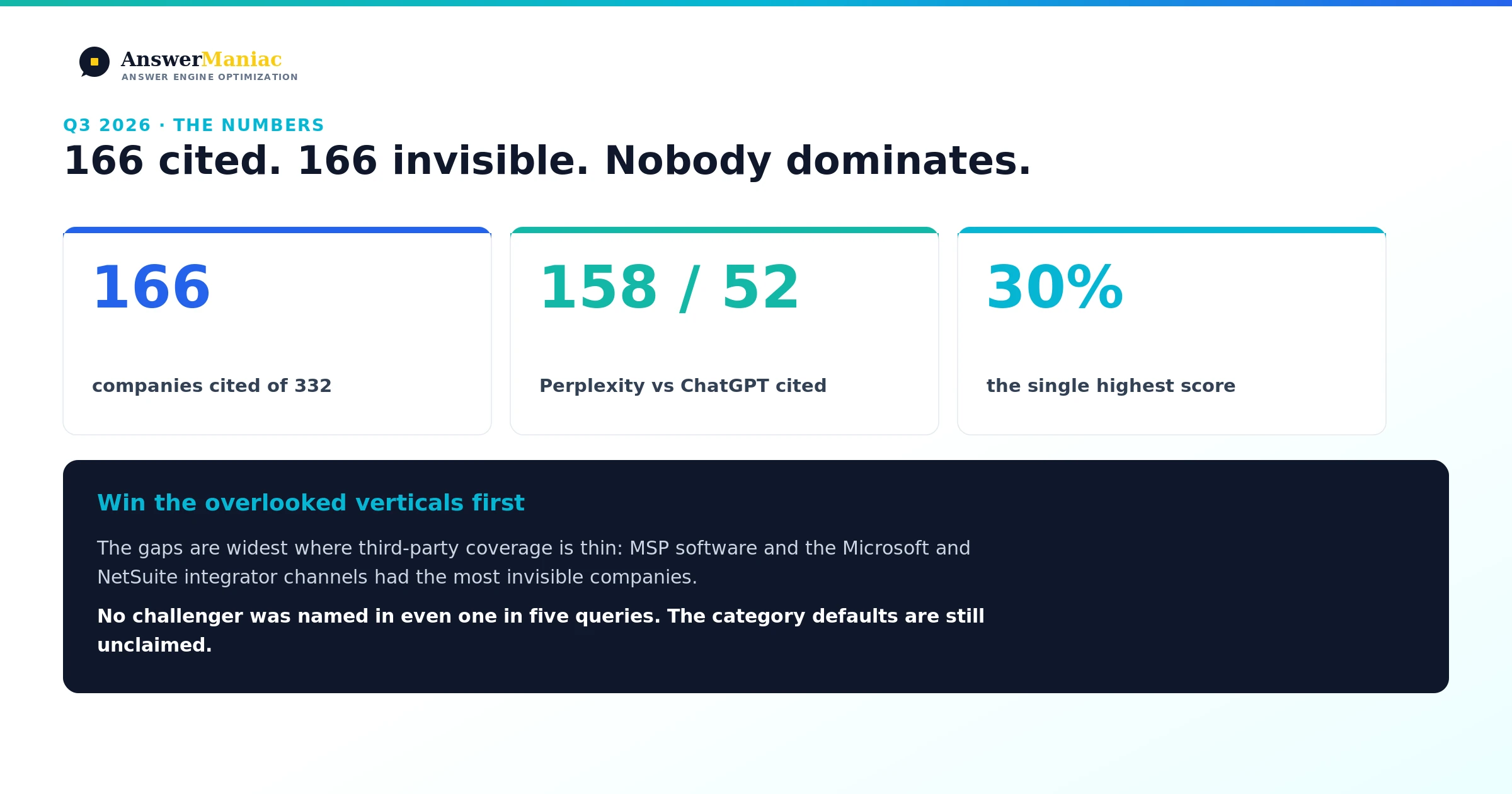
Of 332 companies, 166 got cited at least once. 166 got nothing. That's a 50% invisibility rate across the whole panel.
Put that next to how buyers now behave. G2's March 2026 survey of 1,076 B2B software buyers found 51% start their research with an AI chatbot more often than with Google, up from 29% eleven months earlier, and 54% said AI chatbots are the single biggest influence on which vendors make their shortlist. Semrush reports 66% of professionals regularly use AI to research products and vendors. If half the challengers in a category are invisible to that layer, half the category is being filtered out before a human ever sees a comparison page.
This isn't a traffic problem you can see in GA4. It's a pipeline problem you can't.
The engine gap is bigger than anyone admits
The number that surprised even us: Perplexity cited 158 of the 332 companies. ChatGPT cited 52. That's roughly three times the coverage.
The reason is mechanical, not mysterious. Perplexity runs live retrieval and leans heavily on third-party sources, so a mid-market vendor with a decent review-site footprint and a few industry roundups can surface. ChatGPT's gpt-4o leans more on what's settled in the model plus a narrower retrieval pass, so it rewards entrenched entities and names far fewer challengers.
The practical read for a growth-stage team: Perplexity is where you can win citations in the next two quarters. ChatGPT is a longer game built on entity authority. If you're measuring AI visibility on ChatGPT alone, you're grading yourself on the hardest engine and missing the one where effort pays off fastest. We broke down why the two engines behave so differently in our piece on how ChatGPT, Gemini, and Perplexity treat B2B buyers.
Vertical by vertical
The 50/50 headline hides a lot of variation. Some categories are far more contested than others.
| Vertical | Companies | Cited | Invisible | Cited by ChatGPT | Cited by Perplexity | Category leader |
|---|---|---|---|---|---|---|
| B2B SaaS | 50 | 30 | 20 | 16 | 30 | Help Scout (11%) |
| Cybersecurity | 50 | 30 | 20 | 6 | 30 | Nudge Security (9%) |
| Fintech | 45 | 24 | 21 | 8 | 22 | FloQast (9%) |
| HR Tech | 45 | 28 | 17 | 9 | 27 | Deputy / Culture Amp (14%) |
| MSP Software | 43 | 16 | 27 | 2 | 16 | Auvik (18%) |
| Microsoft Integrators | 50 | 17 | 33 | 5 | 15 | Western Computer (25%) |
| NetSuite Integrators | 49 | 21 | 28 | 6 | 18 | SuiteCentric (30%) |
A few things jump out.
HR Tech is the most visible category. 28 of 45 companies earned a citation, the best ratio on the board. Workforce-management names like Deputy, When I Work, and Homebase showed up repeatedly, and Culture Amp and Docebo held the top alongside Deputy. If you sell HR software, the category is crowded in AI answers, which means your competitors are already there.
MSP software and the integrator categories are the quietest. MSP had 27 of 43 invisible. Microsoft integrators had 33 of 50 invisible, the worst ratio in the study. These are categories where a focused challenger can still own real estate before everyone else wakes up. We dug into the MSP and partner-channel dynamics separately, and the pattern holds: thin third-party coverage means thin AI visibility.
The single best performers are integrators, not SaaS. SuiteCentric topped the entire panel at 30%, and in NetSuite's case did it largely through ChatGPT (50% of applicable queries) rather than Perplexity. Western Computer led Microsoft integrators at 25%. Specialist firms in narrow categories can score higher than much larger SaaS companies, because the query space is smaller and the competition for it is weaker.
No one is dominating
Here's the quietest, most important finding. The highest overall visibility score in the entire 332-company panel was 30%. One company. Everyone else was lower.
That means in six of seven verticals, no challenger is named in even one in five of the category queries that apply to them. There is no runaway winner you have to displace. The "leader" in most of these categories is cited a handful of times out of dozens of chances.
Compare that to traditional search, where the top organic result has usually been locked up by one domain for years. AI answer visibility, at least in these overlooked B2B categories, is still unclaimed. That's the opportunity, and it's the reason we built this quarter's study around challengers instead of the usual suspects.
What separates the cited from the invisible
We'll publish the full pattern analysis separately, but the short version from this quarter's data:
- Third-party presence beats owned content. The companies that got cited almost always had a footprint on review sites and in independent roundups, not just a polished homepage. In our Perplexity citation data, review-site URLs appeared in 28% of answers, with G2 the single most-cited source.
- Entity clarity matters more than page count. Companies with a clean, consistent identity across the web (same name, same category description, a Wikipedia or Wikidata presence) surfaced more reliably. We covered the mechanics in Wikipedia and Wikidata for AI visibility.
- Category framing beats feature lists. The cited companies tended to be described by third parties in the exact category language buyers use. The invisible ones often described themselves in clever internal language no one else repeats.
None of these require a bigger ad budget. They require the kind of structural work that compounds, which is exactly what the ANSWER Framework is built around.
How we measured it
Transparency is the point of this series, so here's the method in full.
- Panel: 332 growth-stage B2B companies across B2B SaaS, cybersecurity, fintech, HR tech, MSP software, Microsoft integration partners, and NetSuite integration partners. Incumbents were deliberately excluded.
- Queries: 155 unbranded, buyer-intent category questions (for example, "best NetSuite implementation partner for manufacturing"). No company names in the prompts.
- Engines: ChatGPT (gpt-4o) and Perplexity (sonar-pro), US market, English, temperature 0.3.
- Scoring: For each engine, a company's rate is the percentage of its applicable queries where it was named or its domain was cited. Overall score is the average of the two engine rates, rounded. We explain the exact calculation in our guide to AI visibility rate.
- Detection: Case-sensitive brand/wordmark match plus domain match in the answer text and cited URLs.
The full dataset, per-vertical reports, and downloadable CSVs live on our research hub. We publish the raw numbers because every other "state of AI search" post asks you to trust a stat with no data behind it. Ours is checkable.
What to do with this
If you're a growth-stage B2B company, three moves this quarter:
First, find out which half you're in. Run your own category queries through ChatGPT and Perplexity, unbranded, and record whether you're named. If you want it done rigorously, that's what our free AI citation audit is for.
Second, start with Perplexity. It's where challenger visibility is winnable now, and the work that earns Perplexity citations (review-site presence, third-party coverage, entity clarity) also builds the authority ChatGPT rewards later.
Third, don't wait for the category to fill up. The 30% ceiling won't last. The companies that claim AI answer real estate in overlooked verticals now will be the defaults the next time a buyer asks.
Frequently asked questions
How is this different from a normal SEO ranking study? We don't measure where you rank on a results page. We measure whether an AI engine names you when a buyer asks a category question. Rankings and citations are different signals, and in these verticals they often don't match.
Why exclude the incumbents? Because "ChatGPT recommends Salesforce" tells a growth-stage founder nothing actionable. The useful question is whether a challenger can earn a citation, and what it takes. Excluding the giants isolates that.
Why did ChatGPT cite so few companies? ChatGPT's gpt-4o leans on settled entity knowledge and a narrower retrieval pass, so it names fewer challengers than Perplexity's live-retrieval approach. It's the harder engine for a growth-stage brand, which is why we recommend starting with Perplexity.
Can a company really move its score in one quarter? Perplexity visibility can move fast because it responds to third-party signals you can influence. ChatGPT visibility moves more slowly because it tracks entity authority. We never guarantee a specific citation count, but the structural work compounds.
This is part of AnswerManiac's quarterly State of AI Search research. Explore the full Q3 2026 dataset, per-vertical reports, and downloadable CSVs on our research hub, or get your own AI citation audit.
Get AEO Insights Weekly
Join 500+ B2B marketers getting AI visibility tactics every Tuesday.
Ready to Get Your Brand Cited by AI?
See how your competitors show up in ChatGPT, Perplexity, and Gemini — and what it would take to get recommended.